
Jean came back from his weekend biking trip with a bit of a cough, which he said was due to using his CPAP sans humidifier.
Seemed plausible.
He had a bad night, though, with cough persisting despite the now-available humidifier, and with congestion as well.
“You need to take a test”, I told him in the morning.
“I do”, he replied.
Results were clearly positive in less than 10 minutes.

DEFCON 1—Wait
Maybe I was also already infected? I wasn’t on the bike trip, but then, he was gone only two days and came back sick. There was no way he got infected on that trip. Must have been in the days before. When we were together, at least in the evenings.
So, I took a test. Waited 20 minutes. Looked.
Negative. And also, I had no respiratory or gastrointestinal symptoms.
So, maybe I could still avoid catching it, and therefore now…
DEFCON 1—Wait, what’s the big deal?
It’s not that I think I’ll die of COVID, or even be hospitalized with it.
Yet I still do quite a bit more than most people to try to protect myself from infection.
If asked why, I point to the long-term damage it can do. I’m particularly concerned about the possible affect on my brain, as that’s pretty common—taking the form of “brain fog” in the middle aged, dementia in the older, anxiety and depression in all ages, along with loss of IQ points for everyone, apparently. Some people also end up with vision problems, which kind of freaked me out to learn.
But Long Covid can take all kinds of bizarre forms. I’m glad that the risk of it seems to have dropped to about 3.5% in the vaccinated, but that’s still a chance of it happening with every infection. Then there’s the increased risk of so many other diseases. The Government of Canada recently released a report about that:
Unlike seasonal influenza, which is predominantly a respiratory virus, SARS-CoV-2 is pleiotropic — meaning it affects most systems of the body….
An increased rate of cognitive decline after SARS-CoV-2 infection has been reported… SARS-CoV-2 infection can lead to dysregulation of and long-term damage to the immune system…
Approximately 1.5 to 2 times higher risk of various cardiovascular complications post-SARS-CoV-2 infection…
COVID-19 illness can result in new diagnoses of diabetes…
Hearing loss is a side effect of Covid-19…
— Dealing with the fallout: Post-COVID Condition and its continued impact on individuals and society, Government of Canada, 7 October 2024
But even just considering the short-term, acute infection… Jean looked and sounded miserable. Nothing that made me want to just shrug my shoulders and accept my fate. Therefore…
DEFCON 1; well, maybe DEFCON 2
At DEFCON 2, the military is prepared for an imminent attack, and they may take action to defend against the threat. This may involve deploying troops and equipment to defensive positions and increasing security measures at key installations.
Step 1: Separation of territory
I masked and grabbed everything I needed from upstairs, which then become Jean territory: three rooms (bedroom, bathroom, office with computer/TV), all with doors that were kept shut at all times.
I got the downstairs (location of the other bathroom), and pulled out an army cot to sleep on. (I had purchased that specifically for this possible scenario, since I didn’t like sleeping on the couches the last time.)

Step 2: Masking in respirators in the neutral zone
Masking was declared mandatory on the main floor, where the kitchen / living room / dining room is. Jean mostly went with the Drager X-plorer N95. One of my favourites was the Breathe elastomeric that I almost never wear otherwise, because it’s super ugly. But it’s also very cool, comfortable, and breathable, and therefore perfect for wearing in the house where nobody could see me other than the cats, who didn’t care. (Speaking of cats, did you know they can also catch COVID? You’re a bigger risk to them than they are to you.)

Step 3: Ventilation
Fortunately, the weather was quite conducive to keeping windows open all the time. My Aranet CO2 monitor confirmed good air quality. (It can get surprisingly bad in our house when all windows are closed, even though it’s never crowded in here.)
Step 4: Air filtration
Much easier this time than last, because we’ve bought or built so many air purifiers over the last two years. Last time we had only one, which Jean had to move back and forth between office and bedroom. This time he already had one in each of his rooms (and the bathroom has a ventilation fan), I had my own two downstairs, and there were two others in the neutral zone. I also had the Laminar portable air purifier.
And the extras
Distancing, masks, ventilation, and filtration are the main defenses, and generally sufficient. Still, past couple years I’d also developed certain habits that possibly help prevent COVID infection, but are generally good for you anyway, so I obviously continued with those as well during this time:
- Saline nasal rinse (Hydrasense), twice a day
- Gargling with CPC mouthwash, upped to three times from my usual two
- Daily BLIS-K probiotic
- Green tea, upped to twice a day from my usual once
- Daily Vitamin D
Then added in the things I now do before undertaking more risky activities:
- Daily H1 (Allegra) and H2 (Pepcid) antihistamines
- Betadine nasal spray three times a day
If nothing else, it gave me lots to do besides obsess over every throat tickle and passing tummy pain.
Bring on the pharmaceuticals
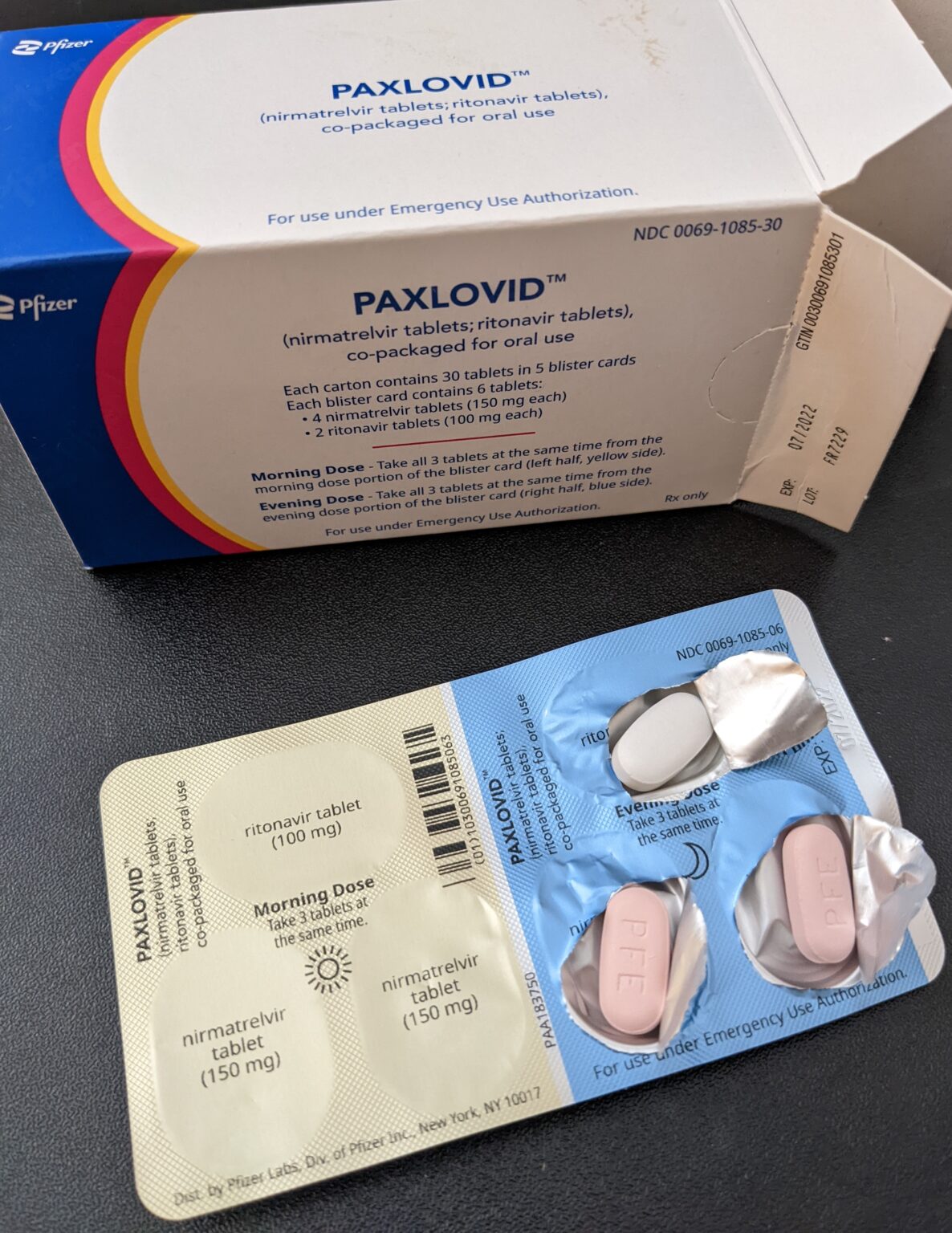
If you’re thinking I wasn’t being a particularly good nurse to Jean during this time, you are correct, though I did cook for him throughout (I’d text him to let him know when food was ready), and the first day, I did look up whether he might qualify for Paxlovid.
Then texted him to let him know that he very well might.
He called the pharmacist, who said that while the government would not cover the cost, his work health insurance would. (This is good, because Paxlovid costs over $1000.)
And, I did go pick it up for him! (Pharmacist was not masked. Interesting choice for dispensing a drug for a COVID-positive person, eh?)
Meanwhile, I was both monitoring symptoms and taking a daily rapid test (after the saline nasal rinse, but before the mouthwash, probiotic, and Betadyne, which I thought might interfere with the results). Last time, I hadn’t tested with this frequency, but this time, I definitely wanted to take metformin if infected, as it’s been shown in several studies to reduce your risk of Long Covid, when started early on. (See Want To Prevent Long Covid? Should You Take Metformin Or Paxlovid?)
Jean took metformin as well.
And in the end
The first time Jean had COVID, he felt pretty terrible, but only for about two, maybe three days.
This time it was a solid week. Not until the following Sunday, the day he took his last Paxlovid dose, did he finally sense the crushing fatigue lifting.
He tested negative that day, which led to a bit of détente between us, though we didn’t fully lift fortifications until another negative test the next day. That was much faster than the first time, when he continued to test positive for near two weeks.
We think that’s probably the Paxlovid effect, though there’s no knowing for sure.
As for me, I continued to test for a few days after Jean was cleared, but remained both asymptomatic and testing negative.
Lessons
So is this a success story? For me, I guess. For Jean—not so much, right? Though he does seem to be recovering well, fortunately. And being a good guy, he’s sincerely happy he didn’t infect anyone else (his biking friends were all fine as well).
But I’m super conscious, writing this, that much of the stuff we did to prevent in-home infection just isn’t possible for a lot of people. And that fact is illustrative of a larger social problem.
But I’ll elaborate on that in a separate post (click to view).
 Cultureguru's Weblog