
Last week, some friends and I went to see the Classic Albums Live group do David Bowie’s ChangesOne album. That album selection is a bit of a cheat, since it’s a compilation album with many of Bowie’s early hits. But it certainly made for an entertaining first half.

The second half was various other Bowie tunes, and ended with a highlight for Gen X types, of “Let’s Dance” followed by “Modern Love”. But they started that half with a cut from Ziggy Stardust and the Spiders from Mars: the very haunting “Five Years”.
Pushing through the market square
So many mothers sighing (sighing)
News had just come over
We had five years left to cry in (cry in)
News guy wept and told us
Earth was really dying (dying)
Cried so much his face was wet
Then I knew he was not lying (lying)…
We’ve got five years, stuck on my eyes
Five years, what a surprise
We’ve got five years, my brain hurts a lot
Five years, that’s all we’ve got
Five years from now: Is that all we got?
One the many newsletter-type things I subscribe to is by an author of the definite opinion that we are in the early stages of collapse, who expects that things will completely have to gone to shit in about five years. Given the climate crisis, species depletion, pandemic risks, misinformation effects, economic threats, food insecurity, and global political instability, it doesn’t seem an utterly crazy notion. And this is a US-based publication, so they’re also living under that administration.
The one that’s threatening us.
I can’t totally buy in. I’m just not there yet. So I have not gone whole hog on things like learning to grow my own food, making my own medicine, and reinforcing my house with bullet-proof glass and sandbags. Still, I have picked up some useful tips. You might find them useful, too! For example…
Stashing some food for emergencies: It’s a good idea, right? In case there’s a power outage or what have you? But what we used to do is have a box of canned goods and bottled water for that purpose in the basement, that would just stay there for so long we were no longer sure we’d want to use the stuff, even in case of emergency.
A better idea: Keep your stash in your kitchen. And use it! Need a can of corn or a bottle water, feel like baked beans, or need to make some rice? Then eat or drink it or cook it. But, also put it on the grocery list to replenish immediately. So it’s more of a living emergency stash, regularly rotated through. I maintain about a week or two’s worth of stuff (for us. And about a two or three months worth for the cats. Priorities…)
Cleaning with HOCl: HOCl is short for hypochlorous acid. Preppers like it because it does an excellent of killing bacteria and viruses. But it’s also just a good general cleaner, one that works on all sorts of surfaces: floors, glass, wood, countertops, stovetops, sinks… And it’s also safe for human and pets, environmentally friendly, and relatively inexpensive. I use a Force of Nature device (bought during the Biden administration) to make my own HOCl cleaner from a mix of water, vinegar, and salt, but you can find all sorts of options, including pre-mixed and (I assume) Canadian-made products.
Helmet in the house: No, no, not even preppers suggest you wear a helmet 24/7. But I do live in tornado-prone area, and if one of those bad boys is barreling toward you, along with taking refuge as best you can, sticking a helmet on your head can be quite helpful. Football helmets are probably ideal, because they cover your neck and face too, but if all you’ve got is a bike helmet, that’s better than a bare head.
Hospital go bag: It’s never convenient to have a medical emergency that requires you to get yourself or your loved one to the hospital. But in case of this occurrence, it can be helpful to have a hospital bag ready to take with you, containing items such as:
- Masks a-plenty, KN95 or better, at least one with SIP valve (also put a straw in the bag) so you can stay hydrated, because hospitals are full of cooties but will not do anything protect you from catching airborne diseases (unless you’re lucky enough to have to go there in the middle of a measles outbreak or something, in which case they might have brought back a mask mandate).
- Water, snacks (ideally of the type you can slip under a mask), because you might be there a while.
- Headphones and eyeshades in case you’re admitted but end up in the hallway, which can be very unpleasantly noisy and bright.
- Portable charger and charging cord for your phone and headphones.
And speaking of going to the hospital…
Five years ago
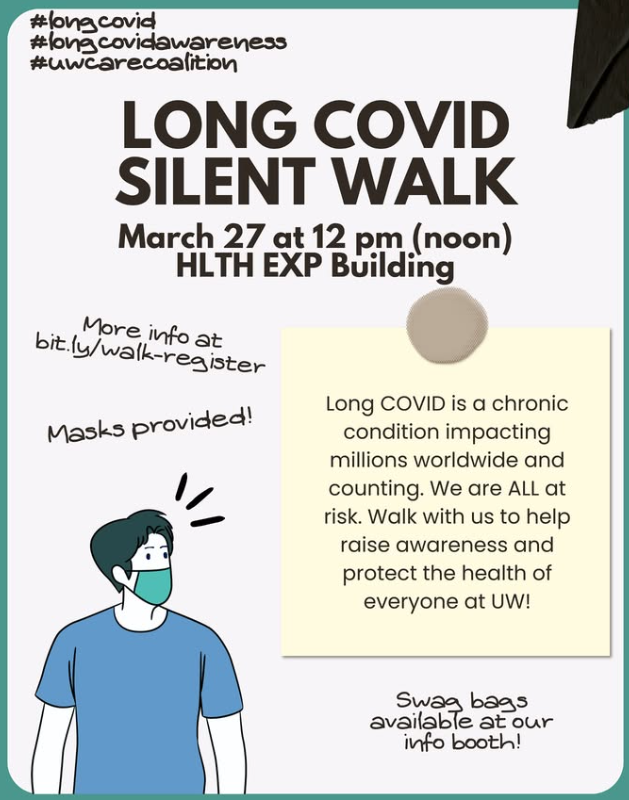
A global pandemic was declared! A few days ago I participated in a Walk for Long Covid Awareness, organized by the Care Coalition at the University of Waterloo. It took place on one of the few sunny days we’ve had of late, and actually had pretty good turnout: 40 to 50 people. It also got media attention, on local CBC Radio and CTV News. And I got to meet some of the Mask Bloc people in person.
The media also had a number of stories about the five year mark of the pandemic start that weren’t as bad as I feared they might be. They tended to acknowledge that a) COVID is not all over and b) The pandemic response wasn’t perfect.
In my view, the two biggest errors—that persist to this day—are:
- Not acknowledging airborne transmission.
- Not recognizing that Long COVID and other post-COVID conditions are major risks for this virus, not just the hospitalization and death that can occur from the acute phase.
Point 1 is covered pretty well in the following media story. If the precautionary principle had been followed, airborne transmission would have been assumed from day one. Once that proven (which would not have taken long), action could have been taken on that basis. Instead of the lockdowns and isolation, there could have been gatherings much sooner, in N95 masks. Schools could have closed only long enough to improve the building’s ventilation or filtration (which can be as fast as installing a bunch of air purifiers). Hospital staff would obviously have been in N95 masks the whole time, never surgical ones, drastically reducing outbreaks among staff and patients. And so on.
“Instead of truly fixing the core problem, one day, we were told by corporations and politicians that the pandemic was over. We decided to agree. Pretending that the problem was solved felt easy….”
And that has led to point 2, a refusal to admit that looking longer term, COVID actually is a risk to everyone, and that everyone needs protection from it. This refusal persists despite how sick the population has become, particularly as one of the common long-term effects is immune system damage; see, for example Kids keep getting sicker as evidence for COVID immune damage builds (The Gauntlet) and Global surge in infectious diseases as over 40 countries report outbreaks 10-fold over pre-pandemic levels (Bloomberg). CBC Radio also did a really good story on this: Beyond long COVID — how reinfections could be causing silent long-term organ damage.
There is no such thing as a COVID infection without consequence,” says long COVID researcher, David Putrino, from the Icahn School of Medicine at Mount Sinai in New York.
A good example of that is the effect that SARS-CoV-2 infections can have on cognition. There was a recent 2024 study that showed us that individuals who survive an acute COVID-19 infection — these are not individuals who are getting diagnosed with long COVID — on average will lose somewhere in the neighbourhood of two to six IQ points per infection.
But that’s enough depressing information. I will share one small bit of good news I came upon: the publication of Canada’s first-ever guidelines for Post COVID-19 Condition (March 21, 2025), through McMaster University, with funding from the Public Health Agency of Canada. I have perused what they are recommending, and it looks good to me!
Obviously, just writing it all down isn’t sufficient; the guidelines actually have to be followed. But it is a start, and it’s something official to point to when, for example, you’re trying to get another COVID booster (vaccination every six months is one of the recommendations), or to convince your doctor that the weird symptoms you’re experiencing could have been been the result of a COVID infection.
“The creation of the Canadian Guidelines for Post COVID-19 Condition marks a significant milestone in our ongoing efforts to address the long-term impacts of COVID-19. These guidelines will serve as a crucial resource to support those living with this condition as well as the health professionals that provide the care that best fit their needs,” says Theresa Tam, Canada’s chief public health officer.
“The establishment of a multidisciplinary team of more than 150 Canadian and international collaborators, including persons with lived experience, who have created these guidelines is an achievement that puts McMaster and Canada at the forefront of long COVID care. With continued support we can update our recommendations as new evidence emerges, expand knowledge mobilization, and ensure that people in Canada have access to the best possible care,” says Nieuwlaat.
 Cultureguru's Weblog