The nature of our week-long Ontario getaway—combined with some unseasonable August weather—meant that the number of photos Jean took was much lower than usual. Good thing we went to Science North in Sudbury, or it would otherwise have been close to a count of zero.
The Science North building is itself very interesting, built right onto the rock of SudburyIt was a gray day in Sudbury, so a good one to be inside a museum
We weren’t the only ones with that thought, though; Science North was crazy full of parents and their kids!
The butterfly room was a nice, calm oasis away from the crowds
We probably spent the most time on the floor focusing on wildlife. We were there late afternoon, which happened to be feeding time for a lot of the critters.
If you’ve ever wanted to pet a porcupine, Science North is the place for youThe skunk was too shy for petting, especially with all the kids there that day, but couldn’t resist coming out for meal wormsThe beaver was nonplussed by his audience, and a big fan of green beans
And to conclude, the now almost obligatory photo of me in front of food, at Churchill’s restaurant in North Bay (another day, on the way back).
It’s not uncommon to have multiple books on the go. Different books for different occasions.
Essay collection for short bursts of reading
Novel for extended reading time
eBook or tablet for low-light conditions
On vacation, the effect only gets multiplied.
Audiobook for car trips
Innocuous book to avoid awkward whatchya reading? conversations when visiting
Travel books, because what better time to plan the next vacation than when on vacation?
But all this switching has the downside of no particular tome actually getting finished. Now I have at least three that I feel equally eager to complete, yet am no longer in the circumstances where I can plough through as much material.
In fact, other than Globe and Mails, sundry magazines, and a Kindle novella, the only book completed last week was the audio version of Muriel Spark’s 1961 novel, The Prime of Miss Jean Brodie. I’d picked this up based on a Guardian article that said those “100 books you must read” lists were ridiculous, but here were five you really must read. This was one of the five.
It’s a fairly short book, but a very interestingly constructed story, moving back and forth in time, revealing more details in each pass. It tells of a teacher, in the prime of her life (as we are reminded repeatedly), whose unconventional teaching methods at a British schools for girls often has her at odds with the school administration. Miss Brodie doesn’t to just “teach to the test” (though she does emphasize the importance of passing the tests, so she can keep her job); she wants to inspire her girls to be creative and bold.
In one of her many controversial moves, Miss Brodie selects certain girls as her favorites based on their particular strengths, and primes them in particular to become the crème de la crème. She continues to meet and try to to influence them even when they are no longer in her class.
And one of them betrays her.
Jean complained that Miss Brodie was an irritating character, and she is. She’s charismatic, but not entirely and always sympathetic. There’s much to ponder on in the interplay of the characters. It would be a great book club book.
As for the unfinished…
I was intrigued by the premise of Will Ferguson’s novel, 419. It’s a suspense story built around the well-known Internet scam of the Nigerian prince who needs your help in getting his considerable fortune out of the country. And it takes off pretty quickly, with the investigation into the tragic end of one victim of the scam, interspersed with the point of view of the scammer in Nigeria.
But then it goes a bit weird, introducing more Nigerian characters who don’t seem to have anything to do with the rest: A young pregnant woman walking across the country, for some reason; a young man whose village is devastated by the oil companies. At first I was impatiently flip-reading through those parts, eager for the original story to return. Then I realized I’d be missing half the novel if I did that.
So I went back and read at a more normal pace, and eventually got caught up in those tales as well. I have about a quarter of the book left now, though, and I still have no idea how the two narratives relate to each.
But I am curious to find out.
On the essay / nonfiction front, we have American Savage, by Dan Savage, a gay man who writes a sex advice column (that I don’t think I’ve ever read). He’s also behind the It Gets Better campaign to support gay youth, and the redefinition of Rick Santorum’s last name. (Ahem.) This is a collection of essays on a variety of topics including relationships, politics, religion, and education.
I have found most of the pieces quite interesting, presenting facts I didn’t always know, and certainly making me look at some issues in a new way. Why we all probably know far more bisexuals than we think we do. (Psst: Because they’re passing as straight!) Halloween as a gay pride parade for straight people (and why that’s a good thing). The anti-man bias of most advice columns—because said columns are mostly read by women. And why that bias is bad for relationships.
His own life experiences often illuminate the arguments: How his mother reconciled being a devout Catholic with fully accepting her gay son, and why he himself can’t do the same. (Be a devout Catholic, that is. He does accept his sexuality. 🙂 The striking evidence, in his own lifetime, of how much things have gotten better for gay people—and how that happened.
Still up: “Still evil. Less evil. But still evil”, “It’s Happened Again”, and “Bigot Christmas”.
Sounds interesting.
And Fangirl, a novel by Rowell Rainbow, is what we started to listen to after Brodie was done. I was struck by how much this book grabbed and held my attention, in contrast to the classic novel, which sometimes caused my mind to wander.
Surprise, because I suppose this would be classified a Young Adult fiction? It’s the story of 18-year-old Cath, who goes off to college with twin sister Wren insisting that they not be roommates and try to be more independent of each other. Wren is very outgoing and friendly, while Cath is the opposite—almost pathologically introverted and anti-social. Needless to say, Cath has a bit of trouble adapting.
The Fangirl part comes from Cath’s hobby—really more an obsession—with writing slash fan fiction about two characters from a fictional but Harry Potter-like series of books: Simon and Baz.
That it was so engaging (for Jean as well) despite not exactly reflecting our current stage of life (and no, I don’t write fan fiction, either) is, I think, a testament to Rowel Rainbow’s ability to create really full-fledged, complex, believable characters: Cath’s fearless and intimidating roommate; her charming writing partner Nick; her creative but unstable father, and so on.
And while I’m actually not too worried about polishing off the two paper books fairly soon, we have 2.5 hours of listening left to Fangirl—and no imminent road trips! How are we going to get this one done?
Last week’s vacation was mostly about visiting family and friends up north. But instead of just barreling our way straight through, we stopped in various Ontario towns on the way and back. Like in Orillia.
“Why Orillia?” That has been a common question.
First visited on a rock concert pilgrimage (Roger Daltrey performed at the Casino there in 2009), we just found we liked the town. Nice beaches, decent restaurants, good shopping.
“Shopping?”
OK, maybe we are the only people in the world who go to downtown Orillia for shopping. But let me tell you, we did a fine job boosting that town’s economy on our two days there.
First stop was this discount clothing store which sometimes has interesting items, for men and women. Jean didn’t have much luck for himself, this time. fortunately, he’s able—in limited doses!—to amuse himself finding things for me to try on.
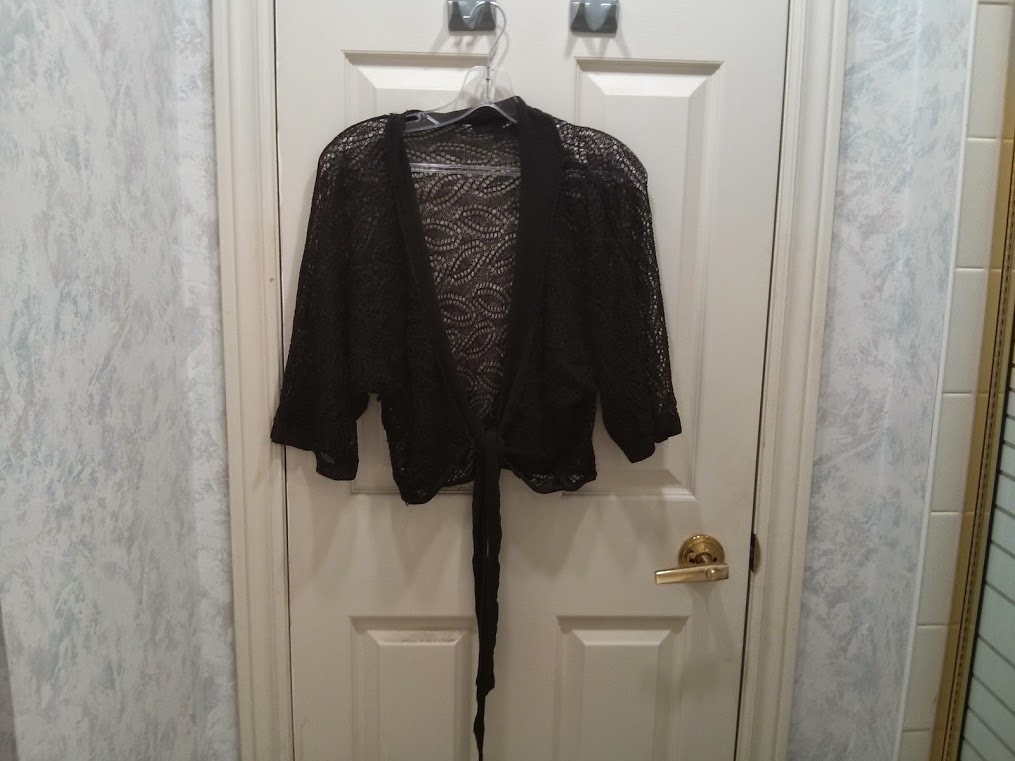
I tried on more than I bought. But one Jean find that I came home with was this brown crochet sweater, as I’m forever looking for something to wear over sleeveless dresses and such that don’t ruin the whole line of the outfit.
This should do the trick
We had gorgeous, hot weather in Orillia, but the rest of the vacation became rather cool, especially for August, so this sweater got some use on this trip. And some compliments.
Also acquired was this blue top, which looked a little odd on the hanger (my pick; Jean was dubious), but quite nice on a person.
Nice blurry photo by me. 🙂
Jean did better at the Walking on a Cloud shoe store (he likes shoes almost as much as socks. No, seriously.). And although I didn’t feel I really needed more shoes, apparently I can’t resist a Rieker. I had just bought these really cute navy blue Rieker sandals before vacation (with heels!); they are now joined by these little sparkly runners:
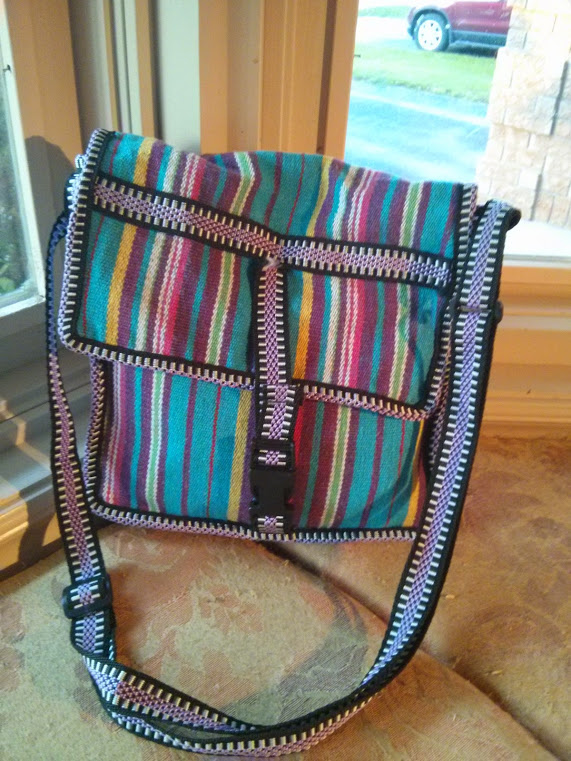
These are photographed with a red purse I also got at the first clothing store. I haven’t used it yet, though, because I’m still sporting this one (a local purchase) for the time being:
Cute, huh?
Another stop was our favorite kitchen store. Yes, we have a favorite Orillia kitchen store, as we told the confused clerk: “We come here every two years to replenish our pots!”
No photos, because, well, pots and pans, but we literally did buy a pot and a pan (both high-end; not your Canadian Tire job-y), plus sundry kitchen gadgets.
We then popped into a big warehouse-style discount store—of the sort we never go to in our own home town—because we were looking for cables that would help our tablets talk to the hotel TV. We bought that, but while there, we thought, hey, why not get that rug we’ve been meaning to get for ages, for the front of the fireplace?
So right, not an expensive rug. But it’s frankly mostly for the cats to sleep on (and potentially sharpen their nails on), and definitely better-looking than the towels we previously put there for them, so that’s OK. Zoë gave the new addition her stamp of approval almost as soon as we put it down at home:
And by the way, we finally got our fireplace brick and frame finished.
And we also acquired various prosaic mats that we hope will help keep the litter residue in better check.
Worst thing? After dropping all this cash downtown, Orillia had the nerve to give us a parking ticket! Even after getting it, I was like, “Parking meter? Where is there is a parking meter?” But there was one… It was just well back from the sidewalk, very easy to miss.
But Orillia, we still like you. We were able to get to the beach and swim both days, for the first time this summer. We also found some nice walking trails. The restaurants were somewhat disappointing this time, though not to the extent that any of the meals were actually bad. Just unimaginative.
Just make your parking meters more visible, already. 🙂
Haisai, in the small town of Singhampton, is an unusual-looking restaurant.
When we drove up to it on Sunday, we weren’t even sure it was open. But the young guitarist outside confirmed that it was. And the fact that there was a young guitarist outside–in jeans, with a beard, and electric guitar–tells you something about the place as well.
Haisai has a strong focus on sustainable and natural food. You are given tap water there, not offered bottled. Both house wines are Ontario. Most of the ingredients are from the owner’s farm. I don’t know if it actually has an organic designation, but it’s certainly no factory farm, but just a small operation with pigs, chickens, vegetables, and fruit.
And, that owner / farmer also happens to be a world-reknowned chef, Michael Stadtlander. He’s no longer the chef at Haisai, however, but he does the guide the menu, which offers tapas-size dishes along with stone-oven pizza.
We went for four of the tapas plates: French bean salad with speck and mustard dressing, speck and Cheddar pierogi, vegetarian gyoza (dumplings), and roast pork on peach ravioli. (As you see, there is a lot “speck” on the menu. That is a delicious long-smoked pork.)
Not having been prepared by Michael Stadtlander, not everything tasted like a miracle in your mouth. But it was all very good, and the offerings were creative. And, not having been prepared by Michael Stadtlander, each dish was only $6 to $9. (The whole meal, with a glass of wine each, and dessert each, came to $75.)
Yet another picture of me in front of food
Speaking of desserts, Jean declared that my trio of ice creams was some of the best ice cream he’d ever had. I felt much the same. (I can’t remember all the flavors–lavendar, peach, another…?) His apple crumble with maple cream was perfectly acceptable too, though.
Either way, it would certainly be cheerier than King Lear. (Which we may still see, in the fall. Although Stratford plays aren’t exactly cheap, are they?)
This production of Midsummer’s Night begins with a same-sex, mixed-race wedding, then presents the familiar Shakespeare play with the premise that Lysander is a woman, and hence not the suitor Hermia’s father prefers. I thought this was a rather effective retelling in our time, and interestingly, it was one thing that both Star and Globe critics appreciated as well.
It’s everything else that also gets thrown into this version of the play that the critics didn’t agree on. For example, that isn’t the only gender switching that goes on: most notable of the others is that the Fairy Queen is played by a gent, and a hairy one at that. And the play seems to be set (somewhat) in modern times, featuring modern pop music (most effectively, “Bizarre Love Triangle”) and a scene where the characters gather around a cell phone to look up the phases of the moon (though the answer is ultimately found in a paper almanac). And there is a whole lot of slapstick, physical humor: cake fights, slipping into water, almost-sex in a tent.
It’s certainly a memorable version of Midsummer Night’s Dream. And a funny one–especially the second half. I don’t know that I loved it quite as much as the Globe critic, but I most certainly didn’t hate it as much the Star one. Though if I have to pick between love it or hate it, as they say, then I’m going with love.
Queen + Adam Lambert capped off our Toronto weekend, but before that, we….
1. Learned about sake
The Distillery District was our first destination (after checking into the hotel), where I happily shopped while Jean felt uncomfortable due to the crowds. (For a people person, he can be surprisingly squeamish about people.)
But we both enjoyed the one-hour sake tasting and tour we signed up for, at Ontario Spring Water Sake.
We had much to learn. I wasn’t even sure I remembered that it was made from rice, let alone what the other three ingredients were—one of which is Ontario water, though not from Toronto! And bacteria also plays an important role in the production, and since bacterial mix is always changing, so no two sake batches are ever quite the same.
We learned about the types of sake, notably pasteurized and unpasteurized, and “first press”, and about sake etiquette and its place in Japanese life. We were even treated to a beat boxing session at the end, as our guide does that on the side. He was very good!
We got to taste five samples, all notably different from one another for all being sake by the same company. Jean and I agree on our two favorites and bought a bottle of each.
2. Walked. A lot!
We were car-less in Toronto. We took the bus in, which itself involved a walk from our chosen parking lot to the Kitchener bus station. But except for some rain Sunday morning, it was nice weekend, so we just walked wherever we wanted to go rather than take transit. Jean figures we got in about 30 K in two days.
Roy Thompson Hall (I think)Things will be great when you’re downtownThe malls are quiet at night
3. Visited the AGO
We spent a few hours there. We didn’t see the feature exhibit, on Francis Bacon and Henry Moore, but did see “Fan the Flames: Queer Positions in Photography.” That was installed, I assume, in coordination with the recent World Pride. It was an interesting collection, with combinations of video, collage collections, commercial photography, and work by artists such as Robert Mapplethorpe.
We also saw most of the “Art as Therapy”, where they gathered various pieces of the permanent collection under themes such as love, money, and politics. That made for some interesting juxtapositions as well.
4. Ate out
We had no bad meals in Toronto, but none were particularly spectacular, either. We decided to try Blowfish Sushi and Sake Bar based on a list that rated it the best sushi restaurant in downtown Toronto. While it was good, we didn’t agree that it was better than Ki, the supposed second-best one. But they did have some creativity in combinations and presentations.
The truffle oil on these was nice. The garlic chip looked cool, but didn’t cohere as a taste. Better on its own…Foamy!
Though we went here after the sake tasting, it was actually no help in picking one from the menu. (Not like they had any from Ontario Spring Water Sake company.) Fortunately the waitress was able to guide us toward one we enjoyed.
Breakfast, though very fine, is just breakfast, and was mainly notable for our managing to get a table just before the lineup for a table started, a feat we had also achieved on Saturday at Balzac’s coffee shop in The Distillery District.
Lunch was at Bangkok Garden, which was featuring a $15 three-course Summerlicious menu. It was very tasty, and a good deal, but mainly about the company, as we met up with my sister and brother-in-law there.
Dinner was another Summerlicious event, at Toula’s on Harbourfront, selected largely for being near the Air Canada Centre. It is a very cool room, though, on the 23rd floor, with windows all around.
It’s an Italian place, and we liked the food. Jean had lobster ravioli as his main; I had gnocchi in tomato sauce. The service was also quite friendly and professional. But the room itself was the highlight.
Other than its lack of in-house wifi (which we solved by bringing our own), we were pretty happy with our hotel room in Menton, which was Hôtel Club Le Balmoral. The hotel’s location, I think I noted, was fantastic: very central, facing the beach on one side. The room and bathroom was a good size (for Europe), and—a feature I find annoyingly rare in hotels—was furnished with well-placed desks and shelves and full-length mirrors, such that we could set up to work on our tablets, easily arrange the toiletry items, and confirm that in fact my outdoor clothing really didn’t match from head to toe. 🙂 The room temperature was a little bit of an issue until we remembered that with European hotels, you can actually open the window (no screens!), and the natural bit of air conditioning did the trick there.
So the only problem was the food.
It wasn’t all dire. They certainly used a good supplier of food ingredients such that breakfast buffet, which we had every day, was very good: delicious croissant, very fresh fruit salad, nice cheese and ham. Similarly, the cheese course that was always included with dinner featured some wonderful French cheeses. And whoever did the desserts had some talent; those were always nice—lemon meringue pie, ile flottante, crème caramel.
But the cooking was a problem. Overcooked, dry fish. Under-seasoned soup. Mushy, overbreaded shrimp. Spring rolls so tough you could barely cut through them. Oy. They were somewhat better with meat—the lamb tangine we had one night was probably the most successful of the week’s entrees—but it was definitely disappointing to be in France and not be able to count on getting great food.
And it wasn’t just us being over-fussy foodies. We had four hotel dinners included, and everyone in the group complained about them. (In fact, if we hadn’t enjoyed the company of our group so much, we would have skipped some of those dinners….)
Fortunately, the restaurant meals did make up for that, to some degree. Best of the lot was Table d’Oc, which I’d read about before leaving, and which ended up being very close to the hotel. It was a small, funky, fairly casual place with a nautical theme, despite not being particularly focused on seafood.
Table D’Oc
Prices were quite reasonable, offering three-course meals for 21 Euros (about 32 dollars).
I started with roast vegetables with a duck stuffing. Jean, unsurprisingly, started with a cold terrine of foie gras. What was surprising? How it was served:
That, my friends, is a bucket of foie gras
His expression was priceless when this was served. The waitress was very amused. “Nous recommendons de ne pas tout le manger.”
He found it some of the best cold foie gras he’d had, but nevertheless managed to leave some of the container for others.
As a main course, I had more duck, sliced and served in a pepper sauce. That came with carrots, long green beans, and scalloped potatoes. All very good. Jean had the pork and morels, which tasted amazing, and the same veg as I.
For dessert I had the lemon meringue pie that this area is known for (Menton is the lemon capital of France), and Jean had the crème brulée, with the brulée done right at the table:
Except for an unusually long wait for the bill, it was quite a lovely evening out.
Another pretty successful meal was at Le Cirke, which I read about in The Guardian. This was a somewhat more expensive seafood place. Jean started with a seafood soup, while I had an octopus and white bean salad. Then we shared the paella, which contained only seafood—no chicken, no sausage. All well-prepared and tasty.
Lunch most days was on the trail, so was basically unexciting sandwiches and granola bars. But in Nice on our free day, we did have lunch at a bistro, enjoying some pasta in a pot .
Squash ravioli
Later that day we joined much of the rest of the group to see what they were doing for dinner, which turned out not to be the greatest idea. I thought the group of 8 might split into 2 or 3 smaller groups headed for different locales, but instead everyone took off together, which of course made it more difficult to find a place that could accommodate us all. One place claimed to be able to, by putting tables together outside, but then he proceeded to basically ignore us for some time: no menus, no drink orders, while attended to other tables and other people arriving. Most of the group got kind of offended by this and decided to leave; Jean, I, and another lady decided to stay.
Our “congenial” host than got a bit irate about the departure and started barking at us to change tables, whereupon Jean pretty much wanted to leave, also. I was kind with him on that, but the lady we were with didn’t seem to catch it (admittedly, she didn’t have as many years experience as I at reading Jean body language), and persisted in ordering us some wine. So, we ended up staying.
The service did get civil, if never quite friendly (this would be a rare time you’d wish they tipped in France, so you could not leave one). But, upside: The food was really good. Jean had gnocchi with gorgonzola, followed by duck with morels. I had grilled calamari with arugula, followed by risotto with a half lobster. And it was a pleasant evening in terms of the company.
But we would never go back to that restaurant again.
I had never heard of Menton, France before this trip, but that’s where we stayed the whole time. It was a great home base. Quieter than Nice, but still offering plenty of interesting shops, good restaurants, and attractive architecture, especially in its Old Town. Our hotel fronted right on the beach, though our view was of the other side, the mountain. Still not too shabby.
The sand is imported; naturally, beaches here are rockyA look at the Old Town streets of Menton
I can’t say we did anything particularly notable in Menton, however. We kept intending to visit the nearby Jean Cocteau museum, but never made it past the gift shop. So I could see going back and giving the place a bit more focus sometime. I would recommend it as a place to stay when visiting that area.
Monaco
Monaco wasn’t far from Menton at all. It is theoretically its own country, though one very much dependent on France, that doesn’t require a passport to visit.
We had thought of spending part of our “free” day here, but ended up deciding against it. So we really spent only about a half hour, 45 minutes here, before one of the walks. It was enough time to climb up the central square and get a little bit of a sense of the place…
… which is that it is very crowded, very dense, and completely paved over. There is no room left here to build anything else. Many people who work here have to live elsewhere.
(And I guess some might be interested to know that when we took the bus to the airport, it did drive on the famous race car track.)
Nice
Nice is where we did spend our free day, and where we finally visited a museum, one devoted to artist Marc Chagall. I enjoyed that more than Jean did. I like Chagall’s whimsical style and use of primary colors. I had no idea he’d done so many works based on the Old Testament, and was amused how many of those had a touch of eroticism. “That’s Jacob fighting the angel,” I told Jean. “I don’t think fighting is what they’re doing.” Unsurprisingly, I guess, Chagall did a whole series based on the Song of Songs (i.e. the “dirty book” of the Bible).
Other than that, we just walked around in Nice, down to the beach, and through its old section. It was more crowded and not quite as charming as Menton, but somewhat more appealing than Monaco.
Nice opera house in Nice
Rothschild Gardens near Villefranche-sur-Mer
Villefranche-sur-Mer seemed a lovely little town:
But we spent our time after our Thursday walk at Ephrussi de Rothschild Villa and Gardens, one of those huge private homes that is now a heritage site that tourists can visit. Béatrice Ephrussi de Rothschild had ample time and money for decorating, and also pretty good taste:
But most special and impressive were the extensive outdoor gardens, featuring many imported plants. Much of the house was designed to provide excellent views of these gardens.
The gardens continue beyond what you can see here
Every 20 minutes, you had a chance to view the “musical fountain”, which means the water from various fountains gyrating in time to broadcast music. I’m not sure if that’s authentic to the time of the Rothschild’s, but it was interesting to watch.
At one point, Stéphanie, our guide, affectionately dubbed us “the toilet group.”
Because this particular walking group was heavily weighted toward women of a certain age, which meant that we all spent an inordinate amount of time waiting around until everyone had a chance to go pee.
On the Amalfi walking tour we’d done previously, pretty much every walk included a stop in the middle of it at a cafe or convenience store where, for the price of a coffee or chocolate bar, anyone who needed to could also use the facilities.
But on these France walks, it seems you often had an opportunity only at the start, then at the end of the walk. Of course, at the start, the urgency tends to not be so great, but then there’s that concern: If I skip this chance, how bad will be the wait for the next one? Hence, the waiting around for the pre-emptive bladder emptying.
For me, though, other aspects factored into the decision of whether to go now, or wait it out. Because with French public toilets, you never really know what you’re going to get. And I don’t just mean missing toilet paper.
Flashback: It’s 1992, we’re in Dieppe, France, and I really have to go. So we stop in for a meal at a restaurant. After giving our orders, I head toward the facilities, have a look, and immediately head back to the table.
“I can’t use that,” I tell Jean.
He, mystified, heads to the facilities to see for himself what horrors await. He shortly returns, laughing.
It was my first encounter with a Turkish-style toilet.
We’ve been to France a number of times since, and I had never encountered another such facility—until this trip. In fact, calling it a “toilet” problem isn’t accurate, as all it is, literally, is a hole in the ground, with two spots for your feet.
And I still can’t use that, so when it was on offer, I was definitely skipping that “opportunity”.
The French also have a certain concern with cleaning the facilities between use, which of course is nice—unless you’re not aware of the method of cleaning. Like, that when you pull the cord to flush, it will also spray water around to clean the whole general area! Regardless of whether you’re still in there…
And no, I did not get caught in that, but others in my group did, having to spend some time in wet pants afterward.
Thereafter, I would skip that style of bathroom as well.
Then there were the pay toilets that require exact change, though that isn’t as bad when you’re in a group, because someone can usually help you out. Some of those also have a cleaning cycle between use, which—again—is nice, only it’s not a super-fast process, so you’re extending the group wait by lining up for those. One them actually conked out after two uses.
Another more modern example had a voice guiding me through the bathroom process (all in français, of course): thanking me for choosing the lower-water flush option and explaining the actual flush would occur after I exiting; warning that I had 20 minutes (20 minutes!) before the door would fly open; etc. It was sort of hilarious.
Then on one walk we actually did stop midway at cafe with a perfectly normal toilet, and what did I do? I became inexplicably unable to unlock the door until those outside told me I was just turning the lock the wrong way.
Nevertheless, I did not give up on cafe bathrooms.
The two things I fretted about most before our “Walking the French Riviera” tour were fitness and weather. Though the tour was classified as leisurely / moderate, we’d found with the Amalfi walking tour that the Exodus definition of “moderate” could result in pretty seriously sore muscles. So this time I thought I’d prepare a bit, by doing more workouts that emphasized lower body strength.
But for weather, obviously, all you could do was try to bring clothing suitable to different conditions. (Even if it doesn’t all match.)
We went on five walks in total, all focused on a different aspect of the Riviera landscape. Our excellent guide Stéphanie would stop at various points to give information about what we were seeing around us. Though interesting, I wasn’t great at remembering that many of those details.
I have no trouble, however, remembering the weather each day.
Walk 1: Cap Martin
This one started right from our hotel in Menton. We did a seaside walk around a cape, then went up into the medieval town of Roquebrune. And though I say “up”, this walk was more on the leisurely side of leisurely / moderate, with an elevation gain of 350 m. Length was 12 km.
We were pleased to find that we were in the fitter half of the walking group of 12, and even more pleased to find that although rain was predicted for the day, it was more like just cloudy. There were a few sprinkles, but nothing too bothersome, and not really interfering with the views.
View of Monaco from the trail
We saw interesting vegetation in the Cap part—olive trees, lemon trees, cactus (which Jean got a little too close to), pepper trees (like, the spice. Which I didn’t know grew on trees.). And Roquebrune was a fairly dramatic, somewhat Italian-looking city. This part of the France is very close to Italy, in fact, and a lot of areas have traded back and forth between the two countries over the years.
Castle in Roquebrune
Walk 2: Sospel
This was our first mountain walk, a bit more of challenge because of the ascent (460 m) and because the path was rougher. To get to the trail start, we took a bus along the narrow, twisty mountain road. The day was predicted to be nice, so I decided to omit the rain pants and waterproof backpack cover, to make things a little lighter.
We pretty much started with an hour’s climbing, but found it quite doable. Our guide was very good at keeping a reasonable, steady pace, so no one got worn out by early over-ambition. Of course, we would stop periodically for the slower ones to catch up. We learned about some of the wild animals in this part of France— though the only ones we saw were squirrels, we did see evidence of boars, who dig up big piles of dirt. We learned that wolves had been wiped out in France, but they are now migrating back from Italy—which isn’t pleasing the French farmers.
At the top was a bunker, built around 1934 in anticipation of war.
We climbed up above this, where there is now a popular site for para-gliding, so a bunch of astro-turf has been laid down. Not the usual thing to see on a mountain top.
We had lunch here, and it was all very pleasant, until some nasty clouds started gathering.
So we gathered up our stuff and started heading down. But there’s only so fast you can climb down a mountain trail. And it did start to rain. And then it rained harder. And then there was thunder and lightning. And then there was hail.
(That would be one thing I hadn’t fretted about in advance: What if I’m caught in a hail storm.)
It soon turned back to rain, and it was just miserable. My jacket was waterproof, but I hadn’t put the hood up in time, so water eventually gathered in there and started running down into the jacket. I had gloves, but they weren’t truly waterproof. No rain pants, and “quick dry” pants aren’t so useful when being constantly rained upon. At least my waterproof boots appeared to hold (though I later found they were little wet inside; I think the wicking socks did their job).
When we got to Sospel, the rain had finally stopped. We had a bit of a wait for the bus, so we toured around the town a bit. But in the time it took us to get a coffee, it started pouring again for our walk to the bus stop. Yay.
At least the bus was warm and dry.
Walk 3: Monaco to Eze
We did manage to dry everything out overnight, partly thanks to our heated towel rack, and the Tuesday forecast was really good. Nevertheless, I packed rain pants, as I would for all remaining walks.
This would be the most challenging walk, I think, because of a significant descent required—775 m. But we cut out some of the ascent by taking the train to Monaco [I’ll do a separate post on some of the city visiting we did], then a bus to La Turbie.
From here, we climbed, getting amazing views all the way. It was just a perfect day weather-wise, as though a reward for the previous day.
Then, after lunch, began a long series of downs, first to town of Eze, a town built on the edge of a cliff.
The group walking down to the Eze, the clump of buildings on the right
Being in Eze itself was a little weird, as it consists of weaving, tunnel-like streets, so you feel a bit like a rat in a maze going through it. But we did stop for a drink at a cafe before doing the final descent, down to the seaside.
There were a lot of stairs at this stage, and many people found that pretty challenging. Again, Jean and I did fairly well with it. I thought I might have sore muscles the next day, but I was pretty good. I guess the working out worked out. (Jean claimed to be fine also, but I did catch him sneaking Naproxin.)
Walk 4: Saint Jean Cap Ferrat
This was the walk after our “free” day, and it was the flattest of them all, just around two capes, through beach front.
It was a beautiful day, and a beautiful easy 11 km walk on nice paths. We started with a train ride (France has a fantastic train network, by the way) to Beaulieu-sur-Mer, then just walked the easy route. Whereas other walks had been more isolated, here there were many beaches, and so many people out sunning themselves.
We finished this walk around 2:00, leaving us enough time to visit the Villa Ephryssi de Rothschild, which I’ll cover separately.
Walk 5: Castellar Menton
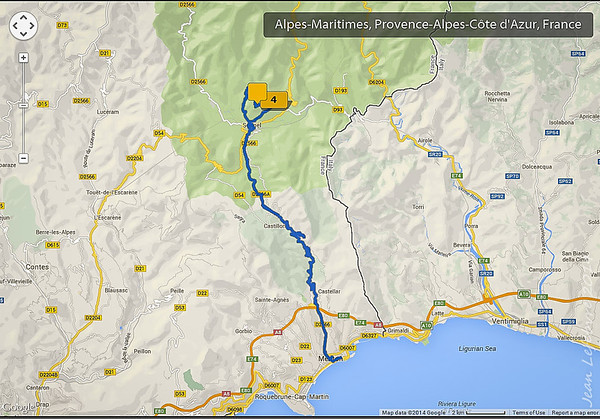
This was another mountain walk, and the forecast wasn’t great, so I wasn’t as much looking forward to this one. Still, the morning was very nice. The plan was to take a small bus to the town of Castellar, then walk up to the Italian border, and back down to Menton.
The road to Castellar was even more twisty than the Sospel road. We walked through the small mountain town before heading up on the trail. It was a fairly easy one as uphill climbs go, as the path was pretty wide and the ascent gradual. The path to the Italian border was more challenging, as it was narrower and more rocky. But everyone made it up.
Nice views up here, must say
We did have a good morning, but once again, on the way down, it started to rain. Lighter rain, though. And yes, this time, I had the rain pants, and put up my hood, so it wasn’t too bad. We actually had a choice here, of taking the bus or walking back to Menton. In the light rain, everyone agreed to do the walk down.
Except then it started to pour. And as we got wetter, more and more people started to change their minds about walking. Until finally, Stéphanie (the guide) declared that we were all taking the bus! She felt it would be too slippy to attempt the walk down (had there been any volunteers remaining for it).
We did get off the bus at an earlier stop, though, to have some time to tour the old cemetery of Menton.








 Cultureguru's Weblog