Perfect for this time of year: Triple berry pie

Dinner tonight featured haddocked topped with Ontario field tomatoes and my own basil and dill (along with lemon and olive), with a side of local organic kale—a veggie that becomes remarkably good once tamed with butter, balsamic, raisins, lemon, and sea salt. And it was topped off with a triple berry pie.

I’m not sure where I got this particular pie recipe, but it was my first time trying it. A definite success. And it does seem the perfect time of year to make it, as at least in these parts, Herrle’s is selling local strawberries, blueberries, and raspberries. (Apparently you can use frozen fruit instead.) It’s very easy (especially if you do what it says and buy the crust), and the only baking is the crust alone for about 8 minutes, so you don’t heat up the kitchen much.

And for pie, sort of healthy-esque, as it’s only one crust, lots of berry, and less sugar than some.

Berry pie

Not my pie, but it did kind of look like this one…

Recipe

  • 1 9-inch frozen pie shell
  • 3 tbsp cornstarch
  • 2/3 cup sugar
  • 1/4 cup water
  • 1 1/2 cups blueberries, divided
  • 1 tsp grated lemon rind
  • 2 tsp lemon juice
  • 1 cup raspberries
  • 2 cups strawberries
  • Icing sugar

Prepare and bake pie shell per package instructions.

In medium saucepan, combine cornstarch and sugar, then stir in water and 1 cup blueberries. Bring to a boil, stirring constantly. [Or when you feel like it, as was my approach.] Simmer 2 minutes or until very thick and clear, stirring constantly. Remove from heat. Stir in lemon rind and lemon juice. Cool 5 minutes. Stir in remaining berries. Spoon into pie shell. Refrigerate until set, about 3 hours. At serving time, sprinkle with icing sugar. [Which I forgot to do, and don’t think is necessary.]

* Variation: Instead of using fresh berries, substitute frozen berries (600 g), thawed. Drain berries well, reserving 1/4 cup juice to replace water. Measure out 1 cup berries to replace blueberries as above.


Liking to cook

Watching her partner prepare dinner, an acquaintance of mine said, “I don’t know how you can find any aspect of cooking fun.” She, needless to say, did not particularly enjoy cooking.

This did get me to thinking, though—why do I like cooking?

Because there are definitely cooking tasks I’m not particularly fond of. I have a friend who adores all the meticulous aspects, like chopping things finely and removing meat from bones. Exactly the sort of fiddly or slightly disgusting tasks I don’t care for. I also don’t like the super-boring ones, like stirring something “constantly” for 10 minutes or more.

So when it comes to that sort of thing, I have a few tactics to cope:

  1. Don’t do it. Like, I don’t make risotto—it requires too much stirring—and I don’t peel and seed tomatoes, because hello? Who has that kind of time, and what’s wrong tomato peel and seeds anyway?
  2. Buy it already done. Your boneless chicken, your deveined shrimp, your peeled and chopped squash, your frozen chopped onions.
  3. Find a more efficient way to do it. The Cuisinart is one of my best friends for grating and chopping, and lot of things turn out to be easier to peel or skin after they’re cooked, so I wait and do it then.

But despite all these avoidance manoeuvre, I really do like cooking. I do all the cooking home, because I want to. I cook just for myself, too. (And I don’t mean a grilled cheese sandwich; I mean a proper full meal with all the food groups.) I just don’t relate to people who find it always tastes better “if someone else made it”.

I think I’ve nailed down why.

It’s all about control.

I am, possibly, a bit of a control freak. And cooking for myself is the very best way to ensure that I eat nothing but what I want to eat. And much as I love some forms of convenience, I don’t like that to go too far. I don’t like pre-seasoned, pre-assembled, pre-cooked stuff. I want to do that. My flavors, my combinations of ingredients, cooked as much as I think appropriate.

It’s relaxing.

Really, cooking is pretty zen—at least the way I do it. I crank up my tunes, I pull out the recipe or recipes of the day (all planned out in advance), I gather my ingredients (all purchased ahead), I make dinner. Sure, I may get the occasional stress bubble when the main course and both side dishes all need something done at the same time, or something isn’t quite working, but that isn’t typical.

It’s a mini-accomplishment every day.

I’m not curing cancer, but at least I’ve created something decent from scratch yesterday, today, and tomorrow.

I like to eat.

Back to only cooking what I want to eat: I’m usually looking forward to eating what I’m making. One of the many, many reasons I could not be a chef is that those guys (they are mostly guys) are cooking for others, and that would just not be motivating enough for me.

Finish it up, place everything nicely on a plate, pour a matching glass of wine… Eat. Instant gratification! How many other tasks that you do in day offer the same?

Lush

Hub and I are not really into the whole yardwork thing. But we do periodically put in a bit of effort. This year, we finally got the hot tub, which hadn’t worked in years, removed from the deck. That made more of a difference than either of us thought, making the deck actually seem somewhat inviting to sit on.

Thus inspired, we (well, mostly he) went after the weeds that had almost invaded the patio, making it look more like a patio again.

The gardens haven’t been particularly coddle but seemed to have enjoyed what nature has provided so far. Yes, the back flower garden certainly contains some monster weeds, but the flowers we planted long ago are definitely competing. The roses seem downright aggressive in their size this year, spreading up and out with their thorns and pink flowers, as if daring the weeds to come closer. And the cover flowers are abundant and on the move, some of them making their way onto the lawn, creating pretty little white patches here and there.

Roses

It was a good year for the roses

In the front garden, the tulips, daffodils, and lilies gamely keep returning. This year they are joined by a bunch of purple flowers that I did not plant. Perhaps these purple flowers are some horribly invasive plant I should be trying to get rid of. But I find them pretty, and they certainly like the shaded part of the garden more than the other flowers do.

It occurs to me that the herb garden probably looks like a big patch of weeds, but it’s actually the least weedy garden I have. It’s just that herbs are so ridiculously lush; normally only weeds to get such size. The tarragon and sage are, as always, monstrous. (I’ve started adding tarragon to many recipes. It’s quite nice, really. Sage, sadly, remains less versatile.) But this year’s returning cilantro, which seemed so wimpy last year, is also now tall, and spreading everywhere. Not to mention the dill I just planted, already a giant, and seeming to sprouts new offshoots every day.

The only other veggie I have this year are tomatoes. If the flowers are any indication, it could be quite the crop of those later on.

We even attempted to start a new backyard flower garden this year, from seed. We had the plot mostly ready, and the instructions on the wildflower seed bag made it sound very easy. Expecting something like grass seed, I was surprised that the flower seeds looked more like laundry lint. The package did warn that regular watering was necessary to get things going, so we’ve been obliging on that front on the days that don’t rain.

Sadly, all we seem to have so far is soggy laundry lint. Reading up on it, I think we may have failed to clear away enough mulch for the seed to make sufficient contact with the soil. This one may be a do-over.

Cooking with Goop

Gwyneth Paltrow is a polarizing figure, I suppose, and people seem surprised when I credit her with a recipe I’ve made (that they’ve enjoyed).

I’ve got to admit—and I think I’ve mentioned this before—that I wouldn’t have guessed that I would find good use for a Gwyneth Paltrow cookbook. I seem to remember her being some kind of vegan, raw-food diet adherent, and that’s just no fun. And though I don’t have hate her as some seem to, I’m also not a huge fan, nor a subscriber to Goop, her “weekly lifestyle journal”, which does sound a bit much, to me.

So it’s thanks to Anna and Kristina on the sorely missed (at least by me) Shopping Bags that I acquired My father’s daughter: Delicious, easy recipes celebrating family togetherness. After a good test, A & K rated her book a Buy. This Christmas, I got it as a present. I have now owned it long enough to have tried a number of the recipes.

And I have to say, they’ve pretty much all been winners. Anna and Kristina did warn me away from some, like the laborious duck ragout that was perhaps not worth the effort. But the hot salad nicoise, and the fish tacos, and chopped salad, and the spaghetti limone parmeggiano, have all been delicious. And easy.

Currently, the smell of her Fudgy chocolate brownies (“as healthy as brownies can get, with no flavor sacrifice”) is wafting deliciously through the house. If they taste as they smell, that will be another success.

There is an emphasis on more healthy cooking, which I prefer anyway, but it’s not extreme. Some vegan recipes are included, but also plenty with dairy, meat, and fish. She does suggest some unusual ingredients, like vegenaise, brown rice syrup, and spelt flour, but I have managed to find most everything at my regular grocery. I’m not completely convinced the stuff is so much healthier than regular ingredients (and she does provide a table of “normal” stuff you can substitute), but it’s good. Vegenaise, if anything, is better than mayonnaise. Brown rice syrup has a very pleasant sweet flavor.

(The one item she calls for a lot that I can’t seem to get my hands on is oil-packed anchovies, but I’ve using olive oil packed tuna instead for that, with a bit of added salt, and that’s turned out fine.)

Another nice detail is that each recipe has a clear and reasonably accurate indication of how long each recipe will take, broken down into active and total time. And I admit I find the whole “family” context of the book nice, even though I most often cook for two.

The perfect wine

Though we’ve had Pinots from Coyote Run before, and they were fine, I don’t remember ever being quite as impressed with them as we both were with the 2009 Estate Pinot Noir, which is only 19.95 (not bad for Pinot). Though it’s a lighter Pinot, not your blockbuster Californian, it still seemed very wow.

I don’t know if it was the wine temperature, or the food match (pan-seared salmon with mushrooms and spinach–a good and easy recipe, but at least double the veggie amounts), or if 2009 was a good Pinot year (like it says on the bottle).

Whatever. That night, it seemed the perfect wine.

And a delicious new year

We followed the usual traditions, spending New Year’s Eve at Verses…

New Year's Eve 2012 at Verses

(There might have been wine involved), only this time with a friend. A lovely four-course meal, the highlights of which were probably the cold foie gras we all started with, and the champagne-poached oyster appetizer I had to follow.

We spent a mellow New Year’s Day (well, I did—Jean actually went canoeing in the rain).

Then on Monday, we did that slightly crazy multi-course cooking thing we do. The Monday actually being the day before we had to go back to work, though, we did scale it back a little, starting the dining at an earlier time, and only attempting three courses this year.

Appetizer: Mussels and clams with lemon grass

This was from a book by Christine Ingram called Appetizers, Starters and Buffet Foods, which I took out of the library. (Did I mention we have library in walking distance now? Me likie.) Though the ingredients sounded delicious—the seafood steamed in a broth of lemon grass, white wine, lime, and coconut cream, the instructions didn’t really make sense. It said to put in the wine with seasonings and cook it until it was almost gone, then add the seafood, then take out the cooked seafood, and reduce what was left by half. How can you reduce nothing by half?

Anyway, so this ended up a free-wheeling improvisation, especially since I also had to use lemon grass in a tube, fresh limes rather than “kaffir lime leaves”, and coconut milk with coffee cream rather than coconut cream. And since we were also in the middle of cooking the main course when we had to start this (it’s just how these meals work), it was a little stressful.

Fortunately, it turned out delicious!

Mussels, clams, and lemon grass with wine

A few of the mussels and clams might have ended up a bit overcooked, but most had a really nice texture, and the broth tasted amazing. We had about three pounds of seafood here, and we ate every bite.

The wine it cooked in was an Oyster Bay Sauvignon Blanc, but for serving, we went with a Stratus 2006 White, which is a rich white blend. It was nice and complex, and definitely involved some Chardonnay. (Website says: Also Sauvignon Blanc, Gewurztraminer, Semillon and Viognier.)

Main course: Cider and honey roast leg of lamb with crisp roasted potatoes and caramelized Brussels sprouts

Three recipes here. The meat was a Gordon Ramsey offering (and also a library acquisition), and never having cooked leg of lamb before, I followed the recipe pretty much exactly. It basically involved roasting the leg with garlic, thyme, and apple, and basting it with honey and cider. Really not too difficult; you just have to allow 2—2.5 hours to get it done.

The only thing that didn’t particular work was the gravy, which he claimed could be produced from the leftover cider with added chicken broth—with no thickener. He claimed that it cooked down to the proper consistency, but there was a ton of liquid! So we just used it runny. It tasted good, but was definitely more bouillon than gravy, to me.

The potato recipe was from Cook’s Country magazine. In their usual method, they had tested and experimented until they came up with the perfect technique for producing a crispy texture on the outside, and a creamy texture on the inside. But we couldn’t follow that, because we had only one oven, and I decided that it was more important that the meat cook at the proper temperature than the potatoes.

And the Brussels sprout recipe was courtesy of Gwyneth Paltrow’s My father’s daughter, a Christmas gift. It was a quick recipe we could do after eating the seafood, while awaiting the meat: You basically steam the Brussels sprouts for seven minutes, then cut them in half and sear each side in olive oil, and serve with lemon juice, more olive oil, and coarse salt.

Lamb, potatoes, and brussel sprouts with red wine

We had a good year; this all turned out well also. (Though I couldn’t eat that entire plate, above.) Despite their lack of perfectly crispy exterior, the potatoes were very good—Jean thought they were the highlight. The meat was tasty and tender. And strangely, it tasted even better the next day, when we had it as a leftover.

The Brussels sprout recipe was intended to make converts of those who don’t like Brussels sprouts, and I could see that. As Jean said, they kind of ended up not tasting like Brussels sprouts very much. They were good, but since we actually like Brussels sprouts, maybe they didn’t need all the disguise.

We served it with a wine that we picked up in California, a 2004 Bartholomew Park Cabernet Sauvignon. It was very nice, full and fruity but still with some tannins.

Dessert: Praline cream pie

This is from Cooking Light magazine. It wasn’t difficult, but it was involved, as you had to make the crust, then let that cool, then make the praline layer, and let that cool, then make the cream, and (you guessed it) let that cool, then put the whole thing together and chill it for a long time. So I started that in the morning, and we ate it around 8:30 or 9:00, and it still wasn’t completely set.

On the other hand, it was nice to have dessert out of the way early, so that last part of dining could be quite relaxed. And slightly runny or not, it was really very good. Like a lighter sugar pie, maybe?

Praline cream pie with Ice cuvee

We had that with a Peller Estate Ice Cuvée, a lovely blend of ice and sparkling wine.

Sucre à crème

Another traditional French Canadian recipe I decided to try making this year is sucre à crème. Unlike tourtière, this stuff doesn’t tend to be made in huge batches. It’s delicious, though, so it doesn’t stick around long. So I thought it might be nice to have a batch of my own.

As recipe source, I went for the nontraditional Google, and found many recipes. Most, however, involved candy thermometers and manual stirring. Lots of manual stirring. Much complaining about a need for strong arms to successfully complete the recipe.

This was starting to seem less fun.

Near the top of the results, though, was one from Allrecipes.com Canada, that said simply:

1 cup white sugar
1 cup brown sugar
1 cup heavy cream

  1. In a large microwave-safe bowl, stir together the white sugar, brown sugar and cream. Cook at full power for 10 minutes, stirring twice. Let stand for 5 minutes.
  2. Use an electric mixer on low speed to beat the mixture for 4 minutes. Pour into a buttered 8 inch square glass baking dish. Refrigerate for 1 hour or until firm. Cut into squares when set.

I thought, that’s the one for me!

Based on comments, I adjusted the microwave time down slightly, to 9 minutes (which also made it easy to stir on the 3 minute marks). As for the mixing part, I couldn’t make it quite to the 4 minutes—not because my arm was sore—but because it just seemed to be getting too thick.

That’s where experience with this stuff would help, as I wasn’t totally sure what texture I was aiming for. The result was slightly more crumbly than I think was ideal.

Still, with those ingredients, it’s hard to go wrong, and it did taste delicious. I brought it in for work pot luck, and the worst part was being asked by anglophones what it was, as I can’t find an adequate English word for it. (It’s along the same lines as fudge, but it’s not fudge.) But despite the slight crumble and the weird French name, it proved very popular—in fact, there was none left.

Just like at Réveillon.

The recipe

4 cups halved or quartered strawberries

(Needless to say, these need to be fresh Ontario strawberries. I got mine at Herrles.)

2 1/2 tsp. balsamic vinegar

(Don’t chintz here. Get the good stuff. I used Balsamico Cotto by John D’Angelo. Available at Brady’s.)

1/4 cup packed light brown sugar

1/8 tsp freshly ground black pepper

3/4 cup low-fat sour cream

(Nothing special here; no-name brand, I think)

1 1/2 Tbs. granulated sugar

2 tsp. grated lemon rind

Sprinkle the strawberries with the vinegar, brown sugar, and pepper, and toss; let stand 15 to 20 minutes. Mix the sour cream, granulated sugar, and lemon rind. Plop on strawberries. Eat.

How’s it taste? To quote DH: “This tastes the way good sex feels.”

Balsamic strawberries and mint

A cooking show I like

I like to cook, and I’ve been known to watch a little television, so people are sometimes puzzled that I don’t particularly like watching cooking shows. Some other people who like to cook, I’ve learned, love cooking cooking. In fact, they find themselves becoming somewhat “addicted” (their words) to the Food Network.

Me, not so much. For whatever reason, I don’t particular enjoy sitting there watching celebrity chefs prepare food (that I’m not going to get to eat). So since Food Detectives stopped making new episodes (far as I can tell), there is no Food Network program that I watch regularly.

But over on the W Network, I have recently discovered Anna and Kristina’s Grocery Bags. It’s basically a cooking show. And that one, I may be just a little addicted to.

Photo of Anna and KristinaI had seen their previous show (possibly still on), called Shopping Bags, in which they test various consumer products. It was definitely an entertaining approach to product testing, but the information always seems to whiz by so quickly it wasn’t that useful. Three types of five different products in one half-hour; how are you supposed to remember which to buy afterward?

Whereas each episode of Grocery Bag focuses on one (1) cookbook. That’s what they test: cookbooks. They do this by making a sampling of recipes from the book, within a time limit, to be judged by a chef. Interspersed in there, they do a little pre-taped product testing of both kitchen gadgets and ingredients, to be used on “cook day”.

I like it in part because I can relate to it. Anna and Kristina are competent cooks, but not trained chefs. As the stress mounts of trying to prepare five or more new recipes for a guest who is coming to judge your efforts, they make mistakes. They get annoyed with each other. They swear. They redo. They run off to the grocery store to buy more ingredients. They curse the poor instructions or weird ingredients of the book. They get grossed out trying to deal with octopus tentacles or squid ink.

Then when the food is done and the chef arrives with a bottle of wine, everything seems a little better. And the tasting begins… Will the dishes make the taste buds sing, or stimulate the gag reflex?

It’s drama, man. It’s highly entertaining every time.

Plus, it’s useful. As it’s a test, they try to be real sticklers for following the recipes—like manually chopping all the onions if the book says to, instead of what I would do, which is stick those suckers in the food processor. In the end, they come out with a recommendation to buy or not, but as you’ve seen how and why they came to that conclusion, you can decide if you agree. It’s made me consider cookbooks I otherwise never would have, like Gwyneth Paltrow”s (!)—turns out it’s not just the vegan, raw-food weirdness you might expect—and Gordon Ramsey’s.

Now what I want to know is whether those “addicted to the Food Network” people would (or do) like this show. Or is it just too real?

And a foodie new year

Our annual new year gourmet dinner was held January 2, giving us a day’s break from New Year’s Eve dinner, and the day following (today) to rest up before heading back to work.

First course: Wild mushroom toasts

Originally my idea was to have lobster bisque as the first course, but I changed my mind based on:

  1. Feeling that soup might be too heavy a starter for also fairly heavy main course.
  2. A sense that I didn’t really want to kill anything to ring in the new year, but that frozen lobster might be sub-par.

So, we went back to a fairly standard item at these dinners, wild mushrooms. But a new recipe, from Fine Cooking magazine.

The one ingredient I wasn’t able to find was crème fraîche. But I did find instructions on how to make your own. Basically, it’s this:

  1. Add 1 Tablespoon buttermilk to 1 cup slightly warm whipping cream.
  2. Let that sit on your kitchen for about a day and half, stirring every once in a while, til it’s thick.
  3. Put it in the fridge.

Isn’t that weird? You’d think leaving dairy products out at room temperature for so long would be a bad thing, but we did eat that yesterday with no ill effects, so I guess not. (I also don’t understand why that’s called crème fraîche, which literally means fresh cream.) It didn’t seem to impart that much taste to the dish, which mostly tasted of mushrooms. I think it was more about adding texture.

Adding crème fraîche to the mushrooms:

The wine we had with this course was a 2007 California Beringer Pinot Noir. We’d bought it that same day, in the “last chance” bin, just on the thought that Pinot would be good with mushrooms. Turned out to be a very nice wine.

The soundtrack for this course was my Get Happy! playlist. Looks like it worked:

Dining on mushrooms and Pinot

Second course: Seared Scallops with Spiced Mango Coulis

The recipe we used here was from the New England Culinary Institute, and we picked it up while on vacation in Vermont. It was super-easy, though; the most challenging part, which Jean took on, was peeling and slicing the mango. Half a mango decorated the plates, and the rest was blended with ingredients like ginger, white wine, and clove, to make a coulis.

Happily, we were able to find some beautiful, large sea scallops at Sobey’s, and then you don’t have to do much to them. Salt, pepper, sear in a bit of grapeseed oil, then drizzle on a bit of olive oil.

Scallops and Chardonnay

The result was just delicious… My second-favorite dish of the night. (And Jean’s number 1.)
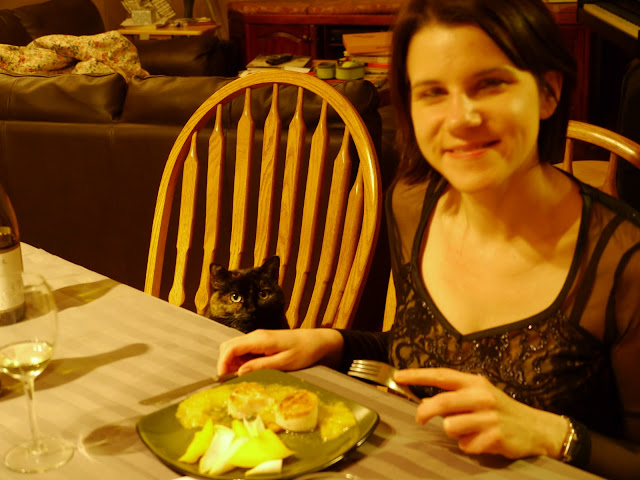
Zoe, me, and scallops

The wine was a French Chardonnay we had on hand, that wasn’t spectacular in itself, but went quite nicely with this food (which you really didn’t want to upstage). Moments after this shot, a bit of an accident occurred. It made us really happy this was a white wine:

Tower of wine

I guess the soundtrack for this portion—the Thoughtful playlist—wasn’t quite as effective.

Third course: Venison Osso Bucco with side of Vegetable Barley

This was the one course planned well ahead, when I spotted the venison osso bucco cuts at Brady’s. I then scoured the Internet for recipes, since I’d never made any kind 0f osso bucco before. I finally settled on a recipe from cdkitchen.com, which involved cooking it with lemons, oranges, carrot juice, red wine, juniper berries (which I couldn’t find, so I substituted gin), chicken broth, and various veggies. It wasn’t too hard at all.

Unfortunately, the results were disappointing. For whatever reason—having to scale down the recipe size, not using the best pots, whatever—the meat just wasn’t tender enough. It was tasty, but lacked that “falling off the bone” quality. If I try it again, I think I’ll go for a slow cooker method.

Osso bucco and Zinfandel

The barley side dish, though deliberately unexciting, was quite nice. I started with a recipe from Taste of Home, but made some changes: Cooked it in chicken broth instead of just water, used carrots instead of red peppers, and reduced the amount of green onion.

The California Zinfandel wine we had with this was a Christmas gift this year, and man, that was a lot of wine. Big and fruity. Nice, though.

Soundtrack was an old standby for dining, my Beautiful Ones playlist.

Dessert: Chocolate soufflé

I wanted a light (tasting) dessert to round things off, and what could be lighter than soufflé? I’d never made it before, either, so again I had to search online for recipes. I ended up with a highly recommended one from Epicurious.com, which had the added bonus of being fine with making everything ahead and just baking it right before eating.

The ingredients were really simple: eggs, milk, sugar, and 10.5 ounces of “extra-bittersweet chocolate”. It was easily the most fun dish to prepare, starting with the need to round up six soufflé ramekins when we had no idea what those were. And the word just struck us as really funny, so we were giggling the whole time we gathered a dog’s breakfast of custard dishes, small corningware, and oven-safe storage containers we figured could substitute for ramekins.

Then it was all beating egg whites and melting chocolate and buttering and sugaring the faux ramekins, not to mention really enjoying licking all the bowls and spoons.

After baking, the moment of truth: Would the soufflés rise? But, they did, they did! (The photo is of them inside the oven.)

Souffles in oven

While we considered port, we decided to open a Cabernet France ice wine from Stratus (a gift we received last Christmas) to serve with the soufflé. It was lovely.

Souffle and ice wine

What I wasn’t expecting, and loved, was the molten chocolate pool lying under the floating soufflé top:

Inside the souffle

This (unsurprisingly for me) was my favorite dish of the night. (And Jean’s #2.) The soundtrack for this portion of the evening was, of course, “Love, the sweetest thing” (that is, romantic songs).

Happy 2011, all.