Last week, some friends and I went to see the Classic Albums Live group do David Bowie’s ChangesOne album. That album selection is a bit of a cheat, since it’s a compilation album with many of Bowie’s early hits. But it certainly made for an entertaining first half.
Singer Joseph Salsbury seemed like a very cool guy, and did a great job on the Bowie vocals.
The second half was various other Bowie tunes, and ended with a highlight for Gen X types, of “Let’s Dance” followed by “Modern Love”. But they started that half with a cut from Ziggy Stardust and the Spiders from Mars: the very haunting “Five Years”.
Pushing through the market square So many mothers sighing (sighing) News had just come over We had five years left to cry in (cry in) News guy wept and told us Earth was really dying (dying) Cried so much his face was wet Then I knew he was not lying (lying)
…
We’ve got five years, stuck on my eyes Five years, what a surprise We’ve got five years, my brain hurts a lot Five years, that’s all we’ve got
Here’s the whole song
Five years from now: Is that all we got?
One the many newsletter-type things I subscribe to is by an author of the definite opinion that we are in the early stages of collapse, who expects that things will completely have to gone to shit in about five years. Given the climate crisis, species depletion, pandemic risks, misinformation effects, economic threats, food insecurity, and global political instability, it doesn’t seem an utterly crazy notion. And this is a US-based publication, so they’re also living under that administration.
The one that’s threatening us.
I can’t totally buy in. I’m just not there yet. So I have not gone whole hog on things like learning to grow my own food, making my own medicine, and reinforcing my house with bullet-proof glass and sandbags. Still, I have picked up some useful tips. You might find them useful, too! For example…
Hansen, recuperating in his cage, was very sweet, full of purrs and head-butts. But his blankies and towels all seemed to be somewhat damp. Not smelly, though. And his water dish was really low. So perhaps a bit of water bowl spillage.
Following the morning protocol, I removed his food and water dishes, and replaced them with new ones, topped up. But before putting those back in the cage, I gathered up all his damp bedding and replaced each of those. Litter scooped, a few more pets doled out, then I gave him his new food and water dishes, and closed the cage door.
Whereupon he flicked, flicked, flicked almost all the water out of the dish and onto his newly installed bedding.
That was on my first day volunteering for Pet Patrol, the cat rescue organization from whom we acquired Gus and Mac (and previously, Zoë, McSteamy, and Mocha). Some cats in cages, but most were just loose in the sanctuary, and all seemed a bit crazed with energy after a night without people. It was a flurry of litter scooping, cage cleaning, food exchanging, and floor mopping, with just a side of cat petting.
I solved my Hansen dilemma by not immediately restoring the water dish after providing him with yet another set of dry blankets and towels. I snuck the water bowl in later, when Hansen had settled for a nap.
My next shift was in the evening, and the cats were much more mellow then. There was still a certain amount of crazy-ness, as several were heading to surgery the next day, and had to be given canned food to make sure they got a fill of food before their dry food was taken away overnight. Might not sound complicated, but remember that there are tons of cats loose who are not getting canned food—but would like some.
My third shift, also an evening, was the quietest yet. Newcomers included a couple ferals temporarily being sheltered from the extreme cold. There was no point in trying to socialize them, but I was getting to know a few of the others.
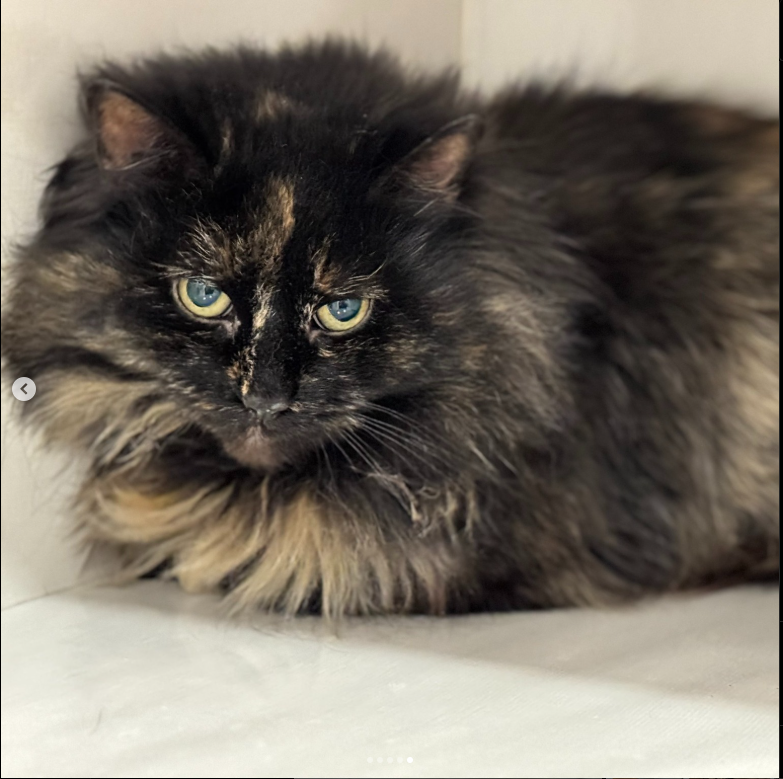
So far, it has not been difficult trying to resist the lure of adopting one of these babies myself. It probably helps that there’s been a slow but steady stream of adoptions occurring. But it’s also true that Gus and Mac are enough for us right now.
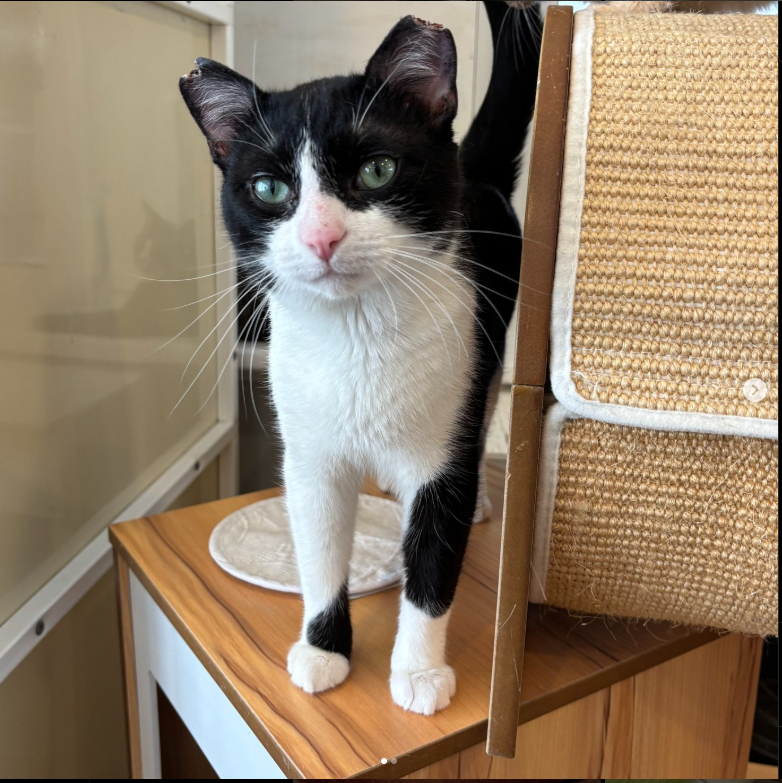
Gus says hi.
I also heard from Mask Bloc WR recently, asking me if I’d like to join in their latest meeting. Per Mask Bloc. org,
Blocs are formed when individuals or groups unite around a common goal. Blocs can take many forms, ranging from voting and political pressure groups, to advocacy groups and mutual aid organizations.
Mask Blocs are independent mutual aid group providing high quality masks to their community for free. They may also provide other tools and information about COVID-19, clean air, testing, vaccination and accessibility.
I’d been hearing about them in various cities, and it seemed like an interesting thing to try to help out with. At the meeting (which was virtual), I learned that the Waterloo Region group, which is relatively small, has been making high-quality masks available to those who want them but can’t afford them for some time now. They have a number of community locations, but will also deliver for people who can’t easily get to those.
From https://www.instagram.com/p/DD2ZBEEOG1D/. I’m personally excited about this service, as I do have some guilt about all my disposable masks ending up in landfill. Now they won’t!
Recently, they have also expanded to providing rapid tests. The challenge there is that while the masks get donated to them (by the companies who make them), the tests are not. So they need to focus more on fund-raising now. Not really my forte, but they have other initiatives and ideas:
Holding more COVID-safe events (one of which is happening tonight!)
Providing assistance to those suffering from serious Long COVID
Doing more advocacy and research
During the meeting, the subject of the current Ontario election came up, and they noticed that I was able to rattle off various political facts and events rather easily. They asked if I could come up with a list of the Ford government record in this area, for potential use on their Instagram.
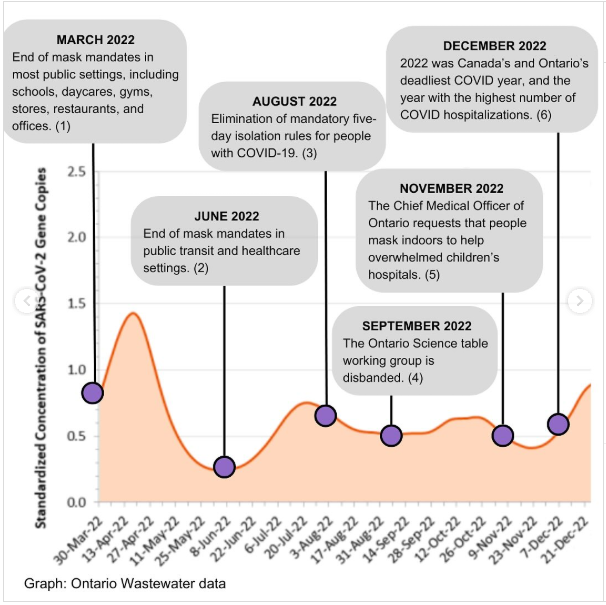
I did, though I did not really see how what I provided could be “Instagram-able”. It was stuff like this:
August 2022 Ontario eliminates the mandatory five-day isolation rules for people with COVID-19. (8)
September 2022 The Ontario Science table working group, which advised the government on COVID protections, is disbanded. (9)
November 2022 The Chief Medical Officer of Ontario requests that Ontarians mask in indoor settings to assist overwhelmed children’s hospitals. (10) Most Conservative MPPs refuse to do so in the Legislature. All opposition members wear masks. (11)
December 2022 Statistics Canada reveals that 2022 was Canada’s and Ontario’s deadliest COVID year, and also the year with the highest number of COVID hospitalizations. (12)
March 2023 The Ontario government ends a program that gave workers’ access to three paid sick days.
(Covering not the early pandemic years, but the subsequent ones.)
Jean came back from his weekend biking trip with a bit of a cough, which he said was due to using his CPAP sans humidifier.
Seemed plausible.
He had a bad night, though, with cough persisting despite the now-available humidifier, and with congestion as well.
“You need to take a test”, I told him in the morning.
“I do”, he replied.
Results were clearly positive in less than 10 minutes.
Not our actual test. Image via JJonahJackelope/ Creative Commons
DEFCON 1—Wait
Maybe I was also already infected? I wasn’t on the bike trip, but then, he was gone only two days and came back sick. There was no way he got infected on that trip. Must have been in the days before. When we were together, at least in the evenings.
Imagine, if you will, a system of disease surveillance that doesn’t rely on expensive and painful tests. It does not require us to get swabs stuck up our noses, needles poked into our arms, or even to answer banal questions about symptoms. Instead, this system asks us to go about our regular day, sleeping, waking, eating, and…. defecating… exactly as we would normally. In this system, heroic nerds—out of sight and out of mind—scoop and test samples of sewage in order to tell us whether disease rates are either concerning or tolerable.
Now imagine that shortsighted policymakers decide to defund such a surveillance system, just as its worth and pioneering quality are being celebrated worldwide.
Of course, you don’t have to imagine it, because that’s exactly what’s happening in the Province of Ontario. Dr. Deonandan’s short article linked does a great job of explaining why this is bad; the key points being:
It’s really the only metric we have left for informing the public about current infection risk
Vulnerable individuals require such information to determine what activities they can do when
It’s a useful source for ongoing scientific research into various infectious diseases and conditions
It can serve as an early warning system of new threats
The Ontario government points out that the Federal government is planning to expand its wastewater system in Ontario, suggesting that means that the provincial system is no longer needed. Problem is, all evidence suggests that the Federal system will be a poor cousin to what is in place now:
Far fewer sites (59 now, down to maybe 8)
Much slower release of information
No direct ties to hospitals, universities, and public health units
Less informative: fewer diseases covered, weaker data analysis
Let’s do a chart comparison. In Winter 2023, Ontario experienced the second biggest Covid wave ever. In Spring 2023, Ontario Covid rates dropped to the lowest level of the Omicron era. Which government agency’s wastewater data conveyed this information most clearly?
The Federal government’s?
Or the Ontario government’s (GTA = Greater Toronto area)?
My response
As I still (quite unfashionably) feel that Covid is a disease best avoided, I still (even more unfashionably) make some efforts to avoid catching it. This has included periodically checking these charts to assess how much vigilance is currently warranted.
I’m not really sure what I’ll do without that option. Just give up? (I don’t think I can just give up.) Stay at highest alert levels always? (I don’t think I can do that, either.)
It seems very unfair for government / public health to say “Make your own risk assessment!”, then remove any way doing that. So, I have tried to both raise public awareness about this, and contacted various levels of government to complain.
Action
Result
Emailed CBC KW (the region’s most popular morning radio station) to ask them to cover the story.
They did a story on it the following week. And they emailed me back to thank me for suggesting it and for giving them a lead on who to interview for it.
Emailed the Big Story podcast to ask them to cover the story.
No response and they haven’t covered the story.
Wrote a letter to the editor in the Waterloo Region Record (the local paper).
They published it.
Wrote to complain to the Premier, the Minister of Health, and the Minister of the Environment of Ontario.
The Ministry of the Environment emailed back saying to not worry my pretty little head about it, that they’re working with the Federal government to keep something going. (I might be paraphrasing.)
Wrote to my MPP, who is an Opposition member.
She wrote back saying she agreed it was a terrible decision, and encouraged me to also complain to the government. (Her party has also spoken out against this decision.)
Wrote to some Waterloo Regional Council members, suggesting that they should lobby the Ontario government to not cancel the program.
Did not hear back a thing from any of them. However, at one of their subsequent meetings, they did agree to contact the Federal government to try to get them to keep the program going.
Wrote to MPPs in the region who belong to the governing party to point out that it appeared that other cities were going to get some wastewater monitoring, but Waterloo wasn’t, and that wasn’t fair, since we pay as much as taxes as they do (that’s me trying to speak Conservative).
TBD, because I just did that.
What you can do
Various sites make it pretty fast and easy to write your own letter of complaint (thanks to John Dupuis for compiling)…
Safe Care Ontario: Email template you can copy (and adapt, if you’re ambitious) and a list of the email addresses to send it to you. (Also material for other valuable campaigns you can join in on, should you be even more ambitious.)
Still COVIDing Canada: Handy-dandy mailto: links for key provicial politicians, and another email template. Bonus: email template and contact information for municipal politicians in Waterloo (hey, that’s my town!) and Ottawa.
Wastewater Advocacy Resources: Google Drive with contact information, email script, phone script, and social media post suggestions.
When integrated with other types of epidemiological data, WBS can contribute to a more holistic understanding of disease incidence at both the provincial and national levels in Canada. The extensive dataset and comprehensive methodology outlined in this manuscript, which includes specific normalization techniques, is not only instrumental in improving the current understanding of SARS-CoV-2 WBS but also holds promise for helping public health units and researchers make better predictions for future outbreaks of similar viral diseases. This set of protocols can be adapted by other research institutions or public health agencies interested in employing WBS.
For the cows! The life quality of dairy or beef cattle on factory farms… isn’t great.
For the humans! Migrant farm workers, in particular, are often exploited.
It’s all got me thinking… Maybe I could at least cut back?
Where’s the beef?
The meat part is done and dusted. I gave up eating beef years ago.
To be honest, I didn’t do it for any of the fine reasons I listed above. Since being a teenager, I’d been a little suspicious of ground beef. I wondered, what was really in that burger? But I didn’t entirely stop eating them until I read Fast Food Nation, which provided an answer:
There is shit in the meat.
Eric Schlosser, Fast Food Nation
(Here I feel compelled to point out that Fast Food Nation was published way back in 2001. Maybe the sanitary conditions have improved since then. Maybe there isn’t so much shit in the meat now. I dunno. I haven’t looked into it.)
Steak, though less shitty, was excised from my diet some time after that, more as a health measure. To follow that general “try to eat less red meat” advice.
Got milk?
Drinking milk all by itself, in a glass, is also something I gave up decades ago. And again, not for any particularly high-minded reasons. At some point, as a teenager, I just decided I preferred drinking other beverages.
Silk unsweetened is generally my favourite almond milk
But I continued to use milk as an ingredient. Continue. It’s not a past tense thing. But, I have reduced it, without much pain.
Almond milk, for some time now, has become my go-to for smoothies and hot cereals, because I enjoy the almond flavor with those foods. And while almond milk is not the most environmental choice of milk alternative, it’s still more environmental than dairy milk.
It’s also lower in carbs than dairy milk, if you care about that sort of thing.
And while I haven’t tried this yet—because I don’t bake that much—I’ve read that barista-style oat milk is the best substitute for dairy milk in many recipes. Speaking of which…
You’re the cream in my coffee
Finding an alternative to cream for my coffee was initially a challenge, because many non-dairy creamers contain sugar. I don’t like my coffee to be sweetened, and I don’t need any extra sugar in my diet in general.
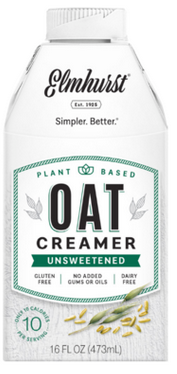
But Elmhurst makes an unsweetened oat coffee creamer that I like just fine. It also works for me in black tea. Not going to lie—it has a somewhat different taste than milk / cream, so it might not work for you. But could be worth a try. And oat is a really good environmental choice.
I’ll try to keep this short. It is Thanksgiving weekend in Ontario, meaning a lot of people getting together with friends and family, which is great.
Weather, however, is not fabulous, making outdoor gatherings not all that appealing. The updated vaccine rollout has been kind of slow in these parts, and it won’t be available to everyone for another three weeks or so. And the Covid wastewater signal for the province is as follows:
A bit outdated—guess they took this week off for Thanksgiving. But the trend is clear.
So I feel that this a good time to point out that if you’re not feeling well in the coming days, or hear that some of those you gathered with aren’t:
There’s an excellent chance that you qualify for PCR testing, to find out for sure (because if you’re an adult who hasn’t had a vaccine in the last six months, which is about 96% of us, you’re in the running!).
If the test results aren’t what you’d hoped, there’s an excellent chance you qualify for Paxlovid, as the criteria is similar. This drug could make you feel better faster, and reduce your risk of Long Covid. Also: cinnamon candies can help with the “metallic taste in your mouth” side effect.
Above links are to my other site, which I give more information about this. You can also go right to the source (even though it says nothing about cinnamon candies!):
As I’m sure it’s been worrying all y’all, I’m pleased to report that we’ve crossed a couple other restaurants off the summer dining list.
The food at Sole was quite good, if not outstanding, and the service was quite professional as always. They retain their prize as prettiest patio in Waterloo Region, in my option. And we biked there and back, which is always nice.
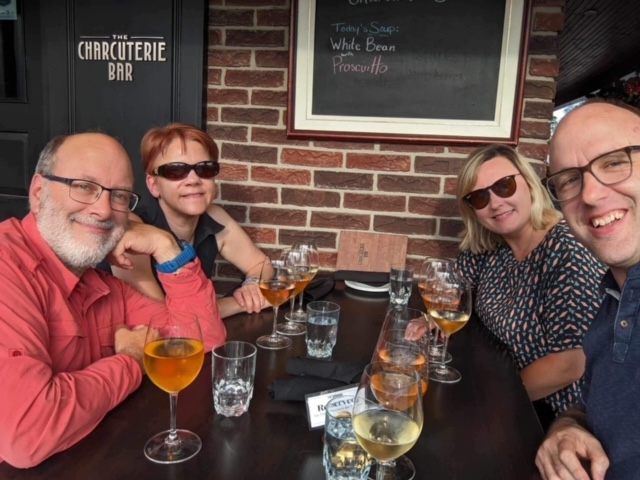
However, we deemed The Charcuterie Bar in St. Jacobs a little too far to bike to after work, though it is a good weekend bike trip. Their patio is on the street, but since that’s a street in St. Jacobs, it’s not without charm. This time of year, however, it’s also not without house flies. Not the restaurant’s fault, and we could have moved indoors, but we decided to stay out and swish away the insects.
Their selection of cheese is fantastic; their pates are very good; they have quite interesting wines by the glass and wine flights; and we also enjoyed the non-charcuterie board options like the smoked trout. Only two desserts, but both really great. Quite limited on the hot drinks; like, only peach green tea (which seemed an odd single option)? Nevertheless, recommended overall.
The best part was meeting up with friends
Then I had a bit of SARS-Cov2 information that I wanted to share… More on the good new side of things (relatively speaking).
Finally, there was a significant inverse relationship between the number of COVID19 vaccine doses received and the risk of having Long COVID; individuals receiving 2 or fewer and 3 doses of COVID-19 vaccine were 60% (RR=1.6, 95%CI: 1.3-1.9) and 40% (RR=1.4, 95%CI: 1.3-1.6) more likely to have Long COVID compared to those receiving ≥4 doses (Table 2).
Long COVID in a highly vaccinated population infected during a SARS-CoV-2 Omicron wave – Australia, 2022, medRxiv Preprint
So sign up for that new vaccine out this fall.
In the meantime, masks work best at protecting you, but if / when you… can’t mask (or don’t wanna)? Try nasal spray like BETADINE Cold Defence. Doesn’t work as well as a mask, but definitely better than nothing. Other options are nasal filters, and even CCC-based mouthwash might be of some assistance.
And on the treatment side, studies continue to show that taking Metformin can reduce your risk of ending up with Long Covid. Metformin is a cheap and safe drug, but only available by prescription. It’s usually prescribed for diabetes, but some doctors know to offer it for other conditions as well.
On a bike ride the other day, I decided to make a point of noticing how many other riders were also wearing helmets. It was a clear majority—probably 80%? Although we were not on difficult trails or busy streets. Most roller bladers, e-scooter riders, and skateboarders were also helmeted.
Interesting.
Then I got home and looked up whether it was actually mandatory to wear a helmet when riding a bike in Ontario. And for adults, it is not.
Interesting.
Particularly given that Covid is contagious, incurable, airborne, rampant, the third leading cause of death in Canada, and a huge burden on the healthcare system… Yet hardly anyone wears a mask.
Public health messaging
You might think I’m about to say this is public health messaging failure, but I think it’s actually a huge success… In terms of their intention anyway, which was to discourage masking.
Because ongoing masking would make it seem that Covid was still a problem, and then there might be some pressure to do something about it. And their political masters, the politicians, didn’t want particularly want to do anything more about it. Two years, man. Enough!
But no, you might say, public health still tells people to mask. People just don’t because it’s not mandatory anymore, and because masks are uncomfortable.
So how do you explain bike helmets? Condom use? Sunscreen (sticky!)? None of these products are mandatory, and none are more comfortable to wear than to go without, yet somehow the mature majority manages to routinely use all of these for protection anyway.
No, I think the messaging achieved just what it intended to. They said:
You can wear a mask to protect yourself.
Masking is recommended for people at risk of severe outcomes from Covid, such as those over 65 and the immunocompromised.
Everyone’s choices on masking need to be respected.
Don’t go looking for Take one of this post; it’s hanging out in my Drafts folder. Big long post, as yet unfinished, having trouble getting to any point.
Sometimes it seems better to just start again. I think this is what I was trying to say.
There is good news on the Covid front
Mainly, the vaccines are great. In Canada, most of the population has had at least two doses. And yes, people previously infected (a majority of the Canadian population by now) have gained some protection against reinfection, for some period of time.
Also, there are some better treatment options now (Paxlovid). This combination of factors has protected many people against hospitalization or death from infection.
But by some key measures, the Covid situation has never been worse
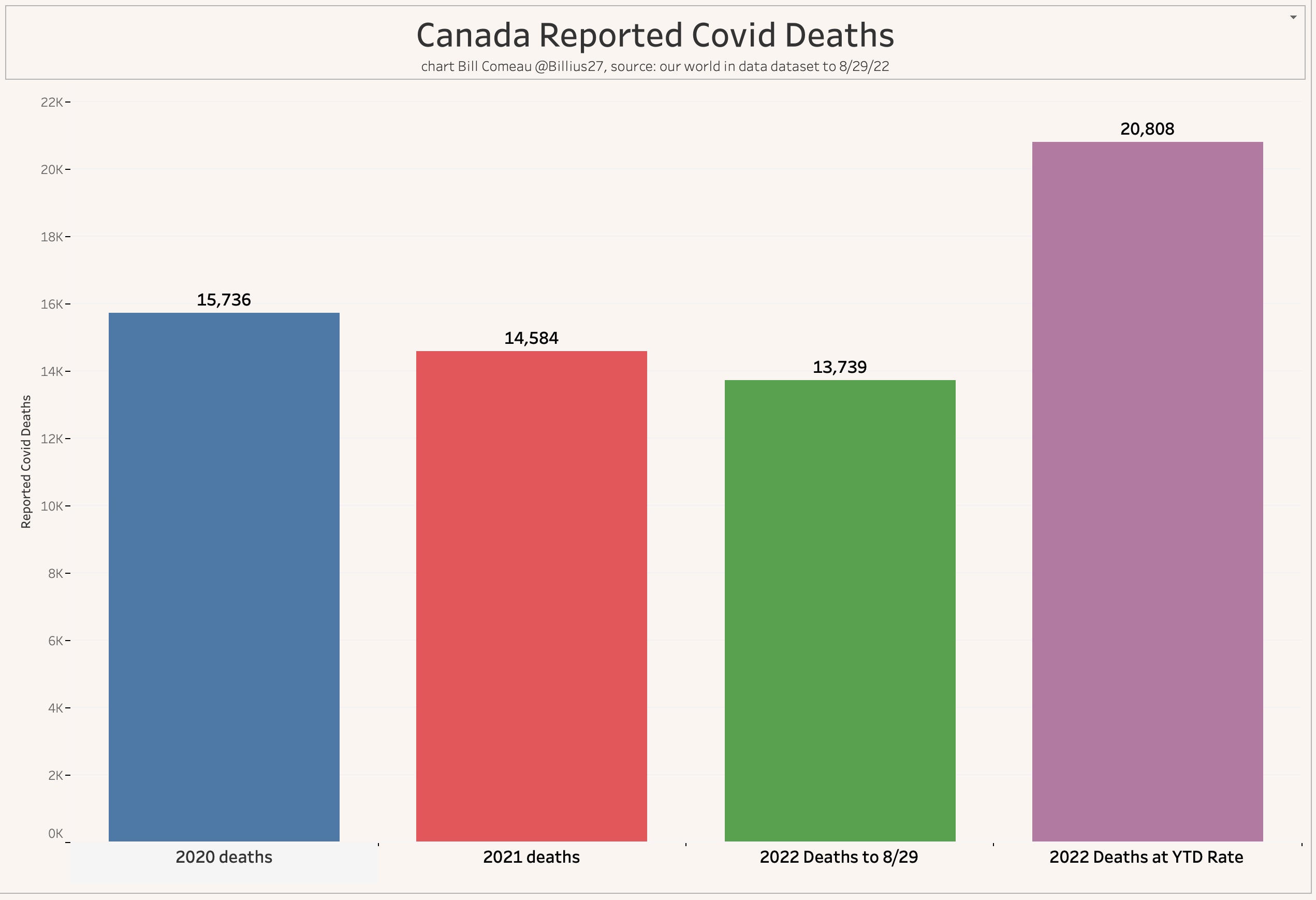
More Canadians are dying of Covid now than ever. 2022 has already surpassed 2021 in number of deaths, and is well on its way to surpassing 2020’s total.
This is a bit old; 2022 has by now surpassed 2021
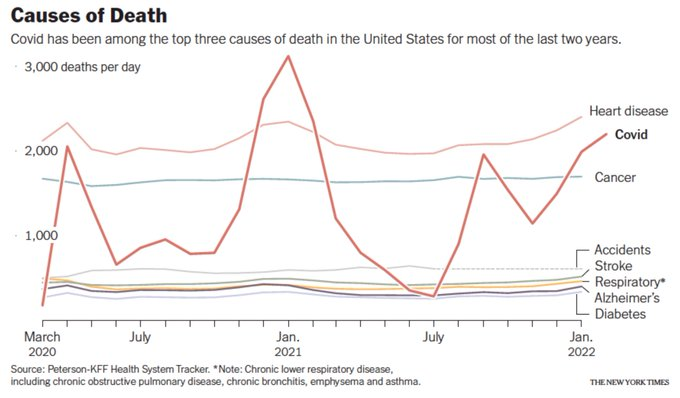
Covid is the third leading cause of death of Canada. It is five times more deadly than the flu.
Many of the dying pass through hospitals first, contributing the unprecedented level of crisis, with emergency rooms repeatedly closing across Ontario for the first the time in history, and serious problems in other provinces as well. While Covid is not the only reason—understaffing, low pay, structural flaws, etc. are others—it’s a really significant contributor.
Remember why we did all that social distancing in 2020 and 2021? The main reasons? It was to save lives and to preserve hospital capacity. All our efforts are being undone now.
And, yeah. It might be helpful to think of Covid as less of a wave that now goes over our heads, but one that is steadily eroding the ground under our feet. https://t.co/S6qcMPTTuY
This is happening because the government went too far in removing restrictions
I’m not saying we need a return to the full social distancing of those years. Policies such as business closures, remote schooling, social gathering limits, and travel restrictions had very clear downsides, and given the good news I started with, can defensively be added.
But getting rid of mask mandates almost everywhere; essentially stopping meaningful vaccination efforts after teens and adult Canadians had two doses, and before children had any; and changing the isolation requirements such that the infectious are definitely out amongst us—the damages of all that on society outweigh the minimal individual benefits.
Why are they doing this?
Because it benefits them politically. I’m not going to pretend to know exactly why they think it’s a political winner, but they clearly do.
Being beneficial to a political party’s election prospects doesn’t make it good or wise policy. Doesn’t mean it benefits you personally or the province generally. Doesn’t mean it’s in our collective best interest, long term.
Why should I care, I’m young and vaccinated
The young and the vaccinated are indeed unlikely to be hospitalized with or die of Covid. But Covid spreading so widely is still a problem for that group (which includes me—at least, in the vaccinated part of that category).
Being sick sucks
Those people who dismiss it as the flu—the flu is terrible, what are you talking about. When I had the flu as a very healthy 21 year old, I literally couldn’t get out of bed, I was so sick. I had to call for help!
And I realize some people truly have a very mild acute Covid case, but most people, at least for a couple days, feel pretty damn awful. And some people it’s more than a couple days.
And even if it’s the sniffles… The sniffles also kind of suck! Sore throats aren’t great!
And you can catch Covid again. It’s not a “one and done” disease.
You might need a hospital for some other issue
Our whole healthcare system is built around hospitals. (Probably it shouldn’t be, but it is, and changing that won’t be fast or easy.) And just because you’re unlikely to need it for a Covid infection, doesn’t mean you or yours won’t need it for something else—an accident, a serious infection, a troubling test result, intractable pain, an overdose… And then it’s going to be big freakin’ problem for you personally that you can’t the care you need in the time you need it, in part because of all the Covid patients in there.
It’s affecting other services
While, again, it’s not the only cause, Covid is a definite contributor the flight delays and cancellations that have been the ban of travelers; to supply chain shortages; to labour shortages; and to other cancelled events (most recently for me, a play at Stratford).
Long-term, Covid might still bite you in the ass (metaphorically)
There’s that Long Covid risk, for one. Yes, vaccination does seem to reduce the risk, thankfully, but not to zero! Not even always that low a risk, depending which study you look at. And there’s no good treatment for it yet. Sometimes people recover, and sometimes they don’t.
And then there’s that whole cornucopia of unpleasant diseases you’re at higher risk of in the year following an infection, “even mild”:
Heart disease and stroke (the number 1 cause of death in Canada, so Covid is “contributing” in this way as well!)
Diabetes
Brain disorders
Kidney disease
Shingles (though there is a good vaccine for this one!)
Immune dysfunction (leaving you at higher risk of catching, among other things,colds, flus, and Covid again)
But what can we do, Omicron is so catchy
You can keep everything open at full capacity while also making indoor spaces safer from infection. We know exactly how to do so. You follow a plan such as this Equity Schools Policy Plan, whose advice would work for pretty much any public space. The key points:
Support vaccination
Plan for mask mandates at the start of surges
Support testing
Improve ventilation and filtration
Support isolation when infectious
How do we make any of that happen?
Well, that’s a bloody good question, isn’t it? Because government sure doesn’t want to do it!
I’d certainly like to try to do something, as that seems more productive than merely fretting or raging.
Contact politicians / public health officials
Personally, for me, writing letters to or phoning government officials is not terribly satisfying, as it feels like screaming into the void. However, they apparently do at least somewhat keep track of what calls / emails / letters they get on what subject, so it’s good if some people express disapproval about the current path.
File a human rights complaint
This group of Ontario Physicians, Nurses, Scientists, and Education Professionals has written this amazing letter, urgently requesting an inquiry into the human rights violations represented by the current policies (discrimination on the basis of age, disability, family status, and sex): https://drive.google.com/file/d/1ceci-kYmOLz19LZHdNCLijnP4Ux4WxRb/view (PDF)
These people have particular clout (and deep research at hand), but anyone can file an Ontario Human Rights complaint.
Support (or launch?) legal challenges
Threat of legal action has caused the Ontario government to act on vaccination (opening up fourth doses, making the vaccine available to children under 5). This parent’s group is raising money to legally challenge the Ontario government’s lack of Covid protections in schools: https://gofund.me/e0a4840d
Do you have a case, or can you support others who do?
Stay home when sick if you can
Our society needs to get past this idea that it’s heroic to work, and that it’s any kind of acceptable to go out in public with an infectious disease. If you are privileged enough to have sick days, to be able to work from home, please do isolate if you feel unwell.
And if it turns out to be Covid, please stay isolated until you test negative on a rapid test.
But an awful lot of people just can’t do that. And now public health has told those people they can head right back to work 24 hours after they start to feel better, no matter that they’ll likely be infectious for many days yet.
Canada needs paid sick days, like other civilized countries have. Consider voting for political parties that support workers, maybe?
Support masking
With apologies to people who work in these areas (except that this might protect their health), I do think masking should have stayed in place on transit, in schools, in grocery stores, and in pharmacies—in essential spaces, in other words. And I think they need to stay in place forever in hospitals, long-term care homes, and for other medical services.
I don’t know how to make that happen. I’m not about to organize a pro-mask rally.
I’ll do what I can to support mask mandates wherever I can. Currently, a few universities are among the few institutions willing to have them. So instead of giving a donation to Waterloo U, my alumni that doesn’t have a mask mandate, I think I’ll give it to Wilfrid Laurier, the local university that does. And I’m going to tell them both of them why.
And, I’ll keep wearing a mask myself in public indoor spaces. Yes, it’s mainly to protect myself. But I also know that a huge reason most people don’t mask is simply that most people don’t mask.
That is, nobody (or not very many people) wants to be the one weirdo in the mask. An unmasked person surprised to walk into a sea of masked faces might very well put one on themselves (if offered). Someone feeling a bit nervous about their risk of infection but not wanting to stand out alone might then feel the courage to put one on.
Me in an elastomeric mask that I have yet to wear in public, because my masking courage also has limits. (Elastomeric masks are the most protective available, but yes, they look a bit weird! Fortunately, N99s are also quite effective, and these days look fairly normal.)
Maybe because they feel a solidarity.
Maybe because they think I’m walking around with an active Covid infection, per latest public health guidelines.
You deserve clean indoor air
No, we cannot quickly, widely, and cheaply improve public building’s ventilation and filtration systems such that indoor spaces are nearly as safe as being outdoors.
But most indoor spaces can be improved to some degree by measures that are pretty quick and cheap—opening windows, moving furniture to improve air flow, setting HVAC fans to run continuously, using better furnace filters, adding HEPA filters or Corsi-Rosenthal boxes… That sort of thing. Which can be built on with time.
And any improvement has the potential to reduce the number of people in that space that get infected. Furthermore, improving ventilation and filtration:
Requires no individual action—no masking, no hand washing, no distancing (although layering on these things remains helpful to the individual!)
Benefits health in other ways—improved cognition, allergy control, headache reduction, energy levels…
Is a good investment into the future, a building improvement that remains helpful beyond the purpose of suppressing Covid.
This feels like one of the most positive things that can be done.
I bought a CO2 monitor a while ago, as it’s a useful proxy as to whether an indoor space is well-ventilated or not. But having found out, I really wanted the ability to share the information. And I craved a way to find out without going somewhere first myself, only to be sitting there for hours knowing it’s terrible (which has happened).
It’s in the early stages. But these people have plans, and now, some funding. I have been to some meetings, I have contributed some readings, and so are more and more people, every day.
Web app logs CO2 levels at various locations to assess COVID-19 risk https://t.co/mIuvievyH1
You can’t fix a problem you don’t know about. You can’t see or smell bad ventilation. Somehow, you have to measure it. This is one way. This is step one. Which spaces have a problem.
Next, we do small fixes. Then, bigger and better ones.
Clean air. It’s not the most glamorous battle, but to me, it’s one worth fighting.
My calendar is not especially full, but there are events in it here and there, and as each one comes around, so do the questions…
How many people will be at this event?
How close will be they be to me?
How bad does the current transmission rate seem to be?
Is the venue doing anything to mitigate risk?
Can I do anything to mitigate risk?
Should I stay or should I go?
And it’s Just. Bloody. Exhausting.
So I can definitely see why most people find the current government messaging very appealing:
Everything’s fine. Just do all the things. Don’t worry about getting infected. Live your life! Even if you do get infected, it will be fine! It’s all fine. Everything’s fine.
It does sound lovely. I wish my brain would let me join you in the “everything’s fine” camp. (But I just know too much!)
Unfettered Covid is still a problem. Ignoring it doesn’t seem that effective at making everything fine.
For one thing, a lot of people are still dying of it.
Yes, this is US, and Canada has tended to not be as bad. But Canada is also slower at counting its dead. And is now following US policy much more closely.
And if the main goal/rational was preservation of hospital capacity, well, these are all recent (Ontario) news stories:
If, every few months, cases increase exponentially and half the population gets (re)infected, all while thousands continue to die weekly and countless others quietly become disabled & drop out of the workforce, then it’s not endemic. There is nothing “endemic” about any of this.
Basically, it’s not good to have sickly population. Even if you don’t care about the ethics of allowing unfettered mass infection, it’s also not good for the economy.
Everyone is so happy about having schools open, not only to benefit the kids, but also to benefit working parents and their companies. But Covid is absolutely tearing through schools, to the extent that many of them can’t stay open.
Ontario lifted mandatory masking in classrooms in mid-March. Since then, #tvdsb schools have had 10% staffers out with COVID or in quarantine. 2 schools moved to remote learning because there weren't enough ts, &other schools have reported 20% absences. https://t.co/c38bRVskdC
The whole point of Public Health is to avoid the problems just described. Saying “you have to learn to live with it” or “make your risk assessment” is not Public Health! It’s an abdication of responsibility. It’s government not doing their job.
What if governments treated other public health threats the way they’re currently handling Covid?
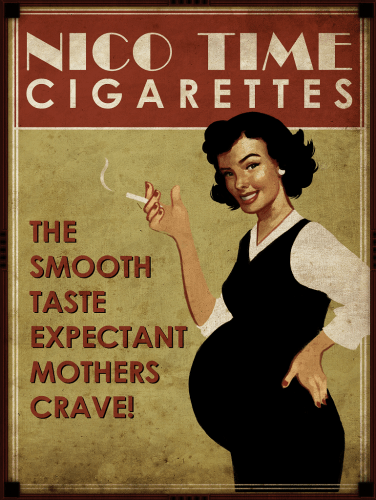
Smoking: Given that lung cancer and emphysema rates are currently declining, you are once again permitted to smoke in all indoor spaces. Yes, we do expect that this will cause lung cancer and emphysema rates to rise again, but it’s OK; we have plenty of room in the hospital for these new patients!
We all have to learn to live with smokey air. For most people, the effects of second-hand smoke are mild, and not much worse than a cough caused by the flu. Those worried about long-term effects can consider attaching a HEPA filter to their face. If you are at immediate risk due to severe allergy—stay home!
Drinking and driving: With so many people drinking so much alcohol, our Ride programs are getting overwhelmed, so we have decided to stop checking blood alcohol levels. If you think you’ve been around alcohol, and now feel dizzy, assume you’re drunk, and don’t drive for, let’s say, 30 minutes?
Hard hats, steel-toed boots: Data has shown that these protect workers at construction sites, but they are annoying: so hot! so uncomfortable! So, it’s now your choice what to wear while working. It’s so lovely to see everyone’s bare heads and feet again!
Asbestos in buildings: Some buildings have asbestos leaks; if you breathe in the fibres, you could damage your lungs. If concerned, you might want to avoid going into those buildings.
No, we’re not going to tell you which buildings those are. No, we’re not certainly not going to make any effort to remove the asbestos from those buildings. What are you even talking about?
If you’re worried about breathing in asbestos, just wipe down the tables and wash your hands.
Car seats for infants: Optional.
Babies should be able to assess their own risk
— Hemi Himalayan + Natalie🇨🇦🇺🇦 (@HemiHimalayan) April 15, 2022
So what should they do?
Doing something instead of nothing would be nice. That something does not have to be business or school closures, capacity limits, or restrictions on public gatherings. How about just reversing some of the stupider decisions and actually promoting vaccination again, for a start.
1. If we are to “live with it”, we have to suppress the virus enough to permit life to continue for us all as safely as possible.
2. And we must suppress it until healthcare capacity is increased enough to manage Covid without rationing healthcare for all.
My God, the government was eager to put this 5-day isolation rule in place, even though this Delta-variant data was never true for Omicron. People are at peak infectiousness at 5 to 8 days. The standard must go back to isolating for 10 days when you’re Covid positive. Ideally with people using rapid tests to ensure they’re no longer infectious before they go back out in the world.
Get adults and teens fully vaccinated
Two vaccination doses are much better than one or none, but this is a three-dose vaccine. But the messaging around the third dose has been so muddled that third dose rates have stagnated at about 50% in Canada, even in light of evidence that two doses no longer protects as well against hospitalization.
The Federal government could help here by changing the terminology. Stop calling that third dose a “booster”, which definitely makes it sound “optional”. Redefine “fully vaccinated” to mean three doses. And extending everything for which you need vaccination proof (travel, federal jobs) to now mean three doses.
Get children vaccinated
Children are also very under-vaccinated, many vaccinated parents apparently having concluded that vaccine isn’t necessary, since they keep hearing that Covid isn’t very dangerous for kids. When in fact it’s children under 4 who are the most hospitalized age group for Covid, after those over 70. And children can also get Long Covid, which vaccinations reduce the likelihood of.
Only 39% of Ontario kids aged 5-11 are double vaccinated. 0% of Ontario kids under 5 are vaccinated. How can we say we are "done" with #COVID19 when the majority of our youngest Ontarians aren't even protected yet?https://t.co/8FCPUXYv9o
Two-way masking works better than one-way. If you’re the only one masked for a longer period in a poorly ventilated space with Covid-positive people, the virus might very well through. I’m not saying masks need to be mandatory “forever”, but they are needed at times of high transmission, like now.
And masks don’t stop you from doing anything. You’ve always been exempt from wearing them when you want to eat, drink, or exercise in public. What’s the big deal about wearing them to shop, go to a concert, or ride transit. And I would note that not doing so, at least in essential places, is a human rights violation:
there are like 3 places that I am begging y’all to continue to require masks and they are planes, trains, and any places people literally have no choice but to be in (doctors office, DMV, etc.) high risk people have been asking for crumbs for two years and yet pic.twitter.com/XFRahKHXwn
My suggestion: Get this decision out of the hands out the hands of politicians and give it to a more independent authority (which politicians can then hide behind, the bunch of cowards). Here, that could be Ontario Public Health and the Ontario Science Table (which is now part of OPH), who have clearly stated that lifting the mask mandate made this wave bigger than it needed to be, and that it should be brought back.
1/n PHO has a new risk assessment on the spread of the current BA. 2 wave.
Among other things it says:
– The wave is associated with lifting mask mandates – We're likely to see ++ serious illness in children – Reintroducing masking would be an effective + practical intervention pic.twitter.com/175J0uMVEG
OK, masks, needles, and being all alone when sick are not fun. Those tactics won’t be needed forever (hopefully!).
But some changes we could make because of Covid should stay around for good, because they are nice things that would permanently benefit everyone.
Paid sick days for all. And a reasonable number of them too, like 10. Who wants to catch colds, flus, or any disease from their coworkers? Which companies want to have a bunch of people off sick when they could stop it at one person? (And frankly, even if a coworker has something non-communicable, I don’t want them at work suffering. The moaning sounds are very distracting!)
Cleaner indoor air. Outdoors is great, and very Covid-safe, but we are an indoor species. Having cleaner indoor air—everywhere—not only reduces transmission of all airborne diseases, but also reduces headache, fatigue, nausea, skin irritation… It’s just generally better for our health. And our productivity! We be so much better worker bees with more air exchanges per hour, breathing in fewer air pollutants.
Restructure the healthcare system. The Globe did a big story on this recently that is difficult to summarize in a bullet point. But it’s not about more money; it’s really about spending the money better by integrating all aspects of health into one system instead of funding only doctors and hospitals. This is exactly what the 300,000 or so Canadians with Long Covid need—but it’s also what we all need, to treat every ailment!
Longer Christmas break. Happens every year, previously with flu and now with Covid: Families gather at Christmas, infect each other, then all go back to work and school and pass it on further. Reduce that risk by making that a longer school break for kids, with the time made up by extending the school year. Wouldn’t that also help reduce learning loss from the long summer break? More people would surely take more vacation time at Christmas, too, further reducing spread in workplaces. (While at it, how about: More vacation days for all.)













 Cultureguru's Weblog