A tour of downtown Kitchener restaurants

Since we go to the Electric “Thursdays” series of concerts with friends, we typically go out for dinner first. This year, for whatever reason, each meal has been at a downtown Kitchener restaurant we’ve never been to before. Here’s how they were.

Niko Niko Roll & Sushi, at 20 King Street East, blessedly was not an “all you can eat” type, and did have pretty good sushi. One in our party had the Korean bim bap dish instead (vegetarian version), and also enjoyed that. The lack of wine was a bit disappointing; we tried the saki, but it wasn’t one of the better ones. The service was fine, if unspectacular. And they certainly got us out of there in plenty of time for the show. In fact, we even had time to get some wine from Centre in the Square…

271 West Restaurant, which is in fact at 271 King Street West in Kitchener,  has kind of an Italian-focused menu, and brags of everything being made in-house. They also have a wine list, although not a good understanding of Ontario liquor laws: The waiter insisted (pretty adamantly) that we were not allowed to take a leftover bottle of wine with us. He’s wrong about that—here’s the proof—and as a result lost out on the sale of a bottle of a wine (in favor of two glasses).

The food was all right here, but nothing outstanding. But again, they at least did get us out in time.

Caesaria, at 320 King Street West, was selected based on its online menu, and at least some of us were surprised by its bar-like appearance. Our waitress was young, perky, and pretty, but not that well-informed about the menu. We heard “I’ll have to check on that!” quite a bit. But, to be fair, she did.

The meal timing was rather odd, in that our mains arrived very shortly after our starters, so we ended up with this overflow of food on our rather small table. The upside of it was that, at least, ensured that we once again were done in time for the show. The food here, too, was all right, but not outstanding. (Jean and I shared the edamame and hummus appetizers, and I had the chicken skewer main, while Jean had the squash ravioli.)

The final downtown Kitchener restaurant we tried, Marisol, at 30 Ontario Street South, was just me and Jean, before the KW Symphony’s wonderful Tap! pops concert (featuring dance music, complete with dancers). And it was… A really nice experience.

Marisol outside
From their website: Marisol sign

The room is nice-looking and mellow, and as a change from the all the other places described, the waiter was very professional and skilled. He gave great wine suggestions and was clearly knowledgeable about all items on the menu.

The chef here once worked at Langdon Hall, and the menu is Mediterranean, with a lot of seafood items on offer. I started with the grilled calamari, which had a good texture and was in a really good sauce, while Jean enjoyed the grilled sardines in tomato caponata. If sardines can never live up to those we ate in Portugal, they were still well-prepared, and the tomato sauce very flavorful.

As a main, I had the lemon ricotta gnochi with tomato and pine nuts, and that was very nicely done. Jean had the fish special of the day, which was sea bream. We didn’t take the time for dessert on this outing, but if we had, I believe they still would have gotten us out in time for the show. Now, Marisol is more expensive than any of the other places we tried. But you do get what you pay for sometimes, eh?

So the do-overs would be Niko Niko Sushi & Roll and (especially) Marisol. The other two were experiences that were not unpleasant, but don’t particularly need repeating.

Cameron Carpenter: Organ superstar

I got tickets for this concert on a bit of whim, and then had trouble finding anyone to go with; seems a busy time of year for work, travel, work travel, and other. But though I could have exchanged for another, I had ended up intrigued by this guy, Cameron Carpenter.

He looks like a rock star. He’s young, good-looking, fit, has a mohawk, dresses in sparkly / paisly tights pants and shirts, and wear outlandish, heeled shoes.

Cameron Carpenter

And he plays classical music. On the organ.

Naturally, he doesn’t approach it in a traditional way. Notably, he prefers digital organs to traditional pipe organs. And he improvises on the classics. And composes his own arrangements, and entire concertos.

Saturday night’s KW Symphony concert gave us a taste of what this guy can do. I went to the Prelude before the concert (which I don’t always bother with) because it was a conversation between Carpenter and a musicologist. He’s a really interesting guy, and I learned a lot about organ (not that I knew much to start with), including the fact that every organ in the world is different, And not subtly different—so different that the extremes might as well be different instruments. And since organists do not travel with their own instruments, they have to arrive early and get acquainted with the particularities of whatever they will be given to play in that town.

I also found out that, somewhat to my disappointment, that Carpenter was only playing on two of the numbers in the program.

The first half was all Bach. The first was a short piece, Ricercare No 2, arranged by Anton Webern. The third was the longer Suite No 3 in D major, whose second movement is very well-known (I think I play it on the piano), but which ends with lively movements with dance rhythms.

Those were both nice. But there’s no doubt they were overshadowed by the middle bit, of Cameron Carpenter riffing on Bach’s most famous composition, Toccata and Fugue in B minor. My sixth row center seats couldn’t have been better for watching hands, and my goodness, could those move. And did you know organists also have a keyboard for their feet? The whole thing was just mesmerizing.


(A taste from YouTube, though I think what he did Saturday was even better.)

In the second half, we jumped from the 1700s to current-day. First up was just the symphony on Arron Copland’s five-movement Music for the Theatre. This was a very fun, jazz-inspired composition, with humorous bits to it.

And then Cameron Carpenter presented his composition for organ and symphony, The Scandal. Based on what he’d done in the first half, I thought this would be all about the symphony adding colour around his own demonstration of proficiency, but it wasn’t that at all. It was a true integration of organ and symphony in a beautiful and lively piece of music. The cello got a big solo moment, and until maybe the last three minutes, the organ wasn’t necessarily the major focus. I was impressed.

So was the audience, as the standing ovation felt more sincere than it sometimes does. And in an extreme rarity at classical music concerts, we got encores! I don’t know what the first was (I’m not that good at classical music edition), but the second was a wonky but awesome version of Oh Canada! Not bad for an American who now lives in Germany.

Busy week

Some weeks are quiet, and others, you have something on every night. This past week was the latter.

Monday night we were out for ballroom dance practice, and there isn’t much more to say about that.

Brain on Fire coverTuesday night I had book club meeting (and Jean braved the grocery store all by hisself!), to discuss Brain on Fire: My Month of Madness by Susannah Cahalan. It was definitely a quick and interesting read, an account of  how a 24-year-old suddenly gradually became more psychotic, to the point of spending a month in such a state of delirium that, to this day, she cannot remember that time. Yet most testing showed nothing wrong with her; a medical mystery. To write the book, she had to rely on eye witness accounts by her family, friends, and boyfriend, along with medical records and some hospital video footage.

So it made for some good discussion. Two of us had only the eBook version, and we both reacted the same way to seeing the physical hardcover: Picking it up in fascination at its surprising “heft” in “real life”. “I feel like I’ve brought in an ancient artifact,” friend-with-actual-book remarked.

Wednesday night we were off to see Jeans’n’Classics / KW Symphony rendition of “The Music of Annie Lennox”. But before that, we went out for dinner to Niko Niko Roll & Sushi. The level of service was a little weak, and the lack of a wine list a bit disappointing, but the food was pretty good. Not quite up to Watami Sushi level, but better than most “all you can eat” places. And, for the first time I can recall, we were actually at Centre in the Square a full half hour before concert start! That speed of service was much appreciated.

(I was told my speed of walking may have contributed, too. It was chilly out!)

The concert itself was very enjoyable. They had six different female singers covering the various Eurythmics and Annie Lennox solo songs, so you got to hear them interpreted through a variety of voices and singing styles. They all wore dresses in the first half, and men’s wear in the second, in tribute to Annie Lennox’s own range of fashion.

Thursday, we had a Jean work event at the Culinary Studio, to celebrate some achievements (that this isn’t the place to describe). Children and spouses were welcome to join. What we did was move from workstation to workstation, preparing a different appetizer at each: soup, spanakopita, crepes, spring rolls, and bruschetta. (The kids made chocolate chip cookies.) It was a lot of fun—and I’ve learned I’ve been chopping vegetables incorrectly for 25 years. (Gonna be a hard habit to break.)

Spring rolls
We learned how to make spring rolls much like these

Then, we all ate what we had made. It was surprising how filling a small number of appetizers (and cookies) can be!

Friday we stayed home and watched a movie called Secret Things. There will be a separate post on that.

And Saturday we were out for a very special dinner, which will also merit its own post.


Bollywood and Beyond

Last Thursday we braved the pre-storm (really, no big deal) to go out for dinner and a concert. The dinner plan had been to check out Imbibe, on The Museum premises. Only, they didn’t seem terribly interested in serving us. It was a while before anyone even told us we could sit anywhere, and as the minutes ticked by with no one offering drinks or a menu, we left. (I’m not sure they noticed.)

Fortunately, the reliable Peter Martin’s was across the street. We discovered that they seemed to have largely abandoned their “cheaper bistro” idea, going back to the pricier appetizer and entree approach. Everything very good, though. We shared mussels in cream sauce with smoked bacon to start, then I had the pork belly with excellent greens and sweet potato sides, while Jean enjoyed the lamb with side of gnochi.

Then, off to our Intersections concert across the street. This one focused on Indian music, and befitting that, some members of the orchestra—including conductor Edwin Outwater—were in Indian garb.

Bollywood image
Not how members of the symphony were dressed, but a cool pic nonetheless

The guest performers did not play sitars. Highlighted on the first few pieces was the mrdangam, which is a type of drum. One side of it plays bass notes, the other higher-pitched rhythms. The performer, Trichy Sankaran, could play incredibly quickly.

He was joined by his daughter, Suba Sankaran, who clapped out rhythms during the instrumental numbers, but then also took over on vocals. One piece she presented was an reinterpretation of Leonard Cohen’s “Bird on a Wire”. As befitting the title of this section, she did also present some songs from Bollywood movies, although with a twist: She sang lyrics from the somewhat humorous English translation, rather than the original Hindi. (No actual dancing, but we did some movie footage in the background.)

During a lovely piece called “Maya” it occurred to me that many of us had been trained in the sounds of Indian music by the British rock stars of the sixties: The Kinks with “See my Friends”, and of course, The Beatles. Fittingly, the last piece of the evening was a great version of George Harrison’s “Within You, Without You” from Sgt. Pepper.

The concert, performed without intermission, seemed to be over in a flash. Indeed, it was just about an hour long. Just enough to whet our palate.

A Barenaked Christmas

My rather excellent run of live concerts this year was capped off with The Barenaked Ladies, performing “Hits and Holiday Songs” with the KW Symphony, at Centre in the Square last Sunday.

Barenaked for the Holidays

Jean was a bit puzzled at my interest in this one, as I don’t exactly idolize this band. But I had been thinking for a while that I wouldn’t mind seeing them in concert. I definitely like the albums and songs of theirs that I have (which is probably only the obvious ones), and I figured their humorous approach to performance would make their live show fun. So when a local concert was announced, I didn’t wait long to get tickets.

Continue reading “A Barenaked Christmas”

Beethoven, Mahler, Penelope, and The Beatles

Playing a bit of catch-up here, on the eclectic mix of KW Symphony concerts we’ve seen this fall and winter…

It began in September with the season opener. The first half were two fairly fabulous modern classical pieces, both by local composers, Stewart Goodyear’s Count Up and John Estacio’s Brio: Toccata and Fantasy for Orchestra. The second half was somewhat more familiar: Beethoven’s Symphony in D minor: The Ode to Joy. It’s a bit funny in that it features a mass choir (four choirs, combined) and four soloists, but for most of the performance time, they are just sitting there. They only start singing in the later movements.

But what a gorgeous piece that is. I’m always worried I’ll get a bit bored during the slow bits of classical pieces, but that didn’t happen here. Too beautiful, too moving. Then afterward, we attended the opening gala, which offered a live band (not classical), dancing, hors d’oeuvres, drinks, and an auction. It was a fun evening.

In October, we saw Penelope, by Sarah Kirland Snider (who was in attendance), which was part of the Intersections series. It was a “song cycle”, in which a woman’s husband returns from the war after many years, not remembering his previous life. The performance is his wife’s reaction to this and attempts to restore his memory, partly through reading Homer’s Odyssey to him.

Haunting is probably the best descriptor of this one. It wasn’t quite like anything I’ve heard before. It was written for and performed by Shara Worden, who has a gorgeous but unusual, almost unearthly, quality to her voice. Think I’d like to get the recording, though it would be the kind of thing you’d want to just listen to and through on its own, and not on shuffle mode with other things.

(I found this video while researching this, and really got drawn into watching it all, though it’s seven minutes long…) After the song cycle, Shara Worden performed some of her own songs, which were quirky and somewhat lighter, even featuring audience participation.

Then earlier this month, Edwin Outwater presented the work he’d listened to a lot as a (clearly very unusual) teenager, Gustav Mahler’s Symphony No 5. The piece is over an hour long and requires more musicians than KW Symphony has, so they were joined by about 40 additional musicians. In the first half, after with Schubert’s brief Entr’acte No. 3 from Rosamunde, Outwater explained what was going on the various parts of the Mahler symphony, with excerpts, then in the second half, they played it all. Though I’d had kind of a day at work, I couldn’t help but be drawn in by the gorgeous music rather than brooding on that.

He’s right that it’s an amazing work. Still can’t imagine myself having listened to it as a teenager, though.

Revolver cover artFinally, the first Jeans’n’Classics concert led off this month with something I did listen to as a teenager: The Beatles: Rubber Soul and Revolver. Jean calls me a snob for this, but I still protest that following the old US releases of these albums rather than the more definitive UK / CD versions was a weird Boomer thing to do, particularly as it meant the omission of songs like “Love You to” (my favorite of the three Harrison songs on Revolver) and “And Your Bird Can Sing”. And the even more brilliant songs “Drive My Car” and “Nowhere Man” are only recent additions, tacked on at the end of Rubber Soul’s odd US play order.

But then again… Maybe has does have a point that it’s just a quibble, because it was a really good concert. The Beatles music is very suited to the symphonic treatment, and Peter Brennan clearly loves them and does cool, original things with the arrangements, such as intermixing “Within You Without You” (from Sgt. Pepper) into Octopus’s Garden.

The two lead singers, David Blamires and Neil Donnell, both have exquisite voices, and their weaker stage presence was made up for by having personable keyboardist John Regan lead us through the set. We also got Don Paulton on keyboards, in a rare double-shot on the ivories. And one has to mention that apart from singing well, as always, Kathryn Rose looked particularly fetching. She seems to be one of those women who just get more attractive as they get older.

The set list, of course, featured three of my all-time favorite Beatles songs, “Norwegian Wood” (which led to a night-long debate as to just what John Lennon was setting fire to there), “In My Life”, “Girl” (so sensual), and “For No One” (a most devastating breakup song). But those two albums are just strong in general, so there wasn’t much dross. The very odd “Tomorrow Never Knows” was suitably trippy ending to the evening.

The trifecta: Big bands, a night at the opera, and war horse

trifecta, n. (traɪˈfɛktə)

Any achievement involving three successful outcomes

Our self-created “culture weekend” began Friday night with the KW Symphony’s salute to big band music, featuring In the Mood, Take the A Train, It Don’t Mean a Thing (If It Ain’t Got That Swing), Come On-A My House, As Times Goes by… Songs like that. Songs that swing.

Guest conductor Matt Catingub, who’s from Hawaii, brought along some guest saxophonists, guitar and bass, and drummer. He himself at various time played sax, sang, and played piano. The symphony were able to keep up with the challenging arrangements—ones that taxed the horn section in particular.

It was a very fun night out. The only thing that would have made it better was if the Centre in the Square had a dance floor we could have used. This music was made for dancing, not sitting.

A Night at the Opera cover

Saturday we made our way to Toronto for Classic Albums Live: Queen—A Night at the Opera. This was our second time seeing a Classic Albums Live presentation, and we were both a little dubious about it, having been underwhelmed by the first. But I just couldn’t resist seeing how they would possibly tackle this very challenging album, “cut for cut, note for note”.

As the liner notes for the show said, “with Queen, the key word was more. More singers. More guitars. More sound.”

So to handle Brian May’s multi-layered guitar sound, they had six guitarists (one of whom focused on the acoustic and the koto). Lead vocal duties were handled by three different singers: one for Freddie’s higher vocal parts (that was a woman), another for his lower range, and one more singer to present Brian and Roger’s vocal leads. And another singer (another woman) who did lead backup.

That not being enough, there was also a full choir. (“We had all of Toronto up here on stage”, the announcer said.) Somehow, though, they did manage with just one each of drums, bass, and piano.

Classic albums live for Queen

“It takes a village” to perform Queen music. (And this doesn’t even include the choir.)

It was really an awesome show. Why did it work so much better than The Beatles one, which felt a bit pointless and lifeless to me?

  • You can’t suck the life and fun out of Queen sings by playing them as recorded, because fun is built into the songs. Doing this whole album meant singing a passionate love song to a car, doing an entire musical break on kazoos, and embracing lyrics like “You call me sweet like I’m some kind of cheese” and “Thursdays I go waltzing to the zoo”.
  • By playing live what were purely studio effects (just four musicians and three singers, massively overdubbed), you aren’t reproducing what was on the record. You are re-creating it. And as an audience, we are hearing it in a new way, for the first time.
  • Queen were show-offs, and the musicians managing to pull off all those notes, and guitar chords, and that crazy intricate timing, was truly impressive. We were in the second row, and you could almost see them sweating blood trying to get everything in at the right time, in right pitch. The announcer said it was the most difficult one they’d ever tackled, and I believe it.

I’m in Love with My Car performance (video)

The second half featured more Queen songs, some quite well known (We Will Rock You, We Are the Champions, Under Pressure, Bicycle Race—complete with bike bells, Somebody to Love), and some not as much (Brighton Rock, Keep Yourself Alive, Get Down Make Love). The show seemed to go by in a flash.

Brighton Rock performance (video)

warhorse

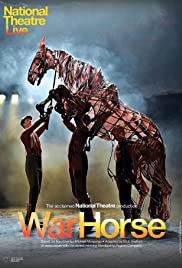
And on Sunday, still in Toronto, we saw the Mirvish production of War Horse, which really deserves all the praise it has received.

The puppetry used for the horses (and a goose!) is just incredible. Despite seeing people legs and bodies beneath and around the horses, they really seem very horsey, and you gradually don’t even really notice the puppeteers.

The story, of course, is not a totally cheery one, as nothing about the First World War is cheery. It’s interesting, though, how Joey’s encounters with British, Germans, and French in turn shows all in an ultimately sympathetic light. The plot is very well constructed and emotionally compelling.

Toronto Star review: War Horse is bold, brave and heart-stoppingly wonderful

That’s about right.

Toronto building

Photo taken on our walk over to see War Horse

Symphonic prog rock

Last night’s Intersections concert by the KW Symphony was called Prog Rock. But this was not symphonic versions of rock songs, per se. It was symphonic music that either inspired, or was inspired by, heavy rock. For example, there was a composition by Matthew Hinson called, I kid you not, “Homage to Metallica”. It contained not a lick of Metallica music, but definitely had the Metallica spirit.

There was also Grieg’s In the Hall of the Mountain King, which has been covered by tons of rock bands, including The Who. And Anton Mosolov’s Iron Foundry, which was inspired by actual heavy (industrial) metal. And a more modern piece by Paul Stanhope called Throbbing, evoking the sound of a police car chase around the neighborhood.

All of this loud, heavy music was a challenge. (Definitely the first time I was handed ear plugs at a symphony concert—though I didn’t find I needed them.) In fact, Edwin Outwater included a couple lyrical Satie Gymnopédie numbers as interludes. “This concert,” he said, “needs a palate cleanser”.

The grande finale of the evening was a piece by Nicole Lizée commissioned for the KW Symphony: 2012: Concerto for Power Trio. This one was inspired by, and did include bits of, Rush music, but elaborated upon, distorted, sped up… Like hallucinogenic Rush, Lizée (who was there) said. It included the classic Rush music trio of guitar, bass, and drums.

It was my favorite piece of the evening. And Jean’s least.

I guess Rush is always polarizing.

————————————-

Also, some interesting material about the last Intersections concert, Quantum: Music at the Frontier of Science.  First, Paul Wells, from Macleans Magazine, has written an article about it, and the positive response to it from the people of KW (two sold-out shows).

And you can sample of it yourself, from YouTube. Excerpts from the show:


And a documentary about the making of the show:

Music as weirdly beautiful as the universe itself

Kitchener Waterloo Symphony’s performance of “Quantum: Music at the Frontier of Science” began with a warning from conductor Edwin Outwater:

Some of the music we’re about to play may drive you nuts. You may not like it.

But that’s OK.

Part of the Intersections series, this concert was meant to explore how the work being done in theoretical physics influenced classical music. It was a collaboration with KW’s Institute for Quantum Computing. It featured a narrative and some visuals giving a brief history of physics, particularly the quantum part, with additions from Outwater explaining how these had influenced the piece we were about to hear. Raymond Laflamme, Director of the Institute for Quantum Computing, also participated.

Quantum Mechanics scoreWe were eased into the whole thing with Newtonian physics, solid and elegant, as represented by the first movement of Mozart’s Symphony No. 29 in A major. Then, it was explained, delving into the realm of quantum mechanics seemed to put all that in doubt. We had particles that could be both here, and there. Elements that didn’t behave in a mathematically cohesive way. Physics theories that no longer aligned.
This uncertainty affected the artists of the times. As an example, we heard an early piece by Anton Webern, excerpt from Langsamer Satz, which was very grand and beautiful in a Wagerian way. Then a later one, in which he starts to explore dissonance—Ruhig schreitend. You wouldn’t guess it was the same composer.

More directly exploring this opposition was Charles Ives’ The Unanswered Question, in which most of the orchestra plays a beautiful melody, but it is interrupted by a trumpe, moved to the back balcony, asking questions that the woodwinds, from the side balcony, then try, but fail, to answer. It was a great piece to listen to, really; I’d like to get a recorded version of that one.

After the break we were introduced to a piece by Henry Brant, On the Nature of Things (after Lucretius). The theme at this point was composers coming to terms with, and indeed embracing, the weirdness of quantum physics. Brant’s contribution was to add another dimension to orchestral interpretation: geographic space. He was very concerned with where the musicians were located in the room. So the piece had some of the symphony in their usual locations on the stage, others were placed above, beside, and behind us.

And it does make a difference, hearing the music in “surround sound”.

Up next was a John Cage piece called the Atlas eclipticalis, which was inspired by the cosmos itself. He created the score by superimposing musical staves over the star-charts in an atlas. Brightness of the stars was translated into the size of the notes in the composition.

Finally, we came to Iannis Xenakis, who was both a scientist and a musician. He would start with mathematical equations, and convert these into stanzas. And he would assemble his pieces with the aid of a Fortran computer, lending the final result a little randomness. The resulting piece, called ST/48-1,240162—did have repeating musical themes, but they didn’t move around the symphony in the expected, “classical” way. It did have sort of computer, sci-fi feel to it. Though it went on for 11 minutes, it was not unpleasant to listen to.

So despite the warnings, it was actually a very enjoyable evening at the symphony, one that worked the brain cells in a new way.

Classical Mystery Tour

When asked who they’d like to go back in time to see in concert, a lot of people say, “The Beatles”. Which would be such a wasted opportunity to break the laws of physics!

The Beatles were a great band, obviously, but live? Pick The Who, The Stones, or Hendrix instead. Or even The Kinks. Heck, pick Paul McCartney and Wings! Any of those would be so much better than the mass hysteria and constant high-pitched screaming that was a Beatles concert. You’d barely be able to see and certainly couldn’t hear the band. They couldn’t even hear themselves. There is a reason they stopped touring.

Beatles on Ed Sullivan

And so, The Beatles leave a legacy of great albums that they never performed live, or performed only poorly. A great big, blank canvas into which many a tribute act has followed.

As a teenager, I saw Beatlemania in Toronto, a tribute that mixed film with live music to cover the history of the Beatles. And in Timmins, I saw another, more straight-up Beatles tribute band, just playing a concert at a hockey arena. More recently, one of the best Jeans’n’Classics concerts I’ve ever seen was based around the Beatles Abbey Road album, featuring Rik Emmett and Alan Frewe, among others. Las Vegas’ Beatles Love show, by Cirque du Soleil, was both touching and astounding. Less successful was Classic Albums Live tribute to Sgt. Pepper, as the efforts at reproducing the album so exactly seem to take all the life out of the live performance.

So I was a little worried about Classical Mystery Tour, as the pre-show interviews emphasized how they went back to the original albums and tried to re-create the symphonic score. I also wasn’t too sure what to think when I saw the odd stage setup, with the symphony fairly far back on the stage, behind sound barriers.

But from the opening notes of “Got to Get You into My Life”, the cast quickly put my fears to rest. They were interactive, relaxed, somewhat improvisational—all around very entertaining. They did provide a reasonable simulation of what might have happened had the actual Beatles ever been able to play their songs live with a symphony, and without all the squealing.

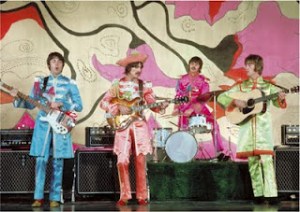
They came out initially garbed in Ed Sullivan Show-style suits, then during “Yesterday”, everyone but “Paul” left the stage, and came back in Sgt. Pepper gear. (“Paul” caught up with them partway through the next number.) Highlights of the first half included hearing the amazing Larry Larson on the “Penny Lane” trumpet solo; “A Little Help from my Friends” as sung by their drummer, a much better vocalist than Ringo; and a searing performance of my favorite Beatles song, “A Day in the Life”, which closed out the first half.

Beatles in Pepper gear

It was a pretty good turnout for the show, but it seemed to me that the crowd was a bit subdued—at least those in front and beside me. Who were probably mostly symphony subscribers first, Beatles fans second.

Nevertheless, everyone really seemed to get into it during the second, with “Ob-La-Di, Ob-La-Da” turning into a major clap-along, singalong, fun-fest that mostly continued into “Yellow Submarine”. Since I’ve been reporting on clothes, I’ll say that this half featured the hippie Beatles look, complete with John’s white suit, long hair, and mustaches.

They also broke out of the strictly Beatles format and gave us “Live and Let Die”, one of the numbers that best took advantage of the symphonic power available. For fairness, we also got “Imagine”. We weren’t sure if there would be encores at this type of show, but there were 2 or 3, actually. The first was “Hey Jude” (after a bit of a humorous false start, as “George” struggled to get guitar plugged in, prompting a do-over: At least we know it was all live), which of course become another singalong, men vs. women at one point. (“Paul” declared the women had it.)

Then we had just the band on “Twist and Shout”, for which the audience stayed on their feet dancing, and “whoo-ing” along at all the appropriate times. And “Can’t Buy Me Love” to close out the show.

Definitely one of the most fun symphony concerts I’ve ever been to.

——————–

Our programs didn’t include the set list, so the first half is approximate, based on what I recalled at intermission. The second half, I actually wrote down as we went.

Part I

  1. KW Symphony – Beatles medley, including “Lucy in the Sky with Diamonds”
  2. Got to Get You Into My Life
  3. I Saw Her Standing There
  4. A Hard Day’s Night
  5. Yesterday
  6. All You Need Is Love
  7. Eleanor Rigby
  8. Penny Lane
  9. Here Comes the Sun
  10. Sgt Pepper’s Lonely Hearts Club Band / A Little Help from My Friends
  11. A Day in the Life

Part II

  1. Magical Mystery Tour
  2. I Am the Walrus
  3. Ob-La-Di, Ob-La-Da
  4. Yellow Submarine
  5. Come Together
  6. Dear Prudence
  7. The Long and Winding Road
  8. Live and Let Die
  9. Imagine
  10. Golden Slumbers / Carry That Weight

Encores

  1. Hey, Jude
  2. Twist’n’Shout
  3. Can’t Buy Me Love