Ontario election or voter suppression

Well, I voted, and it was really easy. Just needed some basic ID and some time to wait in the line I was, I admit, rather surprised to have encountered. Nobody tried to intimidate me or influence my vote. I went on just one of the several days that voting was possible. I didn’t have to register in advance. My vote was private. I saw it go into the machine and be counted.

And yet…

Holding a snap election in February in Ontario seems very much designed to ensure low voter turnout.

  • Weather: February’s always kind of miserable, but this year the province has been hammered with record amounts of snow. Some people literally cannot get out of their homes to vote, because they need clear sidewalks, and those are hard to come by. It’s also tough to get campaign signs in snow-covered lawns, or volunteers willing to stay out very long knocking on doors.
  • Condensed time frame: The election was announced one day, started the next day, and runs for only four weeks. It’s very little time to even let people know it’s happening, let alone any campaigns to gain steam and make an impression. No party started with a full slate of candidates! A lot of people won’t receive voter cards in time. (They can vote without it, but not everyone knows that. Or even realizes an election is happening.) Those who want to vote by mail are hard-pressed to get that completed by deadline.
  • There’s a lot else going on. The US keeps talking about annexing our country, along with doing various appalling things daily. The Federal Liberal party is having a leadership race, the winner of which will be Prime Minister. Shortly afterward, a general federal election is expected. Lots of competition for Ontario politicians trying to let people even know there is a provincial election, let alone who all the leaders, candidates, and positions are.

There’s nothing illegal about all this; but it kind of feels like it should be? Because this is not truly a free and fair election. Especially if you consider:

  • The governing Conservatives have been found to have inappropriate used taxpayer money to advertise themselves, before the election, and party money to advertise the Premier’s trip to Washington, which is also not allowed. The penalty? Bupkus! More votes for them, even though they’ve cheated!
  • The Conservatives have told their candidates to not attend any local debates, something they have followed, with few exceptions.
  • The Conservatives have not bothered to release a platform. (Today they did release one…)
  • Conservative leader Doug Ford has mostly avoided the media.

So the governing party, the one with by far and away the most funds, is doing its level best to ensure that voters are uninformed about anything.

They clearly hope that hardly any people will vote, since low voter turnout tends to favor incumbents and conservative parties. And polls have consistently shown them to be in majority territory.

Do the Conservatives deserve re-election?

I would argue no—and not only because of their “keep the voters ignorant” campaign style. Fortunately, I don’t have to personally write up all the reasons why, as many others have. One of my favourite examples is Please: Anyone but Doug Ford by Justin Ling. A few excerpts:

His years in office have been defined by shortages — a lack of homes, doctors, teachers, jobs, skilled workers, subways, buses, and bike lanes. Worse yet, his plan for a third term is ambitious only in its plan to build a massive new white elephant.

Let’s start with housing, inarguably the priority for any incoming government. But, somehow, Ford remains indifferent. Ontario is, in the full swing of a housing crisis, breaking ground on fewer units of new housing today than it was in 2012. It’s a stunning failure.

There are few problems in Ontario which don’t flow out of this acute housing shortage. Tent encampments, rising crime, the opioid crisis, sluggish growth, a stagnant culture, and declining productivity: All things that could be ameliorated by cheaper, abundant housing. 

Ford is addicted to giving private companies public money, often for no benefit to the province.

He has had nearly seven years to fix the province, and he hasn’t. What is he proposing for the next four years?

Ford’s healthcare plan is absolutely anemic, little more than a vague hand-wave at the crisis. If he has actual new plans to boost housing construction, he’s certainly been holding out on us. Does he have a real plan to improve education, reduce homelessness, hire more doctors, provide care for people struggling with addiction, or get real economic growth started again? No.

What Doug Ford has is a big dumb tunnel.

The opposition problem

If not Doug’s PCs, then who? And therein lies the problem. Both Liberals and NDP have new leaders that aren’t well known. Neither has managed to bust out a fantastic campaign to make them the clear alternative. The Green Party has a appealing leader and great platform, but are strong only in a limited number of ridings. The voter who wants “not Conservative” has to do the frustrating dance of whom exactly to pick instead.

I have voted. I will say it: I voted NDP. I live in a riding with an NDP incumbent who is excellent. I was happy to support her. I was less happy to support some aspects of the NDP platform. Really, you’re going to make the 407 toll-free to “reduce congestion” (which it won’t). Really, that’s your first announcement? And that whole grocery rebate thing? That sounds… complicated.

But as whole, it’s still a better platform than what the PCs have on offer. The party leader, Marit Stiles, is more appealing than Ford. And their Instagram ad today is one of the funniest political ads I’ve seen in some time (here’s hoping they also post on YouTube or somewhere more accessible than Instagram).

And they know the mission: Focus on the ridings they hold, and the ones they might conceivably take away from the Conservatives. From the Conservatives. Not so much from the Liberals or the Greens.

The Liberals haven’t played too much of a factor in my personal consideration, with the Greens having earned my “heart” vote, and the NDP clearly being the smart vote. But being someone who frankly doesn’t really understand political strategy, it’s been interesting periodically dipping into the writings of Evan Scrimshaw, who lives and breathes this stuff.

This one, pointing out that with Conservatives sitting at 45% support in polling (it’s since dipped a bit, not enough), there is no “rearranging of the deck chairs” possible to prevent them winning a majority, was particularly interesting: Ontario: Progressives’ Absurd Focus.

The idea that if you could magically optimize the Liberal and NDP votes, somehow Ford would be defeated is nonsensical. Not every vote who is voting for one or the other is a vote for the other. Not every Liberal trusts the NDP on fiscal policy or some of their more out there social values ideas (remember safety zones around drag bars?), while plenty of New Democrats are union, working class, blue collar voters who oscillate between the NDP to advocate for more health spending and the Conservatives because they’re mad at progressives, wokeness, and the general fact that the world isn’t how it was in 1995. Only 62% of Liberals and New Democrats think the OLP and ONDP should merge into one party, per a Friday Research Co poll. 

….

The unfortunate truth is that if you were to do head to head polling, Ford would easily beat Crombie’s Liberals, Stiles’ NDP, or some merged entity. He is what Ontario wants. The reason he’s what Ontario wants is in large part because the Opposition have not been good enough.

If there was some option of a merger or a deal, the Greens would also be a big impediment to it working. Green voters aren’t idiots who think the Greens can win, they’re about building slowly and adding to the conversation through presence and generally not making the compromises that the NDP and especially the Liberals make. It’s a party that is on some level about being anti-Liberal and anti-NDP more than it is about the environment or ecology or whatever else. It’s a statement of principles, and about one’s self. 

What both parties of the left have failed to do is create a coherent narrative for why they need to be elected. The real problem for Ontario progressives isn’t how the opposition splits their votes, it’s the fact that 45% of Ontario is about to vote for Ford, and any person or any organization focused on anything other than driving that down isn’t helping.

Vote anyway

The weather forecast has improved this week. The NDP still looks perky. The Greens are are encouraging you to not feel bad about voting for some other party if you don’t live in one of their favored ridings. The Liberals… Well, I’m not too sure what’s going on there, but they do have some good candidates.

You can vote any day between now and Thursday. Go here: https://voterinformationservice.elections.on.ca/en/election/search?mode=postalCode, enter your postal code, and it will tell you where and what form of ID to bring.

It’s not really a fair election, but it helps nothing to sit it out. Happy voting.

Ontario election dilemma

Ontario’s having an election in a few, and I’d rather Doug Ford’s Progressive Conservatives not win the most seats. The main reason is that climate change remains our biggest problem, and this party has been and will continue to be terrible on the environmental front. We can’t really afford that for another four years. Not only are they not trying to reduce emissions, they really seem to want to increase them. Their main campaign point is that they more people in more cars on more highways, producing more greenhouse gases on the paved-over wetlands.

But, the PCs also weren’t great on (just off the top of my head):

  • Healthcare—Freezing wages, cutting public health
  • Long-term care—Failing to protect seniors in care (like, seniors died of starvation and neglect, not Covid…)
  • Autism—Cancelling the Liberal autism program because the wait list was too long, and replacing it with nothing but an even longer wait list
  • Opioid addiction—Arbitrarily capping the number of needle exchange centres in the province while overdose deaths soared
  • Open government—Paying lawyers to keep secret information citizens have the right to know, such as ministerial mandate letters and taxpayer-funded reports on municipal amalgamation
  • Municipal government—Cancelling the ranked ballot option (why?), changing the number of Toronto city councillors mid-election (!)

So, clearly I would like people to… well…. do what exactly?

Vote for a member of another party, of course. But that’s the issue: which one? This ain’t a two-party system. And none of the other main alternatives—NDP, Liberal, or Green—are clearly the best choice. At least to me, anyway. But I think to a lot of other people, also.

Which is why we have this split. A chunk who will vote PC, because you always have a minimum 30% or so who will, with the remaining majority of voters dividing up support in such a way that the PCs are well on track to win more seats than anyone. Quite likely a majority of seats overall, which will allow them to govern and do whatever the heck they want.

PCs at 36% vs Liberal at 28%, NDP at 24%, and Green at 5%.

The other parties should combine and stop this from happening

I keep hearing this, even now, from people whom, I guess, don’t really know how our political system works?

The election has started. The ballots are printed. Heck, people have already voted! It’s too late for the Liberals and NDP to collaborate and agree to split the ridings and govern as a coalition—which is not really how our system works anyway…?

In the end, after the vote, if the non-PC parties have, combined, more seats than the PCs, they could look to eventually defeat that government and indeed, offer to govern in some sort of partnership as an alternative to making everyone go to the polls again. But not before the vote.

(Also, you know, you can’t just assume that people who like the Liberals like the NDP second best and vice versa. If those parties were to collaborate ahead of time, it could well annoy loyalists into voting for some other party entirely…)

Strategic voting

Is the other big idea, and is at least is in realm of possibility (unlike the fantasy of an NDP-Liberal coalition forming mid-election campaign). But it’s not as easy as it seems, even despite all the tools and movements to help, such as https://votewell.ca/ and (for Toronto) https://www.notoneseat.ca/

The idea is that you vote for whichever party your riding is most likely to defeat the PC candidate.

The problem is that it’s largely based on polling at the local riding level, which is simply not accurate, mainly because it isn’t done! At least not on any mass scale. Polling is mostly done provincially, and then they try to extrapolate to the local level to estimate how the seat count will work out (considering historical data for that riding, etc.). It gives you an idea, but that’s it. It’s not really solid data.

Squaring my own circle

All I can 100% control is my own vote, so what are the considerations?

Party leader

My favourite for sure is Mike Shreiner of the Green Party. He’s smart, he’s likeable, he’s been a constructive presence in the Legislature the last four years, and in my opinion, he was the best at the Northern Ontario leaders debate (one of the better debates I’ve seen a while, actually).

Steven Del Duca (Liberal) and Andrea Horwath (NDP) also seem smart and reasonably likeable, but do somewhat lack in charisma. Del Duca was somewhat better in the debate, in my opinion, for what that’s worth.

Platform

If you look at my Vote Compass:

Liberal 73%, Green Pasrty 64%, NDP 63%, PC 43%

The Liberals have it.

But, I feel like each of these parties has some promises I really like, some that I’m meh about, and a few I’m not quite on board with but, overall, any one would be an improvement over the PCs.

Local candidate

The only local candidates I know anything about are incumbent Catherine Fife of the NDP, and Shefaza Esmail of the Green Party, whom I talked to briefly on the phone. I’ll have to nerd out and watch a local debate to see how the others are, but Catherine has been a good MPP: smart, engaged, well-spoken. At this point, she certainly seems like the best local option.

In sum

I have my own three-way tie: Green, Liberal, NDP.

If the election were held today…

I’d likely vote NDP, to support Catherine Fife, and because, despite my serious doubts about strategic voting… She still seems like the smart choice if you’re going to consider it at all.

(For what it’s worth, VoteWell has Waterloo pegged as more of a Liberal / NDP battleground, and says you can therefore vote for “the candidate you prefer”. I dunno. Last time the PCs did come in second, but that was also the Great Liberal Collapse election, so… Who knows. Strategic voting is a mug’s game.)

Anyway. Making up my own mind isn’t really the problem.

The problem is how to you chip away at the soft part of the 37% currently planning to vote PC, and try to get them to vote some other way?

… When you can’t even quite tell them what that other way should be…?

I do still love this ad…

The Green Party sign on the lawn

Ontario is in the midst of a provincial election, as evidenced by the lawn signs popping up around town. In our neighbourhood, the PCs were out first, and I’m surrounded by them. The NDP were next; they’re further up the street. Haven’t seen too many Liberal. Then on my way home yesterday, I’m like hey, there’s a Green Party sign.

Then: Wait, that’s on my lawn.

They actually shouldn’t have done that. I get why they thought they could—because at some point in the past year or so, I donated to that party. So few people donate to political parties, I can understand them thinking that, for sure, it must mean that I plan vote Green.

Except that I’m that rare weirdo who will donate to a party just to encourage them, secure in the knowledge that I will get 75% of my donation back at tax time. If donating meant that you could automatically plant signs in my lawn, in some cases, I would have had three or four different parties’ signs on my lawn. But still only one vote.

signs-for-indecisive
Signs of the indecisive

The Greens didn’t ask me if it was OK for them to put a sign on my lawn. So I could by rights call them up and ask them to take it away. Or more simply, just take it out myself put it in my garage.

Having it out there feels like a lie, as though I’m saying I plan to vote for this party, and you should too. When really, the only thing I’m sure of in this election, is that because of Doug Ford, I will not be voting PC, and I wish that others would not, either. But as to whom I or anyone else should vote for instead…? It’s a tough one.

This is a sentiment difficult to express with any lawn sign.


Voting in an Ontario provincial election is very simple: Using a pencil, you put your x beside the name of one candidate from one party (or an independent), and you’re done.

But it’s a fairly complex set of factors you have to consider when deciding where to put that x.

Which party has the best leader?

It’s unfortunate that in our parliamentary voting system, where each party leader is just another elected MPP, that leaders have such focus and importance. But that’s the way it is.

leaders.png
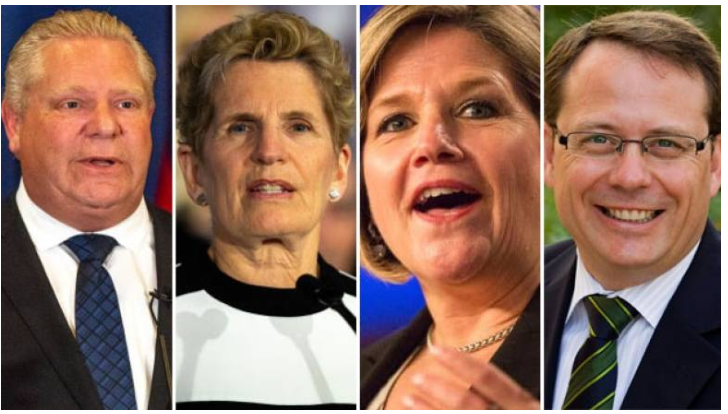
Provincial party leaders Doug Ford (PC), Kathleen Wynne (Liberal), Andrea Horwath (NDP), and Mike Schreiner (Green)

As I’ve said, I don’t think Doug Ford is qualified to be Premier. I don’t want to go on a big rant about it, so I’ll keep it to a little rant. His only political experience is a Toronto city councilor, where he was frequently absent, and always uninterested in learning the details of policy. Which is probably why the PCs are basically running without a platform. All evidence suggests he’d be a terrible Premier. (See: https://www.notdoug.com/)

“Vote for this guy, his worst ideas are so terrible the courts will save us from them and she’s just the worst” isn’t as novel a platform as it used to be and we’re already seeing how it plays out down south, but let’s give it another go up here. What could possibly go wrong?

Doug Ford’s politics of indulgence by Tabatha Southey

But who’s the best other option?

Would you rather vote for the incompetent incumbent, the profligate wildcard, or the fake conservative who refuses to show his work?

— Robyn Urback, being cynical

Honestly, I don’t know. I’m not on the “I hate Kathleen Wynn” train. The woman is impressive. She’s smart and decent and qualified. Here I’m going to quote Christie Blatchford, a conservative I often disagree with:

…it’s why the decision facing Ontario voters on June 7 is so freaking difficult — or rather, she’s why.

Kathleen Wynne is so clearly heads and tails smarter, better informed and more capable than Doug Ford that it borders on the ridiculous.

Smarter, more capable Kathleen Wynne

But, the NDP’s Andrea Horwath is having a good campaign. Last election she came off as angry and aggressive, and it was rather off-putting. (I also thought the NDP platform then was dumb.) This time, she’s sounding much more positive and putting herself across in a reassuring way. These Paul Wells assessment is probably fair:

She has richly earned a reputation for being one of the least exciting politicians in the land. But there is something fascinating in her old-fashioned willingness to answer a question in detail.

Just how far can Andrea Horwath go?

The Green’s Mike Schreiner suffers from being excluded from a lot of debates, so I suspect the average Ontarian knows nothing about him. But I’m again that sort of weirdo who will make the effort, and he also comes off well. Here’s a report from a forum he was allowed to attend [and how much do you love that they also included the None of the Above party?]:

Perhaps neophyte fringe candidate Paul Taylor, representing the None Of The Above Party, summed up Thursday’s night’s all-candidates forum best.

Seating arrangements on stage at the Italian Canadian Club had the affable Taylor sitting to the right of Green Party candidate Mike Schreiner’s, meaning Taylor had to repeatedly address a question after Schreiner’s energetic, precise and crowd-pleasing responses.

“Oh shit. I should have sat down there,” said Taylor motioning further down the table.

Schreiner led the pack at the first local public all-candidates forum. He has been campaigning for months, he is by far the most experienced of the bunch and he is well versed on the issues and his party’s stances on them.

Schreiner shines at first all-candidates forum

If I lived in his Guelph riding, I’d have no doubt about my vote. Or the appropriateness of a Green Party lawn sign.

But I don’t live in Guelph.

Who’s the best local candidate?

Individual MPPs don’t matter as much as I think they should, but that is who we are actually voting for. And in this case, I have an answer to the question: NDP candidate Catherine Fife. She is the current MPP, running for re-election. And she has always been an impressive politician: articulate, well-informed, charismatic. If the NDP did manage to be part of some sort of government, she’d likely be in Cabinet.

catherine-fife.png

I did hear a debate between her and the local Liberal and PC candidates, and the other two sounded good as well. Just not necessarily better than Ms. Fife.

As for the Green candidate, I have yet to catch a debate that includes him, and I know nothing about him. (Except that he puts out lawn signs without asking.)

Who’s most likely to beat the PCs in my riding?

This is the strategic vote angle. If all I’m sure about is that I’d rather not have a PC government under Doug Ford, then I should vote for whoever is most likely to beat that party.

And in this riding, no doubt that means voting for Catherine Fife of the NDP. Despite this not being a traditionally NDP riding, she’s managed to win the last two elections with margins of 7% to 8%. One of those was a by-election, but the other case she managed to win despite it being a fairly disastrous election for the NDP as a whole. This time the NDP  is so far polling much better than last time, making her the horse to bet on with your anti-PC vote.

Who has the best platform?

Oh yeah, that. Which party’s policies do I most agree with?

According to the CBC vote compass poll that I took, that would be… The Green Party of Ontario.

This blog post is already running to novel lengths, so I’ll just touch on three policy areas where the Greens impress.

Deficits

Not always a bad thing for a government to run deficits, but Ontario is in a bit of a precarious financial situation and none of the major parties are being honest about what that implies.

First of all, they are starting with numbers that are likely bogus, according to the Auditor General (see: Bad books: How Ontario’s new hydro accounting could cost taxpayers billions). Nevertheless, the Liberals plan to forge ahead with a number of new drug, dental, childcare, and mental health programs, along with a commitment to high-speed rail which (lovely as it sounds), just isn’t economically viable (see: Kathleen Wynne’s pledge to spend billions on a bullet train makes zero sense).

The NDP would do similarly things, but differently. Like drug plans for everyone, instead of only those of a certain age, but excluding those who have employee coverage. And not committing to high-speed rail. To pay for their commitments, they would increase taxes on the wealthiest and larger corporations, but that wouldn’t make much of a dent in the deficit.

The PCs? Their “plan” involves spending more (in certain areas) and reducing government revenue (lowering various taxes, getting rid of cap and trade). Oh, and they wouldn’t lay anyone off. How will they pay for that? Wave their hands and say, “efficiencies”, apparently. They unsurprisingly haven’t released any costing for this impossible plan. People sort of assume they care about the deficit, but there’s no evidence of it.

The Greens also support spending in new areas, but they at least have some proposals for how to pay for it: congestion taxes, parking levies, tobacco tax increases. “Even with a better range of public services, our projected deficit will be almost one third of the deficit projected by the Financial Accountability Office for the 2018 Ontario Provincial Budget. No other party has accounted for these higher budget deficits.” Source: Green Party platform

Hydro

Ontario’s hydro system has been mismanaged (mostly under Ontario’s previous premier) and a lot of people (not me so much, but) are angry about their higher utility bills. The Liberals, as already noted, are doing some accounting hocus-pocus to put off some hydro bills til later, even though that’s going to end up costing way more in the end. The NDP plans to bring Hydro One back into public hands, which may be is a good idea, but unlikely to be as easy to accomplish as they claim. The PCs will just lower rates, somehow. I don’t know, and I don’t believe they plan to undo the hocus-pocus.

The Greens, meanwhile, have a really specific idea: “Ontario can save $1.1 billion per year by closing the Pickering Nuclear station on schedule in 2018. We can replace high cost nuclear power with low cost water power from Quebec.” Is there something wrong this plan? I don’t know; they’re the Green party, nobody bothers to analyze their plans. But it certainly sounds more sensible than anybody else’s.

Marijuana

Canadian Senate permitting, marijuana will become legal this summer. The Liberal plan is to sell it only through government stores, à la LCBO, pushing out the small producers who have, for years now, supplying the product for medical marijuana users. The NDP have rightly criticized the very small number of stores the Liberals plan to roll out, but haven’t proposed a different approach. Doug Ford has mumbled something about supporting the free market there, but as always, without any details.

Whereas the Green Party were hot off the presses with an alternative plan to regulate and license small businesses to sell cannabis, way back in September.

Can you read the signs?

Clearly, I would like some sort of ranked ballot to better catch these nuances (and only the Greens support that). But in the current one-vote world? Three weeks to decide…


Please save us, NDP, you’re our only hope

Given its persistence in my thoughts, apparently I need to write something about the strange goings-on in Ontario politics.

Setting the stage

To catch up people living elsewhere:

The Ontario Liberal Party is currently in power. It has formed the government since 2003—15 years. The official opposition is the Progressive Conservative (PC) party.

There is a provincial election in June.

With the Liberals, and leader Katherine Wynne, having persistently low approval ratings, the PCs appeared poised to win that election.

It was all kind of routine and dull. Which isn’t necessarily a bad thing.

But then the PCs decided to make it interesting

About four weeks ago, PC leader Patrick Brown was accused of sexual misconduct; specifically, of initiating intimate activity with women who were much younger (though of legal age), while they were inebriated. One of them worked for him.

Brown denied the accusations and vowed to stay on as PC leader. He was convinced to step aside by his staff, who resigned en massed, and by the rest of the PC caucus, who went on to elect Vic Fedeli as interim leader.

Fedeli then discovered serious problems within the PC party itself, including a sexual assault allegation against the president of the party and bogus membership numbers. There were more resignations.

The new PC party officers decided to have a quickie leadership convention, with a winner to be declared on March 10. Four candidates entered the race, include Doug Ford, brother of former Toronto mayor Rob Ford (gah!), and a woman (Tanya Granic Allen) who thinks children shouldn’t be learning anything about sex in school. (She was just endorsed by a white nationalist organization. That’s nice.)

Satirical take on Doug Ford’s leadership announcement. But he really did announce it in his mother’s basement, and he did used to be a drug dealer

And then last week, Patrick Brown came out swinging. He defended himself against the sexual misconduct allegations (including, in part, through statements from his girlfriend, 17 years his junior, whom he started dating when she was his intern. Umm…). He launched a defamation suit.

Oh, and he applied to be PC leader again, and has been allowed to run.

And then they blew up their platform

That Patrick Brown won the PC leadership in the first place was a surprise. He had been undistinguished backbench MP in Stephen Harper’s Conservative government. But he won by getting a lot people to sign up as new members of the party to vote for him.

He ran for the leadership as being at least sympathetic to social conservative views, but as the election, he and his team gauged that to win Ontario, you had to be a bit more centrist. They came out with a platform to mostly… Keep doing what the Liberals had been doing. The only “radical” element was getting rid of the Liberal’s cap and trade system for carbon pricing, and instead adopt the federal Liberal’s carbon tax plan. They would use the greater revenues from that to reduce income taxes.

But one by one, all the PC leadership candidates have declared they will not support carbon taxes. And they are going to get rid of cap and trade, too. in Maclean’s, Mike Moffat outlines how Scrapping carbon taxes leaves a gaping hole in the Ontario PC platform. To not run a deficit, they’d have to cut spending by $16 billion instead of the originally planned $6 billion. And they simply won’t have any way to cut greenhouse emissions. Ontario just won’t.

people-s-guarantee-ontario-pc
So much for that….

Except, as National Post’s Andrew Coyne has pointed out, A carbon tax is coming, no matter what the PC candidates say. Because if they do cancel cap and trade, then the Federal Liberal government says they are going to impose a carbon tax on Ontario (and give the revenues back to the province). While it’s always possible the Federal government will backtrack on that plan, none of the PC candidates can personally make that happen. Whining alone will not do it.

And that’s one of the reasons Patrick Brown stepped back into the race, he says: To defend his platform. For the record, I do not believe his motivations are noble; I think he’s just very ambitious and really wants to be Premier. But he’s not wrong in saying that the policy void of the rest of the candidates is irresponsible.

Problem is, responsible policies will not win you the PC party leadership. Compared with the general population, the PC membership has a much higher percentage of people who hate carbon taxes in a deep, passionate, and irrational way, and cannot be convinced to accept them as policy, no matter (for example) how big an income tax cut you offer in return. Saying what you need to say to get past the members in March, then pivoting to become mainstream enough to win in June, is going to be a challenge for whoever wins this.

Which proves that having a tiny minority of the population with special interests select party leaders is ridiculous. Elected members of the party caucus should be the one to decide who leads them. Member vote has been the practice long time in Canada; there’s no real momentum to change that now. But if that time ever comes, this will be a textbook case as to why it’s needed.

So do the Liberals win again?

I’m not going to make that prediction. If nothing else, the PCs are gaining a ton more attention than they managed with Patrick Brown as uncharismatic leader, and the Liberals remain stubbornly unpopular. (That people say they actually dislike Katherine Wynne as a person is a puzzle to me, by the way. To me, she comes across very well, as knowledgeable, compassionate, and well-spoken. But maybe people are just tarring her with whatever Liberal policies they’re angry about.)

140304wynnec

Which seems to be mostly increased hydro rates? Although those date back to some bad contracts that previous Liberal premier Dalton McGuinty got us into, and that no party can get us out of. But the Wynne government has made some of their own bad decisions (along with some good ones, it has to be said): I’m not convinced that selling Hydro One was such a great idea. I’m not a fan of their LCBO-style plan for selling marijuana. Back-tracking on their promise to Toronto mayor John Tory in implementing tolls on the DVP and Gardiner was unconscionable. As is the amount of money they spend trying to get us to gamble more, online.

Overall, I think they could use a little time out here.

But I can’t see voting for that gong show of a PC party, either.

Our last hope? No, there is another

Ontario actually has a third party with seats in the legislature: The NDP.

Even before all this, I was leaning toward voting NDP. My MPP, Catherine Fife, is from that party and is a very good representative. She deserves to be returned to Queen’s Park.

But the party as a whole still seems to having trouble setting themselves up as a government in waiting. Even though they have the most popular leader. Even though the PCs are in a bit of a mess and people are tired of the Liberals. The NDP still seems to have trouble getting any attention, and keeping showing up third in “Who would you vote for” polls.

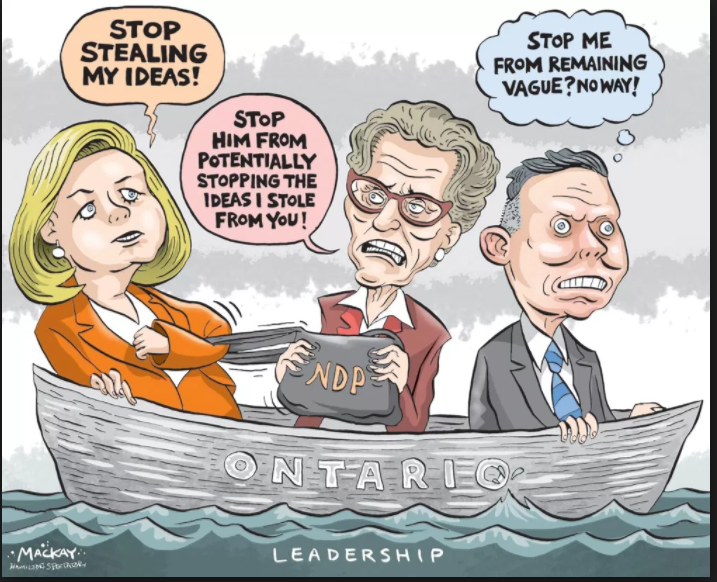
Could be a few reason for that, including having less money than the other parties, but they also seem notably light on the policy front. (Though what they have, on pharmacare and Hydro, seems sensible.) Maybe they should take a page from the Liberals, who have been known to crib from the NDP, and borrow some from other parties.

ndp-ideas.png
Horwath, Wynne, and Brown (this is an older cartoon….)

Like, the Ontario Green Party has some excellent policies, such as having small business dispensaries sell marijuana instead a government monopoly.  (Also, Ontarians should consider voting Green, at least anywhere they stand some chance, like in Guelph.)

And / or, how about if the NPD gets rid of cap and trade, happily accepts the Federal government carbon tax, and gives everyone an income tax cut?

For one thing, it would be hilarious to see them debate the PC leader on that. And the NDP isn’t going to get any of the “I hate carbon taxes” vote, anyway. They could even put an NDP spin on it, and make sure all low-income people got a carbon tax credit.

An NDP government in 2018?

Look, it’s a long shot, it definitely is. But the past four weeks have shown that nothing in Ontario politics is as predictable as we’d thought.


Some quick ones

Other issues have been getting in the way of blogging lately. Let’s see if I can cover a few items with some brevity (not always my strong suit).

Politics: NDP leadership

It’s been interesting to read the views on Thomas Mulcair, but I haven’t formed my own opinion of him yet. Me, I liked Nathan Cullen. To the point where I was almost wishing I had joined the NDP, just so I could vote for him.

Politics: Robocalls

Yep, I’m still following this issue pretty closely and may rant more about it later. In the meantime I will say that Rick Mercer’s 2-minute rant this week summed it up nicely for me. The MPs themselves don’t really know what happened, but someone does. Several someones, higher up. We know it’s rotten. We know the government won’t investigate itself, but someone must.

Rick suggests the G-G. I don’t have much faith that he would do; he’s really not the shit-disturber type, which is probably why Harper picked him. Still, I don’t have a better suggestion. And like Rick, I want to something to happen on this, and sooner rather than later.


Books: What not to read

On fairly short notice, we ended up having to take a somewhat long road trip. So I tried to find an audiobook. A novel called Mine Are Spectacular! looked kind of fun, and had pretty good reviews.

People, it was so ridiculous. It was intended, I think, as a kind of wish fulfillment novel for middle-aged women. Everyone was rich, richer, and richest, and their was no end to the designer labels being dropped into the prose, as though every paragraph had a sponsor. We started mockingly repeating each as they went by: Louis Vuitton! Gucci! Dolce Gabana!

And though not that old (2006), it seemed so dated. AOL buddies. The cutting-edge concept of metrosexuals. And frankly, all that reveling in the luxury goods, which seemed a bit wrong, post-recession.

And then there was Kurt. Gorgeous, smart, successful, (rich!) Kurt, in his 20s, who nonetheless has so little life of his own that, of course, all he wants to do is hang out with a bunch of women in their 40s. He’s what “the girl” usually is in action movies–a bit of eye candy for our heroines, who has no apparent existence outside of them.

Food: New ways to drink ice wine

We did the Niagara-on-the-Lake thing recently. Like a lot of people, we kind of like ice wine, but it is so thick and so sweet, we don’t really drink it that often.

But on this trip we purchased a wine that was a mix of Riesling and ice wine. The result was a sweet wine, but one that was much less thick and sweet. Much more approachable.

Then at a wine pairing dinner we went to, we were served sparkling wine—with a dash of ice wine in it. That made for a slightly off-dry sparkling (reminiscent of Peller Estates’ Ice Cuvee) that went really nicely with the pumpkin soup.

That got us thinking that we could do our own blending here. A touch of ice in a cabernet franc. Our own blend of ice cuvee with some other sparkling wine. You know? So that bottle of ice doesn’t just sit for months in your fridge after you’ve had your one glass of it.

So what do you think of your coalition now?

Now that the Conservatives have blinked, it’s more complicated.

They’ve dropped the funding cut to political parties. And also the ban on the right to strike. And, they pledge to bring forward a budget, with stimulus package, earlier, in January.

And yet the coalition agreement was signed, with Dion as Prime Minister, members of the NDP in cabinet, and the Bloc agreeing to support it for at least a year.

Politically, I don’t know how wise this is. The unpopular leader, the deal with separatists, leaving the party with the single most seats out in the cold—it’s just going to make a lot of people really angry.

On the other hand… It really is cooperation, isn’t it? And isn’t that exactly what a lot of people say they want? Three parties agreeing to work together for the good of Canada. Of course, their motives are nowhere near pure. But, it’s still a little refreshing.

And, I kind of like some the policy statements I’ve heard from the coalition side so far. Dropping the NDP demand to cancel corporate tax cuts (thank goodness). A stimulus package sooner. A blue chip economic advisory committee. Possibly restoring arts funding. Elizabeth May, Senator.

On the other hand (I clearly need more hands), it’s really hard to have great confidence in this group. The Liberals are still in a fair amount of disarray, and the NDP campaigned on a completely unrealistic platform. One hopes the NDP would learn from actually governing, but Canada isn’t in the best position right now for them to practice on. And Dion, despite some definite virtues, has not exactly shown himself to be a great leader.

I guess there isn’t any way for us to get Barack Obama as leader without actually joining the US? No? Well, OK then…

In this article I just found [link no longer valid!], Andrew Steele lays out Harper’s options.

  1. Preemptively Remove Michaëlle Jean.
    To which I say, wow, he can do that? I don’t like that one. It’s not right. And I like Ms. Jean.
  2. Reschedule the Vote again.
    How long a delay would be long enough? Eventually, someone has to govern…
  3. Appoint Opposition MPs to the Senate.
    This option is too boring to even contemplate.
  4. Caretaker Prime Minister.
    This apparently means admitting defeat, to some extent, and seeking to find a coalition partner. He would just be a “caretaker” Prime Minister in the meantime, with more limited powers. Interesting. Would he actually do this?
  5. Prorogue
    i.e. Cancel this session of Parliament and start again. This is the one he wants, but which admittedly limited precedent suggests the G-G shouldn’t grant.
  6. Apologize, fire Flaherty, and reach across the aisle.
    Is it a big enough gesture? And would he do this?
  7. Request an election.
    No! Not another damn election! No!
  8. Convince Opposition MPs to support the government.
    They’d need 12 turncoats.
  9. Seduce the Bloc into supporting the government.
    They’re already running anti-Bloc, so doubtful this is still a viable option.
  10. Step down as Conservative leader.
    Which is also what the Globe Editorial today recommends, and would, I think be a big enough gesture to appease the opposition (at least the Liberal party). But would he do that?

“May you live in interesting times.” Really is a curse, eh?

See? This is why you shouldn’t have voted Conservative!

Well, that didn’t take long.

I actually cannot believe that Parliament has just opened, and Stephen Harper already has me in a blind rage.

Step 1: Economic statement focus

Earlier in the week, I heard that the government’s economic statement was to focus on preserving a small surplus, plus some initial cuts.

I thought that was a very strange approach in a time when most economists, including conservative (small “c”) ones, seemed to be saying that spending and stimulus were the most important priorities at this time.

Still, I was only mildly irritated at this point. Sure, it suggested the Conservatives were bad economic managers. But I already knew that, and there is some comfort in being right. Plus, I still have a job, for the time being at least, and it’s Christmas. So why fuss about politics now?

Step 2: Cutting federal funding for political parties

This, I was not happy about, even before all kerfuffle arose.

Bully for the Conservatives that they’re so great at fund-raising they don’t need any help from the taxpayer. That’s what happens your party is the one that attracts most of the rich people.

But parties who attract more lower-income people who can’t afford to donate (NDP, Greens), or are currently in some disarray (hello, Liberals), still have the right to exist. No, more than the right; they must exist, or we don’t have a democracy. We have a Conservative dictatorship.

Step 3: The opposition rises

That is some hubris that caused Harper to think the other parties would actually vote for their own demise.

Now, it may well be politically wise for the other parties to say it’s the economic statement itself, and not the cutting of federal funding to political parties, that is the tipping point. I’ll come back to that.

But my opinion is that the party funding alone is enough reason to defeat this bill.

  1. It’s unbalanced. This bill came in to compensate for loss of other ways for political parties to raise money. Previously, corporations and unions could donate; now they cannot. Previously, individuals could give as much they wanted; now they’re capped at $1000. You can’t take the funding away without making other legal changes that allow the parties to compensate for that loss.
  2. It’s undemocratic. Funding is calculated on a per-vote basis (with the exception of parties earning less than 5% of the popular vote). It’s one of the very few ways in our system that (almost) every vote counts. Some people, particularly Green Party supporters, do cast their votes exactly for that reason: to get federal funds to their party of choice. Taking away the funding disenfranchises all who voted for a major party.
  3. It doesn’t help the economy. The amount is too small to matter. Now, there is something to be said for the mostly symbolic gesture. Freezing top-level government salaries and cutting perks also probably doesn’t really help the economy, but it’s just bad optics to be flying all over in first class while people are losing their jobs and savings. But party funding isn’t a luxury; democracies aren’t completely cost-free.

    If the Conservatives don’t want their share of that funding, they can give theirs back and dare the other parties to do the same (knowing that they won’t). That way the Conservatives can get on their high horse, where they like to be, without kneecapping their opposition.

But party funding probably is a dicey thing to defeat a government on, so the opposition is instead focusing on the content of the economic statement. And frankly, there is plenty to be against there, too.

  • Claiming they already stimulated the economy with 2006 tax cuts. Huh? Even ignoring that they selected the most non-stimulative form of tax cut possible—the GST—something you did three years ago is not going to have a new effect now.
  • Claiming a surplus based on bogus number, such as inflated projections for the price of oil.
  • No infrastructure programs at all, though it’s not difficult to find excellent candidates for these across the country.

But even at this point, I wasn’t quite in a blind rage. I was really kind of excited that the opposition was showing some teeth, and acting cooperative, and refusing to roll over for the bully at the helm. Until…

Step 4: Harper claims a coalition government is undemocratic

While we have been working on the economy, the opposition has been working on a backroom deal to overturn the results of the last election without seeking the consent of voters. They want to take power, not earn it.

Stephen Harper

Overturn the results? No consent of voters? Makes me crazy ever time I read or hear it.

Mr. Harper, the majority of Canadians voted against you and your party.

The majority of Canadians voted for four center-left parties who agree on a number of major issues.

Three of these parties won seats. Two are discussing forming a coalition government, with the backing of the third.

This could be the closest Canada has ever had to the makeup of the government reflecting their actual votes.

Step 5: ?

Who knows how this plays out. But if the Conservatives don’t change their statement, they deserve to go down over it. And that better not lead to an election!

In the midst of a global economic slowdown that may plunge Canada into a deep recession and threaten the livelihood of many Canadians, it would helpful if there were some adults in Ottawa. … While there is certainly a crisis, there is no semblance of crisis leadership here, and therefore no chance for national cohesion. The responsibility for that lies squarely on the shoulders of Stephen Harper.

— Globe and Mail editorial, How to compound an economic crisis

Martin Luther King dreamed of the day when men would be judged “by the content of their character.” By that benchmark, Stephen Harper has proved himself to be a nasty little man.

— Peter Blaikie, letter to the Editor, Muzzling the opposition

The miscalculations have been stunning. Mr. Harper’s strategy has accomplished already the near-impossible: to bring the Liberals and NDP together.

He had so many other, less partisan options at a time of economic crisis and grave national concern. That he acted in this fashion, at this time, was enormously revealing. And very sad.

— Jeffrey Simpson, Economist with a tin heart, politician with a tin ear

Whatever the debatable merits of distancing parties from taxpayers, this isn’t the time or way to change payments peripheral to dangers facing Canadians. It won’t save a single job, meaningfully reduce the ruling party’s runaway spending, or somehow make the democratic exercise cost free.

— James Travers, Harper has needlessly provoked this crisis

RDtNVC: Increasing energy prices without compensating with tax cuts

There were two letters in the Record yesterday related to the carbon tax plan. One asked how charging for pollution could possibly reduce it — wouldn’t companies just pass the increased cost onto customers as higher prices? The other asked, wouldn’t it be better to just force big polluters to pollute less, via regulation?

Both good questions. Comes down intuitively favoring a regulatory or “cap and trade” approach over a carbon tax, as so well articulated by Jeffery Simpson in the Globe and Mail:

They [the Green Party] bring urgency to the debate that the Conservatives lack, and they’ve got one thing right: that carbon emissions have to be assigned a price, that a tax is a defensible way to do it, and that the revenues from the tax are best recycled into lower personal and corporate income taxes.

There is another way of finding a price, through a cap-and-trade system, as proposed by the Conservatives and NDP. This targets mostly large polluters. Some of the costs are then passed to consumers. Using the tax, a method favoured by many economists, gives carbon a price certainty but doesn’t guarantee a particular emissions result; using the cap-and-trade produces a particular result but at an unknown price.

Politically, the cap-and-trade is a much easier sell, since the eventual effect on the ordinary person is indirect, whereas changes to the tax system are in the faces of consumers. The easier politics of the cap-and-trade explains in large part why Conservatives, New Democrats and U.S. politicians like it.

It’s too bad we can’t have a reasoned debate between these two approaches, instead of the slanging match and attack ads about the “carbon tax” that the Prime Minister calls “insane” and says will “screw” Canadians and “wreck the economy,” something that’s not happened in any of the countries that have thus far introduced one.

Now, I’m think of writing my own letter to the editor on this subject, and I can’t just plagiarize Jeffrey Simpson if I do that. So here’s my draft, which I’ll refine later! [I’m such a technical writer, sometimes. Just can’t resist the bulleted list!]

Something that seems to be missed in all the wild claims about the effects of a carbon tax on the economy and prices is that the regulatory or cap-and-trade system offered as an alternative will also raise energy prices — and without balancing them with an income and corporate tax cuts.

A cap-and-trade system involves only the largest polluters. Total target emission levels are set and are assigned a price. Companies who pollute the most pay the companies who emit the least. But exactly as with a carbon tax, some of those extra costs are likely to be passed on as higher prices for consumers.

The reasons the most economics and environmentalists — groups that don’t typically agree on much — favor a carbon tax over a cap-and-trade system include the following:

  • By involving everyone, not just the largest polluters, the potential reduction in pollution is therefore much greater.
  • With a cap-and-trade system, there’s no benefit to companies that will never reduce their emissions below the overall target, so they won’t. With a tax, the more they reduce, the more they save–and the greater the environment benefits.
  • It rewards companies and individuals who are already doing well, environmentally. They get more back in income and corporate tax cuts than they pay in increased carbon taxes.
  • Corporate and income tax cuts are generally stimulative to the economy, freeing up more money for investment, savings, and spending.

The truth is, the environmental policies of all the political parties–including the Conservatives–are going to increase energy prices. The question is, do you want an income tax cut to help you pay for those inevitable price increases, or not? If you do, then you should vote for one of the two parties planning to implement a carbon tax: the Green Party or the Liberals.

(2023 Postscript: These are the roots of the Conservative war on carbon taxes, but interesting that they supported cap and trade at the time. Also interesting that the Liberal plan was to reduce income taxes as compensation rather than the current “revenue neutral” approach. Finally, so sad that so many years later Canada has accomplished so little on this front.)

Canadian federal election: Week 2 recap

The Liberals were much more visible this week, taking my advice by taking on Harper on a number of fronts, including childcare. The Liberal team was emphasized, which seemed wise. Dion explained the Green Shift on The Current podcast, and was, to my mind, clear and convincing.

The NDP and the Conservatives, meanwhile, were busily injecting a rare note of humour into the campaign. The NDP experienced the resignation of not one but two, toke-smokin’, car-drivin’, former members of the Marijuana Party as candidates for the party in BC, because they apparently didn’t bother to YouTube them before offering them the nomination. And the Conservatives, of course, had the whole “death by a thousand cold cuts” kerfuffle. Am I a bad person because that made me chuckle?

Anyway, this inspired the fourth apology by Harper since the campaign began (emphasizing why he’s so reluctant to let his candidates speak to the media), but the first that seemed to stick. And stick. Please, enough with the calls for his resignation, already! Lack of regulation might be the serious issue here. A dark sense of humour is not.

The US economy provided some excitement, with huge companies collapsing and stocks going on a roller-coaster ride in the wake of the sub-prime mortgage crisis. It ended only when the Bush government reversed its laissez-faire policies and stepped in with massive investment. (Fun fact: $1 trillion could buy you 5 billion iPhones. Or 1 war in Iraq.)

Canada never allowed sub-prime mortgages, and so isn’t at risk of this exact same crisis. But there’s a more general lesson here about what happens when governments aren’t involved enough, when companies (banks, meat) that need regulation don’t get it, when governments are downsized to the point of ineffectuality.

[Harper’s] inability to think in a positive, passionate way about large political projects shows starkly at this tense economic moment. In policy, he prefers to act small. His favourite word is modest. “Our plan is simple, modest and practical,” he said about a tax break for home buyers. As if he’d rather do nothing but, in a pinch, will settle for the least possible. His modest GST cuts give little relief, but they whittle government revenues down so he can claim we can’t afford much anyway. This week, he announced a ban on tobacco ads, which are already banned, and sales to kids, ditto. I know this “modesty” reflects Stephen Harper’s political philosophy and he could rattle on passionately about why government should do the least it can, for the good of us all. It’s the reason he wants a majority: so he can do even less and eliminate more. But he may be the wrong leader at the wrong time.

Rick Salutin, Globe and Mail

Canadian federal election: Stepping back to survey the week

The most interesting, and heartening, event this week was the Green Party being admitted to the leader’s debate after public protests of the initial exclusion. I heard leader Elizabeth May interviewed on CBC’s The House, and the woman is a breath of fresh air. She’s smart and articulate, but doesn’t hide behind that political “bull” filter that all the other leaders do.

The Conservatives have campaigned effectively this week, and this point certainly look to be on a victorious path. I’m not sure any of their gaffes—the infantile Dion cartoon (I’m just not linking to it), insulting the father of a slain soldier[had link here, but it’s no longer valid]—will really stick. But it certainly highlights to me just how mean and nasty significant parts of the Conservative crowd can be. Why so angry, folks? You’re winning!

The Liberals really weren’t very prominent, getting attention mostly for defending themselves against Conservative attacks. A good defence is important, but they need way more offence. It’s not as though the Conservatives haven’t left them plenty of targets. Start shooting at them, already.

The NDP, on the other hand, I’ve seen a surprising amount of. They’ve run an ad that I think isn’t too bad, though it’s a bit low on specifics. [Had link to this also; also no longer valid.]

I’ll end with some favourite comments from others this week:

But the mystery is: Why did the Harper-Layton-media juggernaut back down here? I never expected it. Jeffrey Simpson says they “misread public opinion,” which “insisted Ms. May be heard.” So what? The public wants lots of things. Usually it’s just ignored.

Rick Salutin, Globe and Mail

But increasingly, Mr. Harper himself looks like a deer frozen in the headlights of onrushing economic and environmental change. He insists now is not the time to risk a new course. But what does he propose?

It sounds more and more as if he is seeking a mandate to do nothing.

Ian Porter, letter to the editor

On some August nights, my father, a professor of economics and a rather conservative man, would phone me (during the cheap hours) to try to explain Stéphane Dion’s plan.

“It’s brilliant,” he’d say. “The cheapest way to lower greenhouse gases. It’ll lower income taxes, which slow growth …”

My father said Stephen Harper must know that it’s a good plan. “He can’t not know. He’s an economist. He’ll have an election before someone finds a way to explain it to the likes of you and his party goes down.”

Tabatha Southey, Globe and Mail