Ontario election or voter suppression

Well, I voted, and it was really easy. Just needed some basic ID and some time to wait in the line I was, I admit, rather surprised to have encountered. Nobody tried to intimidate me or influence my vote. I went on just one of the several days that voting was possible. I didn’t have to register in advance. My vote was private. I saw it go into the machine and be counted.

And yet…

Holding a snap election in February in Ontario seems very much designed to ensure low voter turnout.

  • Weather: February’s always kind of miserable, but this year the province has been hammered with record amounts of snow. Some people literally cannot get out of their homes to vote, because they need clear sidewalks, and those are hard to come by. It’s also tough to get campaign signs in snow-covered lawns, or volunteers willing to stay out very long knocking on doors.
  • Condensed time frame: The election was announced one day, started the next day, and runs for only four weeks. It’s very little time to even let people know it’s happening, let alone any campaigns to gain steam and make an impression. No party started with a full slate of candidates! A lot of people won’t receive voter cards in time. (They can vote without it, but not everyone knows that. Or even realizes an election is happening.) Those who want to vote by mail are hard-pressed to get that completed by deadline.
  • There’s a lot else going on. The US keeps talking about annexing our country, along with doing various appalling things daily. The Federal Liberal party is having a leadership race, the winner of which will be Prime Minister. Shortly afterward, a general federal election is expected. Lots of competition for Ontario politicians trying to let people even know there is a provincial election, let alone who all the leaders, candidates, and positions are.

There’s nothing illegal about all this; but it kind of feels like it should be? Because this is not truly a free and fair election. Especially if you consider:

  • The governing Conservatives have been found to have inappropriate used taxpayer money to advertise themselves, before the election, and party money to advertise the Premier’s trip to Washington, which is also not allowed. The penalty? Bupkus! More votes for them, even though they’ve cheated!
  • The Conservatives have told their candidates to not attend any local debates, something they have followed, with few exceptions.
  • The Conservatives have not bothered to release a platform. (Today they did release one…)
  • Conservative leader Doug Ford has mostly avoided the media.

So the governing party, the one with by far and away the most funds, is doing its level best to ensure that voters are uninformed about anything.

They clearly hope that hardly any people will vote, since low voter turnout tends to favor incumbents and conservative parties. And polls have consistently shown them to be in majority territory.

Do the Conservatives deserve re-election?

I would argue no—and not only because of their “keep the voters ignorant” campaign style. Fortunately, I don’t have to personally write up all the reasons why, as many others have. One of my favourite examples is Please: Anyone but Doug Ford by Justin Ling. A few excerpts:

His years in office have been defined by shortages — a lack of homes, doctors, teachers, jobs, skilled workers, subways, buses, and bike lanes. Worse yet, his plan for a third term is ambitious only in its plan to build a massive new white elephant.

Let’s start with housing, inarguably the priority for any incoming government. But, somehow, Ford remains indifferent. Ontario is, in the full swing of a housing crisis, breaking ground on fewer units of new housing today than it was in 2012. It’s a stunning failure.

There are few problems in Ontario which don’t flow out of this acute housing shortage. Tent encampments, rising crime, the opioid crisis, sluggish growth, a stagnant culture, and declining productivity: All things that could be ameliorated by cheaper, abundant housing. 

Ford is addicted to giving private companies public money, often for no benefit to the province.

He has had nearly seven years to fix the province, and he hasn’t. What is he proposing for the next four years?

Ford’s healthcare plan is absolutely anemic, little more than a vague hand-wave at the crisis. If he has actual new plans to boost housing construction, he’s certainly been holding out on us. Does he have a real plan to improve education, reduce homelessness, hire more doctors, provide care for people struggling with addiction, or get real economic growth started again? No.

What Doug Ford has is a big dumb tunnel.

The opposition problem

If not Doug’s PCs, then who? And therein lies the problem. Both Liberals and NDP have new leaders that aren’t well known. Neither has managed to bust out a fantastic campaign to make them the clear alternative. The Green Party has a appealing leader and great platform, but are strong only in a limited number of ridings. The voter who wants “not Conservative” has to do the frustrating dance of whom exactly to pick instead.

I have voted. I will say it: I voted NDP. I live in a riding with an NDP incumbent who is excellent. I was happy to support her. I was less happy to support some aspects of the NDP platform. Really, you’re going to make the 407 toll-free to “reduce congestion” (which it won’t). Really, that’s your first announcement? And that whole grocery rebate thing? That sounds… complicated.

But as whole, it’s still a better platform than what the PCs have on offer. The party leader, Marit Stiles, is more appealing than Ford. And their Instagram ad today is one of the funniest political ads I’ve seen in some time (here’s hoping they also post on YouTube or somewhere more accessible than Instagram).

And they know the mission: Focus on the ridings they hold, and the ones they might conceivably take away from the Conservatives. From the Conservatives. Not so much from the Liberals or the Greens.

The Liberals haven’t played too much of a factor in my personal consideration, with the Greens having earned my “heart” vote, and the NDP clearly being the smart vote. But being someone who frankly doesn’t really understand political strategy, it’s been interesting periodically dipping into the writings of Evan Scrimshaw, who lives and breathes this stuff.

This one, pointing out that with Conservatives sitting at 45% support in polling (it’s since dipped a bit, not enough), there is no “rearranging of the deck chairs” possible to prevent them winning a majority, was particularly interesting: Ontario: Progressives’ Absurd Focus.

The idea that if you could magically optimize the Liberal and NDP votes, somehow Ford would be defeated is nonsensical. Not every vote who is voting for one or the other is a vote for the other. Not every Liberal trusts the NDP on fiscal policy or some of their more out there social values ideas (remember safety zones around drag bars?), while plenty of New Democrats are union, working class, blue collar voters who oscillate between the NDP to advocate for more health spending and the Conservatives because they’re mad at progressives, wokeness, and the general fact that the world isn’t how it was in 1995. Only 62% of Liberals and New Democrats think the OLP and ONDP should merge into one party, per a Friday Research Co poll. 

….

The unfortunate truth is that if you were to do head to head polling, Ford would easily beat Crombie’s Liberals, Stiles’ NDP, or some merged entity. He is what Ontario wants. The reason he’s what Ontario wants is in large part because the Opposition have not been good enough.

If there was some option of a merger or a deal, the Greens would also be a big impediment to it working. Green voters aren’t idiots who think the Greens can win, they’re about building slowly and adding to the conversation through presence and generally not making the compromises that the NDP and especially the Liberals make. It’s a party that is on some level about being anti-Liberal and anti-NDP more than it is about the environment or ecology or whatever else. It’s a statement of principles, and about one’s self. 

What both parties of the left have failed to do is create a coherent narrative for why they need to be elected. The real problem for Ontario progressives isn’t how the opposition splits their votes, it’s the fact that 45% of Ontario is about to vote for Ford, and any person or any organization focused on anything other than driving that down isn’t helping.

Vote anyway

The weather forecast has improved this week. The NDP still looks perky. The Greens are are encouraging you to not feel bad about voting for some other party if you don’t live in one of their favored ridings. The Liberals… Well, I’m not too sure what’s going on there, but they do have some good candidates.

You can vote any day between now and Thursday. Go here: https://voterinformationservice.elections.on.ca/en/election/search?mode=postalCode, enter your postal code, and it will tell you where and what form of ID to bring.

It’s not really a fair election, but it helps nothing to sit it out. Happy voting.
Doing what you can

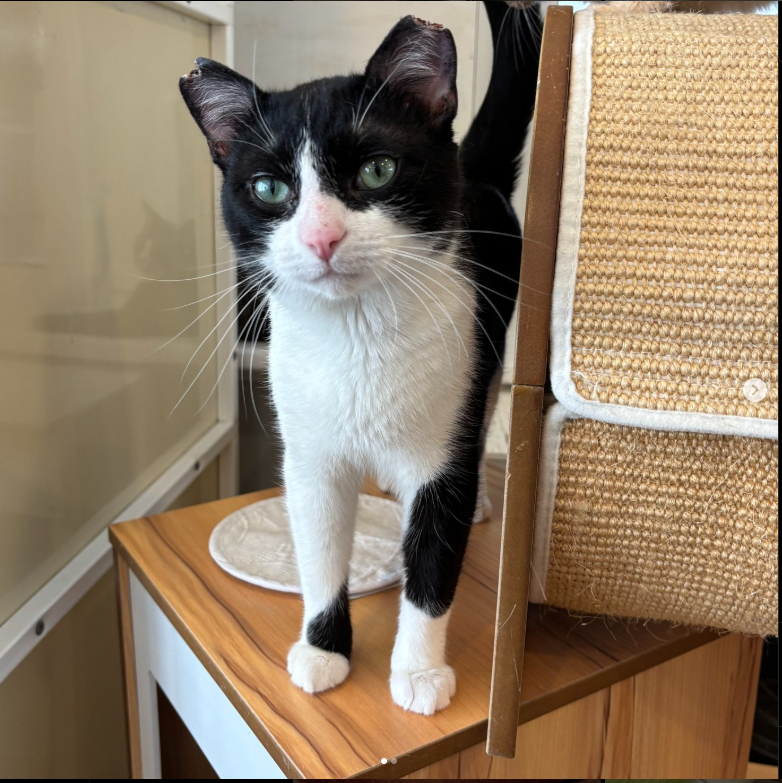
Hansen, recuperating in his cage, was very sweet, full of purrs and head-butts. But his blankies and towels all seemed to be somewhat damp. Not smelly, though. And his water dish was really low. So perhaps a bit of water bowl spillage.

Following the morning protocol, I removed his food and water dishes, and replaced them with new ones, topped up. But before putting those back in the cage, I gathered up all his damp bedding and replaced each of those. Litter scooped, a few more pets doled out, then I gave him his new food and water dishes, and closed the cage door.

Whereupon he flicked, flicked, flicked almost all the water out of the dish and onto his newly installed bedding.

Good thing he’s cute.

Black and white cat with missing ear tips and pink nose.
From https://www.instagram.com/p/DFjK4W-o1a3/?img_index=1. Hansen was rescued from the cold outdoors, and his ear tips didn’t make it.

That was on my first day volunteering for Pet Patrol, the cat rescue organization from whom we acquired Gus and Mac (and previously, Zoë, McSteamy, and Mocha). Some cats in cages, but most were just loose in the sanctuary, and all seemed a bit crazed with energy after a night without people. It was a flurry of litter scooping, cage cleaning, food exchanging, and floor mopping, with just a side of cat petting.

I solved my Hansen dilemma by not immediately restoring the water dish after providing him with yet another set of dry blankets and towels. I snuck the water bowl in later, when Hansen had settled for a nap.

My next shift was in the evening, and the cats were much more mellow then. There was still a certain amount of crazy-ness, as several were heading to surgery the next day, and had to be given canned food to make sure they got a fill of food before their dry food was taken away overnight. Might not sound complicated, but remember that there are tons of cats loose who are not getting canned food—but would like some.

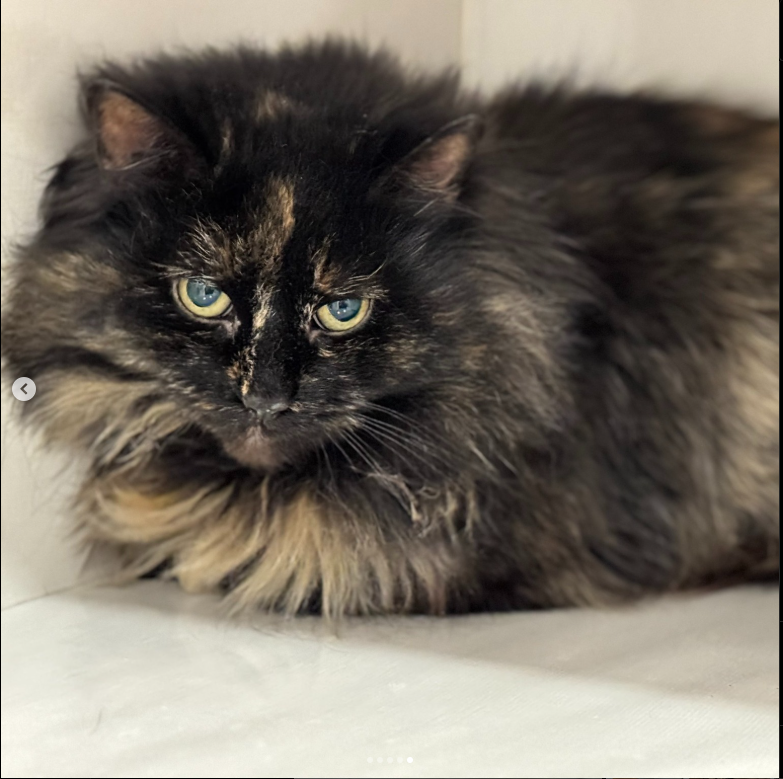
Fluffy black calico.
This is Monet. She got canned food that night. She is now ready for her forever home. From https://www.instagram.com/p/DFxwwnvIH2S/?img_index=5

My third shift, also an evening, was the quietest yet. Newcomers included a couple ferals temporarily being sheltered from the extreme cold. There was no point in trying to socialize them, but I was getting to know a few of the others.

So far, it has not been difficult trying to resist the lure of adopting one of these babies myself. It probably helps that there’s been a slow but steady stream of adoptions occurring. But it’s also true that Gus and Mac are enough for us right now.

Fluffy black cat.
Gus says hi.

I also heard from Mask Bloc WR recently, asking me if I’d like to join in their latest meeting. Per Mask Bloc. org,

Blocs are formed when individuals or groups unite around a common goal. Blocs can take many forms, ranging from voting and political pressure groups, to advocacy groups and mutual aid organizations.

Mask Blocs are independent mutual aid group providing high quality masks to their community for free. They may also provide other tools and information about COVID-19, clean air, testing, vaccination and accessibility.

I’d been hearing about them in various cities, and it seemed like an interesting thing to try to help out with. At the meeting (which was virtual), I learned that the Waterloo Region group, which is relatively small, has been making high-quality masks available to those who want them but can’t afford them for some time now. They have a number of community locations, but will also deliver for people who can’t easily get to those.

Recycle your used masks!
From https://www.instagram.com/p/DD2ZBEEOG1D/. I’m personally excited about this service, as I do have some guilt about all my disposable masks ending up in landfill. Now they won’t!

Recently, they have also expanded to providing rapid tests. The challenge there is that while the masks get donated to them (by the companies who make them), the tests are not. So they need to focus more on fund-raising now. Not really my forte, but they have other initiatives and ideas:

  • Holding more COVID-safe events (one of which is happening tonight!)
  • Providing assistance to those suffering from serious Long COVID
  • Doing more advocacy and research

During the meeting, the subject of the current Ontario election came up, and they noticed that I was able to rattle off various political facts and events rather easily. They asked if I could come up with a list of the Ford government record in this area, for potential use on their Instagram.

I did, though I did not really see how what I provided could be “Instagram-able”. It was stuff like this:

August 2022
Ontario eliminates the mandatory five-day isolation rules for people with COVID-19. (8)

September 2022
The Ontario Science table working group, which advised the government on COVID protections, is disbanded. (9)

November 2022
The Chief Medical Officer of Ontario requests that Ontarians mask in indoor settings to assist overwhelmed children’s hospitals. (10)
Most Conservative MPPs refuse to do so in the Legislature. All opposition members wear masks. (11)

December 2022
Statistics Canada reveals that 2022 was Canada’s and Ontario’s deadliest COVID year, and also the year with the highest number of COVID hospitalizations. (12)

March 2023
The Ontario government ends a program that gave workers’ access to three paid sick days.

(Covering not the early pandemic years, but the subsequent ones.)

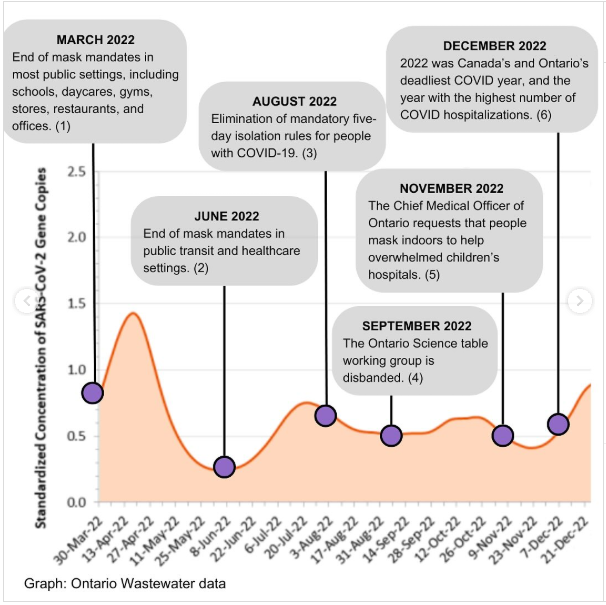
But look what they came up with! At https://www.instagram.com/maskblocwr/p/DFqg7devZc4/

On graph of Ontario Wastewater data
March 2022: End of mask mandates in most public settings, including schools, daycares, gyms, stores, restaurants, and offices (1)
June 2022: End of mask mandates in public transit and healthcare settings. (2)
August 2022: Elimination of mandatory five-day isolation rules for people with COVID-19. (3)
September 2022: The Ontario Science table working group is disbanded. (4)
November 2022: The Chief Medical Officer of Ontario requests the people maks indoors to help overwhelmed children;'s hospitals. (5)
December 2022: 2022 was Canada's and Ontario's deadliest COVID year, and the year with the highest number of COVID hospitalizations.
March 2023: End of program that gave workers access to three paid sick days. (7)
June 2023: End of free rapid tests in pharmacies and grocery stores. (8)
August 2023: The Toronto Unity Health Rehabilitation Program for patients with Long COVID is shut down. (9)
October 2023: The Ontario NDP introduce the Improve Air Quality for our Children Act. It has not gotten past first reading. (10)
December 2023: There were 1199 emergency room closures in Ontario in 2023. ER closures were extremely rare before 2020. (11)
My additional comment: Note the change in the y-axis here. That was a hell of a peak in December 2023.

(If you don’t like Instagram, you can also see the whole thing—just five slides—here: A message from MaskBlocKW.)

A pretty smart group, and they seem quite nice also. There is a hope to safely meet in person at some point—likely in the warmer weather.

Times are nuts. I’m hoping that by finding community, and doing what I can to help, I won’t go nuts myself.

More summering, more updates

Because it’s the most important topic ever, I’ll get y’all up to speed on my latest hair colour, while also providing a bit of a “tour de restaurant patios”.

First up, at Loloan Lobby Bar, you can see that the hair is kind of rose gold (and also windswept, and also my makeup is quite faded, but oh well).

Diner with rose gold hair in front of plate with scallops.

We biked over to the Loloan that Tuesday for dinner, and partook of their new summer menu. It was very good!

Then a couple weeks later, behold the blonde look at our anniversary dinner (32 years married, 36 together) chez The Odd Duck.

Blonde in white dress at patio table with red drink in foreground.

I now I understand why Jean commented on how their patio lacked charm—I hadn’t realized til looking at these pictures how much of the street view he was seeing! My view was pretty different…

Coffee pot, cheesecake, man in sunglasses against patio walls.

… because the canvas did block the streetscape for me. (Also note Jean’s weight loss, hey?) We’ll have to trade seats next time to be fair.

Regardless of charm or lack thereof, we both really enjoyed the meal. They know their food, and their wine, at The Odd Duck.

I ended up selecting a semi-permanent colour called light golden brown to dye my hair. I was quite happy with the result. You can pretty much see it in the photo below (along with more faded makeup—I’m really bad about reapplying makeup) from our dinner at Arlo, in Ottawa, last week.

Woman with golden brown hair in front of plates of appetizers.

Arlo also had excellent food! It’s been a good run. This isn’t even a complete list.

A couple days after our anniversary dinner, we biked over to Babylon Wine Sisters to meet some friends for vino and a meal. Less elaborate than these other places, but still très bon. And perfect weather for it.

Woman with cheese ball and sauce.
This was some sort of cheese bombé situation…

And our other big dinner in Ottawa, at Fairouz Cafe, was also fantastic and creative. Halloumi cheese with cappuccino cream, dates, and figs; duck confit flatbread; babaganoush with shaved truffle!

Foregrounded Brussels sprouts, duck flatbread, with cappuccino cream and babaganoush in the background.

And between meals…

we did a few other things. The Friday before leaving for Ottawa, we went to see Something Rotten in Stratford. Lordy, that was funny! It’s set in the time of Shakespeare. Two brothers are trying to compete with him as playwrights. With the help of a soothsayer, they come up with the idea of producing the world’s first musical!

It ends up mocking / paying tribute to numerous musicals, as well as various Shakespearean plays, and it’s all just delightful.

As for the trip to Ottawa, that went well! It was very hot and humid, but we managed by doing our longer walks more in the morning, and spending afternoons in cooler museums or drinking iced beverages. Our hotel, the Sonder Rideau, was very spacious and well-equipped, and located right downtown, so that was all good. We visited KIN Winery, the Canada Aviation and Space Museum, and Rockcliffe Park. If you’d like more details and photos, I’ve posted them here: Ottawa 2024.

Ottawa Rideau canal.
Great photo by Jean from that trip

The poop scoop

I and fellow activists have not been successful in saving the Ontario Wastewater Surveillance Program, but there have been some minor accomplishments:

  • Quite a few media articles about it, in The Globe and Mail, The Toronto Star, CBC, CTV News, the Tyee. The Health Minister got asked about it at a media scrum, which seemed to make her cranky. It’s definitely something, as other program cancellations have gone mostly unremarked.
  • The cities of Ottawa and London have come up with funding to continue the program, in a somewhat reduced capacity, for 2 or 3 more months. (Peterborough and Windsor might also have cobbled something together; not as sure here.)
  • The Federal government has given official statements that confirm the Ontario government has been lying about the reason for cancelling it (their claim was that the Federal government was taking it over):
    • The Federal program does not duplicate what the Ontario one did.
    • The Federal expansion will not result in a system as comprehensive as Ontario’s was.
    • Ontario did not consult or collaborate with the Federal government on coordinating wastewater testing programs.

I personally got a flurry of email responses about this in recent days, from the Mayor of Waterloo, the Chair of Waterloo Region, and my Federal MP, Bardish Chagger.

You deserve clean air (take two)

Don’t go looking for Take one of this post; it’s hanging out in my Drafts folder. Big long post, as yet unfinished, having trouble getting to any point.

Sometimes it seems better to just start again. I think this is what I was trying to say.

There is good news on the Covid front

Mainly, the vaccines are great. In Canada, most of the population has had at least two doses. And yes, people previously infected (a majority of the Canadian population by now) have gained some protection against reinfection, for some period of time.

Also, there are some better treatment options now (Paxlovid). This combination of factors has protected many people against hospitalization or death from infection.

But by some key measures, the Covid situation has never been worse

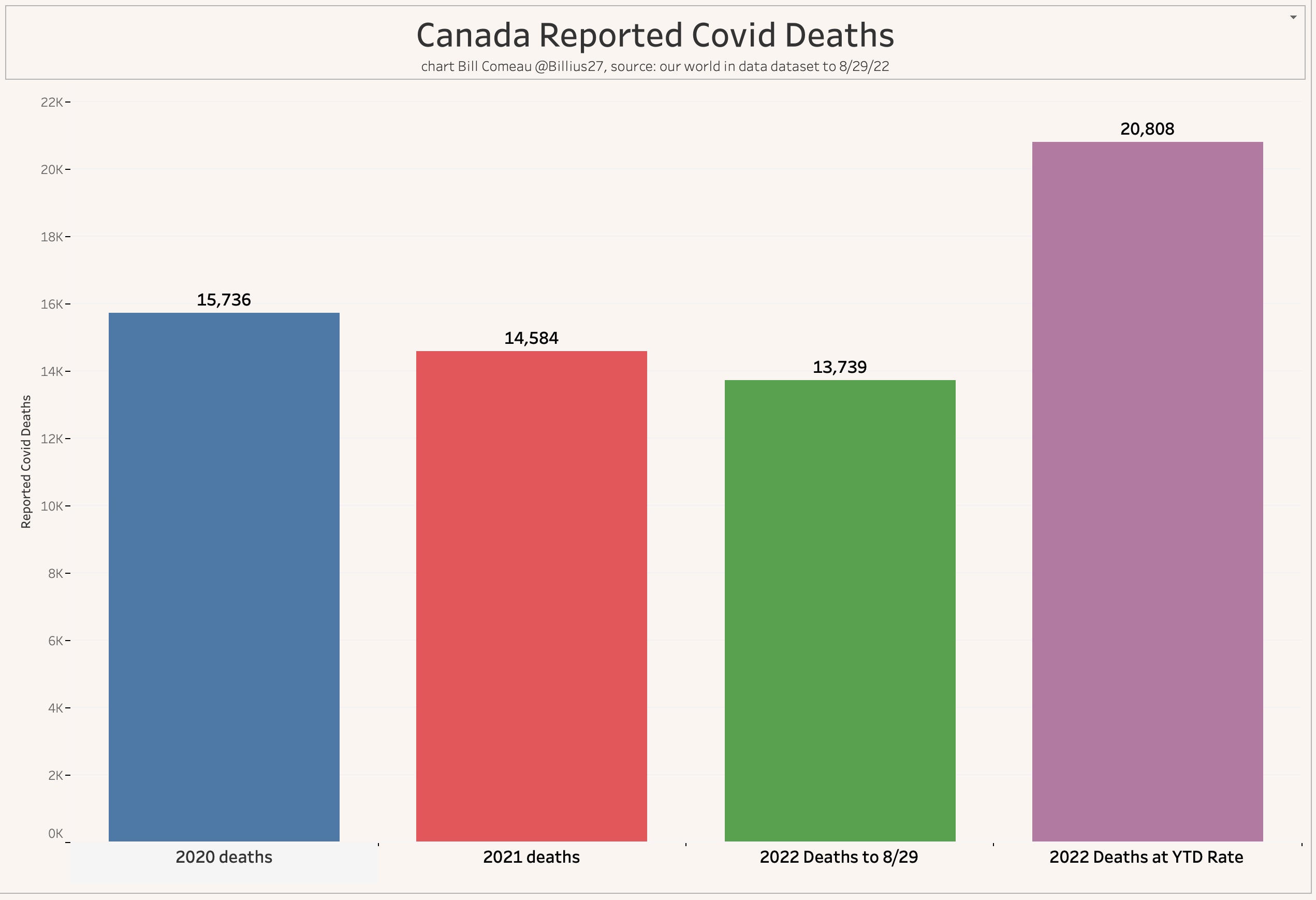
More Canadians are dying of Covid now than ever. 2022 has already surpassed 2021 in number of deaths, and is well on its way to surpassing 2020’s total.

Canada reported Covid deaths: 15700 deaths in 2020; 14500 in 2021; 13700 in 2022 so far; but on track for 20808
This is a bit old; 2022 has by now surpassed 2021

Covid is the third leading cause of death of Canada. It is five times more deadly than the flu.

Many of the dying pass through hospitals first, contributing the unprecedented level of crisis, with emergency rooms repeatedly closing across Ontario for the first the time in history, and serious problems in other provinces as well. While Covid is not the only reason—understaffing, low pay, structural flaws, etc. are others—it’s a really significant contributor.

Number of Covid 19 patients in hospital in Canada

Remember why we did all that social distancing in 2020 and 2021? The main reasons? It was to save lives and to preserve hospital capacity. All our efforts are being undone now.

This is happening because the government went too far in removing restrictions

I’m not saying we need a return to the full social distancing of those years. Policies such as business closures, remote schooling, social gathering limits, and travel restrictions had very clear downsides, and given the good news I started with, can defensively be added.

But getting rid of mask mandates almost everywhere; essentially stopping meaningful vaccination efforts after teens and adult Canadians had two doses, and before children had any; and changing the isolation requirements such that the infectious are definitely out amongst us—the damages of all that on society outweigh the minimal individual benefits.

Tools to manage sixth wave (coffins, body bags)

Why are they doing this?

Because it benefits them politically. I’m not going to pretend to know exactly why they think it’s a political winner, but they clearly do.

And Public Health is very much under the yoke of provincial government direction. They are more motivated to to please their political masters than protecting you and your family. (Ontario proof: Disbanding the Ontario Science Table because they insisted on providing independent advice, and not just saying what the politicians wanted them to say.

Being beneficial to a political party’s election prospects doesn’t make it good or wise policy. Doesn’t mean it benefits you personally or the province generally. Doesn’t mean it’s in our collective best interest, long term.

Why should I care, I’m young and vaccinated

The young and the vaccinated are indeed unlikely to be hospitalized with or die of Covid. But Covid spreading so widely is still a problem for that group (which includes me—at least, in the vaccinated part of that category).

Being sick sucks

Those people who dismiss it as the flu—the flu is terrible, what are you talking about. When I had the flu as a very healthy 21 year old, I literally couldn’t get out of bed, I was so sick. I had to call for help!

And I realize some people truly have a very mild acute Covid case, but most people, at least for a couple days, feel pretty damn awful. And some people it’s more than a couple days.

And even if it’s the sniffles… The sniffles also kind of suck! Sore throats aren’t great!

And you can catch Covid again. It’s not a “one and done” disease.

You might need a hospital for some other issue

Our whole healthcare system is built around hospitals. (Probably it shouldn’t be, but it is, and changing that won’t be fast or easy.) And just because you’re unlikely to need it for a Covid infection, doesn’t mean you or yours won’t need it for something else—an accident, a serious infection, a troubling test result, intractable pain, an overdose… And then it’s going to be big freakin’ problem for you personally that you can’t the care you need in the time you need it, in part because of all the Covid patients in there.

It’s affecting other services

While, again, it’s not the only cause, Covid is a definite contributor the flight delays and cancellations that have been the ban of travelers; to supply chain shortages; to labour shortages; and to other cancelled events (most recently for me, a play at Stratford).

Long-term, Covid might still bite you in the ass (metaphorically)

There’s that Long Covid risk, for one. Yes, vaccination does seem to reduce the risk, thankfully, but not to zero! Not even always that low a risk, depending which study you look at. And there’s no good treatment for it yet. Sometimes people recover, and sometimes they don’t.

And then there’s that whole cornucopia of unpleasant diseases you’re at higher risk of in the year following an infection, “even mild”:

  • Heart disease and stroke (the number 1 cause of death in Canada, so Covid is “contributing” in this way as well!)
  • Diabetes
  • Brain disorders
  • Kidney disease
  • Shingles (though there is a good vaccine for this one!)
  • Immune dysfunction (leaving you at higher risk of catching, among other things,colds, flus, and Covid again)

But what can we do, Omicron is so catchy

You can keep everything open at full capacity while also making indoor spaces safer from infection. We know exactly how to do so. You follow a plan such as this Equity Schools Policy Plan, whose advice would work for pretty much any public space. The key points:

  • Support vaccination
  • Plan for mask mandates at the start of surges
  • Support testing
  • Improve ventilation and filtration
  • Support isolation when infectious

How do we make any of that happen?

Well, that’s a bloody good question, isn’t it? Because government sure doesn’t want to do it!

I’d certainly like to try to do something, as that seems more productive than merely fretting or raging.

Contact politicians / public health officials

Personally, for me, writing letters to or phoning government officials is not terribly satisfying, as it feels like screaming into the void. However, they apparently do at least somewhat keep track of what calls / emails / letters they get on what subject, so it’s good if some people express disapproval about the current path.

File a human rights complaint

This group of Ontario Physicians, Nurses, Scientists, and Education Professionals has written this amazing letter, urgently requesting an inquiry into the human rights violations represented by the current policies (discrimination on the basis of age, disability, family status, and sex): https://drive.google.com/file/d/1ceci-kYmOLz19LZHdNCLijnP4Ux4WxRb/view (PDF)

These people have particular clout (and deep research at hand), but anyone can file an Ontario Human Rights complaint.

Support (or launch?) legal challenges

Threat of legal action has caused the Ontario government to act on vaccination (opening up fourth doses, making the vaccine available to children under 5). This parent’s group is raising money to legally challenge the Ontario government’s lack of Covid protections in schools: https://gofund.me/e0a4840d

Do you have a case, or can you support others who do?

Stay home when sick if you can

Our society needs to get past this idea that it’s heroic to work, and that it’s any kind of acceptable to go out in public with an infectious disease. If you are privileged enough to have sick days, to be able to work from home, please do isolate if you feel unwell.

And if it turns out to be Covid, please stay isolated until you test negative on a rapid test.

But an awful lot of people just can’t do that. And now public health has told those people they can head right back to work 24 hours after they start to feel better, no matter that they’ll likely be infectious for many days yet.

Canada needs paid sick days, like other civilized countries have. Consider voting for political parties that support workers, maybe?

Support masking

With apologies to people who work in these areas (except that this might protect their health), I do think masking should have stayed in place on transit, in schools, in grocery stores, and in pharmacies—in essential spaces, in other words. And I think they need to stay in place forever in hospitals, long-term care homes, and for other medical services.

I don’t know how to make that happen. I’m not about to organize a pro-mask rally.

I’ll do what I can to support mask mandates wherever I can. Currently, a few universities are among the few institutions willing to have them. So instead of giving a donation to Waterloo U, my alumni that doesn’t have a mask mandate, I think I’ll give it to Wilfrid Laurier, the local university that does. And I’m going to tell them both of them why.

And, I’ll keep wearing a mask myself in public indoor spaces. Yes, it’s mainly to protect myself. But I also know that a huge reason most people don’t mask is simply that most people don’t mask.

That is, nobody (or not very many people) wants to be the one weirdo in the mask. An unmasked person surprised to walk into a sea of masked faces might very well put one on themselves (if offered). Someone feeling a bit nervous about their risk of infection but not wanting to stand out alone might then feel the courage to put one on.

Elastomeric mask
Me in an elastomeric mask that I have yet to wear in public, because my masking courage also has limits. (Elastomeric masks are the most protective available, but yes, they look a bit weird! Fortunately, N99s are also quite effective, and these days look fairly normal.)

Maybe because they feel a solidarity.

Maybe because they think I’m walking around with an active Covid infection, per latest public health guidelines.

You deserve clean indoor air

No, we cannot quickly, widely, and cheaply improve public building’s ventilation and filtration systems such that indoor spaces are nearly as safe as being outdoors.

But most indoor spaces can be improved to some degree by measures that are pretty quick and cheap—opening windows, moving furniture to improve air flow, setting HVAC fans to run continuously, using better furnace filters, adding HEPA filters or Corsi-Rosenthal boxes… That sort of thing. Which can be built on with time.

And any improvement has the potential to reduce the number of people in that space that get infected. Furthermore, improving ventilation and filtration:

  • Requires no individual action—no masking, no hand washing, no distancing (although layering on these things remains helpful to the individual!)
  • Benefits health in other ways—improved cognition, allergy control, headache reduction, energy levels…
  • Is a good investment into the future, a building improvement that remains helpful beyond the purpose of suppressing Covid.

This feels like one of the most positive things that can be done.

I bought a CO2 monitor a while ago, as it’s a useful proxy as to whether an indoor space is well-ventilated or not. But having found out, I really wanted the ability to share the information. And I craved a way to find out without going somewhere first myself, only to be sitting there for hours knowing it’s terrible (which has happened).

So I was very happy when the Raven CleanAir Map launched.

It’s in the early stages. But these people have plans, and now, some funding. I have been to some meetings, I have contributed some readings, and so are more and more people, every day.

You can’t fix a problem you don’t know about. You can’t see or smell bad ventilation. Somehow, you have to measure it. This is one way. This is step one. Which spaces have a problem.

Next, we do small fixes. Then, bigger and better ones.

Clean air. It’s not the most glamorous battle, but to me, it’s one worth fighting.

Ontario election dilemma

Ontario’s having an election in a few, and I’d rather Doug Ford’s Progressive Conservatives not win the most seats. The main reason is that climate change remains our biggest problem, and this party has been and will continue to be terrible on the environmental front. We can’t really afford that for another four years. Not only are they not trying to reduce emissions, they really seem to want to increase them. Their main campaign point is that they more people in more cars on more highways, producing more greenhouse gases on the paved-over wetlands.

But, the PCs also weren’t great on (just off the top of my head):

  • Healthcare—Freezing wages, cutting public health
  • Long-term care—Failing to protect seniors in care (like, seniors died of starvation and neglect, not Covid…)
  • Autism—Cancelling the Liberal autism program because the wait list was too long, and replacing it with nothing but an even longer wait list
  • Opioid addiction—Arbitrarily capping the number of needle exchange centres in the province while overdose deaths soared
  • Open government—Paying lawyers to keep secret information citizens have the right to know, such as ministerial mandate letters and taxpayer-funded reports on municipal amalgamation
  • Municipal government—Cancelling the ranked ballot option (why?), changing the number of Toronto city councillors mid-election (!)

So, clearly I would like people to… well…. do what exactly?

Vote for a member of another party, of course. But that’s the issue: which one? This ain’t a two-party system. And none of the other main alternatives—NDP, Liberal, or Green—are clearly the best choice. At least to me, anyway. But I think to a lot of other people, also.

Which is why we have this split. A chunk who will vote PC, because you always have a minimum 30% or so who will, with the remaining majority of voters dividing up support in such a way that the PCs are well on track to win more seats than anyone. Quite likely a majority of seats overall, which will allow them to govern and do whatever the heck they want.

PCs at 36% vs Liberal at 28%, NDP at 24%, and Green at 5%.

The other parties should combine and stop this from happening

I keep hearing this, even now, from people whom, I guess, don’t really know how our political system works?

The election has started. The ballots are printed. Heck, people have already voted! It’s too late for the Liberals and NDP to collaborate and agree to split the ridings and govern as a coalition—which is not really how our system works anyway…?

In the end, after the vote, if the non-PC parties have, combined, more seats than the PCs, they could look to eventually defeat that government and indeed, offer to govern in some sort of partnership as an alternative to making everyone go to the polls again. But not before the vote.

(Also, you know, you can’t just assume that people who like the Liberals like the NDP second best and vice versa. If those parties were to collaborate ahead of time, it could well annoy loyalists into voting for some other party entirely…)

Strategic voting

Is the other big idea, and is at least is in realm of possibility (unlike the fantasy of an NDP-Liberal coalition forming mid-election campaign). But it’s not as easy as it seems, even despite all the tools and movements to help, such as https://votewell.ca/ and (for Toronto) https://www.notoneseat.ca/

The idea is that you vote for whichever party your riding is most likely to defeat the PC candidate.

The problem is that it’s largely based on polling at the local riding level, which is simply not accurate, mainly because it isn’t done! At least not on any mass scale. Polling is mostly done provincially, and then they try to extrapolate to the local level to estimate how the seat count will work out (considering historical data for that riding, etc.). It gives you an idea, but that’s it. It’s not really solid data.

Squaring my own circle

All I can 100% control is my own vote, so what are the considerations?

Party leader

My favourite for sure is Mike Shreiner of the Green Party. He’s smart, he’s likeable, he’s been a constructive presence in the Legislature the last four years, and in my opinion, he was the best at the Northern Ontario leaders debate (one of the better debates I’ve seen a while, actually).

Steven Del Duca (Liberal) and Andrea Horwath (NDP) also seem smart and reasonably likeable, but do somewhat lack in charisma. Del Duca was somewhat better in the debate, in my opinion, for what that’s worth.

Platform

If you look at my Vote Compass:

Liberal 73%, Green Pasrty 64%, NDP 63%, PC 43%

The Liberals have it.

But, I feel like each of these parties has some promises I really like, some that I’m meh about, and a few I’m not quite on board with but, overall, any one would be an improvement over the PCs.

Local candidate

The only local candidates I know anything about are incumbent Catherine Fife of the NDP, and Shefaza Esmail of the Green Party, whom I talked to briefly on the phone. I’ll have to nerd out and watch a local debate to see how the others are, but Catherine has been a good MPP: smart, engaged, well-spoken. At this point, she certainly seems like the best local option.

In sum

I have my own three-way tie: Green, Liberal, NDP.

If the election were held today…

I’d likely vote NDP, to support Catherine Fife, and because, despite my serious doubts about strategic voting… She still seems like the smart choice if you’re going to consider it at all.

(For what it’s worth, VoteWell has Waterloo pegged as more of a Liberal / NDP battleground, and says you can therefore vote for “the candidate you prefer”. I dunno. Last time the PCs did come in second, but that was also the Great Liberal Collapse election, so… Who knows. Strategic voting is a mug’s game.)

Anyway. Making up my own mind isn’t really the problem.

The problem is how to you chip away at the soft part of the 37% currently planning to vote PC, and try to get them to vote some other way?

… When you can’t even quite tell them what that other way should be…?

I do still love this ad…

Covid conundrums

I had started this post a while back, on the difference between the people who will do everything the COVID rules you say you can do (dine indoors, drink at bars, get a tattoo, hang out at the mall, attend a large indoor wedding), and those who mostly try to follow the guidelines—which are to avoid gathering with people from outside your household, and to stay home as much as possible.

And that the guideline people can get kind of irritated with the rule-following people.

Shannon Proudfoot tweets about people in restaurants
From journalist @sproudfoot

And then I was getting into the fact that it didn’t help that the rules themselves were so illogical:

  • Outdoor weddings are capped at 100 participants, while more dangerous indoor ones can have over 200 (being based on a percentage of total capacity).
  • Movie theatres cannot project movies to any number of masked, distanced patrons, but can serve alcohol at their venues to unmasked patrons, up to 50% capacity.
  • Theatre companies cannot film plays at their venues, under any protocols, but can rent out those venues to companies to film movies or TV shows.

Not to mention the fact that different parts of Ontario kept shifting into different “color code” areas, and that the meaning of those color codes kept changing, so who could keep track anymore anyway?

And that while I feel that I’m mostly in the guideline camp, it is weird to find myself with the rule people on one issue: wearing masks outside. Because I generally don’t do this. I do if I’m standing in line, having a longer talk with someone outside my household, and on more crowded streets. But otherwise, no. I do try keep moving and always give other people space. I figure, outdoors, that should be enough to keep us safe.

But this annoys some guideline people, as to wit: Even when you’re outside you should still be masked, which I’ll quote part of:

It was a very busy weekend for walkers in downtown Waterloo this past weekend and most walkers had no masks. Perhaps there should be more enforcement by bylaw officers.

Carolyne Wagner, Kitchener

The first thing I want to say to this person? 

“There’s no rule that you have to wear a mask outside!”


But since then, my attempt at light-heartedness seems a bit off, because things are really terrible now and about to get worse. And now the rule muddle has simplified, somewhat, in that all of Ontario is moving to “gray color code” for at least four weeks.

A lot experts think… These latest measures just aren’t going to work. For the worst parts of Ontario, Toronto and Peel, nothing much changes—they’ve basically been in this state of closure since October or so. How changing nothing going to make case numbers go down instead of continually up? Are those areas going to benefit that much from people not being able to go to other parts of Ontario for lunch or a haircut?

While the Christmas lockdown was effective, this one isn’t as restrictive (notably, schools aren’t moving back to remote, despite evidence of a lot of spread there), and that one wasn’t maintained nearly long enough. So we’re starting this one at a worse state than we did that one. So too little, and starting too late.

It’s all… super depressing. I will not get into extensive political critique myself, but I do encourage you to read Bruce Arthur’s summary (a 5-minute read):

Remember the choices Doug Ford made when ICU doctors are making theirs

(And just say, next time: Vote different! Well unless you voted NDP, Liberal, or Green. Then maybe vote the same.)

The only thing that makes me feel any better these days is reading about vaccination. Yes, it’s been too slow, it’s clunky, it’s uneven, there have been mistakes, but nevertheless, it’s the only thing going semi-well, and where the numbers actually improve daily.

Chart from John Michael McGrath, TVO—this is one case where rising numbers is good!

Chart of vaccination rates, Ontario
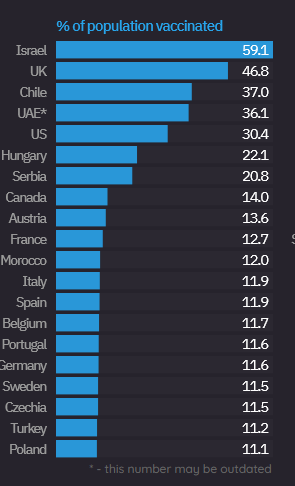
And since there’s been so much fretting about Canada’s relative performance, Jean pointed me to this chart, from Information is beautiful:
% of population vaccinated, Canada in 8th spot

14% (and rising) with at least one dose isn’t going to get us out of the current crisis, but at least it puts us on the path.

Winners and losers: What a week!

I did not expend a lot of mental energy worrying about the US election, but not because I felt confident that the Joe Biden and the Democrats would easily win it. It’s simply because, after therapy, I have gotten better about not spending a lot of time worrying about things I have no control over. And as a Canadian, it’s really no control. I couldn’t vote, couldn’t donate, couldn’t campaign. Just watch it happen.

Continue reading “Winners and losers: What a week!”

Not an open and shut case

Both Ontario and Toronto hit record numbers of COVID-19 cases this week, yet Doug Ford, it seems, wants the shuttered restaurants, bars, gyms, and cinemas to reopen. Is that really wise?

Nobody much cares what I think about it, but I can’t help thinking about it anyway. So now I’m inflicting my thoughts on you.

Continue reading “Not an open and shut case”

Garbage election day

Monday, October 22 was the municipal election day in Ontario. Much as I rely on electronic calendars like anyone else, I still like to rock it old-school with the paper calendar,  on which I note items such when garbage day (that is, the biweekly date on which the region picks up trash along with the recycling and compost they pick up weekly) and municipal elections occur. Those fell on the same day this year, so the calendar read: Garbage Election day.

Only it wasn’t.

Nor was the historic US midterm election that took place on November 6. It wasn’t immediately apparent how historic it was, because the counting and recounting, it turns out, goes on long past that date—it just finished last week or so. And the Democrats got the largest margin of victory in history, thanks in large part to that election having had the largest turnout for a non-Presidential election in a century.

midterm-turnout.png

Way to go, Americans.

Our municipal elections, of course, were far less consequential, and featured the usual poor voter turnout: 34% for the City of Waterloo (though 48% in the uptown Waterloo ward, so kudos to them). I don’t see this ever changing much unless we bring political parties into municipal politics, allowing people to forget about the individuals running and just focus on party platforms. Which I don’t want, as the partisanship would be a terrible side effect that we get enough of at every other level of government.

Municipalities try to increase voter turnout. This year, several cities and townships in Waterloo Region—not including the City of Waterloo—offered electronic voting from home. Though this greatly increased the days on which you could vote, a lot of people left it til election day. And then the system crashed under the load. Forcing extensions to the voting time, in some cases by an extra day.

Hence we didn’t get all the results—including who the new Regional Chair would be—until a full day later. Whereas cities who used the old paper ballots had results counted in a few hours.

Also, it didn’t really increase voter turnout.

Apart from the potential computer snafus, the most compelling argument against electronic voting is that some dominant person in the household could do the voting for everyone else. I’m sure that would be a very small problem, but there’s no way to eliminate it. Whereas when you have to go vote in person, everybody gets a chance to mark their own x’s in private.

Obviously, compared to the US wait, one day longer wasn’t a big deal, but it was odd and I was curious about the results. If you are going to vote in these local elections semi-responsibly, you do have to do a fair amount of reading and research. And at least in these parts, there’s no polling to give you any idea who might win!

There were some pleasing and somewhat surprising results.

In the absence of parties, incumbents always have a big advantage, with many getting re-elected for years. But in Cambridge, long-time mayor Doug Craig lost out to Kathryn McGarry (who had her own name recognition due to having recently been the city’s MPP). To me, Doug Craig’s political philosophy could be summed up as Cambridge First, characterized as an unwillingness to compromise and a large propensity to complain. I was happy that the people of Cambridge were also getting tired of that approach. (And now Craig is planning to run for the federal Conservatives.)

And Michael Harris, who had been unfairly (in my opinion) cast out of provincial politics by Doug Ford shenanigans, won a seat on regional council. He always seemed one of the brighter lights in the Progressive Conservative party, so I was glad to see him get another chance to serve (in a less partisan environment).

In general (and as in the US), a lot more women got elected. The new regional chair is Karen Redman; Kitchener City Council and two of the townships achieved gender parity. On both Waterloo and Kitchener City Councils, women candidates managed to defeat incumbents.

regional-chair.png
She defeated these three guys

ward-5-waterloo.png
She defeated this guy (the incumbent)

On the other hand, the two women I voted for (there are two seats) as Waterloo regional councilors both lost to men. But, at least the two men in question weren’t unqualified, boorish, populists, so one can take some comfort in that.

In my city ward, the incumbent chose not to run again. One candidate captured the support of most of my immediate neighbours by expressing dismay about the planned residential high-rise building nearby. I considered joining that bandwagon, but ultimately voted for Royce Bodaly, who seemed to have a really good grasp of the local issues and a real online presence, and who made an effort to visit every household in the ward during the campaign. I must have talked to him for 20 minutes myself! He ended up winning the seat… By a margin of 11 votes. (And yet, there was no recount.)

By the way, I am not critiquing how long the US results take—or that they have recounts. Those are elections on a much bigger scale, of course, and conducted very differently (in ways I won’t pretend to understand). Giving people various ways to vote and taking the time to count all the votes is good, even though that means you can’t trust the narrative on voting day. It’s not a blue wave! Unless, wait for it, wait for it, yes it is…

One of the challenges raised in the US midterms (in Maine) was over the use of ranked ballots, as the leader after the first round of ranked ballot voting lost his lead in the second. (The results were upheld.) Ranked ballots were also tried in one Ontario city this year: London. They had to do something like 14 rounds of counting, but in the end, the same person who was in the lead after the first round became mayor. People said that demonstrated that ranked ballots are pointless, but I’m not so sure. There were a lot of people running (hence the number of rounds of counting), and at least the winner now knows he’s not a polarizing figure, and that the majority who voted are basically OK with him being their mayor.

I think it might be worth trying elsewhere. (Cambridge and Kingston voted to do so in the next election, though the results aren’t binding in Cambridge.) When you do this local election research, you do generally end up with not only your #1 choice, but an idea of the other people you think would also be OK, and those you really don’t want elected under any circumstances. So marking your ballot accordingly wouldn’t really be so much more work.

Finally, municipally there was a period after the election where the previous council continued to sit and govern, til the new crew were oriented and took over about a month. There was no drama or scandal surrounding this that I know of—except perhaps Cambridge council voting themselves a raise without accepting the offsetting reduction in benefits. But they did that for selfish reasons that they wanted their cake and eat it too (many were re-elected), and not to hamstrung the newbies.

The US has a longer “lame duck” period during which some states, like Wisconsin, well:

wisconsin.png

Details: https://www.huffingtonpost.ca/entry/in-stunning-power-grab-wisconsin-republicans-pass-bill-weakening-new-governor_us_5c06e268e4b0680a7ec9a289

Democracy, man. It’s fragile. But worth fighting for.

Democracy then and now

Saturday we went to a fundraiser for the Cambridge Fashion History Museum. They were holding a Tango Tea, and type of event popular in the 1910s. This was a high tea at which people would do the popular dances of the day—including, but hardly limited to, the tango. They encouraged us to dress in outfits reminiscent of that time. I didn’t have exactly that, but wore a tango dress with a fashion hat—I looked at pictures, and everyone wore hats then.

Me with a Givenchy that was part of the exhibits

Jean wore a fetching pinstripe suit and his Dad’s fedora; unfortunately, the person we got to take Jean’s picture didn’t press the camera button all the way down, so his outfit is lost to the mist.

Another friend took a picture!

They brought in a Stanford professor who specializes in dance history. He did a few classes in the morning that we didn’t attend, but during the tea also did some demos and shorter lessons on the basics of the one-step, the grizzly dance, and other popular dances of the time. Our ballroom dance instructor wouldn’t have approved of the techniques (or lack thereof), but it was fun learning and seeing these dances that did evolve into today’s waltz, tango, quickstep, foxtrot, and samba.

The Sufragettes were active in the 1910s, and through some educational (but fun!) games, we learned more about them. We were also invited to join the movement.

The two ladies in the centre made these dresses themselves

In Canada, most women earned the right to vote in federal and Ontario elections in 1917. Asian women were excluded until after the Second World War, and Native women earned the right only in 1960.

In 2018, Canada has a feminist Prime Minister who insists on a gender-balanced cabinet (though parliament remains far from balanced). In Ontario, we have a ridiculous, unqualified Premier who beat several far more qualified women on the way to power.

So, the fight’s not really over.

Premier Ford is currently pretty busy throwing Toronto’s municipal election into chaos for no reason while trying take away their right to free speech as quickly as possible, so when Greenpeace added to his pile of lawsuits for not doing the legally mandated consulting before cancelling cap and trade, he capitulated (to some degree) and opened a one-month opportunity to comment online. You can find it here: https://ero.ontario.ca/notice/013-3738. Just click Submit a comment.

Not sure what to say? Well, in case it helps, this is what I submitted. (And no, I don’t think it will make a difference, but at least I’ll be able to say I tried.)

Continue reading “Democracy then and now”