Please save us, NDP, you’re our only hope

Given its persistence in my thoughts, apparently I need to write something about the strange goings-on in Ontario politics.

Setting the stage

To catch up people living elsewhere:

The Ontario Liberal Party is currently in power. It has formed the government since 2003—15 years. The official opposition is the Progressive Conservative (PC) party.

There is a provincial election in June.

With the Liberals, and leader Katherine Wynne, having persistently low approval ratings, the PCs appeared poised to win that election.

It was all kind of routine and dull. Which isn’t necessarily a bad thing.

But then the PCs decided to make it interesting

About four weeks ago, PC leader Patrick Brown was accused of sexual misconduct; specifically, of initiating intimate activity with women who were much younger (though of legal age), while they were inebriated. One of them worked for him.

Brown denied the accusations and vowed to stay on as PC leader. He was convinced to step aside by his staff, who resigned en massed, and by the rest of the PC caucus, who went on to elect Vic Fedeli as interim leader.

Fedeli then discovered serious problems within the PC party itself, including a sexual assault allegation against the president of the party and bogus membership numbers. There were more resignations.

The new PC party officers decided to have a quickie leadership convention, with a winner to be declared on March 10. Four candidates entered the race, include Doug Ford, brother of former Toronto mayor Rob Ford (gah!), and a woman (Tanya Granic Allen) who thinks children shouldn’t be learning anything about sex in school. (She was just endorsed by a white nationalist organization. That’s nice.)

Satirical take on Doug Ford’s leadership announcement. But he really did announce it in his mother’s basement, and he did used to be a drug dealer

And then last week, Patrick Brown came out swinging. He defended himself against the sexual misconduct allegations (including, in part, through statements from his girlfriend, 17 years his junior, whom he started dating when she was his intern. Umm…). He launched a defamation suit.

Oh, and he applied to be PC leader again, and has been allowed to run.

And then they blew up their platform

That Patrick Brown won the PC leadership in the first place was a surprise. He had been undistinguished backbench MP in Stephen Harper’s Conservative government. But he won by getting a lot people to sign up as new members of the party to vote for him.

He ran for the leadership as being at least sympathetic to social conservative views, but as the election, he and his team gauged that to win Ontario, you had to be a bit more centrist. They came out with a platform to mostly… Keep doing what the Liberals had been doing. The only “radical” element was getting rid of the Liberal’s cap and trade system for carbon pricing, and instead adopt the federal Liberal’s carbon tax plan. They would use the greater revenues from that to reduce income taxes.

But one by one, all the PC leadership candidates have declared they will not support carbon taxes. And they are going to get rid of cap and trade, too. in Maclean’s, Mike Moffat outlines how Scrapping carbon taxes leaves a gaping hole in the Ontario PC platform. To not run a deficit, they’d have to cut spending by $16 billion instead of the originally planned $6 billion. And they simply won’t have any way to cut greenhouse emissions. Ontario just won’t.

people-s-guarantee-ontario-pc
So much for that….

Except, as National Post’s Andrew Coyne has pointed out, A carbon tax is coming, no matter what the PC candidates say. Because if they do cancel cap and trade, then the Federal Liberal government says they are going to impose a carbon tax on Ontario (and give the revenues back to the province). While it’s always possible the Federal government will backtrack on that plan, none of the PC candidates can personally make that happen. Whining alone will not do it.

And that’s one of the reasons Patrick Brown stepped back into the race, he says: To defend his platform. For the record, I do not believe his motivations are noble; I think he’s just very ambitious and really wants to be Premier. But he’s not wrong in saying that the policy void of the rest of the candidates is irresponsible.

Problem is, responsible policies will not win you the PC party leadership. Compared with the general population, the PC membership has a much higher percentage of people who hate carbon taxes in a deep, passionate, and irrational way, and cannot be convinced to accept them as policy, no matter (for example) how big an income tax cut you offer in return. Saying what you need to say to get past the members in March, then pivoting to become mainstream enough to win in June, is going to be a challenge for whoever wins this.

Which proves that having a tiny minority of the population with special interests select party leaders is ridiculous. Elected members of the party caucus should be the one to decide who leads them. Member vote has been the practice long time in Canada; there’s no real momentum to change that now. But if that time ever comes, this will be a textbook case as to why it’s needed.

So do the Liberals win again?

I’m not going to make that prediction. If nothing else, the PCs are gaining a ton more attention than they managed with Patrick Brown as uncharismatic leader, and the Liberals remain stubbornly unpopular. (That people say they actually dislike Katherine Wynne as a person is a puzzle to me, by the way. To me, she comes across very well, as knowledgeable, compassionate, and well-spoken. But maybe people are just tarring her with whatever Liberal policies they’re angry about.)

140304wynnec

Which seems to be mostly increased hydro rates? Although those date back to some bad contracts that previous Liberal premier Dalton McGuinty got us into, and that no party can get us out of. But the Wynne government has made some of their own bad decisions (along with some good ones, it has to be said): I’m not convinced that selling Hydro One was such a great idea. I’m not a fan of their LCBO-style plan for selling marijuana. Back-tracking on their promise to Toronto mayor John Tory in implementing tolls on the DVP and Gardiner was unconscionable. As is the amount of money they spend trying to get us to gamble more, online.

Overall, I think they could use a little time out here.

But I can’t see voting for that gong show of a PC party, either.

Our last hope? No, there is another

Ontario actually has a third party with seats in the legislature: The NDP.

Even before all this, I was leaning toward voting NDP. My MPP, Catherine Fife, is from that party and is a very good representative. She deserves to be returned to Queen’s Park.

But the party as a whole still seems to having trouble setting themselves up as a government in waiting. Even though they have the most popular leader. Even though the PCs are in a bit of a mess and people are tired of the Liberals. The NDP still seems to have trouble getting any attention, and keeping showing up third in “Who would you vote for” polls.

Could be a few reason for that, including having less money than the other parties, but they also seem notably light on the policy front. (Though what they have, on pharmacare and Hydro, seems sensible.) Maybe they should take a page from the Liberals, who have been known to crib from the NDP, and borrow some from other parties.
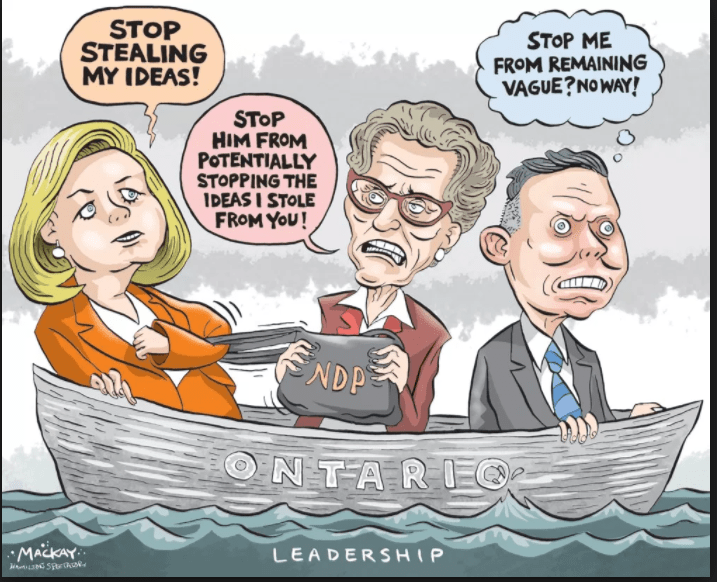
ndp-ideas.png
Horwath, Wynne, and Brown (this is an older cartoon….)

Like, the Ontario Green Party has some excellent policies, such as having small business dispensaries sell marijuana instead a government monopoly.  (Also, Ontarians should consider voting Green, at least anywhere they stand some chance, like in Guelph.)

And / or, how about if the NPD gets rid of cap and trade, happily accepts the Federal government carbon tax, and gives everyone an income tax cut?

For one thing, it would be hilarious to see them debate the PC leader on that. And the NDP isn’t going to get any of the “I hate carbon taxes” vote, anyway. They could even put an NDP spin on it, and make sure all low-income people got a carbon tax credit.

An NDP government in 2018?

Look, it’s a long shot, it definitely is. But the past four weeks have shown that nothing in Ontario politics is as predictable as we’d thought.


Kind of brave

So some months ago, a blue-chip corporate advisory panel recommend the following tax policies to the Ontario government:

  • Reducing corporate taxes
  • Imposing a carbon tax
  • Harmonizing the PST and GST

At the time, all were dismissed by Dwight Duncan, Liberal Finance Minister. And I thought of posting on it at the time, that it was sort of unfortunate they were ignoring that advice.

Now that the situation has changed, I guess I owe some kudos. Especially as I see all the commentary and poll numbers about the sales tax harmonization as a “tax grab”. This isn’t going to be popular.

Now it isn’t, from what I can tell, actually a tax increase for the government overall, as it’s being combined with lower corporate and personal taxes.

But the government is not going to get any credit for that. People will notice paying the PST on things they didn’t have to before, and they won’t notice that their pay cheque (if they still get one) is now a little bigger (unless it isn’t for other reasons).

So, it was kind of a brave move.

Don’t want to overstate that—they do have the comfort of fairly weak opposition parties at the moment, and they were able to defuse criticism by keeping the PST off hot-button items like books, tampons, and diapers. And of course, all those cheques most will be getting that first year.

Still. Going from 0 to 2 out 3 ain’t bad. (Got that song in your head now?)

RDtNVC: Increasing energy prices without compensating with tax cuts

There were two letters in the Record yesterday related to the carbon tax plan. One asked how charging for pollution could possibly reduce it — wouldn’t companies just pass the increased cost onto customers as higher prices? The other asked, wouldn’t it be better to just force big polluters to pollute less, via regulation?

Both good questions. Comes down intuitively favoring a regulatory or “cap and trade” approach over a carbon tax, as so well articulated by Jeffery Simpson in the Globe and Mail:

They [the Green Party] bring urgency to the debate that the Conservatives lack, and they’ve got one thing right: that carbon emissions have to be assigned a price, that a tax is a defensible way to do it, and that the revenues from the tax are best recycled into lower personal and corporate income taxes.

There is another way of finding a price, through a cap-and-trade system, as proposed by the Conservatives and NDP. This targets mostly large polluters. Some of the costs are then passed to consumers. Using the tax, a method favoured by many economists, gives carbon a price certainty but doesn’t guarantee a particular emissions result; using the cap-and-trade produces a particular result but at an unknown price.

Politically, the cap-and-trade is a much easier sell, since the eventual effect on the ordinary person is indirect, whereas changes to the tax system are in the faces of consumers. The easier politics of the cap-and-trade explains in large part why Conservatives, New Democrats and U.S. politicians like it.

It’s too bad we can’t have a reasoned debate between these two approaches, instead of the slanging match and attack ads about the “carbon tax” that the Prime Minister calls “insane” and says will “screw” Canadians and “wreck the economy,” something that’s not happened in any of the countries that have thus far introduced one.

Now, I’m think of writing my own letter to the editor on this subject, and I can’t just plagiarize Jeffrey Simpson if I do that. So here’s my draft, which I’ll refine later! [I’m such a technical writer, sometimes. Just can’t resist the bulleted list!]

Something that seems to be missed in all the wild claims about the effects of a carbon tax on the economy and prices is that the regulatory or cap-and-trade system offered as an alternative will also raise energy prices — and without balancing them with an income and corporate tax cuts.

A cap-and-trade system involves only the largest polluters. Total target emission levels are set and are assigned a price. Companies who pollute the most pay the companies who emit the least. But exactly as with a carbon tax, some of those extra costs are likely to be passed on as higher prices for consumers.

The reasons the most economics and environmentalists — groups that don’t typically agree on much — favor a carbon tax over a cap-and-trade system include the following:

  • By involving everyone, not just the largest polluters, the potential reduction in pollution is therefore much greater.
  • With a cap-and-trade system, there’s no benefit to companies that will never reduce their emissions below the overall target, so they won’t. With a tax, the more they reduce, the more they save–and the greater the environment benefits.
  • It rewards companies and individuals who are already doing well, environmentally. They get more back in income and corporate tax cuts than they pay in increased carbon taxes.
  • Corporate and income tax cuts are generally stimulative to the economy, freeing up more money for investment, savings, and spending.

The truth is, the environmental policies of all the political parties–including the Conservatives–are going to increase energy prices. The question is, do you want an income tax cut to help you pay for those inevitable price increases, or not? If you do, then you should vote for one of the two parties planning to implement a carbon tax: the Green Party or the Liberals.

(2023 Postscript: These are the roots of the Conservative war on carbon taxes, but interesting that they supported cap and trade at the time. Also interesting that the Liberal plan was to reduce income taxes as compensation rather than the current “revenue neutral” approach. Finally, so sad that so many years later Canada has accomplished so little on this front.)

Reason of the day to not vote Conservative: The GST tax cut

Update from 2023: Of course, this lower GST rate remains in place to this day, 8 years into a Liberal government, with no suggestion of change from any party, far as I know.

An easy one for today: Cutting the GST, a policy so bad it actually united right and left [link removed as no longer valid] in opposition to it.

I think Jeffrey Simpson’s “A triumph of politics over economics” [link removed as no longer valid] summarizes the issue best:

Personal and corporate income tax cuts, as every economist knows, tend to stimulate savings and investment, which is what an economy needs to become more productive and competitive, thereby raising overall living standards. Lower consumption taxes stimulate more—wait for it—consumption, some of which leaks out of the economy in the form of purchasing imports and taking trips abroad.

The GST cut is the triumph of base politics over sensible economics.

Thus far, the Harper government’s tax and spending policies have been deeply disappointing for the country’s competitive position.

The government will have drilled a $10-billion hole in federal revenues through the two-point GST cut that will do nothing for productivity and competitiveness when compared with every other available tax cut, as the economists interviewed by the ROB illustrated this week.

Both policies represented the triumph of politics over economics, and short-term political considerations over long-term economic thinking.

Instead of this nonsense, tax policy should involve raising the GST, introducing carbon taxes, and then offsetting these new revenues by reductions in personal and corporate taxes to make Canada more efficient, competitive, fair and green.

Jeffrey Simpson, Globe and Mail

(And as an aside, CBC’s Marketplace did an interesting story this year where they showed that, in many cases, the GST cut was just swallowed up by rounding, giving more money to the seller and less to the consumer. Examples included movie and theatre tickets, whose “price includes GST” didn’t change a whit as the GST rate did. The companies just made more profit on each ticket.)

Sigh. So more’s the pity that we pretty much stuck with this 5% rate now. Though both the Liberals and the NDP argued against the cut, neither will take the political risk of undoing it (despite Conservative ads claiming the contrary). Only the Greens, bless them, are willing to to pledge to raise the GST back to 6% and use the increase to fund mass transit in cities [link removed as no longer valid].

My response to the Conservatives little Tax poll

Conservative MP’s keep mailing me. They give me these flyers that either say that they are great, or that some other party (usually the Liberals) are terrible, then ask me to check off a box on whether I agree with them and mail it back to them.

So far, I’ve only responded once, telling them I thought their GST tax cut was a stupid idea and they should really have just cut my income taxes. This is my response to their “Who do you think is on the right track on taxes?” question. After checking the Stephane Dion / Liberal box, I added this note:

You seem a bit confused by what the Liberals are proposing here. It’s not actually a tax on everything. It’s a tax on carbon emissions. Now, if that ends up affecting many products, that’s because our society has grown far too dependent on fossil fuels. Is this tax the best way to end that dependency? I don’t know. But it’s certainly better than doing nothing.

You also state that Liberals are desperate for money. Well, that’s a bit rich, isn’t it, from a government that has more or less squandered the big Liberal surplus on various spending programs and a very ill-conceived GST tax cut. Not too mention mailing me I don’t know how many of these silly little polls of yours.

But what’s more infuriating here is that the Conservatives are just hurling insults at the Liberals instead of engaging in an intelligent debate on this very important issue. The Liberal plan is crazy. It’s a tax on everything. It’s a trick that Dion devised downtown urban elites (and what does that one even mean? If you live downtown, it’s hard not to be urban, right? Which, of course, 80% of Canadians are. And “elites” just means smart, successful people—can’t imagine why Dion would think they have anything of value to impart!)

The Green Shift is not a tax trick; it’s a plan. You do tax carbon; you reduce income taxes. While designed to be revenue neutral overall, it’s not going to be revenue neutral to everyone, it’s true; those who pollute more will pay more.

Why don’t you talk about that? Why don’t you get into the specifics of it, and attack those where warranted, instead of hurling vague insults? Afraid that ordinary Canadians won’t get it, won’t understand? After all, they’re not very smart, not like those “downtown urban elites”… You said so yourself.

See, isn’t this fun? You should try it yourself.