Just that I’d been thinking for a while that the number of programs I watched on either “live TV” or recorded on the cable PVR just didn’t make sense for the amount of money I was spending monthly. Especially since most of it was available somewhere else, for less. Sometimes for free.
It was convenient, for sure. Turn on the TV, there it is broadcasting, or sitting in my Recorded Programs list. But $25 for the basic channels, plus $5 for some extra channels, plus $5 for the second cable box, every month… When I’m also paying for various streaming services… That’s quite the premium for convenience.
Cutting the cord. Get it? Photo by Yan Krukau on Pexels.com
No way to change Rogers services online, though. Got to make the call! My first attempt to make it through the Rogers voice mail labyrinth on a Sunday afternoon ended with a curt
No one is available to assist you now. Call back during regular business hours.
I was wondering how I might manage to carve out a couple hours during the work day for this task when I remembered I had an upcoming day off. What better way to spend it?
Aging while on hold. Photo by Boris Hamer on Pexels.com
On the holiday weekday, I made it through to a human. Now, Rogers had recently increased the cost of extra cable boxes by $7. So above, where I had quoted $5 for the extra box—that was now $12. This had received some bad publicity, so the person I was talking to was pretty much tripping over himself to make that part of the bill better for me…
OK, so I can reduce the cost of that box to $5 a month, so that your bill will be the same as before. Is that good?
Sure, good, but not really enough! I made the point that even before this particular price increase, I was finding the service too expensive for my amount of my usage. I wondered if any other deals were available, such that I could keep my convenience… For less.
The options were just so baffling! It’s all bundles, so there’s no way to change the pricing of the TV package without also affecting the Internet service. Better deals were available if signing up for a two-year contract, but it wasn’t possible to do that with the same thing I had, only with slower Internet and the same TV channels, or with better internet and more TV channels, but then the price advantage wasn’t that great… And…
Choices, choices… Photo by Antoni Shkraba on Pexels.com
I pondered. But finally went with somewhat better Internet package, bundled with $5 a month streaming-only TV service, on just one cable box. No live channels. No PVR. No cable.
Billing settled, next step for the Rogers people was my updating my modem and cable box with the new services.
… Which took about two hours, during which I was mostly on hold, but with the Rogers person regular checking in:
Are you still with me? Thank you for your patience. We’re still getting errors. We’re continuing to work on it.
But eventually it took. As parting advice, I got:
Call us back in a month. We should have new deals for you!
Hmm.
I tried things out that evening, and they seemed OK. The Internet was working. The TV was now just a portal into Netflix, Prime, Apple TV, YouTube, etc. (I should note, I guess, that all of our television sets are relatively old, so none of them have access to these services built in.)
Albeit not this old
The next morning, though, our Sonos music system failed to deploy the alarm as expected. It should wake us up to the dulcet tones of CBC morning radio. What we got instead was the default backup, the Sonos chimes. Which was annoying.
When I tried to stop the chimes, I found that Sonos app was unusable, and unable to find any speakers. Now, Sonos has had its own troubles of late, with an extremely poor app update back in May that the company and all of its customers are still feeling the effects of. I was able to stop the chimes on the Windows version of the app on my computer, as that hadn’t really been updated.
That Sonos wasn’t exactly happy that my wifi network had been changed wasn’t overly surprising, and not necessarily generally worrying.
However… While we definitely still had Internet, it seemed to have become extremely fussy about what it would let us connect to. All Google services were happy pappy. But Reddit was inaccessible. We could use Amazon, but not Ebay. I could connect to X/Twitter, but not to Bluesky. (This is bad!)
But if I switched off wifi and used phone data, I could connect to everything.
Rebooting the modem wasn’t helping.
I hoped it wouldn’t come to this. Photo by ThisIsEngineering on Pexels.com
It was all extremely distracting, but it was also a work day. I started up the work laptop, and soon discovered that my work VPN was another thing that the new network was simply not going to connect to. Jean’s work VPN: No problem!
I messaged people at work that I was having technical difficulties. And I called Rogers support. Weird problem, I said. We can connect to this, but not to that. He ran tests. He asked questions, like:
He reported that all looked fine for him. He tried to blame the company VPN, but I resisted the attempt.
The only other thing I can do is send someone out.
He said it as if that was a threat, but it sounded good to me.
I can have someone there within two hours.
And you know what? They did!
And that technician quickly diagnosed that the problem was that our modem was nearly as old as our TVs.
Though not this old
So he replaced it with a new one. And instantly everything worked again. (Even Sonos. Sort of. Mostly! But that would be a whole other blog post to get into.)
And the cable-less life has been OK. Even in the week after that election, when I found that I was mostly in the mood for unchallenging network television, rather than the “prestige TV” that is the hallmark of streaming. I figured out that I could watch the latest episode of Abbott Elementary and Elsbeth on the Global TV website and app. And that from the website, it somehow broadcasts them commercial-free, even after I turn the ad blocker off?
(I’m not going to pretend I understand that, but I’m running with it!)
And that the insanely dumb but somehow still so entertaining Doctor Odyssey is available not only the CTV app / website (commercial-free here too, somehow), but also on Crave, which I’m paying for anyway.
And that Shrinking and (especially!) Acapulco on Apple TV are also equally soothing choices.
And when feeling up to it, I can still watch CTV News, Global News, and CBC News.
Imagine, if you will, a system of disease surveillance that doesn’t rely on expensive and painful tests. It does not require us to get swabs stuck up our noses, needles poked into our arms, or even to answer banal questions about symptoms. Instead, this system asks us to go about our regular day, sleeping, waking, eating, and…. defecating… exactly as we would normally. In this system, heroic nerds—out of sight and out of mind—scoop and test samples of sewage in order to tell us whether disease rates are either concerning or tolerable.
Now imagine that shortsighted policymakers decide to defund such a surveillance system, just as its worth and pioneering quality are being celebrated worldwide.
Of course, you don’t have to imagine it, because that’s exactly what’s happening in the Province of Ontario. Dr. Deonandan’s short article linked does a great job of explaining why this is bad; the key points being:
It’s really the only metric we have left for informing the public about current infection risk
Vulnerable individuals require such information to determine what activities they can do when
It’s a useful source for ongoing scientific research into various infectious diseases and conditions
It can serve as an early warning system of new threats
The Ontario government points out that the Federal government is planning to expand its wastewater system in Ontario, suggesting that means that the provincial system is no longer needed. Problem is, all evidence suggests that the Federal system will be a poor cousin to what is in place now:
Far fewer sites (59 now, down to maybe 8)
Much slower release of information
No direct ties to hospitals, universities, and public health units
Less informative: fewer diseases covered, weaker data analysis
Let’s do a chart comparison. In Winter 2023, Ontario experienced the second biggest Covid wave ever. In Spring 2023, Ontario Covid rates dropped to the lowest level of the Omicron era. Which government agency’s wastewater data conveyed this information most clearly?
The Federal government’s?
Or the Ontario government’s (GTA = Greater Toronto area)?
My response
As I still (quite unfashionably) feel that Covid is a disease best avoided, I still (even more unfashionably) make some efforts to avoid catching it. This has included periodically checking these charts to assess how much vigilance is currently warranted.
I’m not really sure what I’ll do without that option. Just give up? (I don’t think I can just give up.) Stay at highest alert levels always? (I don’t think I can do that, either.)
It seems very unfair for government / public health to say “Make your own risk assessment!”, then remove any way doing that. So, I have tried to both raise public awareness about this, and contacted various levels of government to complain.
Action
Result
Emailed CBC KW (the region’s most popular morning radio station) to ask them to cover the story.
They did a story on it the following week. And they emailed me back to thank me for suggesting it and for giving them a lead on who to interview for it.
Emailed the Big Story podcast to ask them to cover the story.
No response and they haven’t covered the story.
Wrote a letter to the editor in the Waterloo Region Record (the local paper).
They published it.
Wrote to complain to the Premier, the Minister of Health, and the Minister of the Environment of Ontario.
The Ministry of the Environment emailed back saying to not worry my pretty little head about it, that they’re working with the Federal government to keep something going. (I might be paraphrasing.)
Wrote to my MPP, who is an Opposition member.
She wrote back saying she agreed it was a terrible decision, and encouraged me to also complain to the government. (Her party has also spoken out against this decision.)
Wrote to some Waterloo Regional Council members, suggesting that they should lobby the Ontario government to not cancel the program.
Did not hear back a thing from any of them. However, at one of their subsequent meetings, they did agree to contact the Federal government to try to get them to keep the program going.
Wrote to MPPs in the region who belong to the governing party to point out that it appeared that other cities were going to get some wastewater monitoring, but Waterloo wasn’t, and that wasn’t fair, since we pay as much as taxes as they do (that’s me trying to speak Conservative).
TBD, because I just did that.
What you can do
Various sites make it pretty fast and easy to write your own letter of complaint (thanks to John Dupuis for compiling)…
Safe Care Ontario: Email template you can copy (and adapt, if you’re ambitious) and a list of the email addresses to send it to you. (Also material for other valuable campaigns you can join in on, should you be even more ambitious.)
Still COVIDing Canada: Handy-dandy mailto: links for key provicial politicians, and another email template. Bonus: email template and contact information for municipal politicians in Waterloo (hey, that’s my town!) and Ottawa.
Wastewater Advocacy Resources: Google Drive with contact information, email script, phone script, and social media post suggestions.
When integrated with other types of epidemiological data, WBS can contribute to a more holistic understanding of disease incidence at both the provincial and national levels in Canada. The extensive dataset and comprehensive methodology outlined in this manuscript, which includes specific normalization techniques, is not only instrumental in improving the current understanding of SARS-CoV-2 WBS but also holds promise for helping public health units and researchers make better predictions for future outbreaks of similar viral diseases. This set of protocols can be adapted by other research institutions or public health agencies interested in employing WBS.
Of 2023. Meaning, this year I spent most of my time listening to music I already own, rather than discovering new sounds on streaming services or radio. So not that much of it was music released in 2023.
Not sure how much this was cause vs. effect, but I also had trouble settling with any particular music streaming service this year.
Spotify: A service I’ve tried off and on over the years (whenever they offer me a discount, as I don’t like the ad version), but it was mostly off in 2023.
YouTube Music: I did subscribe to this earlier in the year. As a previous Google Play Music user, I’d built up a pretty good music data set in there. But YouTube Music has never been as good as Google Play Music was. On the July long weekend, I tried to find some sort of Canada Day playlist there, and pretty much came up empty. (Maybe because Google was at this point fighting with the federal government over streaming service regulations?) This led me to try out…
Apple Music, Spotify, Amazon Music, YouTube Music, Deezer, and ?
Amazon Music Unlimited which offered me a three-month free trial. I found that they had quite a few fun Canada Day playlists! Of course, in general they had only a fuzzy idea of my music tastes, but it still a decent enough service for when I wanted to listen to something other than “my” music. Still, when this offer ran out, we decided to switch to…
Amazon Prime Music: Because it was included with Prime, which we already had. But I had not realized that with Prime, in most cases, you can only listen to albums or playlists in shuffle mode. And it won’t even show you in what order it’s shuffled songs into. While this was perfectly fine for Jean, it was overly limited for me. Sometimes I want to shuffle; sometimes I do not. Either way, I like to see what’s up next. Hence, I decided to take up another three-month offer to try…
Apple Music: It’s pretty nice. No ads, no limitations, clean interface, good queue, embedded lyrics. Will I pay for it when the free period is done? Tbd.
No Spotify Wrapped for me
I did not use that service enough. I did find it pretty amusing that most every other digital service of any kind that I used tried to offer something similar. My Kobo erReader: What a bookish year it’s been! My Washington Post Newsprint: What’s your reader type? My Starbucks year in review? I’m not even kidding! Look back at your Starbucks routine!
I mean…
YouTube Music had enough data to cobble something together for me. Apparently the song I listened to those most on that service last year was…
This was the second of a two-part series on cognitive dissonance: how you try to convince yourself that a decision you made was the right one, even in light of evidence to the contrary. Pretty much all humans do this, so even if you’re well aware of that tendency, you might still do it. But the awareness can at least help you harness it for good.
Some really interesting examples here of how to harness cognitive dissonance for good, including in the realm of public health. Hmm…
The federal government is killing local news by trying to help local news
Thanks to Michael Geist, I’ve been aware of Bill C-18, the law that (essentially) says that Facebook and Google must pay news organizations for linking to their content, for years. And that it has resulted in Facebook (Meta now, I guess) doing exactly what they clearly said they would do if this bill passed, which is to stop linking to news. With Google now likely to do similarly.
What I learned from this Paul Wells podcast is how this has specifically hurt an organization that I had never heard of before. Village Media has been very successful at going into markets that have lost their traditional local news outlets. Village Media has filled that void, supplying communities with local news, all online. They have staff journalists, with benefits—not just a bunch of freelancers! They are profitable, and growing, and had been planning to expand into several new markets this year.
Don’t go looking for Take one of this post; it’s hanging out in my Drafts folder. Big long post, as yet unfinished, having trouble getting to any point.
Sometimes it seems better to just start again. I think this is what I was trying to say.
There is good news on the Covid front
Mainly, the vaccines are great. In Canada, most of the population has had at least two doses. And yes, people previously infected (a majority of the Canadian population by now) have gained some protection against reinfection, for some period of time.
Also, there are some better treatment options now (Paxlovid). This combination of factors has protected many people against hospitalization or death from infection.
But by some key measures, the Covid situation has never been worse
More Canadians are dying of Covid now than ever. 2022 has already surpassed 2021 in number of deaths, and is well on its way to surpassing 2020’s total.
This is a bit old; 2022 has by now surpassed 2021
Covid is the third leading cause of death of Canada. It is five times more deadly than the flu.
Many of the dying pass through hospitals first, contributing the unprecedented level of crisis, with emergency rooms repeatedly closing across Ontario for the first the time in history, and serious problems in other provinces as well. While Covid is not the only reason—understaffing, low pay, structural flaws, etc. are others—it’s a really significant contributor.
Remember why we did all that social distancing in 2020 and 2021? The main reasons? It was to save lives and to preserve hospital capacity. All our efforts are being undone now.
And, yeah. It might be helpful to think of Covid as less of a wave that now goes over our heads, but one that is steadily eroding the ground under our feet. https://t.co/S6qcMPTTuY
This is happening because the government went too far in removing restrictions
I’m not saying we need a return to the full social distancing of those years. Policies such as business closures, remote schooling, social gathering limits, and travel restrictions had very clear downsides, and given the good news I started with, can defensively be added.
But getting rid of mask mandates almost everywhere; essentially stopping meaningful vaccination efforts after teens and adult Canadians had two doses, and before children had any; and changing the isolation requirements such that the infectious are definitely out amongst us—the damages of all that on society outweigh the minimal individual benefits.
Why are they doing this?
Because it benefits them politically. I’m not going to pretend to know exactly why they think it’s a political winner, but they clearly do.
Being beneficial to a political party’s election prospects doesn’t make it good or wise policy. Doesn’t mean it benefits you personally or the province generally. Doesn’t mean it’s in our collective best interest, long term.
Why should I care, I’m young and vaccinated
The young and the vaccinated are indeed unlikely to be hospitalized with or die of Covid. But Covid spreading so widely is still a problem for that group (which includes me—at least, in the vaccinated part of that category).
Being sick sucks
Those people who dismiss it as the flu—the flu is terrible, what are you talking about. When I had the flu as a very healthy 21 year old, I literally couldn’t get out of bed, I was so sick. I had to call for help!
And I realize some people truly have a very mild acute Covid case, but most people, at least for a couple days, feel pretty damn awful. And some people it’s more than a couple days.
And even if it’s the sniffles… The sniffles also kind of suck! Sore throats aren’t great!
And you can catch Covid again. It’s not a “one and done” disease.
You might need a hospital for some other issue
Our whole healthcare system is built around hospitals. (Probably it shouldn’t be, but it is, and changing that won’t be fast or easy.) And just because you’re unlikely to need it for a Covid infection, doesn’t mean you or yours won’t need it for something else—an accident, a serious infection, a troubling test result, intractable pain, an overdose… And then it’s going to be big freakin’ problem for you personally that you can’t the care you need in the time you need it, in part because of all the Covid patients in there.
It’s affecting other services
While, again, it’s not the only cause, Covid is a definite contributor the flight delays and cancellations that have been the ban of travelers; to supply chain shortages; to labour shortages; and to other cancelled events (most recently for me, a play at Stratford).
Long-term, Covid might still bite you in the ass (metaphorically)
There’s that Long Covid risk, for one. Yes, vaccination does seem to reduce the risk, thankfully, but not to zero! Not even always that low a risk, depending which study you look at. And there’s no good treatment for it yet. Sometimes people recover, and sometimes they don’t.
And then there’s that whole cornucopia of unpleasant diseases you’re at higher risk of in the year following an infection, “even mild”:
Heart disease and stroke (the number 1 cause of death in Canada, so Covid is “contributing” in this way as well!)
Diabetes
Brain disorders
Kidney disease
Shingles (though there is a good vaccine for this one!)
Immune dysfunction (leaving you at higher risk of catching, among other things,colds, flus, and Covid again)
But what can we do, Omicron is so catchy
You can keep everything open at full capacity while also making indoor spaces safer from infection. We know exactly how to do so. You follow a plan such as this Equity Schools Policy Plan, whose advice would work for pretty much any public space. The key points:
Support vaccination
Plan for mask mandates at the start of surges
Support testing
Improve ventilation and filtration
Support isolation when infectious
How do we make any of that happen?
Well, that’s a bloody good question, isn’t it? Because government sure doesn’t want to do it!
I’d certainly like to try to do something, as that seems more productive than merely fretting or raging.
Contact politicians / public health officials
Personally, for me, writing letters to or phoning government officials is not terribly satisfying, as it feels like screaming into the void. However, they apparently do at least somewhat keep track of what calls / emails / letters they get on what subject, so it’s good if some people express disapproval about the current path.
File a human rights complaint
This group of Ontario Physicians, Nurses, Scientists, and Education Professionals has written this amazing letter, urgently requesting an inquiry into the human rights violations represented by the current policies (discrimination on the basis of age, disability, family status, and sex): https://drive.google.com/file/d/1ceci-kYmOLz19LZHdNCLijnP4Ux4WxRb/view (PDF)
These people have particular clout (and deep research at hand), but anyone can file an Ontario Human Rights complaint.
Support (or launch?) legal challenges
Threat of legal action has caused the Ontario government to act on vaccination (opening up fourth doses, making the vaccine available to children under 5). This parent’s group is raising money to legally challenge the Ontario government’s lack of Covid protections in schools: https://gofund.me/e0a4840d
Do you have a case, or can you support others who do?
Stay home when sick if you can
Our society needs to get past this idea that it’s heroic to work, and that it’s any kind of acceptable to go out in public with an infectious disease. If you are privileged enough to have sick days, to be able to work from home, please do isolate if you feel unwell.
And if it turns out to be Covid, please stay isolated until you test negative on a rapid test.
But an awful lot of people just can’t do that. And now public health has told those people they can head right back to work 24 hours after they start to feel better, no matter that they’ll likely be infectious for many days yet.
Canada needs paid sick days, like other civilized countries have. Consider voting for political parties that support workers, maybe?
Support masking
With apologies to people who work in these areas (except that this might protect their health), I do think masking should have stayed in place on transit, in schools, in grocery stores, and in pharmacies—in essential spaces, in other words. And I think they need to stay in place forever in hospitals, long-term care homes, and for other medical services.
I don’t know how to make that happen. I’m not about to organize a pro-mask rally.
I’ll do what I can to support mask mandates wherever I can. Currently, a few universities are among the few institutions willing to have them. So instead of giving a donation to Waterloo U, my alumni that doesn’t have a mask mandate, I think I’ll give it to Wilfrid Laurier, the local university that does. And I’m going to tell them both of them why.
And, I’ll keep wearing a mask myself in public indoor spaces. Yes, it’s mainly to protect myself. But I also know that a huge reason most people don’t mask is simply that most people don’t mask.
That is, nobody (or not very many people) wants to be the one weirdo in the mask. An unmasked person surprised to walk into a sea of masked faces might very well put one on themselves (if offered). Someone feeling a bit nervous about their risk of infection but not wanting to stand out alone might then feel the courage to put one on.
Me in an elastomeric mask that I have yet to wear in public, because my masking courage also has limits. (Elastomeric masks are the most protective available, but yes, they look a bit weird! Fortunately, N99s are also quite effective, and these days look fairly normal.)
Maybe because they feel a solidarity.
Maybe because they think I’m walking around with an active Covid infection, per latest public health guidelines.
You deserve clean indoor air
No, we cannot quickly, widely, and cheaply improve public building’s ventilation and filtration systems such that indoor spaces are nearly as safe as being outdoors.
But most indoor spaces can be improved to some degree by measures that are pretty quick and cheap—opening windows, moving furniture to improve air flow, setting HVAC fans to run continuously, using better furnace filters, adding HEPA filters or Corsi-Rosenthal boxes… That sort of thing. Which can be built on with time.
And any improvement has the potential to reduce the number of people in that space that get infected. Furthermore, improving ventilation and filtration:
Requires no individual action—no masking, no hand washing, no distancing (although layering on these things remains helpful to the individual!)
Benefits health in other ways—improved cognition, allergy control, headache reduction, energy levels…
Is a good investment into the future, a building improvement that remains helpful beyond the purpose of suppressing Covid.
This feels like one of the most positive things that can be done.
I bought a CO2 monitor a while ago, as it’s a useful proxy as to whether an indoor space is well-ventilated or not. But having found out, I really wanted the ability to share the information. And I craved a way to find out without going somewhere first myself, only to be sitting there for hours knowing it’s terrible (which has happened).
It’s in the early stages. But these people have plans, and now, some funding. I have been to some meetings, I have contributed some readings, and so are more and more people, every day.
Web app logs CO2 levels at various locations to assess COVID-19 risk https://t.co/mIuvievyH1
You can’t fix a problem you don’t know about. You can’t see or smell bad ventilation. Somehow, you have to measure it. This is one way. This is step one. Which spaces have a problem.
Next, we do small fixes. Then, bigger and better ones.
Clean air. It’s not the most glamorous battle, but to me, it’s one worth fighting.
Friday, one of Canada’s major Internet providers had a country-wide outage, which affected (as in, disabled) my home service. As a result, I went to the office to work. Although they use the same provider, so things weren’t entirely normal there either, even after they routed us connectivity through our European office.
But this post isn’t about that.
Last night (Internet still out), we went out for a patio dinner at S&V Uptown, and the food was just lovely.
(Also, I have a new dress)
But this post isn’t about that, either.
It’s about the fact that I rode a bicycle to both of these locations. As I did to a friend’s house when we there for dinner last month. As I did to Shopper’s when I had to do some errands. And just out for the heck of it Friday night (when we had no Internet, and therefore no TV).
Now, I’ve hardly become a hardcore cyclist. None of these places are particularly far. None of these trips were undertaken in especially bad weather.
But, the fact that I happily opted for the bike when the car was right there… is a change. And not one brought about by high gas prices. The key factors?
It’s an e-bike
With any electric bike, you get assisted peddling: an electric battery motor that helps you move along at your set speed as you pedal. It’s way less work—Jean (who also has one) went biking with a very fit friend who was riding a conventional bike, and thereby realized just how much help one gets from the motor.
Being less work means you end up less sweaty and can wear kind of normal clothes, even if heading somewhere that showers aren’t readily available. (I managed the dress by wearing exercise pants underneath, that I removed once at the restaurant parking lot.)
But what with the pedalling, you are still getting some exercise. Definitely more than just sitting in a car. (Per the video at the end, more than I thought.)
The type of e-bike we got
And the particular type of electrical bike we got, the Rize all-terrain fat tire bike, is very sturdy and stable. This is important for me, as on a standard skinny tire bike, I’m rather wobbly.
It’s also good on gravel, can handle bumps, mud, grass, light snow (yes, I’ve even ridden it a bit in winter!), even ice (to a certain point, anyway). I personally don’t particularly enjoy bumpy or icy trails—it’s just jarring—but the bike can handle it. Jean loves taking it out on rough trails. I do not. But I do love not having to worry about cracks, bumps, or soft patches on the way.
Waterloo has pretty good bike infrastructure
Years ago, when we did make a little effort with standard bikes, I absolutely hated driving on busy city streets. The cars just felt too close, and fast, and it was just uncomfortable.
But over the years, the city, and the region, has done a lot of work on both bike lanes on city streets and walking / biking trails you can use to avoid the streets. And Jean is really good at finding those and mapping them out for me.
To get to the office (admittedly not far), I only have two very brief patches of bike trails on somewhat busy streets. The rest is all trail.
To get to downtown Waterloo, we have a lot of options while still staying mostly on trails and a few quieter streets. To downtown!
And although we haven’t tried this yet, the region’s Ion trains are built to accommodate bikes, given another option for travelling some distance with the bike when time is short, or weather turns, or some such. (Also not yet used but available: a hitch to attach the bikes to the back of the car.)
Bigger picture?
I got the idea for the e-bike after reading about someone who explained that their e-bike was a key component to them being able to give up their car. (Another was living in a city with decent transit.) While I wasn’t looking to give up my car, I did like the idea of having a bike for those trips where walking would take too long, but could be easily accessed by bike.
I mentioned it to Jean, who also got intrigued by the idea. After trying out a friend’s e-bike, he became genuinely enthusiastic about it. (And lucky for me, then did all the research on which one we should get.)
Since getting them, and finding that they do replace some car trips (along with just being another option for getting exercise outdoors for its own sake), I’ve been interested by articles pointing out these vehicles could be a key component to a greener future in general.
With due respect to the electric cars for what they have got to the table, electric bikes are the most interesting thing to happen concerning urban transportation. Electric cars help to reduce CO2 emissions and prevent global warming and so on but they don’t answer the question of un-ending traffic in the cities or the countless number of lost hours on the road. So, after all, the benefits of electric cars in cities have been somewhat shadowed due to those reasons.
Electric cars have long been viewed as the most effective way to decarbonize the transportation sector, but Macdonald believes people are waking up to the benefits of a smaller, stealthier ride. For one thing, they’re cheaper: Whereas the lowest-priced electric car is about $30,000, a new e-bike is in the $1,000-$5,000 range.
Macdonald said a typical adult rider can get a range of about 30-40 kilometres on a single charge, which makes e-bikes well-suited to the average daily commute (provided the weather is nice). If you get a slightly larger e-bike with a bit of storage, you can transport your groceries and even other people.
“It’s not that [e-bikes are] going to replace cars wholesale, but they’re going to replace trips made by cars,” said Macdonald. “A $3,500 [US] e-bike is going to allow many families to think about going from two cars to one car.”
CBC News
Waterloo Region’s various investments in active transportation have engendered a fair amount of whining from some drivers, who’ve felt it’s been a lot of money for a minority, and who don’t like their driving encumbered by reduced lane widths and such.
I never joined in the whining (at least not publicly!), but I also never thought that infrastructure was for me. I never figured I’d be strapping my laptop into a backpack, putting on a helmet, and riding to the office.
This year, like most other people, we weren’t able to do what we normally do at Christmas time. A chance to develop our new traditions, perhaps? Except… Will we really want to nostalgically recall anything from 2020?
So hey, best to focus on the now, and on the “what you can do” vs. what you can’t. In 2021 and subsequent, we’ll see if anything sticks.
The companies have made it clear that we need to take the vacation days to which we are entitled this year–and preferably not all in that last quarter of it. We hope to eventually be able to visit family, even if it’s a hug-free and highly hand wash-y affair.
But our initial two-day vacation was strictly home-based, with different goals than a typical vacation. Less about museums, mountains, and fine dining—and more about just keeping busy with something other than work.
Therefore, hiking the local trails was the main excitement. Though it’s somewhat discouraged, we did drive to trail in Cambridge, and to a RIM park trail on the other side of Waterloo. But the best one we did was in the nature area just outside our door.
This guy wasn’t too worried about us
We also enjoyed walking the neighbourhood Columbia Forest that we snowshoe on in winter. Not as much wildlife viewed, but some lovely foliage, along with it just being interesting terrain (for this part of Ontario).
Trillium, Ontario’s flowerLittle purple flower (I’m not good at identifying flowers!)
I’d had the idea of ordering wine from a Beamsville winery and driving to pick it up, but then that seemed… not really that fun. And a lot of wineries offer free shipping.
So while we were not low on wine overall (we just routinely buy bottles way faster than we drink them), we were out of certain styles, such as Ontario Riesling. Not worth standing in an LCBO line up for, but definitely worth ordering from Angel’s Gate Winery: we got both dry and off-dry Riesling styles. And while at it, added a still and a sparkling Sauvignon Blanc, a Gamay Noir, and a Syrah. Though warned that shipping could be delayed, the box arrived in two days. We’ve only tried the dry Riesling so far, but it was excellent (and only $15, despite being a well-aged 2008).
We’d also been mooning over Wine Align‘s offers of wines normally sold only to restaurants, but now available to the public at the price restaurants would have paid. When the latest case included a donation to support local restaurants and food banks, that seemed excuse enough to go ahead. The mixed case of 12, which just arrived, includes an Italian Chianti, Argentian Malbec, New Zealand Sauvignon, French Cote du Rhone red, and a Spanish cava.
For food, of course, it was mostly home cooking. I made a chocolate-peanut butter pie, I roasted a chicken for dinner one day, and on another made “baked” ziti in the Instant Pot, by following this recipe: Instant Pot Baked Ziti—only vegetarian style, as I didn’t have any ground turkey or Italian sausage. It was still really good, and very easy.
The last vacation day, we got takeout from White Rabbit.
Fish tacos, cauliflower “wings”, protein power bowl, and more! (Yes, we had leftovers.)
Then, there was the matter of my hair. Going on nine weeks since my last hair appointment, it was both rather long (at least for me) and rather gray-rooty. I decided to tackle the easy part first: dyeing the roots. I was lucky that one of the few remaining colours available from Shoppers was the one I wanted anyway, and also that I don’t have complicated color requirements that (I have learned from Internet reading) are tough to do at home. I just wanted to make the gray more brown. Success!
Hair coloured but not cut
As for the cutting, Jean’s since made a few modest efforts to shorten the longer pieces that were falling into my face.
He hasn’t missed his calling as a hairdresser.
But, it’s also not a total disaster, and with a bit of gel and hairspray, I can now mostly just style that hair off my face, which is fine. I’m a bit daunted about what to do about the overgrown layers behind that… Attempt a trim? Let it all grow out to equal length? Bah. Still pondering that one.
In the most-est fun ever, we also got our taxes done. This year we used a new (to us) “pay what you want” software, SimpleTax. It doesn’t “walk you through” the tax form in the same way as TurboTax does, so it’s good to have an idea what deductions you qualify for (and therefore, to not have a very complicated taxes to file). But, that also gave you more ability to move around the different forms than TurboTax did, and I liked that aspect. (Along with paying less to do my taxes.)
And it’s true (and maybe sad) that doing taxes wasn’t even the least fun thing I did on vacation. That would be spending a lot of Sunday (the one day with crappy weather) trying to figure out what was wrong with my Sonos sound system. It somehow kept losing the Internet, even though our Internet was running fine. This affected our morning alarm (CBC radio), which set up the whole day badly, and continued with streaming music stuttering out on a regular basis all day.
It’s also very strange to have your Google speaker tell you: “I cannot find the Internet.”
MobileSyrup ran an article recently called Are you experiencing platform subscription fatigue?. It focused on the mounting cost of the different services: Netflix, Crave, YouTube Premium, Amazon Prime, and so on. “I just wish there was one subscription service for everything”, the writer noted. Which I found a bit funny. Doesn’t that sound like a plea for the big, fat single cable TV bundle that streaming was supposed to save us from?
Nevertheless, I do sympathize. There are so many services now, with more on the way, and they keep raising their prices. The glory days of cutting the cord and getting by with $8 a month for Netflix are long gone.
Apart from the cost of all this, there is just the challenge of remembering what you’re watching (or want to watch) where, then maybe switching from the cable PVR to grabbing the phone to cast from Netflix, the logging in to your Amazon account to see something on Prime. It’s all rather inconvenient!
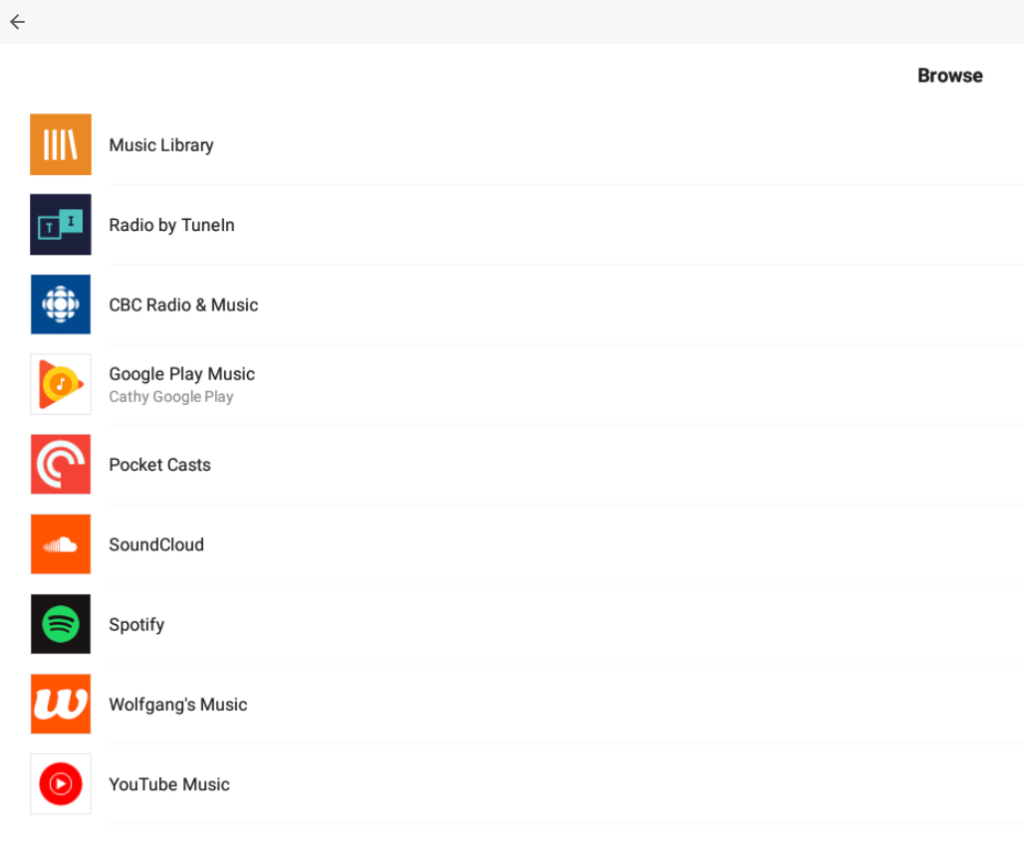
What I want, I’ve lamented for some time, is a Sonos for TV shows. Sonos is a wireless speaker system that, apart from allowing you control speakers in various rooms in the house, consolidates most anything you want to listen to in one place. Your own digital music library. Spotify. Google Music. YouTube Music. Podcast apps. Audible audiobooks. Apple music. Radio stations. Where applicable, the subscriptions are up to you to set up, but once have, you can search through it all, you create playlists that mix and match among them—you can have all your “sound” stuff organized in one place. (At least when you’re home.)
Sonos menu of sound options
Rogers Ignite is kind of like that for TV. By “Rogers”, I do mean, yes, the big cable company. Ignite TV is their IPTV (TV over the Internet) offering. Initially available only with expensive, premium packages, they now have cheaper tiers on offer, and we switched to it this summer.
Of course you get the cable channels you subscribe to, which in our case isn’t a lot (just the $25 “starter package”). But we were also offered Crave + HBO free for six months, which we of course accepted. At regular price, Crave + HBO from Rogers cost the same as if you subscribed to them directly, but then you can access them from TV same as any other channel, including on-demand. (You should also have access to them through the Crave app with your Rogers login, but there is some bug there preventing that from working—Crave can’t seem to recognize that you really do have a Rogers cable subscription.)
If you have a Netflix subscription, you can access that through your Ignite box as well. Also, YouTube. And apparently coming soon: Amazon Prime.
The Ignite box itself is this tiny little thing, compared with the large, power-hungry PVRs of the past. You get a ton of cloud storage with it, so you can record shows to your heart’s content. And it’s much smarter about recording those: if the same show plays three times in a week, it’s only going to record it once for you.
The Ignite TV box is smaller than a Blu-ray case
The basic Ignite package comes with only one box; you can add others for $5/month each. We have two. All the same information (recordings, viewing history) is available on both. If wanting to move one to a different TV in the house, temporarily or permanently, that’s quite easy to do.
There’s also a lovely, seamless integration with anything available on demand. Previously I almost never looked at Rogers On Demand stuff; it was off in its own universe, on those special, hard-to-navigate channels. I often forgot it was even there. Now you can find and watch that on-demand content as easily as anything you’ve recorded.
To find things, as their ads point out, you can just talk to the remote. Wherever it is—on demand, available to record, online—it will show you and give you watch options. It remembers what you’ve already watched and makes logical assumptions based on that. It’s all pretty slick.
Oh, and you can also watch on your phone, tablet, or PC, through the Ignite TV app—live TV, recordings, and on demand content. In many cases, you can download your recordings for off-line viewing. One thing not available? Chromecast, as I guess that would kind be competition. But since your Chromecast is typically on your TV, and you can already watch all the stuff on your TV, I don’t see that as a huge issue. (Just if wanting to watch on someone else’s Chromecast while away, I guess.)
Ignite TV app
So that does bring much TV content together, saving mental energy, though not money. I have no idea what we do about the ballooning cost. For now, I’ll just try to resist the pending Disney service and YouTube Premium.
I was on vacation in Seattle, and awake before Jean was, for some reason, when I got an email about a pre-sale for a Who concert in Toronto nearly a year later. Buying a concert ticket on a tablet while on vacation isn’t the ideal scenario, but I had the time, so I figured I might as well see what I could get.
As anyone who’s tried it knows, buying tickets from Ticketmaster is a roll of the dice. Who knows what seats it will cough up for your consideration, and at what price, at any given time?
But this time the dice landed landed on: Floor seats! In the front centre section! And at the normal price, no VIP / resale nonsense!
Stunned, I started the checkout process…
Only to lose the connection partway as the flaky hotel wifi conked out.
Cue the swearing. (Quiet swearing, as Jean was still sleeping.)


















 Cultureguru's Weblog