And it’s being felt in hospitals already. For example, in Waterloo Region:
Hospitalizations for COVID-19 have climbed to almost the most seen this year. The regional public health unit reported 52 patients in three local hospitals Wednesday. The last time local hospitals had this many patients was New Year’s Day, with 53.
But, the new vaccine is becoming increasingly available. It should be attainable for high-risk people pretty much everywhere in Ontario, and in many cases, “regular-risk” people can access it, too (try pharmacies). It’s approved for ages 6 months and up.
(Of course, wearing an N95 or KN95 in crowded indoor spaces also helps reduce viral spread, not only against COVID but also flu, cold, RSV, and every other airborne disease.)
I’ll try to keep this short. It is Thanksgiving weekend in Ontario, meaning a lot of people getting together with friends and family, which is great.
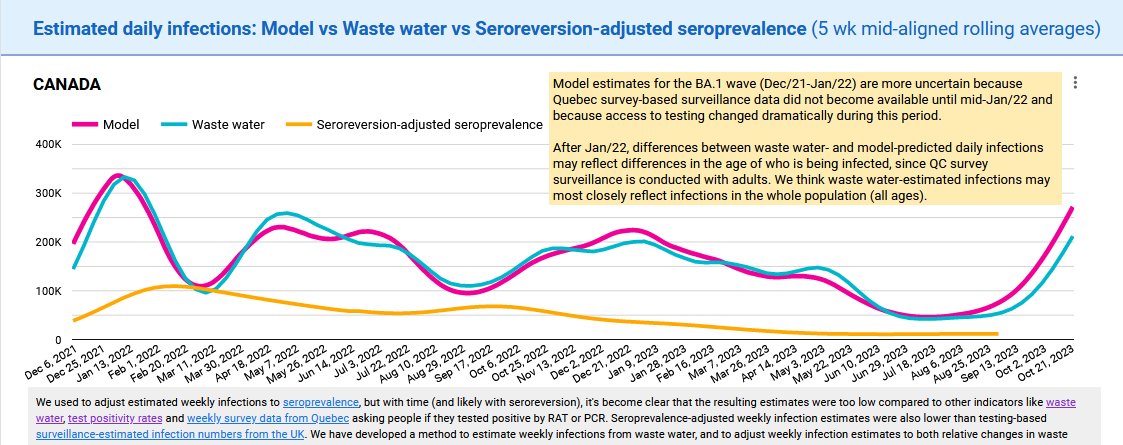
Weather, however, is not fabulous, making outdoor gatherings not all that appealing. The updated vaccine rollout has been kind of slow in these parts, and it won’t be available to everyone for another three weeks or so. And the Covid wastewater signal for the province is as follows:
A bit outdated—guess they took this week off for Thanksgiving. But the trend is clear.
So I feel that this a good time to point out that if you’re not feeling well in the coming days, or hear that some of those you gathered with aren’t:
There’s an excellent chance that you qualify for PCR testing, to find out for sure (because if you’re an adult who hasn’t had a vaccine in the last six months, which is about 96% of us, you’re in the running!).
If the test results aren’t what you’d hoped, there’s an excellent chance you qualify for Paxlovid, as the criteria is similar. This drug could make you feel better faster, and reduce your risk of Long Covid. Also: cinnamon candies can help with the “metallic taste in your mouth” side effect.
Above links are to my other site, which I give more information about this. You can also go right to the source (even though it says nothing about cinnamon candies!):
So if vaccinated, it’s good to get out and enjoy the efforts that have been made. But it’s also important to stay cautious, especially until kids under 12 can also be vaccinated. This post is about a couple more tools you can consider for containing the spread, without hiding in your basement.
Rapid tests
Wondering if your slightly stuffy nose is just allergies, a cold, too much dairy… Or something else?
A bit overwhelmed with worry since that stranger coughed in your direction, or you attended that crowded event?
Love visiting your friend who has recovered from cancer, or your grandma, but always slightly concerned that you might be asymptomatic but contagious when doing so?
Wouldn’t it be nice to just take a quick nose snab test Covid test, instead of trying to get a full PCR test (that you might not qualify for anyway) or just living with the worry?
In much of Europe, in Nova Scotia, you totally can. Rapid tests are widely available to the public at low cost.
Rapid test kit
In most of Ontario, the government offers free rapid tests only to larger businesses, which benefits only those who happen to work for those companies.
Free rapid testing clinics, no appointment required
Screening kits for businesses with 150 or fewer employees who want to run their own program
Full-service screening for small businesses that can’t run their own program
Supplies of rapid tests available to individuals who promise to promote the program
Kits for running your own popup testing service for a sports team, community group, or association
I think this is terrific, and from what I’m seeing on Twitter, it’s the envy of people elsewhere in Ontario. So I decided to sign up to get my own supply of tests, and I’m hereby promoting it as promised (though I’ll also have to tweet this, because who reads blogs anymore!).
So far I’ve used them:
Before a family gathering
Before meeting in person with coworkers
A few days after a slightly-more-crowded-than-I-liked indoor meal
And I’ve lent a couple to a friend who wanted assurance that his kids did in fact just have a cold.
The tests are not difficult to do, but also not intuitive—I did have to watch the video and read the instructions. They require nasal swabbing, but only of the lower portion of the nose, so it’s not uncomfortable.
The first time, I got a bit freaked about this red streak that spreads across the test paper initially—I feared I had given myself a nose bleed somehow. But no, that’s just how it works.
You wait 15 minutes, then if there’s only one line on the left, it’s a presumed negative test. Two lines and you should isolate, then go for a PCR test to confirm. The particular strength of these tests is telling you whether you’re infectious right now. The PCR test can detect presence of Covid over a longer period, including past the point that you’re actively infectious.
It’s really great these tests are available in my town, but I don’t see why they can’t be made as available to everyone in the province. No idea how long this pilot is supposed to run, or when it might be declared enough of a success to make that happen. Hopefully I’m helping on some way.
You see, the feds gave ON nearly 20 million rapid tests.
Then ON decided to funnel those tests to businesses to use on (mostly vaccinated!) employees.
Literally zero tests appear available for screening kids, unless you're in Waterloo (which has #StaySafeAmbassador program).
In crowded indoor settings, masks remain the best option for protecting yourself and others. But type and fit matter. A fitted three-ply cotton mask is good, as are type 2 or 3 surgical masks. But top of the line are the respirator types—KN95, KF94, and N95.
Only if they fit your face, though, and personally, I cannot find a KN95 that does. They all gap at the sides. Also, there’s a big quality problem with KN95s, as reported by Marketplace. Hard to be sure you’re buying a good one.
KF94s fit me better, especially in youth size, and there aren’t as many fakes of those ones. But they are not easy to find! The only place I’ve had luck purchasing them is from Amazon, and they’re often expensive (and not always available in youth size).
So I was pretty happy that the local Canadian Shield company has partnered with Eclipse Innovations to make N95 quality masks available, at https://www.canadianshieldppe.ca/pages/eclipse-surgical-respirators, for about $1 each. They offer two styles, one in three sizes, the other in two, and they have guidance on their site on how to measure your face to get the right size.
I went with the Horizon Surgical Respirator in regular size. I have never had a better fitting mask. My glasses don’t fog up at all. The mask is quite comfortable and easy to breath through. (Although Jean also uses them, same size, and notes that with time, they get less easy to breathe through, as they really do trap particles!)
The mask does involve two straps on the back of your head, making it a bit involved to put on and therefore, in my opinion, not really worth it for a short trip to the store, or for any occasion (like a restaurant) where you expect to be taking it off and putting it back on repeatedly. You also can’t wear it to the hairdresser! But, it can certainly give you piece of mind at something like a crowded concert or sporting event or eventual return to the office.
Canadian Shield also sells good-quality surgical masks, and will soon offer biodegradable masks:
No idea why, but it just got to bugging me this past weekend that the media kept referring to us “losing an hour of sleep” this weekend due to daylight savings time.
Because, no we didn’t. Not necessarily.
Sure the lost hour occurs overnight, and sure most people are sleeping then. But it doesn’t have to follow that they therefore lose an hour of sleep.
You can, after all, go to bed an hour early that day. Or, you can sleep in to an hour later than usual. (It happens on a weekend, after all. Many people don‘t work, or at least start later on the Sunday.) You can even go to bed and get up at your usual times (according the clock), then have an unusual one-hour afternoon nap.
So media, we do not lose an hour of sleep due to daylight savings. We lose an hour of…
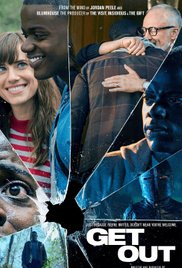
We saw this movie only recently, though it was released in February (and is now available on DVD / streaming). What convinced me to go despite horror not being one of my go-to genres was its 99% positive rating on Rotten Tomatoes, along with:
All this advance research proved correct. Of course the movie had violence, but not much more than you’d see on network TV. It was about suspense, not gore.
And yes, the startling moments, the twists, the laughs, were more enjoyable with a crowd to share them (though this was a sparsely attended showing).
It is a good movie. Just on the surface level, it’s fun trying to figure out the plot, and it does have a good mix of humour in with the mysterious goings-on. The lead character, Chris, is going to spend the weekend with his girlfriend’s family for the first. She’s white; the family does not know that he’s black.
She assures him that it will not be a problem, but in fact, his interactions with the family are uncomfortable, whether by over-compensating (“my man!” exclaims her father) or by thinly veiled hostility of her brother. As well, the few black people in the area behave rather strangely, almost zombie-like. Things only get weirder and, for Chris, more alarming from there.
So if you want to get analytical, there’s also a lot to work with here: issues of cultural appropriation and white liberal racism and even gender issues (the victim here is not the pretty white girl). One of the smarter movies out there.
In an effort to reduce—though most definitely not eliminate—carbohydrate intake, I’ve been experimenting with using stevia in desserts. It generally works well in custards and puddings, though you have to be OK with the slight anise flavor the stevia lends. Baking is trickier—one brownie recipe ended up too dry. But this chocolate chip cookie recipe worked out really well.
I started with a recipe from a Nutrition Action Newsletter, so it wasn’t my idea to use whole wheat flour and non-hydrogenated margarine. (I’m sure butter would work fine for those avoiding margarine.) It was the sugars I adapted.
Ingredients
2½ cups whole wheat flour
1 tsp baking soda
¼ tsp salt
¾ cup non-hydrogenated tub margarine
Baking stevia equivalent to ¾ cup granulated sugar
1 cup packed brown sugar *
1 whole egg
1½ tsp vanilla extract
2/3 cup Stevia chocolate chips (I used Krisda brand)
½ cup chopped walnuts
* I believe some sugar is necessary to avoid overly dry cookies
Instructions
Preheat the oven to 350ºF. Combine the flour, baking soda, and salt in a bowl and set aside. In a large bowl, combine the margarine, baking stevia, and sugar and beat with an electric mixer until smooth. Add the egg and vanilla and beat until combined. Add the flour mixture and beat until all the flour is combined. Stir in the chocolate chips and walnuts with a mixing spoon until incorporated.
Drop the dough, one teaspoonful at a time, onto an ungreased baking sheet. Bake for 10 to 15 minutes or until the cookies are just browned. Remove from the sheet to cool, Makes about 5 dozen cookies.
Guess it would be more normal to have a picture of plate full of cookies, but this is all we have left!
These cookies were really good—no need to grade them on a curve. And of course they’re not exactly a health food, but a treat. Just one that happens to have a bit of fiber, low sat fat, and somewhat fewer carbohydrates.
The KW Symphony’s intersections series was about combining orchestra and… something else. Physics. Fiddling. Food. Heavy Metal. Though Friday’s concert was not part of that series (sadly not offered this year), it was still of that ilk. The partner this time was figure skating.
There was no way I was missing this one. Particularly as it was being hosted by three-time world champion, first man to ever land a quadruple jump in competition, Kurt Browning.
Jean was considerably less enthused about attending.
If wondering, no, they did not somehow bring an ice rink into Centre in the Square, not have the symphony decamp to play at a hockey arena. Instead, most of the skating seen on video.
After an opening performance of An American in Paris, our celebrity host explained that while music was incredibly important in figure skating, it had to go through a certain amount of mangling to fit the sport’s requirements: Cropped to fit into the time constraints. Tempo adjusted to match the tricks. Bit recombined to create certain moods.
This meant that when the symphony played the soundtrack to a video of Browning’s world championship performance of Casablanca, they couldn’t just the pull out the sheet music for “As Time Goes By”. Instead, the conductor had to write a new orchestral score for the Frankenstein version of that piece that Browning skated to.
It was gorgeous.
Example of Cranston’s art
Browning was so moved by it, he barely knew what was on next, so conductor Lucas Waldin stepped in to explain that it was a tribute to Toller Cranston (who apparently pioneered this whole orchestra / figure skating idea), featuring selections from the ballet Gayane. This time, the screens showed scenes of Toller’s amazing paintings and decor before showing his Sabre Dance skate with live orchestra. Just fab.
Given the chance to recover, Browning emerged to point out that while artistic, figure skating is still a sporting competition with some serious rivalries over the years. The Symphony played Sing Sing Sing while we saw clips from the battle of the Brians, the battle of the Carmens (though they didn’t mention that both were defeated by Canuck Liz Manley), Tonya Harding vs. Nancy Kerrigan (remember that?), Virtue/Moir vs. Davis/White, and so on.
We then moved on to a montage tribute to skaters past, when they had to skate outdoors (!), and future, in the form of the youngsters at the KW Skating Club. And Kurt Browning introduced Don Jackson, 1962 World Figure Skating Champion, who was in the audience. Cool! Oh, and the tune played for that piece was Tchaikovsky’s Swan Lake.
The next bit seemed to be interrupted by a badly timed cell phone call—only it was Kurt Browning’s phone, and on the line was Olympic Bronze medallist Joannie Rochette. (Seriously.) She talked about she managed to get through that Olympic performance just days after her mother died. Then the symphony played La cumparsita to a video of it. (Using a few stills so as to not have to cut the piece down to exactly 4 minutes.)
Kurt then dragged out a collection of his costumes from over the years, selecting a purple velvet hat and robe for conductor Lucas Waldin to wear. We then got a montage of some of the more interesting sartorial choices figure skaters had made (admittedly, many from gala and not competition pieces), to selections from Mel Brooks’ The Producers.
Kurt emerged in his Singin’ in the Rain outfit, and we got a singer! And tap dancer, it turned out: Mr. Geoffrey Tyler. With all that going on live, this song was not played to video footage of that famous skating piece. Instead, via roller blades, we got some live Kurt Browning skating! And the first standing ovation of the night.
At intermission, Jean said we very pleased about high entertainment value of the evening so far.
And he was not being sarcastic!
The second half kicked off with the Symphony playing Phantom of the Opera, on their own. Kurt came out to discuss the fact that many skaters tried to skate to that piece—but none had really succeeded in achieving an iconic performance with it. Too big a song, perhaps, for the white, bright, bare stage of figure skating competition.
Singer Tyler returned to perform What a Wonderiful World, a show piece of Kurt Browning’s. Tyler also talked about how he’s worked with figure skaters. on the dramatic aspects of their performance, on connecting emotionally. We then did a bit of a 180 into an Abba medley (though Abba sounds great orchestrated!), highlighting scenes from the world of professional figure skating.
And then, the hauntingly beautiful Mahler piece, Adagietto from Symphony No. 5. Conductor and Browning discussed how only very special skaters could do it justice. Katerina Gordeeva was one; she skated it solo as a tribute to her partner, Sergei Gringov, after his sudden death.
Another were Tessa Virtue and Scott Moir, who won Gold with it at the Vancouver Olympics. The video played to this beautiful piece wasn’t either of those performance in their entirety, but compilations of them along with some from Jamie Sale and David Pelletier, who didn’t use the music (that I know of) but certainly brought emotion and drama to their pairs performances.
The next piece didn’t need, and therefore didn’t get, video accompaniment: Ravel’s Bolero, forever synonymous with Torville and Dean. Though Browning informed that Carolina Kotsner is one of the few who has successfully skated to the piece since that team’s perfect performance.
Our finale was the theme of the Vancouver Olympics, I Believe, featuring the adorable singers of the Grand Philharmonic Children’s Choir. And then they gave us an encore! (Note: This is rare at the symphony.) Conducted by Kurt! The Toreador Song.
As a figure skating fan, I was thrilled to bits with the evening.
As a non-figure skating fan, Jean declared that he glad he had been “dragged out” to this performance. (Again, not sarcastically.)
It was a great intersection.
(Thanks to Skate Canada for all the footage they provided they provided for the show. Much higher quality than what you can find on YouTube…)
No idea why, but it just got to bugging me this past weekend that the media kept referring to us “losing an hour of sleep” this weekend due to daylight savings time.
Because, no we didn’t. Not necessarily.
Sure the lost hour occurs overnight, and sure most people are sleeping then. But it doesn’t have to follow that they therefore lose an hour of sleep.
You can, after all, go to bed an hour early that day. Or, you can sleep in to an hour later than usual. (It happens on a weekend, after all. Many people don‘t work, or at least start later on the Sunday.) You can even go to bed and get up at your usual times (according the clock), then have an unusual one-hour afternoon nap.
So media, we do not lose an hour of sleep due to daylight savings. We lose an hour of the day. Whether that means one less hour spent awake or asleep is really up to each individual’s circumstances and preferences.
Got it? Because I really don’t want to have to go over this with you again next year…



 All this advance research proved correct. Of course the movie had violence, but not much more than you’d see on network TV. It was about suspense, not gore.
 There was no way I was missing this one. Particularly as it was being hosted by three-time world champion, first man to ever land a quadruple jump in competition, Kurt Browning.
 Cultureguru's Weblog