
A bewildered Canadian on a world gone mad

It’s Canada Day. And right now the world is giving me many reminders of how lucky I am to live here.

1. That Quebec’s referendum on separation was defeated.

I wasn’t paying much attention to Brexit until a couple weeks before it happened, and even then I was thinking that surely they wouldn’t vote Leave? Watching the results come in reminded me so much of the horrible Quebec separation referendum of 1995. A full night of tension (following weeks of worry on a vote I, an Ontarian, couldn’t even participate in) watching the movement of a Yes (separate) / No (stay) line on television.

151030_is0se_rci-m-vot_sn635
That nail biting time before the needle moved to the side of good

But then, while the Yes started out strong, it gradually swung toward the No, who ended up taking it with a 0.6% margin. Whereas Great Britain’s vote was the opposite: A strong initial showing for Stay giving way to Leave, who took it with 2% margin. (No matter how many times I refreshed my browser.)

What would have happened to Canada had it gone the other way? Great Britain’s experience is giving us an idea:

  • A precipitous drop in currency.
  • Tumbling stock markets, with the UK dropping from the 5th to the 6th world economy overnight.
  • Expected rises in unemployment, debt and lowering of GDP and growth.
  • A Leave team with no plan for how to exit.
  • Political disarray all around, leaving no party or leader currently able to effectively govern through the chaos.
  • Regions (Scotland, Ireland, London) unhappy with the result talking separation of their own.

For Canada, it would have been all that, only worse. (For an idea just how ill-prepared the country was for the possibility of a Yes vote in the Quebec Referendum, read Chantal Hébert’s The Morning After: The 1995 Quebec Referendum and the Day That Almost Was.)

And just for the record, Leave voters in Great Britain: What you did was crazy. Your country had a great deal in the EU: you were allowed to retain your own currency and greater control over your own borders than other countries, while still enjoying full trading access and movement of workers. And you gave that up for what?

177763_600

2. That recent attempts to win Canadians’ votes through xenophobic appeals have failed.

While a number of factors inspired Leave voters, the wish to reduce immigration—particular a certain kind of immigrant—was among them, as evidenced by the unfortunate increase in hate crime and racist abuse since the vote (as though racists now feel “allowed” to air their views). Meanwhile, the presumptive Republican nominee for US President wants to ban all Muslims from entering the country (“til we figure out what’s going on”) and build a wall to keep out Mexicans. And France has their National Front party. And so on…

But similar appeals haven’t met with success in Canada. In Quebec’s (them again) 2014 election, the Parti Québecois ran, in part, on a “Charter of Values” that would have banned public sector employees from wearing “conspicuous” religious symbols:

MG0911003A_.indd

This bill was so popular in polls, the PQ used it try to turn their minority government into a majority. It didn’t work. After a fairly disastrous campaign by the PQ, it was the Liberals, who opposed the Charter, who were elected with a majority of the seats. With the added bonus that the spectre of another Quebec referendum on separation retreated further.

Then in the 2015 election, the ruling Conservatives appeared to gain ground in polls after they pledged to ban the wearing of niqabs at Canadian citizenship ceremonies, and to set up a barbaric practices tip line. [This is when I had to check out of Canadian election coverage for a while, as I was so distraught.] But the end result was, again, a coalescing around the Liberal party, who were foursquare against both proposals (and, it must be said, who generally ran a brilliant election campaign).

justin_trudeau_liberal_leader_federal_election_surrey_bc_-_mychaylo_prystupa
A plurality of Canadians chose hope over fear

Upon election, Liberals walked the talk, dropping the court case on the niqab ban, and most notably, welcoming 25,000 (and counting) Syrian refugees, moves that have only made them more popular since the election. Americans look on it in wonder, from The Daily Show to the New York Times:

Why? Well, Vox Magazine says it’s the outcome of decades of Canadian government fostering tolerance and acceptance as core national values. As a result, most Canadians see immigration as an opportunity, not a problem; as something that improves rather than threatens the nation. Apparently, Canada is the least xenophobic country in the Western world.

3. That our current government is (mostly) pro-trade

One of the most confusing results of the Brexit vote, to me, was the cavalcade of federal Conservatives MPs who tweeted their approval—the only Canadian I’m aware of who did so. But isn’t Conservatives supposed be all pro-trade, because it’s good for business, while it’s the lefties who are opposed, fearing it’s bad for labour?

And yet there’s Trump, spitting about pulling out NAFTA. What? When did this turn around? (Harper’s government, it must be said, was most definitely pro-trade, making the MPs comments all the more confusing.)

So it was another interesting bit of timing that this week was the NAFTA summit between the current US President, Canadian Prime Minister, and Mexican President.
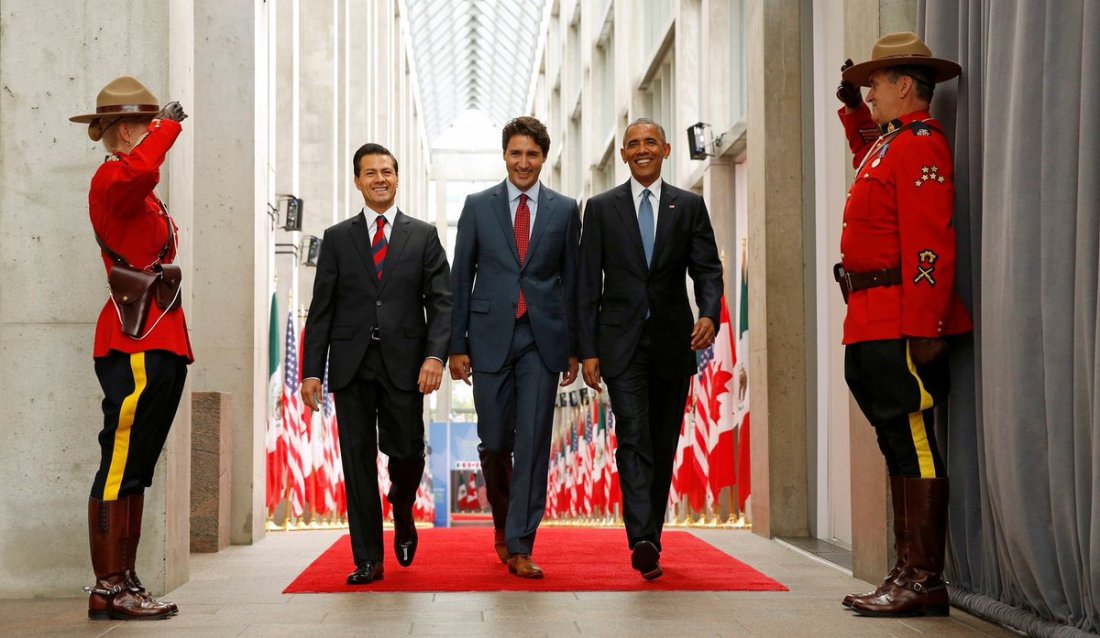
cmjo22zwmaavs9w
Too bad they’re all men (but this US will be changing that soon, right? right?), but a fine-looking trio they are

Their big message: Trade is good. Countries are stronger when they work together. Globalism brings prosperity. And it was all capped off by one amazing speech President Obama gave in the House of Commons:

And what makes our relationship so unique is not just proximity. It’s our enduring commitment to a set of values, a spirit alluded to by Justin that says no matter who we are, where we come from, what our last names are, what faith we practice, here, we can make of our lives what we will.

Watch or read the rest here.

It was heart-warming, and for a while, one might forget that it remains so much easier to cross borders in Europe than it is to move between the US and Canada, that we have to pay duties on even tiny online purchases from the US, and absolute absurdities such as Canadian inter-provincial (!) trade barriers that cost our economy billions.

So there’s a lot of work to do on this one. But at least it seems the intent it to make things better, not worse, on this front.

Cause that’s the Canadian way.

Happy 149, Canada.


Join the majority

Like two-thirds of Canadians (!), apparently, I tuned into the Opening Ceremonies of the Olympics last night. And I even watched it live, and nearly to the bitter end.

They really did a fine job, I thought. I liked the special effects re-creation of the ocean, and the fields, and the mountains (even if it perpetuates the myth that we’re “outdoorsy” country people, when most of us live in cities). And I liked the slam poet, reminiscent of the old “Joe Canadian” ads, but with more eloquence and no beer. (Even though it claimed an environmentalism we don’t deserve. But the rest felt right.) The fiddling medley was lively fun. And man, does this country have a great set of women singers, or what? Nikki Yanovsky, Sarah McLachlan, Joni Mitchell, Measha Brueggergosman, and most especially, KD Lang, actually outdoing her Juno performance of “Hallelujah”.

I liked that the final torch run wasn’t just Gretzky. I liked all the French. And it was appropriate that the tragic death of luger Nodar Kumaritashvili was recognized, and recognized again.

I have some sympathy with Olympic protestors. The IOC is really the most appalling organization. But the athletes… they’re mostly inspiring. They always win me in over in the end.

Finally, live TV meant not fast-forwarding the commercials, and the somewhat dubious sponsors involved. It made this 22 Minutes bit even more hilarious the second time around:

Reason of the day to not vote Conservative: Preventing candidates from speaking to the media

First wrote this in September 8, 2008. This tactic has become considerably worse since. Now they don’t talk to media at all, never mind only waiting for “talking points”, and they routinely skip debates.

This is a small point, but still significant, I think.

Can’t find a link, but CBC Radio reported yesterday that they were not able to interview some new Conservative Party candidates in certain Toronto ridings. Reason? The party specifically instructed them not to speak to the media until they’d sufficiently guided by the party in how to do so. And when would that be? “That’s a good question.”

One can appreciate Harper’s desire not to be embarrassed by candidates who run amok, making homophobic or other inappropriate comments, as has happened in past elections.

But one might suggest that the party try to find better-quality candidates, rather than stifling the lot of them.

Because, it doesn’t matter that not everyone cares who their local candidate is. The fact is, that’s who we vote for to represent us. We have a right to know who they are. The only practical way to find that out is through the press.

If my potential MP sincerely believes the world was created in seven days, I want to know!

Maple flavour films

Cultural lessons in three movies… (Links are to YouTube trailers of same)

1

Last Saturday we wanted to go see The Stone Angel, but it was on at 7:00, and we just couldn’t get ourselves organized to get there on time. So as a kind of boobie prize, we thought, we decided to go see the comedy Forgetting Sarah Marshall. Now, admittedly, that film had received pretty decent critical notices, which is why we considered it at all… But so did Knocked Up, and I was pretty underwhelmed by that one, with its many “man-boy” characters.

But Forgetting Sarah Marshall was different. It is what it is, which is unabashedly a sex comedy, but it rises above what I was expecting in that none of the characters were mere caricatures. Sarah wasn’t just a bitch. Her new boyfriend wasn’t just a stupid himbo. The main character wasn’t entirely blameless for the break-up. You kind of cared about these people. You kind of liked them.

We left the movie in a really good mood.

2

The next night we managed to get ourselves to The Stone Angel. It featured good performances (from the likes of Ellen Burstyn, Ellen Page*, and the yummy Kevin Zegers), moments of humour, and strong characters. But it is what it is, and that is a drama about a 90-year-old woman looking back at the tragedies of her life, and the decisions that led to them.

We didn’t dislike the film, but we weren’t in as good a mood afterwards.

3

By Thursday DH was a little movied-out, but I went to see Maple Flavour Films, a documentary about English-language Canadian movies, and why Canadians don’t go see them. (Ironically, very few people were there!) Various theories are put forward as to why that is—screens dominated by Hollywood movies; lack of star system; lack of promotion. But the director’s own view (he was there for the screening) was that Canadians make too many dramas, which never do as well as other genres. Why not make more of the types of movies people want to see—why not more comedies? Why wasn’t the low-budget, Scarborough-inspired Wayne’s World not made in Canada? “We need our Full Montey“!

And he may have a point. But I’m also thinking, even if The Stone Angel wasn’t a barrel of laughs, there are a number of Canadian movies that have a put big smile on my face. La Grande Séduction—OK, that’s a French-language film—but it’s still one of the damn funniest movies I’ve ever seen. Bon Cop, Bad Cop—bilingual—was rather a lot of fun as well. And Touch of Pink—all in English—was rather fun as well.

And—this sounds like damning with faint praise, but it’s not—some movies are lot more fun than their premise would make you think. Yes, in Saint Ralph, the boy is inspired to run because his mother’s in a coma… But the focus is on him, not her, and the journey is fun, funny, inspiring. Last Night is about the end of the world, but it’s Don McKellar, and to some extent, it restores your faith in humanity as you marvel at some of the absurd responses to this fact. Snow Cake begins with a terrible car crash (I’m maybe not helping the cause here), but gains considerable humour as the British driver involved (the lovely Alan Rickman) is thrust amongst Canadians in Wawa, of all places—including an autistic woman played Sigourney Weaver. And New Waterford Girl has overtones of Juno—a preternaturally smart and witty teenager finds pregnancy the only possible escape from her tiny home town, though in this case it’s a fake one (the pregnancy is, not the town).

And I’m not going to pretend that Les Invasions Barbares or Away from Her are anything but primarily dramatic, but they really do have a lot of humour, and they’re both just so good, everyone should see them.

Or maybe my tastes are weird. Certainly I see way, way more Canadian movies than other people do…

* In 2008, when this was written, this was the name of this actor.

The best sport there is!

… Ice skating

That’s the name of Salon posting post board thread dedicated to the sport (some would say “sport”) of figure skating. A sentiment I confess to sharing.

Before leaving for New York, I set the PVR to tape every bit of figure skating I could find on CBC. (And finding that was a bit of chore, given the off-prime time hours given over to it—midnight, Saturday afternoon…) When back from New York and waiting at the luggage carousel, I saw Jeff Buttle’s smiling face up on the TV screen showing the news. While I couldn’t catch the details, I knew that meant he had to have done well. They weren’t going include a sixth-place finish in a five-minute news summary.

Back home, the stack of newspaper that weren’t supposed to be there (my registered vacation stop was ignored) gave the pre-story: 3 pairs teams in the top 8, including a bronze medal; the strong fifth place in women’s; the silver in dance. But it may have been only the next morning that I heard Buttle had actually won gold.

Why I like watching this sport so much, I’m not really sure. I’ve certainly never done it myself, my own ice skating skills never having progressed much beyond the rudimentary. I like dance, too, but I don’t make a point of watching ballroom dance competitions on TV. But—and especially when Canada does have a reasonably strong team—I can’t help watching the figure skating.

This is a challenge, because I have hours of the stuff on PVR now, and DH does not share my enthusiasm. So I try to cram in the viewing when he’s not around, fast-forwarding the duller commentary and interviews, not to mention some of the duller skaters (that pairs silver team? My God, could they be any slower? As Kurt Browning said, maybe if they did nothing but jumps, I wouldn’t have to fast-forward out of boredom) and those just having a really bad day (one grows weary of wincing at all the falls).

So at this point, I’ve seen most of it. I think I just have the Dance Originals and the full women’s Long Program left.

I feel absurdly proud of the Canadian skaters, as if I had anything to do with it whatsoever. But those who doubt the toughness of people in this sport, think that fifth-place pairs winner Craig Buntin had to move immediately from lifting his partner over his head with one hand to shoulder surgery to repair the damage; that bronze-medal pairs Jessica Dube’s face was slashed by her partner’s skate last year; that gold medalist Buttle could barely walk a year ago, so bad was his back injury.

Also nice to see American Johnny Weir, always an interesting skater, finally win a world medal (a bronze), and that Japanese woman’s skater come back from a terrible fall in the opening moments of her program to be dynamic and perfect enough in the rest to win the gold.

But Jeff Buttle, I have to say, comes across as one of the sweetest human beings on the planet. So it’s really great to see that he won, and won decisively, by doing his quad-free program perfectly. Every big win this guy has had—the Silver at a previous World’s, the Bronze at the Olympics, and this Gold—always seems to be a big shocker. Maybe that’s finally over now.