Can you see the real me?

I’m a latecomer to The Who’s QuadropheniaTommy  was the first Who album I got, and that was decades ago (on LP); Quadrophenia may have been the last, and that was a couple years ago (on CD).

Quadrophenia album cover

I resisted that one, I think, because I just didn’t find the concept that appealing. The story of drug-addicted, “quadrophenic”, disillusioned mod Jimmy just seemed so British, so male, so 1960s–I couldn’t relate.

When I finally got the album, I liked the songs well enough right off, but really couldn’t put “the story” together until I also saw the 1996 Quadrophenia Live DVD. During that concert, a Jimmy narrator (on a big screen) provides a narrative thread through the songs—even though it’s not exactly the same one intended by the original album—that sufficiently put it together for me.

But that’s when I started to realize, with repeated listening, that the “story” didn’t really matter. Because the songs just sounded so great, you didn’t need to worry about plot.

The Quadrophenia songs work as standalones–much more so than most of the Tommy ones do. They also have a universality that you might not expect of “rock opera” songs. Who doesn’t want to be seen for who they are (“The Real Me”)? Who hasn’t had to do a crappy job (“The Dirty Jobs”)? Who hasn’t felt the wish to just slide away from a bad situation, even if it’s into oblivion (“Drowned”)? Who doesn’t want to feel awash in love (“Love Reign O’er Me”)?

You don’t have to be British, or male, or a baby boomer to get it. You just have to be human.

So it’s with that background that I went to see the new Who documentary about the making of Quadrophenia, subtitled Can You See the Real Me?, at the Galaxy theatre last week.

Given previous, it should come as no surprise that the parts I found least compelling were the fuller explanations of Jimmy’s story, and what the mods were all about. Though that wasn’t all a loss, since it’s always good to learn things, and that I did. Story-wise, I hadn’t realized that “The Punk and the Godfather” was about Jimmy going to see The Who themselves in concert, and being disillusioned that they’re now big rock stars, worlds apart from him. (Because that’s something they changed in the 1996 concert version.)

As for the mods, the point that their tidy hair and neat suits made them look like smart, respectable young men at work, when it was really a form of covert rebellion (though they did need those jobs to afford the suits) was an interesting point.

Though Pete Townshend the story-teller is the dominant figure in this documentary, I did like that some commenters view the album more as I do, as fairly universal: “I thought it was about me” says Manager Bill Curbishley, and he doesn’t mean that’s because he was a mentally ill mod, and not so much needing a plot: “Pete always has these great concepts, but the problem is he always wants to wrap a complicated story around it”, says Roger Daltrey.

What I liked best was the exploration of the music, the songs; all the archival concert footage included (nothing like seeing the young and beautiful Roger Daltrey on the big screen); and the look at the band dynamics at the time.

Those dynamics were some ugly, Unfortunately, we are somewhat stymied in exploring them by having only two band members remaining, and apparently not having a lot of footage of what Moon and Entwistle thought of Quadrophenia. Both men are featured, but they of course don’t necessarily get asked what we’d now like to know. For example, Pete says at the outset that John, as a songwriter, was unhappy that the band had become all about Pete’s songs. So how did John feel about Quadrophenia, to which he didn’t contribute a single track? No idea.

Tommy was quite a collaborative effort by the band, at least for The Who. Entwistle contributed two songs, Moon came up with the holiday camp idea (and a writing credit), Daltrey suggested that he embody the Tommy role, thus finally truly becoming the voice of the band. But Quadrophenia was all Pete, all demo’ed and done and presented to the band. “The rest of them must have felt a bit like session musicians,” is one opinion expressed in the documentary.

Yet, Pete did use the four very different band members as the both representative of Jimmy’s four split personalities, and as the four musical motifs that echo through the album, which Pete says is the more important aspect. Moon the lunatic, Pete the hypocrite (interesting, and I’m not sure how that leads to a “Love Reign O’er Me” theme), Roger as “bad” (the album liner notes say “tough guy”, but Pete’s original notes say “bad”) and John as “romantic”, those two intersecting as “sex”. (I don’t think Pete meant that in a gay way.)
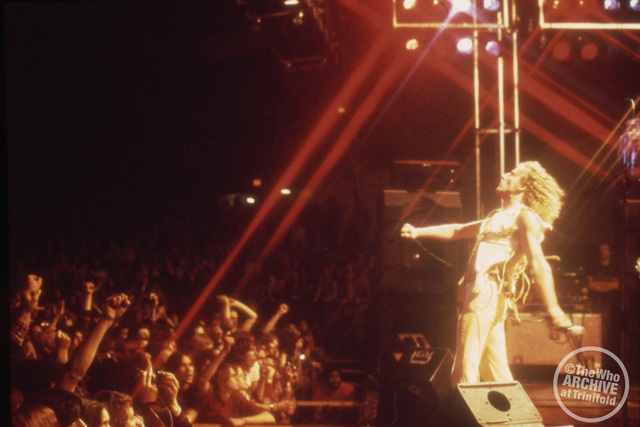
Who concert image

Of course, it’s only Mr. Bad who’s still around to say what he thought of all this, and it’s interesting that there still seems to be so much tension between the two on this (given they’re about to tour it together, and all). Pete comments on how the rest of the band liked to drink for a couple hours before getting to work, which the non-alcoholic Roger hated as a waste of time.

Then there’s this. “Pete may have produced this album”, says Roger, steely-eyed, “but he did not produce my vocals. I wouldn’t have it.” And Pete suggests that’s because Roger could not take criticism. “You had to be very careful what you said to him. You really did.” Little wonder that during the first rehearsal for this album’s tour, Pete hit Roger with his guitar, and Roger responded by knocking him out cold with one punch.

Yet there’s no denying the deep admiration Pete expresses for Roger’s vocal work on the album, particularly, of course, on “Love Reign O’er Me”, a song that literally gave me goosebumps every time it was played on the wonderful theatre sound system during this documentary—the album version, a live version from that time, and the 96 live version.

Looking at Moon’s vocal work on “Bell Boy”, Pete comments on how Keith could never sing anything straight; it was always as a character. And that he did find it hard for his Ace Face character to come off comic. But of course, again, no way to know what Moon thought of this, though he clearly enjoyed singing the song in concert.
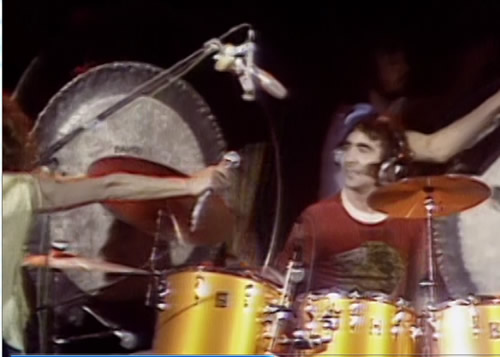
Bell Boy mike handoff

Those two songs get special focus during the documentary, as do some others, like “The Real Me”, “Cut My Hair”, “5:15” (partly Beatle-inspired, that one), and “Drowned”. But I was disappointed that “Doctor Jimmy” didn’t get that treatment. It just seems there would be so much to say about that one… How the complex musical arrangement of song that itself suggests a split personality (it’s my favorite Who song to play on the piano, but it’s not easy!), the shocking lyrics (“Who is she? I’ll rape it!”), even its importance to that darn storyline, as this moment of craziness then leads Jimmy out to that rock and possible redemption. But nada about “Doctor Jimmy” here.

Much as I enjoyed the concert footage, the documentary also covers how that tour was something of a disaster. It was booked a mere two weeks after the album was done, leaving the exhausted band no time to really prepare a stage show, and forcing them to play songs that the audience just didn’t know yet.

Pete said at the outset that his goal had been to write something that would replace Tommy as a concert vehicle. In that, Quadrophenia failed. (And maybe that’s why Pete feels this is the one he just has to take on the road again. Needs another do-over.)

The doc was only about an hour long, the theatre viewing filled out by showing some of the songs from the 1996 Quadrophenia Live DVD. This leads me to wonder if some footage is being held back for the eventual DVD release. Maybe I’ll get that “Doctor Jimmy” analysis after all?

Queen documentary

Queen: Days of Our Lives“In 1971, four college students got together to form a rock band.”
Queen: Days of Our Lives is a relatively recently released documentary about the band. The core of it is a two-part band history that played on the BBC. The Blu-Ray adds about 90 minutes of bonus material.

There have been many Queen biographies before this one, a number sanctioned by the band. The special thing about this one is that Brian and Roger provided a lot of new interview material for it.

As someone who has seen a lot of those earlier documentaries, not to mention read a number of books about the band, I didn’t learn too many new facts. But I definitely still enjoyed the structure of the documentary. It was well-edited, moving briskly along from milestone to milestone. Aspects of the band’s story that have really been covered to death by now—the early success in Japan, Bohemian Rhapsody, Live Aid—are of course here again, but not especially dwelled upon, as how much new is there to say?

Instead, the insights are more personal. For example, Brian discusses how his father, understandly, was just flabbergasted that his son chose rock music over completing his PhD in physics. And it wasn’t until well unto his career that a huge show at Madison Square Garden really brought home to his Dad that Brian wasn’t wasting his life or his education. Brian still tears up at the memory.

John DeaconJohn Deacon, generally considered the least interesting member of the band, casts a surprisingly large shadow over the production. There is, for example, a fair amount of attention given to “Another One Bites the Dust”, which he wrote. One fact I hadn’t know that came out is that it, and not BoRhap, is Queen’s best-selling song. And one of the extras amusingly relates how, in later years, John kept a full bar behind some of the stage equipment, and would nip back there for drinks when his bass playing was not required. (Which reminds me of another rather humorous anecdote from this, of the very rare occasion where Fred was really too inebriated to perform the first part of the show, and the rest of the band struggled to cover. Of course, Freddie brought it home in the end.)

Of course, the fact that John is alive and yet did not provide any new insights for this project is hard to ignore. Naturally, Mr. Deacon has every right to retire, and doesn’t owe the fans any more than the 20+ years he already gave to a band that, this documentary reveals, he was surprised to find become such a big success. Still, it would have been nice to hear from him. And it is a bit sad to hear Brian comment that “We’ve lost John, too.”

Also clear from this project? “Queen were never cool,” as Roger said. And as a fan from the time, I can tell you, this is true. Except for a fairly short time in the late 70s, Queen fandom was something I tried to keep quiet. Because it was not cool to be into them.

The 1970s were a battle between disco and punk, and Queen were… Queen. The 80s brought Brit pop, but except for a little ill-received (though I liked it) foray into funk sounds, Queen still kept sounding like… Queen. Ultimately, this has made them endure. But at the time, they were about as respected as Nickleback as is now.

Never cool. Just really popular.

Well put-together though the documentary was, I also enjoyed the extras. Some were extensions of was seen in the film, some were additional interviews that didn’t make the cut at all. The only thing I found a bit superfluous were the seven music videos, supposedly “all new”. But many are so close to the original videos, it took me a while to realize they were different cuts (often with more “backstage” views of what was going on).

I live you with a video one of the most delightful extras from the disk: Scrabble Wars.

Movie review: Religulous

***½ Religulous (September 2008) – Rental
Documentary featuring Bill Maher, exploring religious belief.

She says: Better than I expected. Maher travels the world, visiting some well-known religious sites (the Vatican, Jerusalem) and some less well-known (Holy Land Experience in Floria, a fledgling Creation museum), speaking to all manner of religious people. Yes, he is rude sometimes; he’s Bill Maher. But the only thing that I made me uncomfortable was his associating between Muslims and terrorism. And he does seem to approach the subject with a sincere desire to understand why people believe. I learned some things, the most surprising being the many similarities between the stories of ancient Egyptian god Horus and that of Jesus. And it was hard not to agree with his final conclusions.

He says: Nice to see a documentary that I can agree with.

Movie review: Three movies I liked more than Jean did

Not that it’s that unusual for me to like movies more than Jean, given that:

  1. He gets bored more easily than I do.
  2. Frankly, I usually pick the movies we see.

On the other hand, none of these were exactly “chick flicks”…

*** Waltz with Bashir (May 2008) – Rental
Animated documentary. An Israli man tries to recall the details of his participation in the massacre of Palestanians that occurred during the first Lebanon war.

She says: I’m not sure what this indicates, but I didn’t realize that this was a documentary. I thought all the interviews and such were just a clever way of framing the movie. But, I knew it was based on a real incident, one I knew nothing about. I found this an interesting way to learn about it, with the animated style creating some distance in the disturbing events.
He says: It was all right, but didn’t quite hold my interest.

**½ Conan O’Brien Can’t Stop (June 2011) – Theatre
Documentary about Conan O’Brien’s Legally Prohibited from Being Funny on Television tour.

She says: I’m not a huge fan (I almost never watch his show), but I did get interested in the drama surrounding O’Brien’s removal from The Tonight Show, and did enjoy seeing the preparations and behind-the-scenes look at his tour.
He says: Oh my God that seemed long. [It’s a 90-minute movie.]

*** The Hurt Locker (June 2009) – Rental
Jeremy Renner, Anthony Mackie. Follows the end of a tour of duty for a group of American bomb dismantlers in Iraq.

She says: It was powerful, tension-filled, and therefore gripping, though not altogether enjoyable, given the subject matter. We saw it in Blu-Ray, and the sound and cinematography were excellent. As was the acting.
He says: OK, I wasn’t bored. But it was kind of depressing, and I didn’t understand anyone’s motivations.

Movie review: Good Hair, Central Station

These two movies have nothing in common, except for having seen both recently…

*** Good Hair (October 2009) – Rental
Documentary. Inspired by his daughters, Chris Rock explores the world of black women’s hair.

She says: As a white girl, I had no idea what black women went through to achieve the look of shiny, full, straight(ish) hair. The expense! The time! The pain! It was really interesting. (Though if expecting big laughs because it’s Chris Rock, you’ll probably be disappointed.).
He says: They spend how much on hair weaves? That’s ridiculous. I’m going to bed.

*** Central Station (November 1998) – Rental
Fernanda Montenegro, Vinicius de Oliveira. A middle-age woman who writes (but doesn’t necessarily mail) letters for the illiterate becomes the reluctant custodian of young boy after his mother dies. Subtitled.

She says: It’s a moving story of how this fairly unpleasant older woman is transformed by her relationship with the boy who is left with no one after his mother dies. Great acting, nice cinematography, and enough twists of fortune to keep your attention. (And not really a depressing movie, though you might expect that.)
He says: I was able to get through it, but it was bit too slow and character-driven for me.

Movie review: Greatest Movie Ever Sold

**½ POM Wonderful Presents: The Greatest Movie Ever Sold (April 2011) – Theatre
Morgan Spurlock documentary looking at product placement in movies, by trying to finance this movie through product placement.

She says: The meta-nature of this documentary was interesting, but it seemed as though it should have gone further. The movie just seemed to end, without really addressing the questions it was raising.
He says: I think his sponsors got in the way of his message.

Movie review – Capitalism: A Love Story

Catching up here, since we watched this weeks ago…

*** Capitalism, a Love Story (March 2010) – Rental
Michael Moore documentary looks at the recent financial collapse and questions the economic system that made it possible.

She says: This is Moore’s most radical film to date. Where previous had fairly uncontroversial (to Canadians) arguments that guns are bad, George Bush wasn’t a great President, and America’s health system needs fixing, this one questions the capitalist economic system itself. I couldn’t as easily get on board. And yet, I couldn’t poke that many holes into his arguments, either. Why couldn’t more companies be run as cooperatives? Why do we allow such enormous wage disparities between executives and workers? It definitely made me think, and that’s a good thing.
He says: So he’s like Fox News, at the other end of spectrum.

Movie reviews: Redefining the chick flick

Though not at all intentional, I’m realizing that the last three movies we watched on DVD all feature strong women characters. Two were even directed by women. Only one qualifies as a “traditional” chick flick. (Also realizing… I’d rather write about this than the election.)

**½ Bright Star (May 2009) – Rental
Abbie Cornish, Ben Whishaw. Story of the unlikely romance between poet John Keats and Fanny Brawne.

She says: Surprisingly engrossing for a slow-paced movie in which comparatively little actually happens.
He says: Yeah, that was slow paced. Like, glacial.

***½ Catfish (September 2010) – Rental
Documentary. Nev Shulman’s roommates decide to do a documentary about his long-distance friendship with an eight-year-old artist and her family, which develops in a way none of them expect.

She says: I got very caught up in the twists and turns of this real-life story. The additional interview on the DVD is also well worth watching for those lingering questions.
He says: I was surprised how interesting I found that. I was expecting something different, maybe more terrible, but it was still really fascinating.

*** The Runaways (April 2010) – Rental
Dakota Fanning, Kristen Stewart. A look back at the story of The Runaways, the first all-girl rock band.

She says: It focuses mostly on Cherie Currie, whose biography this is based on, and secondarily on Joan Jett, the movie’s producer, with the remaining Runaways mostly treated as background players. Though at times you feel an urge to run in and protect these very young women from some of these experiences, overall it was kind of inspiring. Nice music sequences. And a great reminder of how awesome Joan Jett is.
He says: Is it over? I think I fell asleep. I guess I was really tired from the canoeing. How did it end?
She says: Joan Jett became a big star.


Movie review: When the Levees Broke: A Requiem in Four Acts

*** When the Levees Broke (August 2006) – Rental
Spike Lee documentary looking back at Hurricane Katrina and its aftermath.

She says: This four-part documentary uses copious interviews, mostly with those involved, to tell the story of Hurricane Katrina. You revisit parts you heard about at the time, and learn a great deal that you probably did not. I remain stunned at just how badly the US government treated its own people, at the time, and afterward.
He says: This is a bit of downer.

Movie reviews: Secret Lives

The similarity in Jean’s reviews here are both due to the same cause: His looking more at the computer than the TV screen. Star ratings are therefore mine, since I actually watched both movies in full.

*** The Secret Life of Bees (October 2008) – Rental
Dakota Fanning, Queen Latifah. Young teenage girl leaves her abusive father to explore her late mother’s past with a group of bee-keeping sisters.

She says: A pretty good adaptation of the novel. Performances were good and though the “critical consensus” said it was too sentimental, I didn’t find that to be the case. And I hate sentimental.
He says: I didn’t pay enough attention to have an opinion of this one.

***½ My Kid Could Paint That (October 2007) – Rental
Documentary look at four-year-old painting sensation Marla Olmstead.

She says: Really fascinating documentary. Starts off as a look at the nature of abstract art, taking as a given that even a four-year-old can produce works in high demand. Then a 60 Minutes report on the young artist changes the story: is this really her work, or has her father assisted? Finally, the documentarian, realizing he hasn’t really captured any great footage of her painting (despite months of work on the film) reluctantly becomes part of the story himself, and the story evolves again, to his role and the appropriateness of such a young child getting so much adult attention. So many layers. The DVD includes a worthwhile additional set of follow-up footage, scenes deleted from the original, and additional discussions about the many questions raised by the film.
He says: It didn’t quite hold my interest.

By the way, Marla continues to sell her paintings (she’s now 8), and the movie continues to inspire debate. And more debate.