He’d found a small-ship cruise that fit into one of the few periods this spring where we could fit in a 10-day vacation.
And that’s about it, really. Jean did all the booking of this trip: the cruise, the flights (not that easy to arrange), the hotel in Dubrovnik, where we stayed before and after getting on the ship. I bought a couple Croatia travel guides and flipped through them, but overall, this was one of the trips I’d prepped for the least.
Reading the cruise itinerary, we both had similar thoughts: Wow, that sounds really relaxing.
Other than its lack of in-house wifi (which we solved by bringing our own), we were pretty happy with our hotel room in Menton, which was Hôtel Club Le Balmoral. The hotel’s location, I think I noted, was fantastic: very central, facing the beach on one side. The room and bathroom was a good size (for Europe), and—a feature I find annoyingly rare in hotels—was furnished with well-placed desks and shelves and full-length mirrors, such that we could set up to work on our tablets, easily arrange the toiletry items, and confirm that in fact my outdoor clothing really didn’t match from head to toe. 🙂 The room temperature was a little bit of an issue until we remembered that with European hotels, you can actually open the window (no screens!), and the natural bit of air conditioning did the trick there.
So the only problem was the food.
It wasn’t all dire. They certainly used a good supplier of food ingredients such that breakfast buffet, which we had every day, was very good: delicious croissant, very fresh fruit salad, nice cheese and ham. Similarly, the cheese course that was always included with dinner featured some wonderful French cheeses. And whoever did the desserts had some talent; those were always nice—lemon meringue pie, ile flottante, crème caramel.
But the cooking was a problem. Overcooked, dry fish. Under-seasoned soup. Mushy, overbreaded shrimp. Spring rolls so tough you could barely cut through them. Oy. They were somewhat better with meat—the lamb tangine we had one night was probably the most successful of the week’s entrees—but it was definitely disappointing to be in France and not be able to count on getting great food.
And it wasn’t just us being over-fussy foodies. We had four hotel dinners included, and everyone in the group complained about them. (In fact, if we hadn’t enjoyed the company of our group so much, we would have skipped some of those dinners….)
Fortunately, the restaurant meals did make up for that, to some degree. Best of the lot was Table d’Oc, which I’d read about before leaving, and which ended up being very close to the hotel. It was a small, funky, fairly casual place with a nautical theme, despite not being particularly focused on seafood.
Table D’Oc
Prices were quite reasonable, offering three-course meals for 21 Euros (about 32 dollars).
I started with roast vegetables with a duck stuffing. Jean, unsurprisingly, started with a cold terrine of foie gras. What was surprising? How it was served:
That, my friends, is a bucket of foie gras
His expression was priceless when this was served. The waitress was very amused. “Nous recommendons de ne pas tout le manger.”
He found it some of the best cold foie gras he’d had, but nevertheless managed to leave some of the container for others.
As a main course, I had more duck, sliced and served in a pepper sauce. That came with carrots, long green beans, and scalloped potatoes. All very good. Jean had the pork and morels, which tasted amazing, and the same veg as I.
For dessert I had the lemon meringue pie that this area is known for (Menton is the lemon capital of France), and Jean had the crème brulée, with the brulée done right at the table:
Except for an unusually long wait for the bill, it was quite a lovely evening out.
Another pretty successful meal was at Le Cirke, which I read about in The Guardian. This was a somewhat more expensive seafood place. Jean started with a seafood soup, while I had an octopus and white bean salad. Then we shared the paella, which contained only seafood—no chicken, no sausage. All well-prepared and tasty.
Lunch most days was on the trail, so was basically unexciting sandwiches and granola bars. But in Nice on our free day, we did have lunch at a bistro, enjoying some pasta in a pot .
Squash ravioli
Later that day we joined much of the rest of the group to see what they were doing for dinner, which turned out not to be the greatest idea. I thought the group of 8 might split into 2 or 3 smaller groups headed for different locales, but instead everyone took off together, which of course made it more difficult to find a place that could accommodate us all. One place claimed to be able to, by putting tables together outside, but then he proceeded to basically ignore us for some time: no menus, no drink orders, while attended to other tables and other people arriving. Most of the group got kind of offended by this and decided to leave; Jean, I, and another lady decided to stay.
Our “congenial” host than got a bit irate about the departure and started barking at us to change tables, whereupon Jean pretty much wanted to leave, also. I was kind with him on that, but the lady we were with didn’t seem to catch it (admittedly, she didn’t have as many years experience as I at reading Jean body language), and persisted in ordering us some wine. So, we ended up staying.
The service did get civil, if never quite friendly (this would be a rare time you’d wish they tipped in France, so you could not leave one). But, upside: The food was really good. Jean had gnocchi with gorgonzola, followed by duck with morels. I had grilled calamari with arugula, followed by risotto with a half lobster. And it was a pleasant evening in terms of the company.
But we would never go back to that restaurant again.
I had never heard of Menton, France before this trip, but that’s where we stayed the whole time. It was a great home base. Quieter than Nice, but still offering plenty of interesting shops, good restaurants, and attractive architecture, especially in its Old Town. Our hotel fronted right on the beach, though our view was of the other side, the mountain. Still not too shabby.
The sand is imported; naturally, beaches here are rockyA look at the Old Town streets of Menton
I can’t say we did anything particularly notable in Menton, however. We kept intending to visit the nearby Jean Cocteau museum, but never made it past the gift shop. So I could see going back and giving the place a bit more focus sometime. I would recommend it as a place to stay when visiting that area.
Monaco
Monaco wasn’t far from Menton at all. It is theoretically its own country, though one very much dependent on France, that doesn’t require a passport to visit.
We had thought of spending part of our “free” day here, but ended up deciding against it. So we really spent only about a half hour, 45 minutes here, before one of the walks. It was enough time to climb up the central square and get a little bit of a sense of the place…
… which is that it is very crowded, very dense, and completely paved over. There is no room left here to build anything else. Many people who work here have to live elsewhere.
(And I guess some might be interested to know that when we took the bus to the airport, it did drive on the famous race car track.)
Nice
Nice is where we did spend our free day, and where we finally visited a museum, one devoted to artist Marc Chagall. I enjoyed that more than Jean did. I like Chagall’s whimsical style and use of primary colors. I had no idea he’d done so many works based on the Old Testament, and was amused how many of those had a touch of eroticism. “That’s Jacob fighting the angel,” I told Jean. “I don’t think fighting is what they’re doing.” Unsurprisingly, I guess, Chagall did a whole series based on the Song of Songs (i.e. the “dirty book” of the Bible).
Other than that, we just walked around in Nice, down to the beach, and through its old section. It was more crowded and not quite as charming as Menton, but somewhat more appealing than Monaco.
Nice opera house in Nice
Rothschild Gardens near Villefranche-sur-Mer
Villefranche-sur-Mer seemed a lovely little town:
But we spent our time after our Thursday walk at Ephrussi de Rothschild Villa and Gardens, one of those huge private homes that is now a heritage site that tourists can visit. Béatrice Ephrussi de Rothschild had ample time and money for decorating, and also pretty good taste:
But most special and impressive were the extensive outdoor gardens, featuring many imported plants. Much of the house was designed to provide excellent views of these gardens.
The gardens continue beyond what you can see here
Every 20 minutes, you had a chance to view the “musical fountain”, which means the water from various fountains gyrating in time to broadcast music. I’m not sure if that’s authentic to the time of the Rothschild’s, but it was interesting to watch.
The two things I fretted about most before our “Walking the French Riviera” tour were fitness and weather. Though the tour was classified as leisurely / moderate, we’d found with the Amalfi walking tour that the Exodus definition of “moderate” could result in pretty seriously sore muscles. So this time I thought I’d prepare a bit, by doing more workouts that emphasized lower body strength.
But for weather, obviously, all you could do was try to bring clothing suitable to different conditions. (Even if it doesn’t all match.)
We went on five walks in total, all focused on a different aspect of the Riviera landscape. Our excellent guide Stéphanie would stop at various points to give information about what we were seeing around us. Though interesting, I wasn’t great at remembering that many of those details.
I have no trouble, however, remembering the weather each day.
Walk 1: Cap Martin
This one started right from our hotel in Menton. We did a seaside walk around a cape, then went up into the medieval town of Roquebrune. And though I say “up”, this walk was more on the leisurely side of leisurely / moderate, with an elevation gain of 350 m. Length was 12 km.
We were pleased to find that we were in the fitter half of the walking group of 12, and even more pleased to find that although rain was predicted for the day, it was more like just cloudy. There were a few sprinkles, but nothing too bothersome, and not really interfering with the views.
View of Monaco from the trail
We saw interesting vegetation in the Cap part—olive trees, lemon trees, cactus (which Jean got a little too close to), pepper trees (like, the spice. Which I didn’t know grew on trees.). And Roquebrune was a fairly dramatic, somewhat Italian-looking city. This part of the France is very close to Italy, in fact, and a lot of areas have traded back and forth between the two countries over the years.
Castle in Roquebrune
Walk 2: Sospel
This was our first mountain walk, a bit more of challenge because of the ascent (460 m) and because the path was rougher. To get to the trail start, we took a bus along the narrow, twisty mountain road. The day was predicted to be nice, so I decided to omit the rain pants and waterproof backpack cover, to make things a little lighter.
We pretty much started with an hour’s climbing, but found it quite doable. Our guide was very good at keeping a reasonable, steady pace, so no one got worn out by early over-ambition. Of course, we would stop periodically for the slower ones to catch up. We learned about some of the wild animals in this part of France— though the only ones we saw were squirrels, we did see evidence of boars, who dig up big piles of dirt. We learned that wolves had been wiped out in France, but they are now migrating back from Italy—which isn’t pleasing the French farmers.
At the top was a bunker, built around 1934 in anticipation of war.
We climbed up above this, where there is now a popular site for para-gliding, so a bunch of astro-turf has been laid down. Not the usual thing to see on a mountain top.
We had lunch here, and it was all very pleasant, until some nasty clouds started gathering.
So we gathered up our stuff and started heading down. But there’s only so fast you can climb down a mountain trail. And it did start to rain. And then it rained harder. And then there was thunder and lightning. And then there was hail.
(That would be one thing I hadn’t fretted about in advance: What if I’m caught in a hail storm.)
It soon turned back to rain, and it was just miserable. My jacket was waterproof, but I hadn’t put the hood up in time, so water eventually gathered in there and started running down into the jacket. I had gloves, but they weren’t truly waterproof. No rain pants, and “quick dry” pants aren’t so useful when being constantly rained upon. At least my waterproof boots appeared to hold (though I later found they were little wet inside; I think the wicking socks did their job).
When we got to Sospel, the rain had finally stopped. We had a bit of a wait for the bus, so we toured around the town a bit. But in the time it took us to get a coffee, it started pouring again for our walk to the bus stop. Yay.
At least the bus was warm and dry.
Walk 3: Monaco to Eze
We did manage to dry everything out overnight, partly thanks to our heated towel rack, and the Tuesday forecast was really good. Nevertheless, I packed rain pants, as I would for all remaining walks.
This would be the most challenging walk, I think, because of a significant descent required—775 m. But we cut out some of the ascent by taking the train to Monaco [I’ll do a separate post on some of the city visiting we did], then a bus to La Turbie.
From here, we climbed, getting amazing views all the way. It was just a perfect day weather-wise, as though a reward for the previous day.
Then, after lunch, began a long series of downs, first to town of Eze, a town built on the edge of a cliff.
The group walking down to the Eze, the clump of buildings on the right
Being in Eze itself was a little weird, as it consists of weaving, tunnel-like streets, so you feel a bit like a rat in a maze going through it. But we did stop for a drink at a cafe before doing the final descent, down to the seaside.
There were a lot of stairs at this stage, and many people found that pretty challenging. Again, Jean and I did fairly well with it. I thought I might have sore muscles the next day, but I was pretty good. I guess the working out worked out. (Jean claimed to be fine also, but I did catch him sneaking Naproxin.)
Walk 4: Saint Jean Cap Ferrat
This was the walk after our “free” day, and it was the flattest of them all, just around two capes, through beach front.
It was a beautiful day, and a beautiful easy 11 km walk on nice paths. We started with a train ride (France has a fantastic train network, by the way) to Beaulieu-sur-Mer, then just walked the easy route. Whereas other walks had been more isolated, here there were many beaches, and so many people out sunning themselves.
We finished this walk around 2:00, leaving us enough time to visit the Villa Ephryssi de Rothschild, which I’ll cover separately.
Walk 5: Castellar Menton
This was another mountain walk, and the forecast wasn’t great, so I wasn’t as much looking forward to this one. Still, the morning was very nice. The plan was to take a small bus to the town of Castellar, then walk up to the Italian border, and back down to Menton.
The road to Castellar was even more twisty than the Sospel road. We walked through the small mountain town before heading up on the trail. It was a fairly easy one as uphill climbs go, as the path was pretty wide and the ascent gradual. The path to the Italian border was more challenging, as it was narrower and more rocky. But everyone made it up.
Nice views up here, must say
We did have a good morning, but once again, on the way down, it started to rain. Lighter rain, though. And yes, this time, I had the rain pants, and put up my hood, so it wasn’t too bad. We actually had a choice here, of taking the bus or walking back to Menton. In the light rain, everyone agreed to do the walk down.
Except then it started to pour. And as we got wetter, more and more people started to change their minds about walking. Until finally, Stéphanie (the guide) declared that we were all taking the bus! She felt it would be too slippy to attempt the walk down (had there been any volunteers remaining for it).
We did get off the bus at an earlier stop, though, to have some time to tour the old cemetery of Menton.
We’re just back from a trip to the French Riviera, and I expect I’ll be writing a few blog posts about that.
I feel a need to start, though, by explaining my attire.
I have travelled the world (well, Europe and the Americas, anyway) with this green hat that has served me well, and that I still have, but for this new vacation, which was a walking tour, I felt it was time for a new one.
Jean’s had a series of hats over this same time frame, most of them Tilley Endurables brand. This is a Canadian company that was built around these well-made, lifetime guarantee, water resistant, floatable, breathable, hats. So I thought I’d get me one of those.
And I just couldn’t resist the bright red one. It was fun, it seemed to suit me, it was Tilley.
What I didn’t think about what that red just doesn’t match with everything. And it particularly didn’t match either of my Gortex jackets, one turquoise and purple, another pale mauve, that were basically the required outwear for a walking tour. And though I didn’t have to wear the jackets all the time (mostly, we had nice weather), it also didn’t go with my light blue top, or my deep blue top, or my purple top, which again were of the breathable fabric one kind of has to wear when exerting oneself outdoors.
Me, clashing, in the small medieval town of Roquebrune
Then at one point, we got enough rain that I felt compelled to pull out the rain pants, which I hadn’t worn since the 1980s, and were therefore a lovely 1980s turquoise green. So picture this in your mind: Turquoise green pants, pale mauve jacket (if only I had the other coat that day, but no!), and red hat.
In fact, you’ll have to picture that just in your mind, because I refused to let Jean take any photographic evidence of it.
Here, up in the French alps, wearing the only “outdoor” shirt that somewhat matched the hat…
Our latest vacation had us spending about one week in Budapest, Hungary, and another week in Prague, Czech Republic. This gave us time to visit both cities in a fairly relaxed fashion, spreading out the sights we wanted to see over multiple days, leaving plenty of time for just ambling and enjoying.
Budapest was a return visit. It’s a very attractive city, its two halves bisected by the Danube. Jean’s default suggestion whenever we weren’t sure what to do next was to “go to the water”. We stayed in a hotel in central Pest, a convenient location that allowed us to walk almost everywhere. We were further encouraged in that approach by the weather, which was sunny and warm every single day.
Budapest
It was our first time in Prague, which is just gorgeous: stunning architecture and sculptures everywhere. It too has a river, but the focal point was really the Main Square, from which you could fan out (often on pedestrian-only streets) to most any of the city sights that were interested in. Our hotel was about 3.5 K from that area, though, so we made good use of the city’s excellent metro and tram system to get there, when we would resume walking. Weather was cooler and cloudier than Budapest, though fortunately not as rainy as predicted.
Prague
Synopsis of activities
Budapest: Monday—Got oriented to the city while jet-lagged. ■ Tuesday—Took guided tours of Parliament House, and of the State Opera. Attended a concert in a church featuring organ with other soloists. ■ Wednesday—Hiked up Castle Hill. Stopped in at the Liszt Museum. Went through the House of Terrors. ■ Thursday—Saw the sights at Heroes Square and in City Park. Spent time at the Széchenyi Baths. Stopped in at New York Cafe. ■ Friday—Day trip to the small town of Eger, for wine tasting and marzipan art museum. ■ Saturday—Went to the market, saw the Holocaust memorial, and took the night train to Prague.
Prague: Sunday—Got oriented to the city. ■ Monday—Encountered aftermath of a big gas explosion in Old town. Visited Prague Castle sights and the nearby Lobkowicz Museum and (briefly) Strahov Monastery. ■ Tuesday—Took walking tour of the Old Town. Visited the Mucha Museum. Walked on the Charles Bridge. ■ Wednesday—Visited the Jewish Museum sites, other than the Old New synagogue. Visited the Castle again, at night. ■ Thursday—Went to the Museum of Communism. Stopped in at the Cubist Cafe. ■ Friday—Took a bus tour to Terezin Concentration Camp Memorial. Attended a performance of La Traviata opera at the National Theatre.
Back when we visited Vienna, we had really enjoyed a tour of the Opera House there, so we decided to tour Budapest’s opera house as well. That was also very enjoyable—much better than the brief, uninspiring Parliament House tour we’d had earlier, for which we had to wait an hour in line for tickets. At the Opera, no waiting, longer visit, better information.
We were brought around to see various parts of the beautiful Budapest State Opera House: The boxes, the old smoking room (very advanced in its day to separate out smokers, but all that smoke meant major restoration work needed later), the bar, rehearsal rooms, and of course, the concert hall. We even got a little mini-concert at the end, with a tenor doing excerpts of three songs.
Budapest State Opera House
But as for attending an actual opera, we decided to do that in Prague, largely because it offers English super-titles, whereas (as far as I know) Budapest does not.
Getting the tickets in Prague proved more difficult than expected, though, not because shows were sold out, but just because I hadn’t properly researched how to do so. I was confused about which opera was taking place at which hall, where you bought tickets for what… At one point I even ended up buying tickets for a “puppet” opera by mistake. Fortunately, those were returnable.
Eventually, with some help from Google, I got it straightened out, and bought the tickets. They $55 each, for eighth-row center, for Verdi’s La Traviata at the National Theatre. Pretty amazing price, eh? Similar seats in Toronto would run you $365 each.
So then all we had to worry about was: How bored were we going to be during this opera? I’d read the synopsis, and it wasn’t much of a plot. Kind of Moulin Rouge, simplified: Doomed love affair between courtesan with consumption (and old baron boyfriend) and gentleman with disapproving family.
But Prague’s National Theatre is just gorgeous. And the people who attend the opera there dress to the nines. Between the place and the people, it was a feast for the eyes before a note had been sung.
Gorgeous people and place: Prague’s National Theatre on opera night
And the performance? Was just amazing. It begins with a big party scene and lots of lively singing by the chorus in fantastic outfits, so it’s all very entertaining. The leads were physically gorgeous as well as having beautiful voices. And sure the story is simple, but you can’t help getting emotionally invested in it anyway. We both got a bit verklempt during Violetta’s death scene.
So, no, I was never bored. Jean wasn’t bored. If you get a chance to see opera in Prague, I say go for it. (I’ll explain to you how to buy tickets.)
Not bored at the opera!
[Final aside: On the flight home I happened to watch Quartet, a film about old musicians. One character teaches young people about opera, and explains that the extended singing of all these emotions reaches the heart in a way nothing else can, and that Verdi writes for the human voice better than anyone else. That sounded exactly right to me.]
Nazis and communists
Both Hungary and the Czech Republic had the misfortune of being invaded by the Nazis, liberated by the Russians, then taken over by a Communist dictatorship. So a lot of the sights we saw focused on memorials of those times.
In Budapest, we went into the House of Terrors, a building that was once a headquarters of the Gestapo, then became the headquarters of communist Hungary’s secret police (equivalent of the KGB). The top floors gave a high-tech presentation of this dark history. The Nazi era was presented fairly quickly, to the soundtrack of Jews being shot into the Danube. Then there was a model of a Hungarian “changing clothes”, from Nazi to communist oppressor. The rest focused on that part of the history.
They don’t allow photos inside, so this is the outside of the House of Terrors.
In the Gulag room, around the displayed artifacts, we got video testimony of people who were sent to these work camps and survived. Another room showed faux democracy at the front, election fixing behind the curtain. We saw propaganda posters and bricks of pork fat representing shortages.
At one point, we had a wait for an elevator, then as we slowly descended in it (with a bunch of other people), we got a gory description of how executions were done. On exit, we were in the actual basement rooms, left much as they were at the time, where people were imprisoned, tortured, and executed. The last part was a wall of photos of the “victimizers”: those who committed these crimes. Some of whom have never been convicted.
A worthwhile visit, but not exactly cheery.
The Lobkowicz Museum in Prague gave a different perspective. The Lobkowicz’s are a formerly wealthy and prominent (Christian) family who lost their fortune twice: once to the Nazis, then again to the communists. They were able to regain it via a program run by the Prague government, and have put much of this treasure on display in the museum on the Prague Castle grounds.
The beautiful Prague Castle
The audioguide that accompanies the museum visit is by a member of the family, which makes it really interesting. The family did some amazing things in the past, such as subsidize Beethoven regardless of what he composed, for which the whole world should be grateful. And they have some beautiful items, like gorgeous rifles (really), original scores by Beethoven and others, and some amazing sketches of Rome in past times—though many of those sites remain in place today. It was maybe the best museum we visited on the trip. (Photos not allowed, though.)
The most visited museum in Prague, however, is the Jewish Museum, and we went to that as well. The most striking parts, to me, were the old cemetery and the Pinkas Synagogue. The cemetery was, for a long time, the only place the Jews of Prague were allowed to bury their dead. And it’s just so strikingly crowded, as they had to pile the bodies and fit in the gravestones as they could. Very sobering.
The extraordinarily crowded Old Jewish cemetery
The Pinkas Synagogue itself had, painstakingly painted on its walls in red and black, the names of every Jewish person from Prague and surroundings killed by the Nazis. So many names. When you think of it, it’s overwhelming. It also had an exhibition of drawings done by children from the concentration camp of Terezin, the only one where art materials were readily available (as the Nazis gathered Jewish artists there, to create propaganda posters for them).
Prague’s Museum ofCommunism didn’t have the drama of either of those, but I still found the tour of that fairly recent history pretty interested (Jean, less so). They had a lot of footage from the time of the Velvet Revolution, when the communist regime was defeated.
Display from the Museum of Communism
And yes, we visited a former concentration camp, Terezin. The camp was originally in two halves: a smaller part for non-Jewish prisoners—gays, gypsies, prisoners of war, and so on—and a larger part for Jews. The smaller one has been preserved much as it was at the time. We did have a tour guide to take us through it, which was good. The information on the extent of the crowding, the limited food rations, the work requirements, the minimal clothes, the unsanitary conditions, was just staggering. Though it had no gas chambers, most people did not survive this camp, and all that explains why.
“Work will set you free”: Terezin concentration camp memorial
The unusual thing about this camp is that, at one point, the Nazis let the Red Cross tour it as “proof” that Jews were not being mistreated. The Nazis were given 14 months to prepare, during which they did things like build an entirely new shower and bathing room—though it was never used. You can still tour that room. They temporarily gave prisoners more food and clothes so they wouldn’t look as bad, and filmed them playing soccer and singing. You can see part of that film here.
A “nice” shaving room, built to deceive the Red Cross; it was never used
As Jean described it, though, it was horrible, but in an abstract kind of way. I guess because it was seemed more historical (unlike the House of Terrors, where we heard still-living people describe their terrible experiences).
Experiencing the culture (kind of)
Budapest is fairly famous for its thermal baths, so we wanted to try them out. Traditionally, men and women bathe separately, in the nude. You can still do that today, at many sites, such as the famous Geller baths. But we instead went to Széchenyi Baths, where we could bathe together, wearing a bathing suit. Those baths also happened to be near Heroes Square and City Park that we also wanted to visit, so that all worked out.
City Park: Very pretty
But at the baths themselves, first we had to figure out the entry, towel rental, and change “cabin” (“more like a change closet”, Jean said) systems. Then find the pools. And then we got ourselves into the warm water, and we looked at each other, and we were kind of like, “Is that it?”
Fortunately, we then got more into the swing of things. We visited the “fun” outdoor pool, which had vortexes you got pushed along in and jets to play in. We also went in and toured the indoor pools, and some other parts of the building. Then we just switched between fun, cooler pool, and the warmer, calmer outdoor pools. We ultimately found it fun and intensely relaxing.
Szechenyi Baths
In Prague, we felt we should have Czech food and beer at least once. We did that the first day. Jean had this pork knee thing that was just huge; it looked like something from the Flintstones. It wasn’t bad, but it’s just not our preferred food or beverage. So after this, we did a lot of ethnic eating in Prague.
Hungarian food, on the other hand, we quite enjoyed. The goulash, the Jewish eggs, the paprikas… Most every meal we had quite good, often involving duck or foie gras. Which brings us to…
“Oh, that’s lovely”: Dining experiences
When we travel in Europe, we don’t go to the best restaurants. Who can afford that when eating out every single meal? Instead, we look for good value restaurants: Good food that doesn’t cost a fortune. But, in Budapest, we did visit a couple of their finest offerings in a budget-conscious way.
Cafe New York is called the most beautiful cafe in the world, and that could be true. To be able to peruse its architecture, we stopped in for non-alcoholic beverages only. The beverages cost more here than elsewhere, but they’re still just beverages, and they are very good. And it is a lovely room to sit in.
Photos not allowed at Cafe New York, so I snuck this one in using my cell phone.
And near the Széchenyi Baths, dining options are a little limited. But Grundles, one of Budapest’s best restaurants, kindly offers a 3800 Hungarin forint (about $19) three-course lunch, including glass of wine. So we went for that. The service is amazing: Your food is brought on silver tray. And yes, it tastes good, too: sour cherry soup (sounds weird, but these Hungarian fruit soups are wonderful), grilled chicken in mustard paprika sauce with salad, and chocolate lemon cake with vanilla custard for dessert.
We did spend one day in Eger, a not that exciting little town near Budapest. But it is in wine country, so I did a wine tasting. It wasn’t that informative, as the wine guy didn’t speak much English (a very rare thing throughout this trip, actually). But all the wines I tasted were very good, and what they call a serving is way more than what you get at Canadian wineries. Eger also has a museum full of things made of marzipan. Kind of amazing, really.
This is all marzipan! (i.e. sugary almond paste)
Prague also has a number of interesting cafes. We went to the Cubist Cafe for coffee one day; everything there is constructed on cubist principles (which we concluded really means angular designs, rather than a strict definition of cubes). And we had lunch at the Kafka cafe, whose motto is: Kafka snob food.
Definitely the most interesting and maybe the best place we ate at in Prague, though, was at Maly Buddha, near the Castle. It’s quite dark and candle-lit inside, with bamboo-based decor and corners set up like Buddhist shrines. Though meat dishes are on offer, much of the menu is vegetarian, and that’s we went for. (We were at the point in the trip where nothing seemed better than a big plate of vegetables!) Both the veggie soup starter and our two plates of vegetarian selections were just excellent.
The unusual atmosphere of Maly Buddha restaurant
Lehka Hlava (Clear Head) Vegetarian Restaurant, in Old Town, is a super-popular purely vegetarian that we also liked, though not quite as much as Maly Buddha. It has an enchanted forest setting and good food. We were lucky to get in without reservations.
Lehka Hlava vegetarian restaurant also had creative decor
Also worth mentioning is a little Chinese / Japanese restaurant we found, only because it took such effort. One night all the restaurants we had targeted (from guidebooks) turned out to be closed, or we just couldn’t find them. And ones we did find just seemed too expensive. And it was raining. So about an hour’s search, we finally went into this not-very-promising looking Chinese / Japanese restaurant.
Which actually, to our surprise, had very good sushi. Phew! (We even ate there again.)
[“Oh, that’s lovely”, by the way, was Jean’s favorite descriptor of food he enjoyed on this trip. Fortunately, I heard it quite often!]
Running into news
When we first turned on BBC News in our Budapest hotel, we were surprised that Canada was the top story. That was the day those terror suspects were arrested (before they did any damage). Otherwise, though, we didn’t really encounter anything newsworthy in Budapest. We did see the filming of a gum commercial, but that was about it.
In Prague, though, they did have a “top story of the day” major gas explosion downtown, right by the place where we planned to go first that day (in a doomed attempt at opera tickets). Hence we were there about an hour after that happened, in time to see the police barricades, helicopters, ambulances… From a Czech guy on the street we were able to decipher that it had been a gas explosion; at lunch I used my cell phone (on wireless) to read the story. Then we later emailed / Facebook’ed people to let them know we were OK.
Strangely, a police barricade also stopped us on another effort to buy opera tickets. I have no idea what that one was about. (And was rather amazed that two attempts at ticket buying had been stopped by police barricades!)
We also came across a big political protest another day. No idea what that was about, either. We made out the Czech words for Democracy and Capitalism on the signs, but couldn’t tell if the (mostly young) protestors were for or against them.
(I will add that we felt very safe in both cities, always, whether walking during the day or at night, or taking the metro or tram, day or night.)
Going mobile
At a dance we attended the day before leaving on vacation, for some reason someone was giving a demonstration of how to pack light for the trip. And the friends we were sitting with were laughing about them bringing an iPod, and a tablet, and a Kindle.
Well, for the record, I did pretty much the same thing: cell phone, iPod, tablet, and Kobo, all separate. I had my reasons; and besides, the total of all four still weighed far less than the stack of books I would otherwise have travelled with!
Most used, by far, was the Kobo. I put the travel books on it (along with a bunch of novels for leisure reading), and referred to it constantly. It was lightweight, had a built-in light, had a long battery life, and easy links to whatever part of the guidebook was needed… It worked much better than carrying around actual books (or a tablet). Only problem was maps being really too small to read, so we went low-tech for those: we supplemented with paper maps.
Second most-used was the tablet, whenever I could get wifi. In Budapest we didn’t want to pay for it at our hotel, so we would periodically wander the city with our tablets, looking for restaurants with free wifi. Fortunately, the cafe next door was one, so we went there a lot. Helped that it also had good food at reasonable prices.
In Prague we also didn’t want to pay for wifi, but it was free in the hotel lobby, and we were on the first floor—and that was close enough for us to connect. (It’s sad we were so pleased about that.)
And the iPod was great on the Eger bus trip, and the phone was occasionally useful for quick photos and checking of news items.
The travel part of travel
Since I’d knocked KLM Airlines a bit regarding our Danube trip, I’d now like to say that I was very impressed with them on this trip. They were pleasant, on time, served good food (for an airline), a good amount of food, alcohol included, had a nice entertainment system (I recommend the documentaries Searching for Sugarman and Queen of Versailles), offered advance check-in, didn’t lose our luggage… It was as good as flying economy can get, I think. We were even in seats with no one behind us on the flight up, so we could put our seats back as far as we wanted without being rude.
The night train from Budapest to Prague was also a good experience, generally. You don’t sleep that well on a train—it’s a bit noisy, bumpy, and it stops periodically. But you sleep some, and you save time and money that way. I think the trip actually includes a deliberate longer stop (during which you sleep better), both so you get a reasonable amount of sleep, and so you don’t arrive a 4:00 in the morning. And they include an alarm to wake up, and they give you breakfast! There’s even a shower available.
(For both plane and train, I must say, it helps to be short. All this stuff has to be more uncomfortable for the tall.)
On a train, on a train (with beloved tablet)…
The main downside was that you still arrive pretty early. We couldn’t check into our hotel when we arrived, and even after having a second breakfast there, we were still pretty early to be touring around Prague. Did mean we saw it without crowds, though, which is very rare in the Main Square. So I don’t think that was a bad way to go.
And finally: Customs at Pearsons has finally improved! They actually separate out Canadians and others (which I’ve been saying they should do for years) and they have an automated scanning option that lets you go through faster. So much better than before!
*** The Best Exotic Marigold Hotel (May 2012) – Theatre
Judy Dench, Bill Nighy, Maggie Smith. British retirees are lured to the bargain price Marigold Hotel in India, only to find it’s not quite like the brochure.
She says: This is another one Jean didn’t see; I went with my Mom. We both thought it was a fun movie. It wasn’t terribly deep, but it was engaging, and certainly elevated by the excellent cast.
*** Hysteria (May 2012) – Theatre
Hugh Dancy, Maggie Gyllenhaal. Story about the doctor who helped invent the vibrator, as treatment for female “hysteria”.
She says: “This story is based on actual events. No, really.”
Such is the tagline of Hysteria, which tells the story of young, Victorian-era doctor, Mortimer, (Hugh Dancy) who treats female “hysteria”—a very broadly defined condition—by giving them intimate massages, until they achieve “paroxysm”. This popular treatment leads to serious hand cramping until he and a tinkerer friend (Rupert Everett) almost inadvertently invent the vibrator.
These quite strange but true facts are woven into a sort of romantic comedy between the younger doctor and the activist daughter, Charlotte (Maggie Gyllenhaal), of the older doctor who employs him. Charlotte works with the poor and thinks her father’s work frivolous; she is not shy about expressing these opinions.
I found the movie mostly fun and entertaining, with very lively performances by the actors. But the glimpses of Charlotte’s work, and even early scenes of Mortimer toiling at public hospitals, gave this movie a sort of weight that didn’t entirely sit well. It was hard to completely enjoy the story of the ridiculous, yet appreciated hysteria treatment when there was so much misery on the edges of that story.
He says: Well, that was a funny movie. And the hardest part to believe was what was actually true!
Been quiet for me on the blogging front, as we’ve been out of country. We were on a hiking tour of the Amalfi Coast of Italy, followed by a couple days in Rome. The itinerary was as follows (each number representing a day):
Fly to Naples via Rome, on Alitalia.
Arrive and get shuttled to Bomerano. Meet the rest of the tour group and have dinner.
Hike from Bomerano to Amalfi, that has a downhill bias, involving many steps.
Ascend Monte Tre Caili, a small mountain. (On foot, of course.)
Visit the lost city of Pompeii, then climb Mount Vesuvius—the cause of its demise.
Walk through the gorgeous Valle delle Ferrie National Park (11k).
“Free day”, in which we took in a visit to Herculeum (another city lost to the Vesuvian eruption) and the lovely Ravello.
“Walk of the Gods” from Bomerano to Positano, then a boat ride back.
End of tour and train ride to Rome.
Visit Rome (museums on this day).
Continue Rome visit.
Direct flight back home.
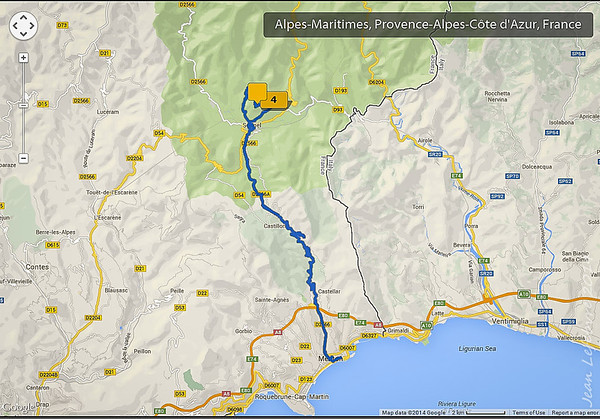
The Amalfi Coast area is here:
You’ll note that the area we were staying in, Bomerano (actually part of Agerola), is not even on the map. It is up away from the sea, in the mountainous area, and not easy to get to. If not for being on a tour that brought us there, I’m sure we’d never have visited on our own.
Where Bomerano is—the red A
Your transportation options are either not-terribly-frequent buses from Amalfi, spending a fortune on a taxi, or attempting to drive yourself—which would practically be a death wish on these very narrow, twisty, and busy roads. (Of course, with the tour, we either had help with the bus system or an experienced driver.)
Furthermore, there ain’t a heck of a lot to do in Bomerano. It’s quite small, not many shops, no bank, no museums (that I know of), and just a few restaurants. (Oh, and all the TV channels are in Italian.)
But as a place to collapse after a day of hiking or touring or both, it was just fine. Especially since it did have Internet, which really provided enough entertainment for the amount of time we spent there not sleeping or eating the multi-course meals. (More on that later).
The weather
The tour group the previous week had the great bad luck of experiencing a full week of cold, fog, and heavy rain. On a hiking tour.
We were in the much more fortunate position of experiencing the upswing in the weather. On the first day (of activity), the fog was heavy, so instead of climbing the mountain as would normally have been the itinerary, we did the walk down to Amalfi, eventually getting below the fog. Unfortunately, of course, we had few views on the way.
The view below the fog
The day of the mountain climb, though, we did have a sunny morning, and therefore nice views all the way up the mountain. However, then the fog decided to come back for our descent. And at the very bottom, we got our only rain of the trip–pretty heavy at the very end. But we all enjoyed the refuge at the Crazy Burger Cafe!
The fog rolling in at the top of the mountain
At Pompeii, the weather was fantastic. On Mount Vesuvius, the fog decided to reappear, though more in a hide and seek kind of way that did allow for some views. (A bigger issue was the strikers who prevented us from walking all the way around and partly down into the volcano, but the alternate route we did instead was a lot of fun.)
The peekaboo fog at Vesuvius
The next three days were nothing but sunny, and the final day got really warm, such that we were all discarding as many clothes as was decent, and getting a great round of sunburns.
Perfect weather on the final hike, The Walk of the Gods
Managing the physical challenges
Though we both do some exercise, it turns out we weren’t really in shape for walking down 2700 steps one day, then climbing up a small mountain the next. By the third day, we could barely negotiate the tiny stairs in the hotel, so sore were the muscles. In my case, it was both calves (from the up) and quads (from the down).
I was actually worried about managing the rest of the trip, but by day four things were much improved, and by the end, despite continued hiking on hilly terrain, the muscles were actually pretty good.
My big toes on the other hand, got extremely whiny about the constant butting up against the end of the hiking boot, and by the end were unbelievably sensitive. That made walking in Rome the first two days something of a challenge, but that too improved in the end. Well, except that my big toe nails are now kind of black.
The group
The tour group we were with, Exodus, are British, so everyone on the tour but us were from the UK or Scotland. (We got a lot of comments about how far it was for us to come. Of course, true. They had only a 2.5 hour flight!) They ranged in age from, I’m guessing, early 30s to late 60s. And most of them in their 60s were in much better shape than us, which wasn’t embarrassing at all. 🙂
The merry band of hikers
It was a good group. Interesting people who tended to have done a lot of traveling, and who worked in all different areas. Jean was particularly great with one of the older ladies, who had hurt her knee on the first day (!), and thereafter struggled with some of the more challenging terrain. He made sure she negotiated all the paths safely. He’s sweet, my husband.
Food and wine
We had all our breakfasts and most of dinners at Hotel Due Torri, where we staying, which is fortunately somewhat renowned for its food. It was, of course, Italian cuisine all week long, but a different menu each night, typically starting with a pasta, then following with seafood or meat, then dessert.
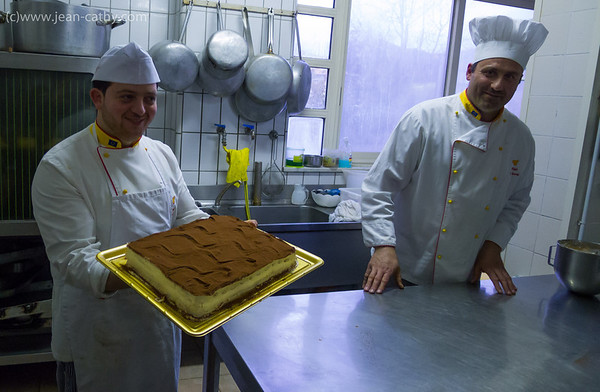
We also got to go into the kitchen a couple times to watch the meals being put together, which was a lot of fun. That’s a lot of olive oil in that seafood linguine! And if you have a wood-burning oven at 200 degrees, your pizza cooks in about 2 minutes.
Freshly made tiramisu
The wines served were regional ones, not exported to Canada (or anywhere). They were good, quite food-friendly, but not the sort you’d make a big fuss over.
We had one night out to another Bomerano restaurant, the whole group together, and they did a fantastic job there, too. Jean and I still argue over which of us had the better meal there. And in Revello, we had a splurge lunch on a gorgeous patio. In Rome, we mostly stuck with Italian food, still. It was all good, but I think most notable was the ricotta and pear ravioli in truffle sauce. Jean liked it so much when I had it at lunch that we went back to the same place for dinner, and he ordered it.
Lunch in Revello, “the most picturesque place on earth”, as one in our group called it
Rome
I should wind up before I’m writing all night (of course I’ll be adding more to the website, later), but not before saying something about our visit to Rome.
The first day in Rome it was 28 degrees and sunny, which you may think sounds great, but Rome is humid, I had to keep somewhat covered up due to sunburn, I had the sore feet, and so it was just uncomfortable. And then there was crowds.
We had been thinking April was still low season there, but not so much–especially late April. That first day, we walked to the Trevi Fountain, and the Spanish Steps, and the Coliseum area… And everywhere was just crawling with an unbelievable number of people.
We had to share the Spanish Steps with just a few other people.
So truthfully, I wasn’t really liking Rome so much on day 1 there. (And did I mention our hotel had no air conditioning?)
Fortunately, Rome improved. It started by clouding over (but no rain) and lowering the temperature (but not getting too cold), which was much better. And, we largely avoided the big sites and saw some of the less well-known yet quite interesting areas we had missed last time:
National Museum of Rome, with fantastic ancient sculptures
Museum of Modern Art, with fantastic modern sculptures and a really neat area on optical illusion art
The Capuchin crypt, with its artful arrangement of 4000 monk bones (web photo below)
A synagogue tour, where I learned just how long Roman Jews have been persecuted
An interesting archeological site behind the synogague, unearthing another Colosseum
The lively Travestere neighborhood
We weren’t allowed to take photos here, so this one is a find
The not-so-well known colosseum behind the Rome synagogue
And the more famous Forum (because this is a cool shot)
So Rome ended up fine as well. Thank goodness it was a second visit.
*** Temple Grandin (February 2010) – Rental
Claire Danes, Julia Ormond. Dramatization of the young adult years in the life of Temple Grandin, an autistic woman who had great career success.
She says: Claire Danes is terrific in portraying Temple Grandin, and the filmmakers do an interesting job of giving us a view into her world by filming parts in the visual, literal way that she sees it. I grew a little tired of the open door metaphor (that she saw literally), but that’s my only complaint. The movie would probably have been even more compelling if I hadn’t gone in knowing a fair amount about Temple Grandin. He says: That was an interesting movie.
***½ Joyeux Noël (March 2006) – Rental
Diane Kruger, Benno Furmann. French, Scottish, and German troops decide to call a truce on Christmas Eve 1914, during World War 1.
She says: Very moving, and almost unbelievable, to see those who had been shooting each other hours before gingerly reach a cease fire through music, then find they have much in common. The DVD extras include an interview with the director (all in French) that shows how most of the events of the film are based on incidents that actually happened during that war. He says: That was a really good movie. Hard to believe.
We’re back from a really lovely vacation, a river cruise on the Danube. In advance of the full report, a few comments.
Days away: 9
But they seemed to go by in a flash.
Number of cities visited: 8
Budapest, Hungary
Bratislava, Slovakia
Vienna, Austria
Melk, Austria
Linz, Austria
Passau, Germany
Regensburg, Germany
Kelheim, Germany
Plus the airports of Munich, Germany and Amsterdam, Holland.
Temperature range: 3c to 20C
It started out quite warm and sunny in Budapest, then cool and sunny, then cloudy, rainy, back to cloudy, and finally around to cool sunny, then warm and sunny again. Typical spring. No snow, at least.
Number of off-boat meals: 1
(Not counting airport and airplane meals.) That one was a fantastic lunch at the beautiful Cafe Centrale in Vienna. Otherwise, we partook of our included onboard meals. And fortunately, except for a few failed efforts here and there, those were pretty good. And sometimes very good—the roast duck, roast lamb, and grilled prawns on risotto were highlights.
Number of countries’ wines we tried: 4
In Hungary, we visited a wine store, learned quite a bit about their industry, and my parents purchased a wonderful pinot noir that they opened on-board.
In Bratislava, Jean and I visited a wine bar for Slovakian wine, which we enjoyed. But most impressive was the price: 1 Euro a glass (about $1.40). In a restaurant.
Onboard, they served Austrian wine, red and white, in quite generous amounts. We also tried a few other varieties in Melk.
That’s 3 of the 4. The last is Chile, as that’s what KLM serves on their flights. (It was pretty good, too.)
Most surprising highlight: Melk
Pretty well everywhere we visited had something worthwhile, and certainly a number of places we wished we had more time for (notably Budapest and Linz), but I have to say the Melk exceeded all expectations. It’s a very small town, and had one tourist attraction that I knew of: The Abbey. So, we went to see the Abbey. We figured it would be some old building with a few interesting artifacts.
But it just blew us away. One of the most interesting, original sites I’ve ever visited. I’ll describe more when I have pictures to go along with it, but here’s an idea (a Wikipedia photo):
That’s the library. And it’s not even the best part.
Number of photos taken: 0
By me, at least.
Jean took about a million-billion, though, so I’m not too worried about lacking visual memories of our journey.
Our on-board claim to fame: Dancing
There was a live band nightly. There was a small dance floor. We took advantage. People noticed (apparently in a positive way). Can’t let those dance lessons go to waste.
Number of books read: 3.5
The High Road by Terry Fallis (so I could read a novel about a Canadian federal election while being away from the actual one)
E A Novel by Matt Beaumont (so I could read a novel entirely written in emails while having no access to my own)
What the Dog Saw by Malcolm Gladwell (that’s the half)
Journey to the Edge of the World by Billy Connolly (the book that kept Jean engaged while “stuck” on board)






 Cultureguru's Weblog