Last Thursday we braved the pre-storm (really, no big deal) to go out for dinner and a concert. The dinner plan had been to check out Imbibe, on The Museum premises. Only, they didn’t seem terribly interested in serving us. It was a while before anyone even told us we could sit anywhere, and as the minutes ticked by with no one offering drinks or a menu, we left. (I’m not sure they noticed.)
Fortunately, the reliable Peter Martin’s was across the street. We discovered that they seemed to have largely abandoned their “cheaper bistro” idea, going back to the pricier appetizer and entree approach. Everything very good, though. We shared mussels in cream sauce with smoked bacon to start, then I had the pork belly with excellent greens and sweet potato sides, while Jean enjoyed the lamb with side of gnochi.
Then, off to our Intersections concert across the street. This one focused on Indian music, and befitting that, some members of the orchestra—including conductor Edwin Outwater—were in Indian garb.
Not how members of the symphony were dressed, but a cool pic nonetheless
The guest performers did not play sitars. Highlighted on the first few pieces was the mrdangam, which is a type of drum. One side of it plays bass notes, the other higher-pitched rhythms. The performer, Trichy Sankaran, could play incredibly quickly.
He was joined by his daughter, Suba Sankaran, who clapped out rhythms during the instrumental numbers, but then also took over on vocals. One piece she presented was an reinterpretation of Leonard Cohen’s “Bird on a Wire”. As befitting the title of this section, she did also present some songs from Bollywood movies, although with a twist: She sang lyrics from the somewhat humorous English translation, rather than the original Hindi. (No actual dancing, but we did some movie footage in the background.)
During a lovely piece called “Maya” it occurred to me that many of us had been trained in the sounds of Indian music by the British rock stars of the sixties: The Kinks with “See my Friends”, and of course, The Beatles. Fittingly, the last piece of the evening was a great version of George Harrison’s “Within You, Without You” from Sgt. Pepper.
The concert, performed without intermission, seemed to be over in a flash. Indeed, it was just about an hour long. Just enough to whet our palate.
My rather excellent run of live concerts this year was capped off with The Barenaked Ladies, performing “Hits and Holiday Songs” with the KW Symphony, at Centre in the Square last Sunday.
Jean was a bit puzzled at my interest in this one, as I don’t exactly idolize this band. But I had been thinking for a while that I wouldn’t mind seeing them in concert. I definitely like the albums and songs of theirs that I have (which is probably only the obvious ones), and I figured their humorous approach to performance would make their live show fun. So when a local concert was announced, I didn’t wait long to get tickets.
Playing a bit of catch-up here, on the eclectic mix of KW Symphony concerts we’ve seen this fall and winter…
It began in September with the season opener. The first half were two fairly fabulous modern classical pieces, both by local composers, Stewart Goodyear’s Count Up and John Estacio’s Brio: Toccata and Fantasy for Orchestra. The second half was somewhat more familiar: Beethoven’s Symphony in D minor: The Ode to Joy. It’s a bit funny in that it features a mass choir (four choirs, combined) and four soloists, but for most of the performance time, they are just sitting there. They only start singing in the later movements.
But what a gorgeous piece that is. I’m always worried I’ll get a bit bored during the slow bits of classical pieces, but that didn’t happen here. Too beautiful, too moving. Then afterward, we attended the opening gala, which offered a live band (not classical), dancing, hors d’oeuvres, drinks, and an auction. It was a fun evening.
In October, we saw Penelope, by Sarah Kirland Snider (who was in attendance), which was part of the Intersections series. It was a “song cycle”, in which a woman’s husband returns from the war after many years, not remembering his previous life. The performance is his wife’s reaction to this and attempts to restore his memory, partly through reading Homer’s Odyssey to him.
Haunting is probably the best descriptor of this one. It wasn’t quite like anything I’ve heard before. It was written for and performed by Shara Worden, who has a gorgeous but unusual, almost unearthly, quality to her voice. Think I’d like to get the recording, though it would be the kind of thing you’d want to just listen to and through on its own, and not on shuffle mode with other things.
(I found this video while researching this, and really got drawn into watching it all, though it’s seven minutes long…) After the song cycle, Shara Worden performed some of her own songs, which were quirky and somewhat lighter, even featuring audience participation.
Then earlier this month, Edwin Outwater presented the work he’d listened to a lot as a (clearly very unusual) teenager, Gustav Mahler’s Symphony No 5. The piece is over an hour long and requires more musicians than KW Symphony has, so they were joined by about 40 additional musicians. In the first half, after with Schubert’s brief Entr’acte No. 3 from Rosamunde, Outwater explained what was going on the various parts of the Mahler symphony, with excerpts, then in the second half, they played it all. Though I’d had kind of a day at work, I couldn’t help but be drawn in by the gorgeous music rather than brooding on that.
He’s right that it’s an amazing work. Still can’t imagine myself having listened to it as a teenager, though.
Finally, the first Jeans’n’Classics concert led off this month with something I did listen to as a teenager: The Beatles: Rubber Soul and Revolver. Jean calls me a snob for this, but I still protest that following the old US releases of these albums rather than the more definitive UK / CD versions was a weird Boomer thing to do, particularly as it meant the omission of songs like “Love You to” (my favorite of the three Harrison songs on Revolver) and “And Your Bird Can Sing”. And the even more brilliant songs “Drive My Car” and “Nowhere Man” are only recent additions, tacked on at the end of Rubber Soul’s odd US play order.
But then again… Maybe has does have a point that it’s just a quibble, because it was a really good concert. The Beatles music is very suited to the symphonic treatment, and Peter Brennan clearly loves them and does cool, original things with the arrangements, such as intermixing “Within You Without You” (from Sgt. Pepper) into Octopus’s Garden.
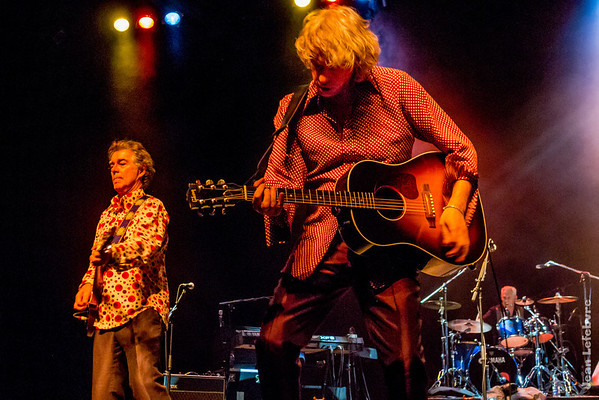
The two lead singers, David Blamires and Neil Donnell, both have exquisite voices, and their weaker stage presence was made up for by having personable keyboardist John Regan lead us through the set. We also got Don Paulton on keyboards, in a rare double-shot on the ivories. And one has to mention that apart from singing well, as always, Kathryn Rose looked particularly fetching. She seems to be one of those women who just get more attractive as they get older.
The set list, of course, featured three of my all-time favorite Beatles songs, “Norwegian Wood” (which led to a night-long debate as to just what John Lennon was setting fire to there), “In My Life”, “Girl” (so sensual), and “For No One” (a most devastating breakup song). But those two albums are just strong in general, so there wasn’t much dross. The very odd “Tomorrow Never Knows” was suitably trippy ending to the evening.
Of course, there was no way I would miss seeing The Who performing one of my favorite albums in nearby Toronto. But despite the mostly positive reviews of the tour (the only exceptions being from those boomers who, far as I can tell, mainly resent The Who for no longer being 25), I wasn’t sure how much I would enjoy it. I thought that:
My seats at the opposite end of the stage (behind the floor seats) would not compare well with the “right in front of the stage” seats I’d had at the last two Roger Daltrey concerts.
The sound quality would be pretty crappy.
The singing quality might be kind of crappy, given how difficult Quadrophenia is to sing.
We weren’t exactly down front this time…
The date would also prove to throw up a few other challenges. When I bought the tickets back in July, I didn’t know that would be bringing me to downtown Toronto on Grey Cup weekend. That made for some incredibly inflated weekend hotel prices! And just a wee bit of extra traffic.
But it all turned out better than expected.
We were actually staying (without intending this at all) at the “official Grey Cup hotel.” Which, yes, it was pretty crazy with people there. But they were a bunch of really happy people! And it’s not every day you see the Winnipeg pipe band playing and marching in your hotel lobby while blue-haired Argos fans and cowboy-hatted Calgary fans look on. It was weird, and definitely seemed that my Who T-shirt was the wrong uniform to be in, but it was entertaining.
And all my concerns about the concert evaporated really quickly as well:
We weren’t close, it’s true, but we were as central as you can get, with perfect sightlines. At any time I could see all five big screens, all members of the band on stage, and if I really wanted a closer view, I had binoculars.
The sound quality wasn’t bad at all. The horns, keyboards, guitars, bass, and drums all seemed nicely mixed; it was loud enough without being too loud.
Of course some of the songs were wisely keyed lower than the original, but Roger Daltrey sang the best I’ve heard him in recent years, deftly handling the vocal jumps in “Dr. Jimmy”, singing the chorus of “Love Reign O’er Me” with impressive power and passion, and absolutely nailing the scream in “Won’t Get Fooled Again”.
But we could still see
The opening act
I do want to pause for a minute and acknowledge that opening act Vintage Trouble were fantastic. Led by Ty Taylor—most famous as a former contestant on Rock Star: INXS—they were energetic, engaging, and charismatic, and Ty’s signing voice remains a miraculous thing. Their half-hour set was tons of fun, and I’m going to pick up a few more of their songs. They earned a standing ovation.
Quadrophenia
As is typical, not everyone showed up for the opening act (their loss) but by the time 8:30 rolled around, that stadium looked really packed—more than I expected, really, as I didn’t think it was a sellout (and maybe it wasn’t, but it must have been close). And once again, I had that feeling that the people of Toronto really love The Who. They may have been average age 50 (I’d guess), but they were as enthusiastic as teenagers.
Another killer Who show. Toronto crowd are loud – like a home crowd. Where to next? Detroit, Minneapolis, Chicago…
Apparently the original Quadrophenia tour was a bit of a mess, the band not having been given enough time to prepare for a live presentation of that complex music. The 1996/97 outing (which I have on DVD) featured a narrator telling the story of Jimmy the Mod. This one returned to another central idea of Quadrophenia: that it represented the band itself, aspects of the four very different personalities in The Who. So it was presented, sort of, as today’s Who paying tribute to their own past.
Earlier in the show; Roger still in jacket
They played the album straight through, no narration, not even pausing to talk to the audience. But throughout, they used the five large screens behind them to either illustrate themes of the songs (a lot of water imagery—don’t see this show on a full bladder) or show scenes from that time. (Along with showing what was happening on stage, of course.) Often the scenes were of their younger selves. For example, during “The Real Me” and “Cut My Hair” were scenes of the very young mod Who at the tiny clubs they originally played at.
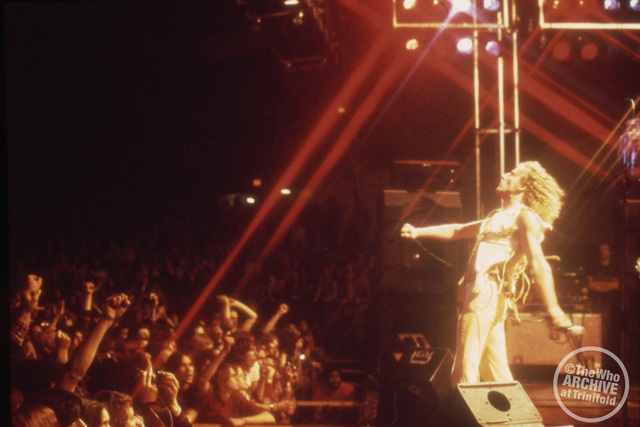
During “The Punk and the Godfather”, the song where Jimmy is angry that The Who have become so famous, abandoning their mod roots, the scenes were all of the band in their glory days: Pete leaping, Keith thrashing, John being cool, and Roger as the ultimate rock God. (Struck me that seeing the younger selves on the big screen while the current members sang live was the closest someone my age could possibly get to seeing The Who in their prime. And yes, I’m grateful for the experience.)
On “Helpless Dancer”, the tough guy theme, Pete and Roger traded off lines (Pete seemed to deliberately censor himself on the “lesbians and queers” line, which was interesting) while the screens showed The Who in their destructive phase, smashing their guitars, drum kits, and microphone stands, and setting off bombs.
Most notably, of course—it’s mentioned in every review—during 5:15, the live band stops at one point to allow the big projection of John Entwistle to play his famous bass solo from the Albert Hall concert in 1997. The band was really rocking at this point, and earned their first standing ovation of the night.
Out of my brain on the train, on the train… 5:15
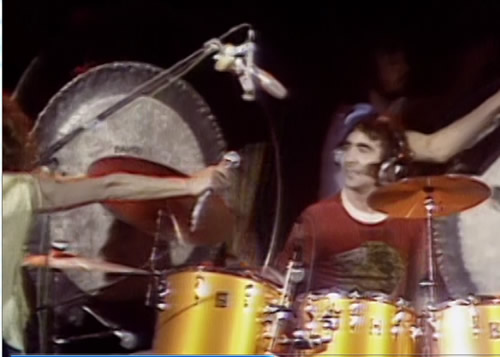
Then during “Bell Boy”, Roger handed off vocal duties to Keith Moon (video image of), just like in the old days. (Here’s video of that–not by us–also featuring the fabulous “Dr. Jimmy”, which followed.)
I have to say I found that part unexpectedly touching. I’m too young to remember when Keith Moon died; to me, in a sense, he’s always been gone, you know? So seeing this footage is the first time I can recall feeling sad about his passing.
During the instrumental “The Rock” (the only time Daltrey left the stage) the images ran through key points in history from mod days to now. The timing of the music to the 9/11 imagery was powerful and, again, very touching.
That led to the aforementioned “Love Reign O’er Me”, in which I was honestly astounded at how great Roger sounded on the chorus. I have to say that another thing about the hockey arena is that it really struck me how big and powerful his voice is, when contrasted with that of the Townshend brothers. Simon has a gorgeous, sweet-sounding voice; Pete’s has developed a bit of an odd growl in the lower ranges. But neither can fill the space in the same way.
Still Mr Body Beautiful at 68: Love Reign O’er Me
“Love Reign O’er Me” produced the second standing ovation. (Video of that: Not from great seats, but does have great audio.) It was also the conclusion of the Quadrophenia portion of the evening.
… And more
The Quadrophenia portion was tailor-made for The Who geeks. It was not so good for more casual fans, such as my husband (who was very happy he at least had his camera with him, to keep him busy. He took 1500 photos!). So the “and more” part of the evening was especially for them. Pete Townshend finally addressed the audience, talking about how Toronto had always been a special place for the band. And then they launched into “Who Are You” over a fun backdrop, featuring, among other images, a Canadian flag (very astute of them) and the Argos logo!
Who are you?
Meanwhile, the smaller screens flitted between different band members. Who are you? Who, who?
“Behind Blue Eyes” followed (the crowd just stayed standing through this entire last part), and it was quite something to hear that many people singing along with every line. Then we got “Pinball Wizard“–and both Jean and I are quite surprised how well the video of that turned out, given the distance, apparent from the shaking:
The very end featured just Daltrey and Townshend, on the most perfect song to end it on, “Tea and Theatre”, from Endless Wire. According to the Toronto Sun, they’d played for 2 hours 20 minutes. And gotta say, both Daltrey (who looks younger than he is) and Townshend (who does not) make growing older look a lot less scary, they had so much energy throughout, jokes about foot rubs and bed times notwithstanding! We should all be in such good shape at their age.
Rockers past their prime? Sure. But #TheWho last night at #ACC was one of the best concerts I’ve seen in years. Simply outstanding.
The timing of our Ottawa vacation was actually determined by one Sir Bob Geldof, who was doing concerts in Eastern Canada for the first time in 9 years. Perversely, I suppose, we decided to see him play at the city farthest from our own. (But really, would you rather visit Hamilton, Oshawa… or Ottawa? Right?)
Thanks to me contacting the theatre more or less the minute tickets went on sale, we were sitting in the very centre of the very first row, which the usher declared were the “Best seats in the house!”. Certainly was nice having no blocked view of the stage whatsoever. And when Bob did stroll to the front of the stage, he was really right in front of us.
And, it wasn’t a bad vantage point for taking pictures.
Jean’s review
You know, I do bring my husband to many concerts of interest more to me. Sometimes he’s bored by them, sometimes he’s slightly mystified by them, sometimes he’s mildly entertained, and occasionally… He loves them.
At the end of this one, he had the biggest grin. His comments included:
That was really good!
He just made it so entertaining!
(I’m figuring, since he’s not the big, life-long fan, his opinion means more than mine.)
How do you think he does it? What makes him so good?
The band is large—six musicians—and highly skilled. They convey Bob’s songs extremely well.
The show, about two hours long, is very well programmed and paced. The hits interspersed amongst maybe lesser-known songs, light music to start leading to more thoughtful than to dark ones, and concluding with completely fun ones. It never lags, whether you know all the tunes or not.
Bob is a really charismatic guy, and he really gets into the songs. You can’t take your eyes off him, and there’s no way to not get caught up in his passion.
He is fascinating guy who has led (well, is leading) an incredible life. When he talks, it’s as interesting as when he sings.
Mr. Chuckles
Geldof, of course, often deals with really serious issues of world poverty and whatnot, and therefore has a reputation of being an angry, grumpy guy. And maybe he is, but he’s also really funny. And he doesn’t trot out the same old jokes each time. No, the ones we heard were definitely customized for us.
Complaints that he thought he was playing the big city of Ottawa, but instead found himself miles from nowhere, on “Little House on the Prairie”. [Centrepointe Theatre, in Nepean, kind of is in the middle of nowhere, in fact…]
Amusement that the biggest highlight of the Ottawa Market was this 900 pound pumpkin on display.
A recurring trashing of the recently visited Oshawa, a city that apparently makes even Ottawa’s “little house on the prairie” look good.
Some set highlights
Our video of Mudslide, always a favorite of mine
Hearing some Boomtown Rats songs that aren’t as famous, and that he hadn’t played on the last tour, like “When the Night Comes” and “Joey’s on the Street again”.
Getting the backstory to “Scream in Vain”, which, on record, is an odd song about yams. It had its genesis in his return to Ethiopia ten years after Live Aid, and finding lush fields where previously there was death, dust, and desert. And seeing that helped him start to get out of his own severe depression, from his wife leaving him. And then they played “Scream in Vain”, and it just came across so powerfully…
An astonishingly sexy, extended version of the lustful “Mary of Fourth Form”.
Age is just a number
Bob Geldof is 61 years old. So all these people commenting on “Oh, he looks so old, now”–well, he is old. Of course he doesn’t look 30 anymore. And, he’s just not the type to run to the Lady Clairol, so with that crazy shock of long, completely gray hair… Kind of looks like a mad professor, or something.
But his voice has lost nothing of its range and power. He can still cover that octave and a half of “I Don’t Like Mondays”, still “scream in vain” during some songs, and sing softly and gently during others. Rather nasal, it’s never been a beautiful voice, but he has sure does a lot with what he has.
He’s also very energetic during the entire show, bobbing in place at times, moving around the stage at others. He remains very lean, and apparently very fit.
And up close, with the crazy hair partly hidden under a hat, and smiling, he still looks pretty handsome.
Final tip
If you ever do go see Bob Geldof in concert—as you should, before you die—you might want to stick around after. He’s often nice enough to come out and meet with fans. Or so I hear.
Apparently it’s quite weird that I want to go see Bob Geldof in concert. (For the third time, no less.) People seem to find it as strange as if I said–I don’t know–that I had tickets to see Bill Clinton. Play saxophone.
In that, it’s not as if Bob Geldof isn’t famous. He’s the Live Aid guy; the one who gets interviewed about African issues; who is an occasional guest editor of national newspapers; who won the knighthood decades before Paul McCartney, Elton John, Bono, and Mick Jagger did; and who is the father of all those girls with weird names (Pixie, Fifi, Tigerlilly, Peaches…).
It’s just that he’s no longer thought of as a musician.
A friend of mine kind of summed up what the world thinks: “Really interesting guy. But I don’t like his music.”
To which I say, Oh, really?
Because it appears to me that most North Americans know exactly two Bob Geldof songs:
I Don’t Like Mondays
Do They Know It’s Christmas?
And that they love both of them. One is the prototypical 1980s song; the other one the prototypical pop Christmas song. When Electric Thursdays does 80s music; “Mondays” is the big encore everybody is thrilled about. At their Christmas concert? Yes, the Band Aid song gains the standing ovation at the end.
I heard this song first via this video–on TV Ontario, of all things
But people have no idea what else Bob Geldof has done (musically).
So this is how I became a fan.
I stuck with The Boomtown Rats longer than most
This seems largely forgotten now, but everywhere except the US (where, thanks to “Mondays” getting banned, the Rats weren’t even a one-hit wonder), the Boomtown Rats were a very popular band in their time. They spent 123 weeks on the UK charts, including two songs at number one (the other being “Rat Trap”). In Canada, they played hockey arenas, and appeared on SCTV.
I became a fan of the Rats the same way everyone else did—after I heard “I Don’t Like Mondays”. It’s just that I stuck with them longer than most. I was not deterred by the “world music” sounds of MondoBongo (the album after the “Mondays” one), nor the dark themes permeating the amazing V Deep, VI Shallow. Judging by sales figures, others were a little put off by this. But I remained a fan to the end (that being the sixth and last album, In the Long Grass.)
One of my favorite songs from V Deep VI Shallow: Talking in Code, live
I saw Bob Geldof live
Bob’s first solo album, Deep in the Heart of Nowhere, in wake of Live Aid and all, was something of a success, with the hit single, “This Is the World Calling”. I got that at the time (my favorite song was “Pulled Apart by Horses”), but honestly, like most people, I then lost track of his musical career. “The Great Song of Indifference” was a big hit most places, but Canada followed the States in ignoring it.
A live version of The Great Song of Indifference
So when I went see him in concert in 2002, it was mostly due to Boomtown Rats nostalgia. And he did a reasonable sampling of those tunes, but also quite a few from the solos albums I had missed, and therefore didn’t know: the Irish jig-infused Vegetarians of Love and The Happy Club.
The fun My Hippie Angel, from The Happy Club
But no matter: I loved the show. As I wrote at the time, it was–and remains–one the best I’ve ever seen.
I bought all his solo albums
After that show, I picked up the two albums I’d missed, and I listened more to the one I’d picked up shortly before the show: Sex, Age, and Death. It would prove to become one of my favorite albums by anyone, ever.
One for Me by Bob Geldof, clearly inspired by now late but then merely former Mrs. Geldof, Paula Yates
And when his new one, the hilariously titled How to Compose Popular Songs That Will Sell came out last year, I bought that. It’s quite varied in style, but consistent in high quality.
Why I’m fan
It’s pretty simple, really. I’m a fan of music of Bob Geldof’s music because I listen to it.
You are not a fan only because you do not listen to it. It is not played on radio, it is no longer a big hit, you have seek it out.
If more people listened to it, more would like it. Not everyone, obviously, but more. His tunes are catchy. They have intelligent lyrics. His band is fantastic. There’s plenty to like. (And Ontarians, please note: You have an exceedingly rare opportunity this week and next week to see him play live, in Hamilton, St. Catharines, Oshawa, Ottawa, and Brockville. They’re small venues, not expensive, and if it’s anything like the two shows of his I’ve seen, you won’t regret it.)
Closing out with Bob’s life in song, in the amusing hidden track from his latest album, Young and Sober. “In the year of 75, that’s when I sang myself alive.”
I had all good intentions of getting a list a few tracks from k.d. lang’s new album, Sing It Loud, before seeing her in concert last Wednesday. But with the renovations going on, that just didn’t happen. So it occurred to me that I didn’t really know that many k.d. lang songs. I have the Ingenue album, and Hymns of the 49th Parallel, a few more versions of her singing “Hallelujah”, and her duet of “Crying” with Roy Orbison. That’s it.
Turns out my three companions to the concert were pretty much in the same boat. We were joking how we’d all just be sitting there, waiting for “Hallelujah”. But that voice, right? It should be great on any tune, whether we knew the song or not.
Bit of a tiring weekend, sorting through papers, files, magazines, books that all needing clearing out of our large downstairs room, so new flooring can be put in. Still to be addressed is all the media–CDs, DVDs, VHS! Many of the latter I expect to finally discard (though I do still have a working player), but I plan to hang on to the CDs and DVDs for the time being. Even though they’re rapidly becoming obsolete themselves.
One concerning thing about DVDs disappearing is that with them seem to go the “extras”. I realize that plenty of people don’t give a toss about the “extras” on a DVD; they just want to see the movie. So the alternative of downloading, or using Netflix (which never includes extras, I hear?), suit them just fine.
But me, I like a good “extra”. I’m a bit a analytical, and if a movie makes me think, I like to see if the extras provide any answers. I therefore still rent physical DVDs (albeit from an online service). And though my movie purchasing has slowed way down, I can still be lured in by the offer of juicy additions to a movie I really enjoyed.
When I discovered that the European version of Ken Russell’s Tommy had a whole extra disc of “stuff”, none of it available on any North American release of the movie (and also not findable, at least by me, on any torrent site), I had to get it. I have reconciled myself to the fact that I basically love Ken Russell’s Tommy, despite its excesses, sexism, controversial portrayal of pedophilia, and casting of people who can’t really sing. For me, that’s just outweighed by the incredible visual design of the film, the effort at teasing out a semi-coherent narrative from a muddled LP, and of course, the sheer beauty of Roger Daltrey.
Young Mr. Daltrey looking rather angelic
Finding a European copy proved a bit tricky, as the movie is going out of print. But via Ebay, I did my hands on a German version. (The movie and extras are all in English, of course; it’s just the subtitles and navigation and cover that are in German.) It was PAL format and Region 2, but Ebay also offers region-free DVD players at a good price, so I was set.
And now, from her interview, I know what Ann-Margret was thinking during her infamous writhing in beans, chocolate, and champagne scene. (At one point it was “ouch!”, because she badly cut her hands on the broken glass.)
Ann-Margret losing herself in the role
Unfortunately, they didn’t ask her one of my other questions, which was how she felt about having been cast a “mother” to someone just 3 years younger than she. Daltrey kind of covers that, though, saying that his biggest acting challenge here was trying to pretend that the gorgeous woman draped all over him in certain scenes was his “mom”.
(Honestly, those two look like they want to devour each other in some scenes. I’m curious to see what Ken Russell has to say about that in his commentary, but I’m not up to those parts yet.)
It seems that no one but Daltrey was ever seriously considered for the lead, but Townshend does say the age thing gave him pause. “Well, Roger wasn’t a natural choice to me! He was a bit long in the tooth for it.”
And what did Ken Russell, an older man who preferred classical man, think of working with the ‘orrible ‘oo, reputed to be so ill-tempered, out of control, and generally nasty bunch of guys? He said:
He [Daltrey] was as good as gold, full of suggestions, willing to do take after take. He suggested things, very inventive, very imaginative guy, and one of the nicest people you will ever hope to work with.
In fact, I was told at the beginning, Oh, you don’t want to work rock stars, they’ll make your life a misery, they’re difficult, they’re drunk. They were the nicest people I’ve ever worked with! They were good as gold. They were like little babies! They were just sweet.
The Who. Sweet as little babies. Where else am I going to hear something like that, but on a DVD commentary track? How will I find out these things, in a future world with no “extras”?
I’d heard good things about Kitchener’s free Blues Festival, but had never attended. This year, a free weekend combined with an appearance by Ray Manzarek, best known as the keyboardist for The Doors, prompted me to go.
A few weeks earlier I’d seen Holly Cole at Waterloo’s free Jazz Festival. I couldn’t help comparing the Bluesfest experience to that. Holly Cole was the marquee event of the Jazz Fest, but although we didn’t arrive much ahead of time, entry was smooth and quick, and we had no trouble setting up with good sight lines of the stage.
By contrast, we had to line up and wait for entry to the Manzarek show (they gave everyone a wrist band), and it was basically impossible to get a good view. We had to rely on the big screen, just getting occasional peaks at the people on stage. Per a letter in The Record, this was a change from previous years, with “VIP” people (who paid, I assume?) getting access to all the good seats. At any rate, as a festival itself, it did leave me more impressed with the Jazz one.
But back to Mr. Manzarek. He wasn’t there to do a Doors nostalgia performance; he was there to perform music from his new album with partner Roy Rogers, a guitarist, forming the Manzarek-Rogers Band. They were joined on-stage by a drummer, bassist, and saxophonist.
I knew this in advance, and wasn’t sure how I’d like it, but despite not being familiar with any of the blues numbers, they were mostly enjoyable. Blues, after all, isn’t really that different from rock, and a lot of these were pretty rockin’ blues numbers. And he did throw us a couple of bones: an instrumental version of “The Crystal Ship” and encore performance of “Riders on the Storm” (both originally by The Doors, of course). Those ones naturally received the most enthusiastic reception.
Physically, Ray pretty much looks his age, I guess. He has a lot of hair, but it’s all gray, and his face is lined. But he’s certainly lost no manual dexterity, and he has a strong singing voice—actually a bit Morrison-like. (Should mention that partner Rogers was no slouch, either, on vocals and guitar.) And Manzarek is still such a hippie in the way he speaks, though, with his “hey man’s” and his basing songs on the poetry of Jack Kerouac. As the evening was winding down, he said, “But that means you get to go and get drunk, get stoned, and get laid. Now it doesn’t seem so bad that it’s ending, right?”
I’m a latecomer to The Who’s Quadrophenia. Tommy was the first Who album I got, and that was decades ago (on LP); Quadrophenia may have been the last, and that was a couple years ago (on CD).
I resisted that one, I think, because I just didn’t find the concept that appealing. The story of drug-addicted, “quadrophenic”, disillusioned mod Jimmy just seemed so British, so male, so 1960s–I couldn’t relate.
When I finally got the album, I liked the songs well enough right off, but really couldn’t put “the story” together until I also saw the 1996 Quadrophenia Live DVD. During that concert, a Jimmy narrator (on a big screen) provides a narrative thread through the songs—even though it’s not exactly the same one intended by the original album—that sufficiently put it together for me.
But that’s when I started to realize, with repeated listening, that the “story” didn’t really matter. Because the songs just sounded so great, you didn’t need to worry about plot.
The Quadrophenia songs work as standalones–much more so than most of the Tommy ones do. They also have a universality that you might not expect of “rock opera” songs. Who doesn’t want to be seen for who they are (“The Real Me”)? Who hasn’t had to do a crappy job (“The Dirty Jobs”)? Who hasn’t felt the wish to just slide away from a bad situation, even if it’s into oblivion (“Drowned”)? Who doesn’t want to feel awash in love (“Love Reign O’er Me”)?
You don’t have to be British, or male, or a baby boomer to get it. You just have to be human.
Given previous, it should come as no surprise that the parts I found least compelling were the fuller explanations of Jimmy’s story, and what the mods were all about. Though that wasn’t all a loss, since it’s always good to learn things, and that I did. Story-wise, I hadn’t realized that “The Punk and the Godfather” was about Jimmy going to see The Who themselves in concert, and being disillusioned that they’re now big rock stars, worlds apart from him. (Because that’s something they changed in the 1996 concert version.)
As for the mods, the point that their tidy hair and neat suits made them look like smart, respectable young men at work, when it was really a form of covert rebellion (though they did need those jobs to afford the suits) was an interesting point.
Though Pete Townshend the story-teller is the dominant figure in this documentary, I did like that some commenters view the album more as I do, as fairly universal: “I thought it was about me” says Manager Bill Curbishley, and he doesn’t mean that’s because he was a mentally ill mod, and not so much needing a plot: “Pete always has these great concepts, but the problem is he always wants to wrap a complicated story around it”, says Roger Daltrey.
What I liked best was the exploration of the music, the songs; all the archival concert footage included (nothing like seeing the young and beautiful Roger Daltrey on the big screen); and the look at the band dynamics at the time.
Those dynamics were some ugly, Unfortunately, we are somewhat stymied in exploring them by having only two band members remaining, and apparently not having a lot of footage of what Moon and Entwistle thought of Quadrophenia. Both men are featured, but they of course don’t necessarily get asked what we’d now like to know. For example, Pete says at the outset that John, as a songwriter, was unhappy that the band had become all about Pete’s songs. So how did John feel about Quadrophenia, to which he didn’t contribute a single track? No idea.
Tommy was quite a collaborative effort by the band, at least for The Who. Entwistle contributed two songs, Moon came up with the holiday camp idea (and a writing credit), Daltrey suggested that he embody the Tommy role, thus finally truly becoming the voice of the band. But Quadrophenia was all Pete, all demo’ed and done and presented to the band. “The rest of them must have felt a bit like session musicians,” is one opinion expressed in the documentary.
Yet, Pete did use the four very different band members as the both representative of Jimmy’s four split personalities, and as the four musical motifs that echo through the album, which Pete says is the more important aspect. Moon the lunatic, Pete the hypocrite (interesting, and I’m not sure how that leads to a “Love Reign O’er Me” theme), Roger as “bad” (the album liner notes say “tough guy”, but Pete’s original notes say “bad”) and John as “romantic”, those two intersecting as “sex”. (I don’t think Pete meant that in a gay way.)
Of course, it’s only Mr. Bad who’s still around to say what he thought of all this, and it’s interesting that there still seems to be so much tension between the two on this (given they’re about to tour it together, and all). Pete comments on how the rest of the band liked to drink for a couple hours before getting to work, which the non-alcoholic Roger hated as a waste of time.
Then there’s this. “Pete may have produced this album”, says Roger, steely-eyed, “but he did not produce my vocals. I wouldn’t have it.” And Pete suggests that’s because Roger could not take criticism. “You had to be very careful what you said to him. You really did.” Little wonder that during the first rehearsal for this album’s tour, Pete hit Roger with his guitar, and Roger responded by knocking him out cold with one punch.
Yet there’s no denying the deep admiration Pete expresses for Roger’s vocal work on the album, particularly, of course, on “Love Reign O’er Me”, a song that literally gave me goosebumps every time it was played on the wonderful theatre sound system during this documentary—the album version, a live version from that time, and the 96 live version.
Looking at Moon’s vocal work on “Bell Boy”, Pete comments on how Keith could never sing anything straight; it was always as a character. And that he did find it hard for his Ace Face character to come off comic. But of course, again, no way to know what Moon thought of this, though he clearly enjoyed singing the song in concert.
Those two songs get special focus during the documentary, as do some others, like “The Real Me”, “Cut My Hair”, “5:15” (partly Beatle-inspired, that one), and “Drowned”. But I was disappointed that “Doctor Jimmy” didn’t get that treatment. It just seems there would be so much to say about that one… How the complex musical arrangement of song that itself suggests a split personality (it’s my favorite Who song to play on the piano, but it’s not easy!), the shocking lyrics (“Who is she? I’ll rape it!”), even its importance to that darn storyline, as this moment of craziness then leads Jimmy out to that rock and possible redemption. But nada about “Doctor Jimmy” here.
Much as I enjoyed the concert footage, the documentary also covers how that tour was something of a disaster. It was booked a mere two weeks after the album was done, leaving the exhausted band no time to really prepare a stage show, and forcing them to play songs that the audience just didn’t know yet.
Pete said at the outset that his goal had been to write something that would replace Tommy as a concert vehicle. In that, Quadrophenia failed. (And maybe that’s why Pete feels this is the one he just has to take on the road again. Needs another do-over.)
The doc was only about an hour long, the theatre viewing filled out by showing some of the songs from the 1996 Quadrophenia Live DVD. This leads me to wonder if some footage is being held back for the eventual DVD release. Maybe I’ll get that “Doctor Jimmy” analysis after all?


 Finally, the first Jeans’n’Classics concert led off this month with something I did listen to as a teenager: The Beatles: Rubber Soul and Revolver. Jean calls me a snob for this, but I still protest that following the old US releases of these albums rather than the more definitive UK / CD versions was a weird Boomer thing to do, particularly as it meant the omission of songs like “Love You to” (my favorite of the three Harrison songs on Revolver) and “And Your Bird Can Sing”. And the even more brilliant songs “Drive My Car” and “Nowhere Man” are only recent additions, tacked on at the end of Rubber Soul’s odd US play order.






.BMP "Ann-Margret with beans in Tommy")

 By contrast, we had to line up and wait for entry to the Manzarek show (they gave everyone a wrist band), and it was basically impossible to get a good view. We had to rely on the big screen, just getting occasional peaks at the people on stage. Per a letter in The Record, this was a change from previous years, with “VIP” people (who paid, I assume?) getting access to all the good seats. At any rate, as a festival itself, it did leave me more impressed with the Jazz one.

 Cultureguru's Weblog