Movie reviews: The Sessions and Blue Valentine

We saw two love stories, of sorts, recently. One is a current release about a man who spends most of his day confined to an iron lung, and thus is still a virgin at 38. The other is about the volatile relationship between a nurse played by Michelle Williams, and a house painter played by Ryan Gosling.

One of the two was really depressing. But probably not the one you think…

**** The Sessions (October 2012) – Theatre

John Hawkes, Helen Hunt, and William H. Macey. Journalist and poet Mark O’Brien, whose childhood polio has left him confined to an iron lungmost of the day, but who does have functioning genitalia, becomes determined to lose his virginity at age 38, with the help of a sex therapist.

She says: The trailer for this movie makes it look really funny, and much of it is, in the interaction between Mark and his caretakers, and especially with his open-minded priest, played by William H. Macey. But it is also really touching, especially in the relationship between Mark and his sex therapist, Cheryl. Cheryl (who is married) knows the pitfalls of transference and how to set limits on the sex therapist / client relationship, but her own emotional response makes these harder to maintain as the sessions (six maximum!) continue.

The sex in this movie is really beautiful, not because of amazing bodies or great cinematography, but because it really is an expression of intimacy and love. It’s triumphant.

He says: That was a really sweet movie. (And that’s all you’re allowed to quote me on.)

Scene from The Sessions

** Blue Valentine (December 2010) – Rental

Poster from Blue ValentineMichelle Williams, Ryan Gosling. A marriage at the end of its ropes is contrasted with the happy start of the relationship.

She says: The acting is good here, it’s very realistic, but it’s brutal watching two people who once loved each other just tear each other apart. Made for rather depressing viewing.

He says: I didn’t find anything good about that. I don’t care that it’s “well made”; there was just nothing to enjoy there.

Movie review: The Perks of Being a Wallflower

The Perks of Being a Wallflower poster**** The Perks of Being a Wallflower (September 2012) – Theatre

Logan Lerman, Emma Watson, Ezra Miller. A troubled young man finds high school less traumatic when he finally makes friends with some misfit seniors.

She says: Since we (the North American over-14 “we”) have all been to high school, it’s hard not to connect with this film: the hormonal confusion, the drug experimentation, the fear of not having anyone to sit with in the cafeteria, or talk to at the school dance. One is so relieved when lead character Charlie gains the friendships that help him negotiate all this, but the movie’s drama shows how Charlie’s problems are deeper than most’s, the friendship’s life-lines more important.

Though it’s mostly serious, the movie has plenty of fun and funny moments. It made me emotional at times, but those moments felt honest, not manipulative. The young actors are strong, though Emma Watson seemed a little hamstrung by having to focus on her American accent. A few details clunked, most notably that these music-obsessed teens were mystified as to the origins of David Bowie’s very famous song, “Heroes”. It also took me a while to locate the movie in time (late 80s / early 90s), though that may not be a critique.

I say, go see this one.

He says: I really liked that one. I don’t even know why I liked that one, because it seems to me not much happened, and usually I don’t like movies like that. But I really enjoyed this one.

Movie reviews: Bubble and Stories We Tell

Back in the true art house realm here with Bubble, a documentary-like drama, and Stories We Tell, a partly dramatized documentary.

Bubble poster*** Bubble (January 2006) – Rental

Directed by Steven Soderbergh. Martha and Kyle are coworkers at a doll factory whose relationship is disrupted by a new arrival at the factory, Rose.

She says: Except for the big-name director, movies don’t get much smaller than this. (I would never even have heard of this one if not for Roger Ebert highlighting it recently.) Its stars are not actors, but locals. The story was plotted, but the dialogue was not scripted. Its a mere 73 minutes long.

These people lead very simple lives, yet its weirdly fascinating, as we just don’t see people like this in movies. They look and talk like real people. They aren’t dramatically poor (not homeless, not starving), but basically have no money, no real prospects. Their job of assembling dolls makes for some really odd images, of doll parts molded, assembled, decorated.

Martha and Kyle have a comfortable, non-romantic relationship. Rose disrupts that, creating a strange triangle. A murder occurs. Who and how that happens is the central mystery of the film.

He says: This one moves at the pace of real life… I don’t really know what to make of it.

Stories We Tell*** Stories We Tell (November 2012) – Theatre

Documentary by Sarah Polley. She explores the family secret that the man who raised her is not her biological father.

She says: Though it lags a bit toward the end, there are a surprising number of twists in this documentary about Sarah Polley’s decision to explore the truth about her parentage. She does this by interviewing everyone in her family, along with family friends, while interspersing old family footage along with dramatic re-creations of certain key events (and it was occasionally difficult to tell which was what).

It’s not all that unusual, apparently, that men end up raising children they think are their own, but aren’t. But it really struck how differently an artistic family and circle such as the Polley’s react to this, with everyone almost tripping over themselves to be the ones who get to own the narrative. And hence, Stories We Tell becomes Polley’s framework.

A bit pretentious, I guess, but as I said, mostly engaging.

He says: Well, there were parts when I was pretty bored. But it could have been worse. I’m still not totally sure what was acting and what were actual inteviews, though.

Movie review: Looper

This one’s pretty short and sweet…

*** Looper (September 2012) – Theatre
Joseph Gordon-Levitt, Bruce Willis, Emily Blunt. Time travel is possible in the future, but illegal, so used only by criminals to commit murders—in the past. Then they “close the loop” by issuing their present-day assassins a  future termination date.

She says: Violent and a bit dire, but definitely thought-provoking and engaging. I’m won over by the latter.
He says: Jeez, that was grim. I still liked it—I’d recommend it—but it isn’t exactly uplifting.

Movie review: The Blind Side

***½ The Blind Side (November 2009) – Rental

The Blind Side posterSandra Bullock, Quinton Aaron. A homeless teenager’s life is transformed through his relationship with the well-to-do family that takes him in.

She says: I didn’t get much from the football scenes—almost remarkable how little I know about that game—but I otherwise found myself quite taken in by this story of (basically) class and race differences in America, and how harmony was achieved in this one case (based on a true story).

He says: Except that it kept trying to make you cry every two minutes, that was a good movie. It was interesting story, and Sandra Bullock was great in it.

Movie reviews: Never Let Me Go, One Week

Never Let Me Go posterWithout intending this, last weekend we ended up watching two movies on the cheery subject of human mortality, as depicted through the prism of young adults facing a death sentence:

Never Let Me Go, 2010, starring Keira Knightly, Andrew Garfield, and Carey Mulligan

One Week, 2008, starring Joshua Jackson and Liane Balaban

Based on a novel, the premise of Never Let Me Go, a British film, is an alternate world where cloning technology was perfected in the 1950s, leading to a world where clones are created for the purpose of providing life-extending organ donations to everyone else. We first meet the donors as children in a British boarding school, then move ahead to their lives as young adults. The focus is on three characters who form a love triangle.

One Week is a Canadian movie in which the protagonist receives a terrible cancer diagnosis in the first scene. Instead of immediately going into treatment, as recommended, he decides to take a motorcycle road trip across Canada first, to take stock of his life.

As you might imagine, Never Let Me Go is sad. But at least, blessedly, you’re never made to wallow in the sadness. It’s there, it’s built into the story, but it’s all underplayed, somewhat interior, all very British. It never brought me to tears. It’s very well-made, with a lot of attention to the look, the dimmed color palette. It moves along at an appropriate pace. Both the child actors and the young adults in the film are quite good in their roles.

Most striking about how the story plays out if how accepting all the clones are of their fate. It never seems to occur to anyone to run and try to escape the transplant surgeries that will ultimately kill them. If they had, that would have been a whole other movie. (I think it was called Logan’s Run.) If still wondering why this story was told in these terms, watch the extras! It is explained there.

One Week movie posterI was going to say that One Week is therefore a contrast, as it’s all about escape, but that’s not really true. Lead character Ben knows perfectly well he can’t outran cancer. He’s just looking for a slice of time before he becomes a patient.

Everything in this movie takes place with Ben basically still feeling well, so it’s much less sad than Never Let Me Go. The whole story is approached with wry humour.  It’s also a real love letter to Canada, as you see a lot of the iconic and beautiful Canadian sites Ben travels through, including the Big Nickel, the Terry Fox statue, the rolling prairies, the gorgeous beaches of Tofino.

The script does not have the fullness and depth of Never Let Me Go‘s, but I still found it interesting to participate in Ben’s examinations of the choices that had led him to a job he isn’t passionate about, and into an engagement with a lovely woman who nevertheless may not be The One. And of course, leads you to wonder why you might do if you had a week before entering into likely hopeless cancer treatment.

Jean’s take? He found Never Let Me Go really sad, and overall thinks I should rent more comedies. As for One Week, he was strongly critical of Ben’s treatment of his fiancee, but did enjoy the travel through Canada aspect. I think his attention reasonably well, for another movie that is more about self-realization than plot twists.

Missing from the North American version of Tommy

Bit of a tiring weekend, sorting through papers, files, magazines, books that all needing clearing out of our large downstairs room, so new flooring can be put in. Still to be addressed is all the media–CDs, DVDs, VHS! Many of the latter I expect to finally discard (though I do still have a working player), but I plan to hang on to the CDs and DVDs for the time being. Even though they’re rapidly becoming obsolete themselves.

One concerning thing about DVDs disappearing is that with them seem to go the “extras”. I realize that plenty of people don’t give a toss about the “extras” on a DVD; they just want to see the movie. So the alternative of downloading, or using Netflix (which never includes extras, I hear?), suit them just fine.

But me, I like a good “extra”. I’m a bit a analytical, and if a movie makes me think, I like to see if the extras provide any answers. I therefore still rent physical DVDs (albeit from an online service). And though my movie purchasing has slowed way down, I can still be lured in by the offer of juicy additions to a movie I really enjoyed.

When I discovered that the European version of Ken Russell’s Tommy had a whole extra disc of “stuff”, none of it available on any North American release of the movie (and also not findable, at least by me, on any torrent site), I had to get it. I have reconciled myself to the fact that I basically love Ken Russell’s Tommy, despite its excesses, sexism, controversial portrayal of pedophilia, and casting of people who can’t really sing. For me, that’s just outweighed by the incredible visual design of the film, the effort at teasing out a semi-coherent narrative from a muddled LP, and of course, the sheer beauty of Roger Daltrey.Roger Daltrey in Tommy

Young Mr. Daltrey looking rather angelic

Finding a European copy proved a bit tricky, as the movie is going out of print. But via Ebay, I did my hands on a German version. (The movie and extras are all in English, of course; it’s just the subtitles and navigation and cover that are in German.) It was PAL format and Region 2, but Ebay also offers region-free DVD players at a good price, so I was set.

And now, from her interview, I know what Ann-Margret was thinking during her infamous writhing in beans, chocolate, and champagne scene. (At one point it was “ouch!”, because she badly cut her hands on the broken glass.)

Ann-Margret with beans in Tommy

Ann-Margret losing herself in the role

Unfortunately, they didn’t ask her one of my other questions, which was how she felt about having been cast a “mother” to someone just 3 years younger than she. Daltrey kind of covers that, though, saying that his biggest acting challenge here was trying to pretend that the gorgeous woman draped all over him in certain scenes was his “mom”.

(Honestly, those two look like they want to devour each other in some scenes. I’m curious to see what Ken Russell has to say about that in his commentary, but I’m not up to those parts yet.)

It seems that no one but Daltrey was ever seriously considered for the lead, but Townshend does say the age thing gave him pause. “Well, Roger wasn’t a natural choice to me! He was a bit long in the tooth for it.”

And what did Ken Russell, an older man who preferred classical man, think of working with the ‘orrible ‘oo, reputed to be so ill-tempered, out of control, and generally nasty bunch of guys? He said:

He [Daltrey] was as good as gold, full of suggestions, willing to do take after take. He suggested things, very inventive, very imaginative guy, and one of the nicest people you will ever hope to work with.

In fact, I was told at the beginning, Oh, you don’t want to work rock stars, they’ll make your life a misery, they’re difficult, they’re drunk. They were the nicest people I’ve ever worked with! They were good as gold. They were like little babies! They were just sweet.

The Who. Sweet as little babies. Where else am I going to hear something like that, but on a DVD commentary track? How will I find out these things, in a future world with no “extras”?

Movie review: Ruby Sparks

*** Ruby Sparks (July 2012) – Theatre
Paul Dano, Zoe Kazan. A young novelist struggling to write his second book after the successful first is finally inspired by a character he names Ruby. Then one day, Ruby shows up in the flesh, just as he has envisioned her…

She says: It was hard not to go all “feminist analysis” on this one, with the character of Ruby being, of course, the ultimate “manic pixie dream girl”. Having literally been imagined into existence, she is indeed a quirky young woman who lives only to inspire and please the main male character.

But then the movie examines that point. Having been brought to biological life as a complete human being, Ruby starts to chaff under her limitations. She’s lonely. She wants to do more. She wants to be more. And the reclusive Calvin isn’t sure he likes it.

It was definitely an interesting movie. Though I still wonder what it would have been with the genders reversed.

He says: Yes, enough happened in that movie; it had enough plot for me. He was an odd duck, that Calvin, though. Not a typical guy at all. She was just riveting. The whole thing held my interest.

Yeah, OK, I liked it.

Movie reviews: Your Sister’s Sister; Inside Job

We saw the first at the early show at The Princess, then saw the other on DVD at home.

*** Your Sister’s Sister (June 2012) – Theatre
Emily Blunt, Mark Duplass, Rosemary Dewitt. When Iris offers friend Tom the family cabin, both she and he expect he’ll be there alone. Instead he encounters Iris’s sister Hannah, and they hit it off.

She says: This is a small movie: small cast, short time frame, moderate drama. But the three principals play well off each other, and I got caught up in their story. Tom is mourning the loss of his brother; Hannah has ended a seven-year-old relationship. They get to drinking, and then they get into each other. Which makes it awkward all around when Iris shows up and confesses to Hannah that she’s in love with Tom (despite having previously dated Tom’s brother George).

He says: You know what I thought of that one.

She says: That not enough happened?

He says: You got it!

She says: I’ll never understand how you’re the people person in this relationship, and yet you don’t like movies about real people with realistic problems,

***1/2 Inside Job (October 2010) – Rental
Documentary about the global economic crisis of 2008. Narrated by Matt Damon.

She says: Rather timely viewing in light of the recent decision to not lay any charges against the Goldman Sachs executives. And after seeing this, you’ll be infuriated about that.

Because the global economic crisis of 2008, which caused (and continues to cause) so much pain to so many people, was no accident. It was caused by very rich people very knowingly playing dangerous games with everyone’s money. And then insuring themselves against the catastrophic losses that they knew were inevitable.

The movie does a very good job at explaining these complex financial transactions in a way that makes sense. And it shows the degree to which those responsible are ingrained in political culture (Republican and Democrat alike—doesn’t matter; Obama does not look good in this one), such that still nothing is being done, really, to stop them from doing this sort of thing again.

He says: I can’t watch this. I’m getting too angry.

Can you see the real me?

I’m a latecomer to The Who’s QuadropheniaTommy  was the first Who album I got, and that was decades ago (on LP); Quadrophenia may have been the last, and that was a couple years ago (on CD).

Quadrophenia album cover

I resisted that one, I think, because I just didn’t find the concept that appealing. The story of drug-addicted, “quadrophenic”, disillusioned mod Jimmy just seemed so British, so male, so 1960s–I couldn’t relate.

When I finally got the album, I liked the songs well enough right off, but really couldn’t put “the story” together until I also saw the 1996 Quadrophenia Live DVD. During that concert, a Jimmy narrator (on a big screen) provides a narrative thread through the songs—even though it’s not exactly the same one intended by the original album—that sufficiently put it together for me.

But that’s when I started to realize, with repeated listening, that the “story” didn’t really matter. Because the songs just sounded so great, you didn’t need to worry about plot.

The Quadrophenia songs work as standalones–much more so than most of the Tommy ones do. They also have a universality that you might not expect of “rock opera” songs. Who doesn’t want to be seen for who they are (“The Real Me”)? Who hasn’t had to do a crappy job (“The Dirty Jobs”)? Who hasn’t felt the wish to just slide away from a bad situation, even if it’s into oblivion (“Drowned”)? Who doesn’t want to feel awash in love (“Love Reign O’er Me”)?

You don’t have to be British, or male, or a baby boomer to get it. You just have to be human.

So it’s with that background that I went to see the new Who documentary about the making of Quadrophenia, subtitled Can You See the Real Me?, at the Galaxy theatre last week.

Given previous, it should come as no surprise that the parts I found least compelling were the fuller explanations of Jimmy’s story, and what the mods were all about. Though that wasn’t all a loss, since it’s always good to learn things, and that I did. Story-wise, I hadn’t realized that “The Punk and the Godfather” was about Jimmy going to see The Who themselves in concert, and being disillusioned that they’re now big rock stars, worlds apart from him. (Because that’s something they changed in the 1996 concert version.)

As for the mods, the point that their tidy hair and neat suits made them look like smart, respectable young men at work, when it was really a form of covert rebellion (though they did need those jobs to afford the suits) was an interesting point.

Though Pete Townshend the story-teller is the dominant figure in this documentary, I did like that some commenters view the album more as I do, as fairly universal: “I thought it was about me” says Manager Bill Curbishley, and he doesn’t mean that’s because he was a mentally ill mod, and not so much needing a plot: “Pete always has these great concepts, but the problem is he always wants to wrap a complicated story around it”, says Roger Daltrey.

What I liked best was the exploration of the music, the songs; all the archival concert footage included (nothing like seeing the young and beautiful Roger Daltrey on the big screen); and the look at the band dynamics at the time.

Those dynamics were some ugly, Unfortunately, we are somewhat stymied in exploring them by having only two band members remaining, and apparently not having a lot of footage of what Moon and Entwistle thought of Quadrophenia. Both men are featured, but they of course don’t necessarily get asked what we’d now like to know. For example, Pete says at the outset that John, as a songwriter, was unhappy that the band had become all about Pete’s songs. So how did John feel about Quadrophenia, to which he didn’t contribute a single track? No idea.

Tommy was quite a collaborative effort by the band, at least for The Who. Entwistle contributed two songs, Moon came up with the holiday camp idea (and a writing credit), Daltrey suggested that he embody the Tommy role, thus finally truly becoming the voice of the band. But Quadrophenia was all Pete, all demo’ed and done and presented to the band. “The rest of them must have felt a bit like session musicians,” is one opinion expressed in the documentary.

Yet, Pete did use the four very different band members as the both representative of Jimmy’s four split personalities, and as the four musical motifs that echo through the album, which Pete says is the more important aspect. Moon the lunatic, Pete the hypocrite (interesting, and I’m not sure how that leads to a “Love Reign O’er Me” theme), Roger as “bad” (the album liner notes say “tough guy”, but Pete’s original notes say “bad”) and John as “romantic”, those two intersecting as “sex”. (I don’t think Pete meant that in a gay way.)

Who concert image

Of course, it’s only Mr. Bad who’s still around to say what he thought of all this, and it’s interesting that there still seems to be so much tension between the two on this (given they’re about to tour it together, and all). Pete comments on how the rest of the band liked to drink for a couple hours before getting to work, which the non-alcoholic Roger hated as a waste of time.

Then there’s this. “Pete may have produced this album”, says Roger, steely-eyed, “but he did not produce my vocals. I wouldn’t have it.” And Pete suggests that’s because Roger could not take criticism. “You had to be very careful what you said to him. You really did.” Little wonder that during the first rehearsal for this album’s tour, Pete hit Roger with his guitar, and Roger responded by knocking him out cold with one punch.

Yet there’s no denying the deep admiration Pete expresses for Roger’s vocal work on the album, particularly, of course, on “Love Reign O’er Me”, a song that literally gave me goosebumps every time it was played on the wonderful theatre sound system during this documentary—the album version, a live version from that time, and the 96 live version.

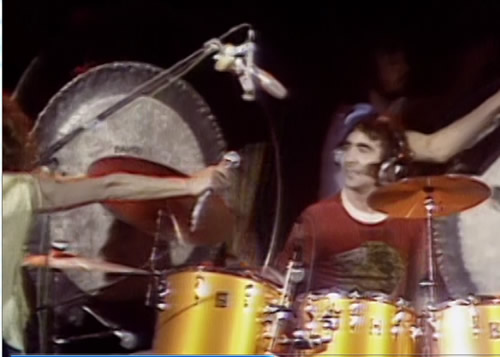
Looking at Moon’s vocal work on “Bell Boy”, Pete comments on how Keith could never sing anything straight; it was always as a character. And that he did find it hard for his Ace Face character to come off comic. But of course, again, no way to know what Moon thought of this, though he clearly enjoyed singing the song in concert.

Bell Boy mike handoff

Those two songs get special focus during the documentary, as do some others, like “The Real Me”, “Cut My Hair”, “5:15” (partly Beatle-inspired, that one), and “Drowned”. But I was disappointed that “Doctor Jimmy” didn’t get that treatment. It just seems there would be so much to say about that one… How the complex musical arrangement of song that itself suggests a split personality (it’s my favorite Who song to play on the piano, but it’s not easy!), the shocking lyrics (“Who is she? I’ll rape it!”), even its importance to that darn storyline, as this moment of craziness then leads Jimmy out to that rock and possible redemption. But nada about “Doctor Jimmy” here.

Much as I enjoyed the concert footage, the documentary also covers how that tour was something of a disaster. It was booked a mere two weeks after the album was done, leaving the exhausted band no time to really prepare a stage show, and forcing them to play songs that the audience just didn’t know yet.

Pete said at the outset that his goal had been to write something that would replace Tommy as a concert vehicle. In that, Quadrophenia failed. (And maybe that’s why Pete feels this is the one he just has to take on the road again. Needs another do-over.)

The doc was only about an hour long, the theatre viewing filled out by showing some of the songs from the 1996 Quadrophenia Live DVD. This leads me to wonder if some footage is being held back for the eventual DVD release. Maybe I’ll get that “Doctor Jimmy” analysis after all?