Ontario election or voter suppression

Well, I voted, and it was really easy. Just needed some basic ID and some time to wait in the line I was, I admit, rather surprised to have encountered. Nobody tried to intimidate me or influence my vote. I went on just one of the several days that voting was possible. I didn’t have to register in advance. My vote was private. I saw it go into the machine and be counted.

And yet…

Holding a snap election in February in Ontario seems very much designed to ensure low voter turnout.

  • Weather: February’s always kind of miserable, but this year the province has been hammered with record amounts of snow. Some people literally cannot get out of their homes to vote, because they need clear sidewalks, and those are hard to come by. It’s also tough to get campaign signs in snow-covered lawns, or volunteers willing to stay out very long knocking on doors.
  • Condensed time frame: The election was announced one day, started the next day, and runs for only four weeks. It’s very little time to even let people know it’s happening, let alone any campaigns to gain steam and make an impression. No party started with a full slate of candidates! A lot of people won’t receive voter cards in time. (They can vote without it, but not everyone knows that. Or even realizes an election is happening.) Those who want to vote by mail are hard-pressed to get that completed by deadline.
  • There’s a lot else going on. The US keeps talking about annexing our country, along with doing various appalling things daily. The Federal Liberal party is having a leadership race, the winner of which will be Prime Minister. Shortly afterward, a general federal election is expected. Lots of competition for Ontario politicians trying to let people even know there is a provincial election, let alone who all the leaders, candidates, and positions are.

There’s nothing illegal about all this; but it kind of feels like it should be? Because this is not truly a free and fair election. Especially if you consider:

  • The governing Conservatives have been found to have inappropriate used taxpayer money to advertise themselves, before the election, and party money to advertise the Premier’s trip to Washington, which is also not allowed. The penalty? Bupkus! More votes for them, even though they’ve cheated!
  • The Conservatives have told their candidates to not attend any local debates, something they have followed, with few exceptions.
  • The Conservatives have not bothered to release a platform. (Today they did release one…)
  • Conservative leader Doug Ford has mostly avoided the media.

So the governing party, the one with by far and away the most funds, is doing its level best to ensure that voters are uninformed about anything.

They clearly hope that hardly any people will vote, since low voter turnout tends to favor incumbents and conservative parties. And polls have consistently shown them to be in majority territory.

Do the Conservatives deserve re-election?

I would argue no—and not only because of their “keep the voters ignorant” campaign style. Fortunately, I don’t have to personally write up all the reasons why, as many others have. One of my favourite examples is Please: Anyone but Doug Ford by Justin Ling. A few excerpts:

His years in office have been defined by shortages — a lack of homes, doctors, teachers, jobs, skilled workers, subways, buses, and bike lanes. Worse yet, his plan for a third term is ambitious only in its plan to build a massive new white elephant.

Let’s start with housing, inarguably the priority for any incoming government. But, somehow, Ford remains indifferent. Ontario is, in the full swing of a housing crisis, breaking ground on fewer units of new housing today than it was in 2012. It’s a stunning failure.

There are few problems in Ontario which don’t flow out of this acute housing shortage. Tent encampments, rising crime, the opioid crisis, sluggish growth, a stagnant culture, and declining productivity: All things that could be ameliorated by cheaper, abundant housing. 

Ford is addicted to giving private companies public money, often for no benefit to the province.

He has had nearly seven years to fix the province, and he hasn’t. What is he proposing for the next four years?

Ford’s healthcare plan is absolutely anemic, little more than a vague hand-wave at the crisis. If he has actual new plans to boost housing construction, he’s certainly been holding out on us. Does he have a real plan to improve education, reduce homelessness, hire more doctors, provide care for people struggling with addiction, or get real economic growth started again? No.

What Doug Ford has is a big dumb tunnel.

The opposition problem

If not Doug’s PCs, then who? And therein lies the problem. Both Liberals and NDP have new leaders that aren’t well known. Neither has managed to bust out a fantastic campaign to make them the clear alternative. The Green Party has a appealing leader and great platform, but are strong only in a limited number of ridings. The voter who wants “not Conservative” has to do the frustrating dance of whom exactly to pick instead.

I have voted. I will say it: I voted NDP. I live in a riding with an NDP incumbent who is excellent. I was happy to support her. I was less happy to support some aspects of the NDP platform. Really, you’re going to make the 407 toll-free to “reduce congestion” (which it won’t). Really, that’s your first announcement? And that whole grocery rebate thing? That sounds… complicated.

But as whole, it’s still a better platform than what the PCs have on offer. The party leader, Marit Stiles, is more appealing than Ford. And their Instagram ad today is one of the funniest political ads I’ve seen in some time (here’s hoping they also post on YouTube or somewhere more accessible than Instagram).

And they know the mission: Focus on the ridings they hold, and the ones they might conceivably take away from the Conservatives. From the Conservatives. Not so much from the Liberals or the Greens.

The Liberals haven’t played too much of a factor in my personal consideration, with the Greens having earned my “heart” vote, and the NDP clearly being the smart vote. But being someone who frankly doesn’t really understand political strategy, it’s been interesting periodically dipping into the writings of Evan Scrimshaw, who lives and breathes this stuff.

This one, pointing out that with Conservatives sitting at 45% support in polling (it’s since dipped a bit, not enough), there is no “rearranging of the deck chairs” possible to prevent them winning a majority, was particularly interesting: Ontario: Progressives’ Absurd Focus.

The idea that if you could magically optimize the Liberal and NDP votes, somehow Ford would be defeated is nonsensical. Not every vote who is voting for one or the other is a vote for the other. Not every Liberal trusts the NDP on fiscal policy or some of their more out there social values ideas (remember safety zones around drag bars?), while plenty of New Democrats are union, working class, blue collar voters who oscillate between the NDP to advocate for more health spending and the Conservatives because they’re mad at progressives, wokeness, and the general fact that the world isn’t how it was in 1995. Only 62% of Liberals and New Democrats think the OLP and ONDP should merge into one party, per a Friday Research Co poll. 

….

The unfortunate truth is that if you were to do head to head polling, Ford would easily beat Crombie’s Liberals, Stiles’ NDP, or some merged entity. He is what Ontario wants. The reason he’s what Ontario wants is in large part because the Opposition have not been good enough.

If there was some option of a merger or a deal, the Greens would also be a big impediment to it working. Green voters aren’t idiots who think the Greens can win, they’re about building slowly and adding to the conversation through presence and generally not making the compromises that the NDP and especially the Liberals make. It’s a party that is on some level about being anti-Liberal and anti-NDP more than it is about the environment or ecology or whatever else. It’s a statement of principles, and about one’s self. 

What both parties of the left have failed to do is create a coherent narrative for why they need to be elected. The real problem for Ontario progressives isn’t how the opposition splits their votes, it’s the fact that 45% of Ontario is about to vote for Ford, and any person or any organization focused on anything other than driving that down isn’t helping.

Vote anyway

The weather forecast has improved this week. The NDP still looks perky. The Greens are are encouraging you to not feel bad about voting for some other party if you don’t live in one of their favored ridings. The Liberals… Well, I’m not too sure what’s going on there, but they do have some good candidates.

You can vote any day between now and Thursday. Go here: https://voterinformationservice.elections.on.ca/en/election/search?mode=postalCode, enter your postal code, and it will tell you where and what form of ID to bring.

It’s not really a fair election, but it helps nothing to sit it out. Happy voting.

Don’t let our waste go to waste

Imagine, if you will, a system of disease surveillance that doesn’t rely on expensive and painful tests. It does not require us to get swabs stuck up our noses, needles poked into our arms, or even to answer banal questions about symptoms. Instead, this system asks us to go about our regular day, sleeping, waking, eating, and…. defecating… exactly as we would normally. In this system, heroic nerds—out of sight and out of mind—scoop and test samples of sewage in order to tell us whether disease rates are either concerning or tolerable.

Now imagine that shortsighted policymakers decide to defund such a surveillance system, just as its worth and pioneering quality are being celebrated worldwide.

Dr Raywat Deonandan, When The Poop Hits The Fan — Ontario wastewater testing needs to be expanded, not stripped back, Canada Healthwatch

Of course, you don’t have to imagine it, because that’s exactly what’s happening in the Province of Ontario. Dr. Deonandan’s short article linked does a great job of explaining why this is bad; the key points being:

  • It’s really the only metric we have left for informing the public about current infection risk
  • Vulnerable individuals require such information to determine what activities they can do when
  • It’s a useful source for ongoing scientific research into various infectious diseases and conditions
  • It can serve as an early warning system of new threats

The Ontario government points out that the Federal government is planning to expand its wastewater system in Ontario, suggesting that means that the provincial system is no longer needed. Problem is, all evidence suggests that the Federal system will be a poor cousin to what is in place now:

  • Far fewer sites (59 now, down to maybe 8)
  • Much slower release of information
  • No direct ties to hospitals, universities, and public health units
  • Less informative: fewer diseases covered, weaker data analysis

Let’s do a chart comparison. In Winter 2023, Ontario experienced the second biggest Covid wave ever. In Spring 2023, Ontario Covid rates dropped to the lowest level of the Omicron era. Which government agency’s wastewater data conveyed this information most clearly?

The Federal government’s?

Toronto wastewater data, federal

Or the Ontario government’s (GTA = Greater Toronto area)?

COVID wastewater signal GTA, Ontario chart.

My response

As I still (quite unfashionably) feel that Covid is a disease best avoided, I still (even more unfashionably) make some efforts to avoid catching it. This has included periodically checking these charts to assess how much vigilance is currently warranted.

I’m not really sure what I’ll do without that option. Just give up? (I don’t think I can just give up.) Stay at highest alert levels always? (I don’t think I can do that, either.)

It seems very unfair for government / public health to say “Make your own risk assessment!”, then remove any way doing that. So, I have tried to both raise public awareness about this, and contacted various levels of government to complain.

ActionResult
Emailed CBC KW (the region’s most popular morning radio station) to ask them to cover the story.They did a story on it the following week. And they emailed me back to thank me for suggesting it and for giving them a lead on who to interview for it.
Emailed the Big Story podcast to ask them to cover the story.No response and they haven’t covered the story.
Wrote a letter to the editor in the Waterloo Region Record (the local paper).They published it.
Wrote to complain to the Premier, the Minister of Health, and the Minister of the Environment of Ontario.The Ministry of the Environment emailed back saying to not worry my pretty little head about it, that they’re working with the Federal government to keep something going. (I might be paraphrasing.)
Wrote to my MPP, who is an Opposition member.She wrote back saying she agreed it was a terrible decision, and encouraged me to also complain to the government. (Her party has also spoken out against this decision.)
Wrote to some Waterloo Regional Council members, suggesting that they should lobby the Ontario government to not cancel the program.Did not hear back a thing from any of them. However, at one of their subsequent meetings, they did agree to contact the Federal government to try to get them to keep the program going.
Wrote to MPPs in the region who belong to the governing party to point out that it appeared that other cities were going to get some wastewater monitoring, but Waterloo wasn’t, and that wasn’t fair, since we pay as much as taxes as they do (that’s me trying to speak Conservative).TBD, because I just did that.

What you can do

Various sites make it pretty fast and easy to write your own letter of complaint (thanks to John Dupuis for compiling)…

  • Safe Care Ontario: Email template you can copy (and adapt, if you’re ambitious) and a list of the email addresses to send it to you. (Also material for other valuable campaigns you can join in on, should you be even more ambitious.)
  • Still COVIDing Canada: Handy-dandy mailto: links for key provicial politicians, and another email template. Bonus: email template and contact information for municipal politicians in Waterloo (hey, that’s my town!) and Ottawa.
  • Wastewater Advocacy Resources: Google Drive with contact information, email script, phone script, and social media post suggestions.

And I dare say that even you don’t live in Ontario, don’t let that stop you! (Though you might want to adapt the email wording…) The data is serving international research purposes; as with this article in the scientific Nature journal: SARS-CoV-2 viral titer measurements in Ontario, Canada wastewaters throughout the COVID-19 pandemic:

When integrated with other types of epidemiological data, WBS can contribute to a more holistic understanding of disease incidence at both the provincial and national levels in Canada. The extensive dataset and comprehensive methodology outlined in this manuscript, which includes specific normalization techniques, is not only instrumental in improving the current understanding of SARS-CoV-2 WBS but also holds promise for helping public health units and researchers make better predictions for future outbreaks of similar viral diseases. This set of protocols can be adapted by other research institutions or public health agencies interested in employing WBS.

Garbage election day

Monday, October 22 was the municipal election day in Ontario. Much as I rely on electronic calendars like anyone else, I still like to rock it old-school with the paper calendar,  on which I note items such when garbage day (that is, the biweekly date on which the region picks up trash along with the recycling and compost they pick up weekly) and municipal elections occur. Those fell on the same day this year, so the calendar read: Garbage Election day.

Only it wasn’t.

Nor was the historic US midterm election that took place on November 6. It wasn’t immediately apparent how historic it was, because the counting and recounting, it turns out, goes on long past that date—it just finished last week or so. And the Democrats got the largest margin of victory in history, thanks in large part to that election having had the largest turnout for a non-Presidential election in a century.

midterm-turnout.png

Way to go, Americans.

Our municipal elections, of course, were far less consequential, and featured the usual poor voter turnout: 34% for the City of Waterloo (though 48% in the uptown Waterloo ward, so kudos to them). I don’t see this ever changing much unless we bring political parties into municipal politics, allowing people to forget about the individuals running and just focus on party platforms. Which I don’t want, as the partisanship would be a terrible side effect that we get enough of at every other level of government.

Municipalities try to increase voter turnout. This year, several cities and townships in Waterloo Region—not including the City of Waterloo—offered electronic voting from home. Though this greatly increased the days on which you could vote, a lot of people left it til election day. And then the system crashed under the load. Forcing extensions to the voting time, in some cases by an extra day.

Hence we didn’t get all the results—including who the new Regional Chair would be—until a full day later. Whereas cities who used the old paper ballots had results counted in a few hours.

Also, it didn’t really increase voter turnout.

Apart from the potential computer snafus, the most compelling argument against electronic voting is that some dominant person in the household could do the voting for everyone else. I’m sure that would be a very small problem, but there’s no way to eliminate it. Whereas when you have to go vote in person, everybody gets a chance to mark their own x’s in private.

Obviously, compared to the US wait, one day longer wasn’t a big deal, but it was odd and I was curious about the results. If you are going to vote in these local elections semi-responsibly, you do have to do a fair amount of reading and research. And at least in these parts, there’s no polling to give you any idea who might win!

There were some pleasing and somewhat surprising results.

In the absence of parties, incumbents always have a big advantage, with many getting re-elected for years. But in Cambridge, long-time mayor Doug Craig lost out to Kathryn McGarry (who had her own name recognition due to having recently been the city’s MPP). To me, Doug Craig’s political philosophy could be summed up as Cambridge First, characterized as an unwillingness to compromise and a large propensity to complain. I was happy that the people of Cambridge were also getting tired of that approach. (And now Craig is planning to run for the federal Conservatives.)

And Michael Harris, who had been unfairly (in my opinion) cast out of provincial politics by Doug Ford shenanigans, won a seat on regional council. He always seemed one of the brighter lights in the Progressive Conservative party, so I was glad to see him get another chance to serve (in a less partisan environment).

In general (and as in the US), a lot more women got elected. The new regional chair is Karen Redman; Kitchener City Council and two of the townships achieved gender parity. On both Waterloo and Kitchener City Councils, women candidates managed to defeat incumbents.

regional-chair.png
She defeated these three guys

ward-5-waterloo.png
She defeated this guy (the incumbent)

On the other hand, the two women I voted for (there are two seats) as Waterloo regional councilors both lost to men. But, at least the two men in question weren’t unqualified, boorish, populists, so one can take some comfort in that.

In my city ward, the incumbent chose not to run again. One candidate captured the support of most of my immediate neighbours by expressing dismay about the planned residential high-rise building nearby. I considered joining that bandwagon, but ultimately voted for Royce Bodaly, who seemed to have a really good grasp of the local issues and a real online presence, and who made an effort to visit every household in the ward during the campaign. I must have talked to him for 20 minutes myself! He ended up winning the seat… By a margin of 11 votes. (And yet, there was no recount.)

By the way, I am not critiquing how long the US results take—or that they have recounts. Those are elections on a much bigger scale, of course, and conducted very differently (in ways I won’t pretend to understand). Giving people various ways to vote and taking the time to count all the votes is good, even though that means you can’t trust the narrative on voting day. It’s not a blue wave! Unless, wait for it, wait for it, yes it is…

One of the challenges raised in the US midterms (in Maine) was over the use of ranked ballots, as the leader after the first round of ranked ballot voting lost his lead in the second. (The results were upheld.) Ranked ballots were also tried in one Ontario city this year: London. They had to do something like 14 rounds of counting, but in the end, the same person who was in the lead after the first round became mayor. People said that demonstrated that ranked ballots are pointless, but I’m not so sure. There were a lot of people running (hence the number of rounds of counting), and at least the winner now knows he’s not a polarizing figure, and that the majority who voted are basically OK with him being their mayor.

I think it might be worth trying elsewhere. (Cambridge and Kingston voted to do so in the next election, though the results aren’t binding in Cambridge.) When you do this local election research, you do generally end up with not only your #1 choice, but an idea of the other people you think would also be OK, and those you really don’t want elected under any circumstances. So marking your ballot accordingly wouldn’t really be so much more work.

Finally, municipally there was a period after the election where the previous council continued to sit and govern, til the new crew were oriented and took over about a month. There was no drama or scandal surrounding this that I know of—except perhaps Cambridge council voting themselves a raise without accepting the offsetting reduction in benefits. But they did that for selfish reasons that they wanted their cake and eat it too (many were re-elected), and not to hamstrung the newbies.

The US has a longer “lame duck” period during which some states, like Wisconsin, well:

wisconsin.png

Details: https://www.huffingtonpost.ca/entry/in-stunning-power-grab-wisconsin-republicans-pass-bill-weakening-new-governor_us_5c06e268e4b0680a7ec9a289

Democracy, man. It’s fragile. But worth fighting for.

My relationship with the Globe and Mail is dysfunctional

I do think that, in these times, it’s important to support the newspaper industry financially, if you can afford to. This might seem crazy, when so much news is available for free online—and there’s certainly an argument that news companies haven’t been that smart in making so much of it available free online. But, we need to support real journalists. Those who hold politicians to account. Who spend months on investigative stories. Who fact check. Who provide the background details on that “click-bait” headline. Someone needs to help pay for all that—or we’ll lose it.

coffee magazine
Photo by Kaboompics .com on Pexels.com

However, there is really no need to subscribe to as many newspapers as I do. Most of these subscriptions, I acquired at some great deal, but these deals gradually expire, I have to start rethinking some of these relationships.

Long-time companion: My local paper

If you’re looking to subscribe to one newspaper, your local paper is a good one to consider. For one thing, if you even have one, you’re lucky—just ask Guelph. And there have been studies that closures of local newspaper increase the cost of local government: no more watchdogs.

But you don’t have to think of your subscription as a charity donation; it is actually a source of useful information—who’s running for office in your town; local perspectives and comments on national and international stories (example: Greg Mercer’s great investigative work on Doug Ford’s shoddy treatment of former Kitchener MPP Michael Harris, later picked up by The Toronto Star); upcoming and ongoing constructions projects; festivals and other events; stores and restaurants opening, closing, moving, and expanding; and updates on when the heck those Ion trains are going to get here. The New York Times is great, but it ain’t going to cover any of that stuff.

Conestogo River at sunset!
Wondering where this lovely neighbourhood trail is? Your local paper might tell you.

Plus, an e-subscription to my local paper, the Waterloo Region Record, is pretty cheap. For just under $8 a month, you get unlimited access to the website and a full replica of the print edition in a handy Android or IOs app. It’s also a nice, I think, that The Record is not a Postmedia publication, meaning it doesn’t run obligatory corporate editorials (that just happen to have a right-wing slant). The Record is owned by the TorStar, who allow the local staff to set their own editorial direction.

Cheap date: The Washington Post

So, this is how they lured me in: They said subscribe to our newsletter, and we’ll give you full website and Washington Post app access for six month. And I said, OK. And it turned out their newsletter was kind of interesting, and I was reading a bunch of their articles (Trump era! You can’t look away!), and when the six months was up they said, how about you give us $20 (US) and then you can keep getting the newsletter and having full website / app access for a year. And I said, OK.

postThen the year was up, and I was like, oh my God, what is my price going to jump to now? But it didn’t jump at all (except to the extent that the Canadian dollar fell); it was still just $20 US for another year. Or about $2 Cnd. a month. Which, I can totally afford, so I’m keeping it, because—you can’t look away!

Weekly gentleman caller: The Toronto Star

Though this is soon to change, the Toronto Star doesn’t currently have a online paywall, so my subscription is an old-timey one, to the paper version, but on Sundays only. And at this point, I’m still getting it at half price.

It is kind of nice to get a paper copy (in limited quantities), and I do usually get it read (though not necessarily all on Sunday). I’m also wondering if this small subscription will provide some access once the paywall does go up. So I’ll hang on to this for now to see what happens.

Toronto Star special project: Daniel Dale keeps track of every false claim Donald Trump makes. (Maybe they should do Doug Ford also?)

Glamour boy: The New York Times

Yes, this is the prestige paper, but the thing that stands out to me about The New York Times is that its online experience is just head and shoulders above everybody else’s. Their long-form stories are interactive and gorgeous. For example, though it broke my heart:  Losing Earth: The Decade We Almost Stopped Climate Change.

losing-earth.png
“Long-term disaster is now the best-case scenario…”

You can seamlessly link to the responsive and attractive New York Times app from browsers and social media. As a subscriber, you can “set aside” any story for safe-keeping or later reading, something I’m now constantly expecting from all other papers! But alas, no one else has it. (Thanks goodness for Pocket.)

And if you like cooking? A vast collection of recipes is available, auto-organized, to which you can add external sources. And even get it all printed up (for a small extra fee). If you want the “full paper replica” experiences, that’s available, too. And though it’s not my thing, the crossword experience is apparently incredible as well.

recipes-nytimes.png
The lovely (and far less depressing) cooking section of the New York Times

I had this subscription for a year at 60% off, and the full monthly price ($22; they let you pay in Canadian) is now a bit of a shock. Cheaper subscription are available—and even freeloaders aren’t completely cut off. So I’ll have to do some research on how much glamour I really need in my life.

Dysfunctional relationship: The Globe and Mail

If you think The New York Times is a bit pricey… Meet the Globe and Mail. I have the cheapest possible subscription, but now that this 60% off discount has expired, we’re talking $27 a month. That’s just to read stuff on the website—no amazing app, no replica of the full paper, no home delivery, nothing much extra other than… Report on Business magazine.

So I keep breaking up with The Globe and Mail. Which is always painful—because it requires a phone call, of course, no handy Cancel button. And the cancellation request is never immediately accepted. No, they first try to lure or guilt you into staying, but if you succumb, you know you’re just putting off the pain to a later date.

But even when I succeed in ending the relationship, I often find myself lured back. Because for all the frustrations with this publication:

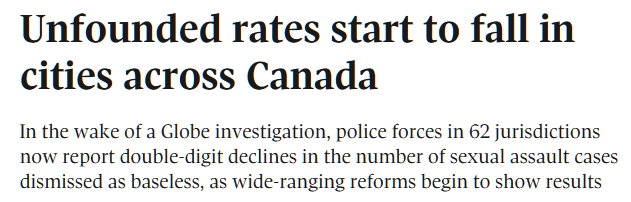
They do have some very good columnists, and they do invest in long-form investigative pieces more so than any other Canadian newspaper. A prime examples is the Unfounded series that Robin Doolittle worked on for 20 months, revealing that an incredible percentage of reported sexual assaults were being dismissed as “unfounded”, or without merit. It’s a rare case of a newspaper story leading to nation-wide changes in policing.

unfounded-rates-fall.png

There’s also the simple fact that a lot of Globe and Mail stories are “subscriber-only”, period. While there are ways around this (you can get the Globe digital replica free from the library, for example), they are not  as convenient as just clicking and reading the story. But what price convenience? That’s what I have to decide.

Excuse for me for not blogging, but I’ve been a crazy person

Woke up in a panic
Like somebody fired a gun
I wish I could be dreaming
But the nightmare’s just begun

Ever do that? Wake up from a dead sleep in full panic mode, heart pounding, mind racing?

It’s happened to me a few times in the past couple weeks, and it’s quite unpleasant. I do not recommend it. And as sleep deprivation accumulates, the brain gets less and less effective. For the first time, I feel I have just a tiny understanding of what parents of babies and young children go through.

Don’t know why I feel so bad
Is it the weather, or am I going mad?
Don’t know why I feel this way
I don’t know whether I’m coming or I’m going
Can’t cover up, ’cause it’s obviously showing

Normally, I’m a fairly calm person, not given to emotional outbursts. So the number of times I’ve heard “You’re stressing me out!” in the past few weeks must be some sort of record.

I didn’t actually know, before, that stress was catching.

“Nice to know you’re human, too,” I also heard. Well that’s over-rated, I say.

Standing on an island
In the middle of the road
Traffic either side of me
Now which way do I go?
I should have stayed at home
I should have never come outside
Now I wish I’d never tried
To cross to the other side

So what’s been bothering me? Well, I’m not going to say. It’s personal, and it’s nothing dire—no cancer, no house burned down. It’s just stuff, that’s led to a lot more introspection than I’m used to, which is clearly bad for me. Frankly, I’m getting quite sick of myself.

Lyin’ awake in a cold, cold sweat
Am I overdrawn, am I going into debt?
It gets worse, the older that you get
No escape from this state of confusion I’m in

The Kinks: State of Confusion

And anyway, it’s gone beyond anything real, and I actually am panicking about going in debt, even though I have no real reason to do so, upcoming trip to Europe or no. And hearing all this bad economic news—not helpful! I’m like a walking Dow Jones average, overreacting to every new bit of information.

I thought, maybe a news break would help, then noticed how much news permeates my life. I wake up to CBC news (business news at 6:45), get up and get the paper (hard to get to the Arts section without passing by Business news with all its downward red arrows), cook dinner to CTV News 1: Your News first! (Business report at 6:30 pm).

So anyway, that’s why I haven’t been writing about politics much. But I suppose I should say something about the federal election results.

Given how bad the Liberal campaign was, it’s fortunate Conservatives managed to lose the majority on their own, scaring the Quebecois with thoughts of arts cuts and 14-year-olds in jail. But they did get a stronger minority, one that will take two parties to bring them down. Stéphane Dion didn’t dither in doing the right thing and stepping down, though this means the Liberals will again be spending all their money on getting a new leader, and not on winning power. There’s been lots of talk of uniting the Left. I’d love to see it, but won’t hold my breath.

Most disappointing for me had to be the local results, losing two excellent Liberal MPs: Andrew Telegdi (by 43 votes!) and Karen Redman. Redman lost to yet another “holy roller”—a social conservative, against gay marriage, pro-life, etc. So the whole region is now “served” by undistinguished Conservative members who will be as muzzled in office as they were running for it.

At least south of border, knock wood and all that, election results are looking to be much more promising. In fact, I was listening to Mr. Obama read from his own Audacity of Hope book today. It was very relaxing. He’s so smart, so well spoken.

It did, indeed, provide me some escape from the state of confusion I’m in.