My Netflix account remained sorely underused for a long time.
I was generally unimpressed with the selection of movies. Tunneling through to the US site helped—great to finally see Cabin in the Woods, which was a pretty clever, deconstructionist take on the horror genre, and fun to see Roger Daltrey play a gay man (albeit with no love scenes) in Like It Is—but overall, I’d still rather go to the Princess.
I’d be watching maybe one show a month on Netflix? So even though it’s only $8 a month, it still wasn’t great value for me.
So I was quite surprised the other day to discover that, somehow, I had watched every single episode of The IT Crowd on Netflix. That’s 4 seasons, folks. Now, it’s British show, so the seasons are much shorter than with American shows.
But still. I’ve clearly stepped up my Netflix usage. And it’s not because of the movies; it’s the TV shows.
The IT Crowd is hardly essential viewing. But it generally makes me laugh, sometimes quite a bit. So watching just one more episode was often appealing.
I’m also finding the Netflix original series Orange is the New Black rather addictive. And Jean likes it too, which is a bonus. It focuses on a middle-class, white (race is very prominent in this series) woman who is sentenced to a year in prison after a youthful indiscretion catches up with her. It’s not Oz (in fact, that’s a direct quote from the series), thank God, in that it doesn’t have that intensity and violence. It’s much funnier. But it still makes it clear, lest I had any doubt, that I never want to go prison.
Most episodes end with Piper facing some new, unexpected dilemma in this very odd world (based on an actual memoir, by the way), so you really want to know what’s going to happen next. And it’s Netflix, so all episodes are available for… whenever.
As are all episodes of Friday Night Lights, and Louis, and House of Cards, and Derek, and Mad Men and… Yeah. With no commercials, and no download time. How TV should be?
It’s been a couple of weeks with the new Windows 8 computer, and while the relationship between us remains a bit tense, at least we aren’t fighting with each other quite as frequently anymore.
Let’s just say I do sympathize with people complaining about Windows 8. Admittedly, day to day, you don’t have to poke around in the bowels of the OS that much, and otherwise it’s not that much different than Windows 7—at least in desktop mode. And it does seem to start more quickly, which is nice.
But when you first setting up a computer, all you’re doing is poking around in the bowels of the OS, and the fact that everything has changed there just makes all those non-fun tasks that much more frustrating. So you do develop this initial, and growing, hatred for Windows 8 as you run through a series of Google searches such as:
How do I map a network drive in Windows 8?
Where is the Control Panel in Windows 8? (Actually, I didn’t figure that one out! I just installed the Star 8 app to put it back in its Windows 7 place on the new computer!)
How do you select which speaker to use in Windows 8?
How do you shut down a Windows 8 computer?
Yes, shut down. I mean, seriously. Microsoft put the Shut down command in the Settings menu, three clicks deep. I’ve now realized that my PC manufacturer added a one-click taskbar menu with Shut Down and Restart options. Yay! But they shouldn’t have had to. That’s just terrible UI design for a super-basic, very frequently used feature.
Put the pointer in the bottom-right corner of the screen to get the side menu displayed, click Settings [and, oh look, there‘s the Control Panel], click Power, and there is Shut down! Nice and inconvenient.
And why the heck doesn’t the ESC key let you out of those “app” windows? That’s exactly what that key is supposed to be for!
Instead, you have to click the right Windows key to get out. This is not a usability improvement!
Mind you, I do make things tough on myself because—I’ve realized—I don’t seem to like the default settings on anything, which means I have a lot of tweaking to do on new computers—something normal people (with lives?) don’t bother with.
And, I now have things mostly working, except for ongoing troubles with my display settings. They’re pretty much set as want them. I’ve made peace with the opaque title bars. I still think they’re kind of ugly, but I do find myself entertained by the fact they change colors with my desktop background to match it better. I also like that you can display different desktop background images on each monitor.
So my only issue now, really, is that the computer keeps losing these settings. Whenever it goes to sleep, I “awaken” it to find, for example, that the resolution is all out of whack, and all the desktop shortcuts are a weird size—or have all moved on to my big-screen TV! Rebooting usually fixes things, but not always completely. To be fair, I’m not sure if this really a Windows 8 issue, or more of a hardware problem. All I know is, my old computer never did that…
I’m managing, for now, by greatly extending how long the computer waits before going to sleep. Longer term, we have a much better display driver from an older computer that we’ll probably install in this one (because, as mentioned, I’m not a fan of the defaults), to see if that helps.
Sunday night, when I returned to the computer I’d been working on just fine all day, nothing was displaying on either monitor, beyond a brief Analog / Digital message. The usual step of just rebooting produced no better effect, and checking all the plugs found nothing loose, nothing amiss.
The next morning, the computer didn’t entirely seem to even be booting anymore (though it’s quite hard to tell what’s going on, with no display).
It was actually the first time a computer had just up and died on me. Of course, I was not pleased. But really, thank goodness it happened in 2013 and not in, say, 2003. Or 1993.
Was a time when losing a PC meant potentially losing an awful lot of data, stored on that hard local drive, not necessarily all backed up.
Now, we store pretty much all the files we care about—songs, documents, spreadsheets, photos, videos, sheet music–on a network drive, with backup . And like everyone else, we’ve moved to keeping some stuff “in the cloud”–email, agenda, blog posts, Evernote lists that organize my life—making them accessible on any tablet, smart phone, or computer. I may not have a computer right now, but I still have basically all my content.
So, this is really more of a bother than a trauma. Despite the above, there are a few things on the old hard drive that I’d like to retrieve if I can, so we’re going to bring the old computer in to get the hard drive taken out and stored into an USB-connected external drive case, which I’ll be able to attach to a new computer.
Did you catch that? Despite this being just a bother (for heaven’s, we have another computer! And two tablets!), I have already ordered a new computer.
I guess the greater speed and power will be nice. Just too bad it’s Windows 8. I swear, the biggest issue these days in having to upgrade hardware, is in then having to relearn software.
I know Windows 8 has its fans. The problem is, Windows 7 is hardly leaving my life. All day, every day, of my work life, I am on a Windows 7 computer, and that won’t be changing soon. And our other computer? Also Windows 7. So it’s not as if I can really move on and switch over to the Windows 8 way of doing things. I fear being in permanent, irritated “learner” mode on my own PC.
Windows 7 desktops are still available, by the way. (Yes, desktop, not laptop. I don’t see the point of a laptop when I have a tablet.) Jean kindly (or, more likely, fearing he’d otherwise have to go back to sharing a computer with me) did the online research and found one decent Windows 7 option, and one Windows 8. I was trying to decide which to get–the Windows 8 one was more powerful, but the Windows 7 one was Windows 7!–when I thought to dig into the question of HDMI ports. The Windows 7 PC didn’t come with one.
“That’s it, then,” I said. “Because HDMI is an absolute necessity!”
And then we both looked at each other laughed at my having put high-definition signals on the same level of importance as food, shelter, and oxygen.
But I still bought the Windows 8 one. Because I do really love being able to connect the PC to the big-screen TV and watching online video super-sized, with great sound, from the comfort of my couch.
And I have found an article called How to make Windows 8 look and feel like Windows 7 , which I’m hoping will be of some help in the transition. And at least iTunes 10 is still available, so I can avoid the transition to iTunes 11 (shudder) a little longer.
It was an unusual enough in itself that my mailbox—and by that I mean my non-virtual mailbox, the one that Canada Post delivers items to—apparently contained no junk mail this day. No flyers, nothing unaddressed. Just real mail! It seemed. Airs of bygones days, when mail was still mostly nice to receive. I got:
A real-life thank you card, with hand-written note.
The latest issue of a paper magazine that I subscribe to
A rental DVD! (From zip.ca, still in business, though I don’t know how long.)
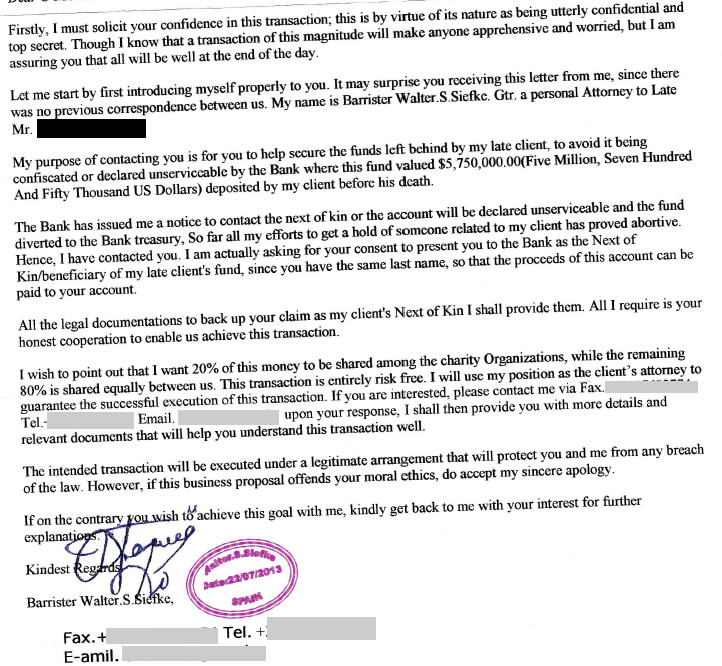
The final item was a bit of a puzzle. An international letter, addressed to me. I was most curious about this one.
This was the opening paragraph.
Firstly, I must solicit your confidence in this transaction; this is by virtue of its nature as being utterly confidential and top secret. Though I know that a transaction of this magnitude will make anyone apprehensive and worried, but I am assuring you that all will be well at the end of the day.
Utterly confidential and top secret! Both! With assurances that all would be well, “at the end of the day”. I was mesmerized.
Somebody in Spain had composed a full, legal-ish sounding letter, largely correctly spelled, outlining an inheritance scheme. But instead of just emailing it more or less for free to every virtual address they could get their hands on, they printed it on paper, folded it and put it in an envelope, added international postage (a stamp celebrating Unesco), and put in a real mailbox.
Is this sort of brilliant, or especially moronic? Either way, I must appreciate the effort. At least this person is working for their ill-gotten gain.
All he requires is my honest cooperation, if it doesn’t offend my moral ethics. This transaction is entirely risk free. 🙂
I can’t give you such a thing, but if you’re interested, head on over to The Wandering Gourmet—an interesting blog anyway, for those into travel and food—and leave a comment on this post saying what you might like to subscribe to. That’s all there is to it. (But hurry; only a few left.)
Zinio, you may recall, offers a wide assortment eMagazines that you can read that you can read on any tablet or PC (or smart phone, I guess, though I personally would not try reading a magazine on that small a screen). I am quite fond of their service.
Just trying out a new theme for this blog. I was tired of the narrow column limiting the width of image I could use.
This one should be more readable on a variety of devices. May do a bit more tweaking in the coming weeks (not sure about that header image), but I think it basically work.
I’m a magazine fan. News has its place, books have their place, but in a nice niche in between there lies the magazine: Current but not daily, engrossing but readable in a couple hours, and often possessing a more beautiful design than either of the other two.
I find out things from magazines that just don’t hear about anywhere else. Did you know that the tiny town of Montague in PEI is currently hosting thousands of new Buddhist monks (as residents)? If you read the latest Maisonneuve magazine, you would. Or from Utne Reader, the benefits of a zero-growth economy based on negative-interest dollars, which actually have existed in history. And, OK, I did know that Windows 8 was unpopular, but had never heard that analyzed as being because its tablet / PC design made it “the mullet of operating systems”, as Wired did.
To do so, I use one of two apps: Zinio or Google Play Magazines. Both give you pretty much the same layout as you’d get on paper, only in scrollable, zoom-able form. The apps are free, but the magazines themselves, in most cases, are not. [Although more on that later…]
Zinio’s been around longer and has a bigger catalog, including a lot of back issues, which can be nice sometimes. Subscriptions are almost always a better deal than single issues, but single issues can be a relative bargain compared to paper, particularly with foreign magazine. Uncut (which is British) is around $15 on the newsstand, and about $5 at Zinio. For magazines that don’t have to travel so far, though, savings are usually a lot more modest. (And some major magazines, it should be noted, are only available for Apple iPads.)
Update to below paragraph: This week, Zinio on Android offered an update that solves the zoom problem! I can now change pages while zoomed. I have to say, given their other features, this now gives them the overall technical advantage over Google Play. Stay tuned..
[ The main advantage I’ve found with the Google Play magazines is that I can swipe to the next page while pages are zoomed. With Zinio, I have to scrunch the page back to “normal” size before I can swipe. Given that I have to zoom pretty much every page (anything less than a 10″ tablet, I think, wouldn’t really work at all for magazines), the Google Play ones are a time-saver. Google Play does lack some of the features of Zinio that are on occasion useful, however, such as the ability to bookmark pages, and to print (with watermark) them or send them to email, EverNote, DropBox, or whatever. ]
Neither, it seems to me, really takes advantage of the possibilities offered by being on a web-enabled medium, such as embedding video or streaming music. (The paper version of Uncut, for example, typically comes with a CD, but in the E version, you just don’t get the songs.) Only the text links are enabled. On the other hand, you aren’t web-dependent. Once downloaded, you can read the magazine while your device is offline.
Recently, Waterloo Public Library (WPL) announced the availability of Zinio magazines through them. I tried it out last weekend. It requires three logins: The expected one with your library card number (which I already had), a new one that grants access to the WPL catalog of magazines in particular, then a Zinio account (which I already had).
Once in, though, it’s quite a large catalog of magazines they have. And, unlike eBooks, which stop working on your device after the loan period of 1 to 3 weeks, the selected magazines don’t appear to have expiry dates. Guess I’ll know for sure in a couple weeks, but the library advertises “no holds and no returns!” So I’m not sure I get the business model here, on behalf of Zinio or the magazine publishers.
But let’s just say, to me, it’s well worth the triple login. Happy reading!
Our latest vacation had us spending about one week in Budapest, Hungary, and another week in Prague, Czech Republic. This gave us time to visit both cities in a fairly relaxed fashion, spreading out the sights we wanted to see over multiple days, leaving plenty of time for just ambling and enjoying.
Budapest was a return visit. It’s a very attractive city, its two halves bisected by the Danube. Jean’s default suggestion whenever we weren’t sure what to do next was to “go to the water”. We stayed in a hotel in central Pest, a convenient location that allowed us to walk almost everywhere. We were further encouraged in that approach by the weather, which was sunny and warm every single day.
Budapest
It was our first time in Prague, which is just gorgeous: stunning architecture and sculptures everywhere. It too has a river, but the focal point was really the Main Square, from which you could fan out (often on pedestrian-only streets) to most any of the city sights that were interested in. Our hotel was about 3.5 K from that area, though, so we made good use of the city’s excellent metro and tram system to get there, when we would resume walking. Weather was cooler and cloudier than Budapest, though fortunately not as rainy as predicted.
Prague
Synopsis of activities
Budapest: Monday—Got oriented to the city while jet-lagged. ■ Tuesday—Took guided tours of Parliament House, and of the State Opera. Attended a concert in a church featuring organ with other soloists. ■ Wednesday—Hiked up Castle Hill. Stopped in at the Liszt Museum. Went through the House of Terrors. ■ Thursday—Saw the sights at Heroes Square and in City Park. Spent time at the Széchenyi Baths. Stopped in at New York Cafe. ■ Friday—Day trip to the small town of Eger, for wine tasting and marzipan art museum. ■ Saturday—Went to the market, saw the Holocaust memorial, and took the night train to Prague.
Prague: Sunday—Got oriented to the city. ■ Monday—Encountered aftermath of a big gas explosion in Old town. Visited Prague Castle sights and the nearby Lobkowicz Museum and (briefly) Strahov Monastery. ■ Tuesday—Took walking tour of the Old Town. Visited the Mucha Museum. Walked on the Charles Bridge. ■ Wednesday—Visited the Jewish Museum sites, other than the Old New synagogue. Visited the Castle again, at night. ■ Thursday—Went to the Museum of Communism. Stopped in at the Cubist Cafe. ■ Friday—Took a bus tour to Terezin Concentration Camp Memorial. Attended a performance of La Traviata opera at the National Theatre.
Back when we visited Vienna, we had really enjoyed a tour of the Opera House there, so we decided to tour Budapest’s opera house as well. That was also very enjoyable—much better than the brief, uninspiring Parliament House tour we’d had earlier, for which we had to wait an hour in line for tickets. At the Opera, no waiting, longer visit, better information.
We were brought around to see various parts of the beautiful Budapest State Opera House: The boxes, the old smoking room (very advanced in its day to separate out smokers, but all that smoke meant major restoration work needed later), the bar, rehearsal rooms, and of course, the concert hall. We even got a little mini-concert at the end, with a tenor doing excerpts of three songs.
Budapest State Opera House
But as for attending an actual opera, we decided to do that in Prague, largely because it offers English super-titles, whereas (as far as I know) Budapest does not.
Getting the tickets in Prague proved more difficult than expected, though, not because shows were sold out, but just because I hadn’t properly researched how to do so. I was confused about which opera was taking place at which hall, where you bought tickets for what… At one point I even ended up buying tickets for a “puppet” opera by mistake. Fortunately, those were returnable.
Eventually, with some help from Google, I got it straightened out, and bought the tickets. They $55 each, for eighth-row center, for Verdi’s La Traviata at the National Theatre. Pretty amazing price, eh? Similar seats in Toronto would run you $365 each.
So then all we had to worry about was: How bored were we going to be during this opera? I’d read the synopsis, and it wasn’t much of a plot. Kind of Moulin Rouge, simplified: Doomed love affair between courtesan with consumption (and old baron boyfriend) and gentleman with disapproving family.
But Prague’s National Theatre is just gorgeous. And the people who attend the opera there dress to the nines. Between the place and the people, it was a feast for the eyes before a note had been sung.
Gorgeous people and place: Prague’s National Theatre on opera night
And the performance? Was just amazing. It begins with a big party scene and lots of lively singing by the chorus in fantastic outfits, so it’s all very entertaining. The leads were physically gorgeous as well as having beautiful voices. And sure the story is simple, but you can’t help getting emotionally invested in it anyway. We both got a bit verklempt during Violetta’s death scene.
So, no, I was never bored. Jean wasn’t bored. If you get a chance to see opera in Prague, I say go for it. (I’ll explain to you how to buy tickets.)
Not bored at the opera!
[Final aside: On the flight home I happened to watch Quartet, a film about old musicians. One character teaches young people about opera, and explains that the extended singing of all these emotions reaches the heart in a way nothing else can, and that Verdi writes for the human voice better than anyone else. That sounded exactly right to me.]
Nazis and communists
Both Hungary and the Czech Republic had the misfortune of being invaded by the Nazis, liberated by the Russians, then taken over by a Communist dictatorship. So a lot of the sights we saw focused on memorials of those times.
In Budapest, we went into the House of Terrors, a building that was once a headquarters of the Gestapo, then became the headquarters of communist Hungary’s secret police (equivalent of the KGB). The top floors gave a high-tech presentation of this dark history. The Nazi era was presented fairly quickly, to the soundtrack of Jews being shot into the Danube. Then there was a model of a Hungarian “changing clothes”, from Nazi to communist oppressor. The rest focused on that part of the history.
They don’t allow photos inside, so this is the outside of the House of Terrors.
In the Gulag room, around the displayed artifacts, we got video testimony of people who were sent to these work camps and survived. Another room showed faux democracy at the front, election fixing behind the curtain. We saw propaganda posters and bricks of pork fat representing shortages.
At one point, we had a wait for an elevator, then as we slowly descended in it (with a bunch of other people), we got a gory description of how executions were done. On exit, we were in the actual basement rooms, left much as they were at the time, where people were imprisoned, tortured, and executed. The last part was a wall of photos of the “victimizers”: those who committed these crimes. Some of whom have never been convicted.
A worthwhile visit, but not exactly cheery.
The Lobkowicz Museum in Prague gave a different perspective. The Lobkowicz’s are a formerly wealthy and prominent (Christian) family who lost their fortune twice: once to the Nazis, then again to the communists. They were able to regain it via a program run by the Prague government, and have put much of this treasure on display in the museum on the Prague Castle grounds.
The beautiful Prague Castle
The audioguide that accompanies the museum visit is by a member of the family, which makes it really interesting. The family did some amazing things in the past, such as subsidize Beethoven regardless of what he composed, for which the whole world should be grateful. And they have some beautiful items, like gorgeous rifles (really), original scores by Beethoven and others, and some amazing sketches of Rome in past times—though many of those sites remain in place today. It was maybe the best museum we visited on the trip. (Photos not allowed, though.)
The most visited museum in Prague, however, is the Jewish Museum, and we went to that as well. The most striking parts, to me, were the old cemetery and the Pinkas Synagogue. The cemetery was, for a long time, the only place the Jews of Prague were allowed to bury their dead. And it’s just so strikingly crowded, as they had to pile the bodies and fit in the gravestones as they could. Very sobering.
The extraordinarily crowded Old Jewish cemetery
The Pinkas Synagogue itself had, painstakingly painted on its walls in red and black, the names of every Jewish person from Prague and surroundings killed by the Nazis. So many names. When you think of it, it’s overwhelming. It also had an exhibition of drawings done by children from the concentration camp of Terezin, the only one where art materials were readily available (as the Nazis gathered Jewish artists there, to create propaganda posters for them).
Prague’s Museum ofCommunism didn’t have the drama of either of those, but I still found the tour of that fairly recent history pretty interested (Jean, less so). They had a lot of footage from the time of the Velvet Revolution, when the communist regime was defeated.
Display from the Museum of Communism
And yes, we visited a former concentration camp, Terezin. The camp was originally in two halves: a smaller part for non-Jewish prisoners—gays, gypsies, prisoners of war, and so on—and a larger part for Jews. The smaller one has been preserved much as it was at the time. We did have a tour guide to take us through it, which was good. The information on the extent of the crowding, the limited food rations, the work requirements, the minimal clothes, the unsanitary conditions, was just staggering. Though it had no gas chambers, most people did not survive this camp, and all that explains why.
“Work will set you free”: Terezin concentration camp memorial
The unusual thing about this camp is that, at one point, the Nazis let the Red Cross tour it as “proof” that Jews were not being mistreated. The Nazis were given 14 months to prepare, during which they did things like build an entirely new shower and bathing room—though it was never used. You can still tour that room. They temporarily gave prisoners more food and clothes so they wouldn’t look as bad, and filmed them playing soccer and singing. You can see part of that film here.
A “nice” shaving room, built to deceive the Red Cross; it was never used
As Jean described it, though, it was horrible, but in an abstract kind of way. I guess because it was seemed more historical (unlike the House of Terrors, where we heard still-living people describe their terrible experiences).
Experiencing the culture (kind of)
Budapest is fairly famous for its thermal baths, so we wanted to try them out. Traditionally, men and women bathe separately, in the nude. You can still do that today, at many sites, such as the famous Geller baths. But we instead went to Széchenyi Baths, where we could bathe together, wearing a bathing suit. Those baths also happened to be near Heroes Square and City Park that we also wanted to visit, so that all worked out.
City Park: Very pretty
But at the baths themselves, first we had to figure out the entry, towel rental, and change “cabin” (“more like a change closet”, Jean said) systems. Then find the pools. And then we got ourselves into the warm water, and we looked at each other, and we were kind of like, “Is that it?”
Fortunately, we then got more into the swing of things. We visited the “fun” outdoor pool, which had vortexes you got pushed along in and jets to play in. We also went in and toured the indoor pools, and some other parts of the building. Then we just switched between fun, cooler pool, and the warmer, calmer outdoor pools. We ultimately found it fun and intensely relaxing.
Szechenyi Baths
In Prague, we felt we should have Czech food and beer at least once. We did that the first day. Jean had this pork knee thing that was just huge; it looked like something from the Flintstones. It wasn’t bad, but it’s just not our preferred food or beverage. So after this, we did a lot of ethnic eating in Prague.
Hungarian food, on the other hand, we quite enjoyed. The goulash, the Jewish eggs, the paprikas… Most every meal we had quite good, often involving duck or foie gras. Which brings us to…
“Oh, that’s lovely”: Dining experiences
When we travel in Europe, we don’t go to the best restaurants. Who can afford that when eating out every single meal? Instead, we look for good value restaurants: Good food that doesn’t cost a fortune. But, in Budapest, we did visit a couple of their finest offerings in a budget-conscious way.
Cafe New York is called the most beautiful cafe in the world, and that could be true. To be able to peruse its architecture, we stopped in for non-alcoholic beverages only. The beverages cost more here than elsewhere, but they’re still just beverages, and they are very good. And it is a lovely room to sit in.
Photos not allowed at Cafe New York, so I snuck this one in using my cell phone.
And near the Széchenyi Baths, dining options are a little limited. But Grundles, one of Budapest’s best restaurants, kindly offers a 3800 Hungarin forint (about $19) three-course lunch, including glass of wine. So we went for that. The service is amazing: Your food is brought on silver tray. And yes, it tastes good, too: sour cherry soup (sounds weird, but these Hungarian fruit soups are wonderful), grilled chicken in mustard paprika sauce with salad, and chocolate lemon cake with vanilla custard for dessert.
We did spend one day in Eger, a not that exciting little town near Budapest. But it is in wine country, so I did a wine tasting. It wasn’t that informative, as the wine guy didn’t speak much English (a very rare thing throughout this trip, actually). But all the wines I tasted were very good, and what they call a serving is way more than what you get at Canadian wineries. Eger also has a museum full of things made of marzipan. Kind of amazing, really.
This is all marzipan! (i.e. sugary almond paste)
Prague also has a number of interesting cafes. We went to the Cubist Cafe for coffee one day; everything there is constructed on cubist principles (which we concluded really means angular designs, rather than a strict definition of cubes). And we had lunch at the Kafka cafe, whose motto is: Kafka snob food.
Definitely the most interesting and maybe the best place we ate at in Prague, though, was at Maly Buddha, near the Castle. It’s quite dark and candle-lit inside, with bamboo-based decor and corners set up like Buddhist shrines. Though meat dishes are on offer, much of the menu is vegetarian, and that’s we went for. (We were at the point in the trip where nothing seemed better than a big plate of vegetables!) Both the veggie soup starter and our two plates of vegetarian selections were just excellent.
The unusual atmosphere of Maly Buddha restaurant
Lehka Hlava (Clear Head) Vegetarian Restaurant, in Old Town, is a super-popular purely vegetarian that we also liked, though not quite as much as Maly Buddha. It has an enchanted forest setting and good food. We were lucky to get in without reservations.
Lehka Hlava vegetarian restaurant also had creative decor
Also worth mentioning is a little Chinese / Japanese restaurant we found, only because it took such effort. One night all the restaurants we had targeted (from guidebooks) turned out to be closed, or we just couldn’t find them. And ones we did find just seemed too expensive. And it was raining. So about an hour’s search, we finally went into this not-very-promising looking Chinese / Japanese restaurant.
Which actually, to our surprise, had very good sushi. Phew! (We even ate there again.)
[“Oh, that’s lovely”, by the way, was Jean’s favorite descriptor of food he enjoyed on this trip. Fortunately, I heard it quite often!]
Running into news
When we first turned on BBC News in our Budapest hotel, we were surprised that Canada was the top story. That was the day those terror suspects were arrested (before they did any damage). Otherwise, though, we didn’t really encounter anything newsworthy in Budapest. We did see the filming of a gum commercial, but that was about it.
In Prague, though, they did have a “top story of the day” major gas explosion downtown, right by the place where we planned to go first that day (in a doomed attempt at opera tickets). Hence we were there about an hour after that happened, in time to see the police barricades, helicopters, ambulances… From a Czech guy on the street we were able to decipher that it had been a gas explosion; at lunch I used my cell phone (on wireless) to read the story. Then we later emailed / Facebook’ed people to let them know we were OK.
Strangely, a police barricade also stopped us on another effort to buy opera tickets. I have no idea what that one was about. (And was rather amazed that two attempts at ticket buying had been stopped by police barricades!)
We also came across a big political protest another day. No idea what that was about, either. We made out the Czech words for Democracy and Capitalism on the signs, but couldn’t tell if the (mostly young) protestors were for or against them.
(I will add that we felt very safe in both cities, always, whether walking during the day or at night, or taking the metro or tram, day or night.)
Going mobile
At a dance we attended the day before leaving on vacation, for some reason someone was giving a demonstration of how to pack light for the trip. And the friends we were sitting with were laughing about them bringing an iPod, and a tablet, and a Kindle.
Well, for the record, I did pretty much the same thing: cell phone, iPod, tablet, and Kobo, all separate. I had my reasons; and besides, the total of all four still weighed far less than the stack of books I would otherwise have travelled with!
Most used, by far, was the Kobo. I put the travel books on it (along with a bunch of novels for leisure reading), and referred to it constantly. It was lightweight, had a built-in light, had a long battery life, and easy links to whatever part of the guidebook was needed… It worked much better than carrying around actual books (or a tablet). Only problem was maps being really too small to read, so we went low-tech for those: we supplemented with paper maps.
Second most-used was the tablet, whenever I could get wifi. In Budapest we didn’t want to pay for it at our hotel, so we would periodically wander the city with our tablets, looking for restaurants with free wifi. Fortunately, the cafe next door was one, so we went there a lot. Helped that it also had good food at reasonable prices.
In Prague we also didn’t want to pay for wifi, but it was free in the hotel lobby, and we were on the first floor—and that was close enough for us to connect. (It’s sad we were so pleased about that.)
And the iPod was great on the Eger bus trip, and the phone was occasionally useful for quick photos and checking of news items.
The travel part of travel
Since I’d knocked KLM Airlines a bit regarding our Danube trip, I’d now like to say that I was very impressed with them on this trip. They were pleasant, on time, served good food (for an airline), a good amount of food, alcohol included, had a nice entertainment system (I recommend the documentaries Searching for Sugarman and Queen of Versailles), offered advance check-in, didn’t lose our luggage… It was as good as flying economy can get, I think. We were even in seats with no one behind us on the flight up, so we could put our seats back as far as we wanted without being rude.
The night train from Budapest to Prague was also a good experience, generally. You don’t sleep that well on a train—it’s a bit noisy, bumpy, and it stops periodically. But you sleep some, and you save time and money that way. I think the trip actually includes a deliberate longer stop (during which you sleep better), both so you get a reasonable amount of sleep, and so you don’t arrive a 4:00 in the morning. And they include an alarm to wake up, and they give you breakfast! There’s even a shower available.
(For both plane and train, I must say, it helps to be short. All this stuff has to be more uncomfortable for the tall.)
On a train, on a train (with beloved tablet)…
The main downside was that you still arrive pretty early. We couldn’t check into our hotel when we arrived, and even after having a second breakfast there, we were still pretty early to be touring around Prague. Did mean we saw it without crowds, though, which is very rare in the Main Square. So I don’t think that was a bad way to go.
And finally: Customs at Pearsons has finally improved! They actually separate out Canadians and others (which I’ve been saying they should do for years) and they have an automated scanning option that lets you go through faster. So much better than before!
Some weeks are quiet, and others, you have something on every night. This past week was the latter.
Monday night we were out for ballroom dance practice, and there isn’t much more to say about that.
Tuesday night I had book club meeting (and Jean braved the grocery store all by hisself!), to discuss Brain on Fire: My Month of Madness by Susannah Cahalan. It was definitely a quick and interesting read, an account of how a 24-year-old suddenly gradually became more psychotic, to the point of spending a month in such a state of delirium that, to this day, she cannot remember that time. Yet most testing showed nothing wrong with her; a medical mystery. To write the book, she had to rely on eye witness accounts by her family, friends, and boyfriend, along with medical records and some hospital video footage.
So it made for some good discussion. Two of us had only the eBook version, and we both reacted the same way to seeing the physical hardcover: Picking it up in fascination at its surprising “heft” in “real life”. “I feel like I’ve brought in an ancient artifact,” friend-with-actual-book remarked.
Wednesday night we were off to see Jeans’n’Classics / KW Symphony rendition of “The Music of Annie Lennox”. But before that, we went out for dinner to Niko Niko Roll & Sushi. The level of service was a little weak, and the lack of a wine list a bit disappointing, but the food was pretty good. Not quite up to Watami Sushi level, but better than most “all you can eat” places. And, for the first time I can recall, we were actually at Centre in the Square a full half hour before concert start! That speed of service was much appreciated.
(I was told my speed of walking may have contributed, too. It was chilly out!)
The concert itself was very enjoyable. They had six different female singers covering the various Eurythmics and Annie Lennox solo songs, so you got to hear them interpreted through a variety of voices and singing styles. They all wore dresses in the first half, and men’s wear in the second, in tribute to Annie Lennox’s own range of fashion.
Thursday, we had a Jean work event at the Culinary Studio, to celebrate some achievements (that this isn’t the place to describe). Children and spouses were welcome to join. What we did was move from workstation to workstation, preparing a different appetizer at each: soup, spanakopita, crepes, spring rolls, and bruschetta. (The kids made chocolate chip cookies.) It was a lot of fun—and I’ve learned I’ve been chopping vegetables incorrectly for 25 years. (Gonna be a hard habit to break.)
We learned how to make spring rolls much like these
Then, we all ate what we had made. It was surprising how filling a small number of appetizers (and cookies) can be!
Friday we stayed home and watched a movie called Secret Things. There will be a separate post on that.
And Saturday we were out for a very special dinner, which will also merit its own post.
Pandora radio is this website / app that is, apparently, amazingly good at finding new music you will like, based on algorithmic analysis of music you already like. However, it’s never been legally available to Canadians.
Nevertheless, I have found my way through to it a few times. But I’ve never had the patience to stick with it long enough to see its amazing-ness in action. Because, of course, you have to “seed” it with information about your current tastes. This requires you rating songs it throws at you, or trying out shortcuts like naming a band you like.
I don’t have the patience to stick with the ratings thing for too long, and naming, for example, The Who, as band I like, results in a fairly unsophisticated playlist of bands like The Rolling Stones, Cream, and Jimi Hendrix, none of whom I’m that bowled over by. (So whatever it is I love about The Who, it’s not whatever musical commonality they have with those bands.)
But, then rediscovered Last.fm. Legally available to Canadians—albeit not on our smart phones!
I had actually signed up for a free trial with Last.fm a little over a year ago, but didn’t end up motivated enough at the time to switch to pay mode. However, I did allow them to continue to “scrobble” on my computer, even though I didn’t quite know what that meant. I just knew that after running iTunes to sync my iPod, it would ask if it could “scrobble” certain tracks, and I’d say sure, and it would apparently do that.
But I checked them out again recently and discovered that it has been essentially building up a profile of my musical tastes. It has lists of the artists and songs I’ve listened to most in the past year, 6 months, 3 months, or ever… Most of which are not a surprise, although the vagaries of the iPod shuffle do result in some weirdness, such as the fact I that I apparently listened to Abba’s “Thank You for the Music” more than any other song last year! (Geez, it’s not even my favorite Abba song…)
Abba, of whose music I am apparently very grateful
And then, if you pay Last.fm (a big $3 for a month), you get access to various “radio” stations based on your stats. You can use them to just listen to stuff you already own (to which I say, don’t I already have an iPod / iTunes for that?), or to a mix of your songs plus other songs they think you’ll like, or to entirely new music they suggest.
You can also build stations based on theme (like 80s music, classic rock, or dance), or other artists, which will also take into account your listening history.
I don’t believe Last.fm has the sophisticated algorithm that Pandora does. So, results are a bit uneven. For example sometimes my mix has just too frequent repetitions of weak-link offerings such Keith Moon solo songs or Queen without Freddie Mercury, or gets too heavily weighted toward female singers (maybe that’s the Abba effect?), leaving me with a testosterone craving.
A girl can only take so much Bjork…… before she needs a little Daltrey
Although The Who playlist (sigh) has too much Cream, Jimi Hendrix, and Rolling Stones.
Fortunately, though, you can always switch to another “station” if the current one is letting you down. I had great luck with “The Police” radio, for example, which seemed to result in playlist of all the 80s music that didn’t suck! And that magically seemed to improve my “Mix” when I went back to it after.
All in all, Last.fm is helping me find new (or old) music that I like, or had forgotten I like, even though I though I do have to skip forward through some tracks on the way. (I now know, for example, that Elvis Costello did a quite decent version of Christina Aguilera’s “Beautiful”) For the impatient Canadian, it’s not a bad option.



 Zinio’s been around longer and has a bigger catalog, including a lot of back issues, which can be nice sometimes. Subscriptions are almost always a better deal than single issues, but single issues can be a relative bargain compared to paper, particularly with foreign magazine. Uncut (which is British) is around $15 on the newsstand, and about $5 at Zinio. For magazines that don’t have to travel so far, though, savings are usually a lot more modest. (And some major magazines, it should be noted, are only available for Apple iPads.)


 Tuesday night I had book club meeting (and Jean braved the grocery store all by hisself!), to discuss


 Cultureguru's Weblog