Good health news and what to do about it

Rates of Covid infection are the lowest they’ve been in quite some time in Canada. This trend started around May this year, and persists.

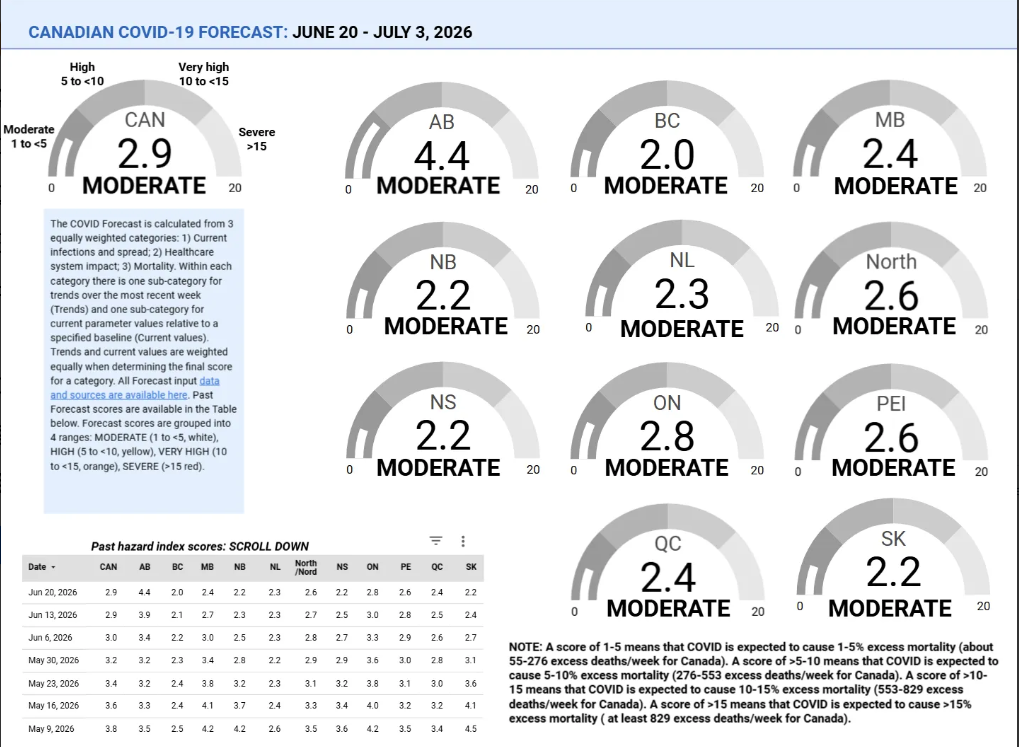
This image shows gauges with the Jun 20 - Jul 3, 2026 COVID Forecast scores for Canada, the provinces, and territories. From left to right:

Canada: MODERATE - 2.9
Alberta: MODERATE - 4.4
British Columbia: MODERATE - 2.0
Manitoba: MODERATE - 2.4
New Brunswick: MODERATE - 2.2
Newfoundland & Labrador: MODERATE - 2.3
North: MODERATE - 2.6
Nova Scotia: MODERATE - 2.2
Ontario: MODERATE - 2.8
Prince Edward Island: MODERATE - 2.6
Quebec: MODERATE - 2.4
Saskatchewan: MODERATE - 2.2

A text box reads: 'The COVID Forecast is calculated from 3 equally weighted categories: 1) Current infections and spread; 2) Healthcare system impact; 3) Mortality. Within each category there is one sub-category for trends over the most recent week (Trends) and one sub-category for current parameter values relative to a specified baseline (Current values). Trends and current values are weighted equally when determining the final score for a category. All Forecast input data and sources are available here (https://datastudio.google.com/embed/u/0/reporting/42b886cf-d661-488e-b7d8-5c5836b55ab6/page/p_2yqs028mwc). Past Forecast scores are available in the table below. Forecast scores are grouped into 4 ranges: MODERATE (1 to <5, white), HIGH (6 to <10, yellow), VERY HIGH (10 to <15, orange), SEVERE (>15 red).'
This apparently equates to about 1 in 320 people being infected

Furthermore, basically the same thing is happening in the US:

COVID-19 levels remain very low across much of the U.S. as a deep lull between waves continues

And in the UK, viz Let’s celebrate the lowest Covid levels recorded since the pandemic started.

There is hardly any Covid in the community, hardly anyone is being hospitalised with Covid and thankfully it is contributing to very few deaths.

Also in Germany. And in Denmark:

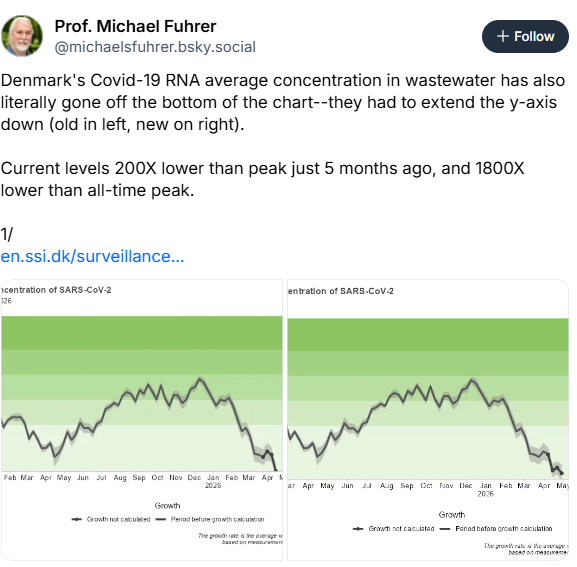
Bluesky post from Prof. Michael Fuhrer:

Denmark's Covid-19 RNA average concentration in wastewater has also literally gone off the bottom of the chart--they had to extend the y-axis down (old in left, new on right).

Current levels 200X lower than peak just 5 months ago, and 1800X lower than all-time peak.

And two charts with a downward trend.

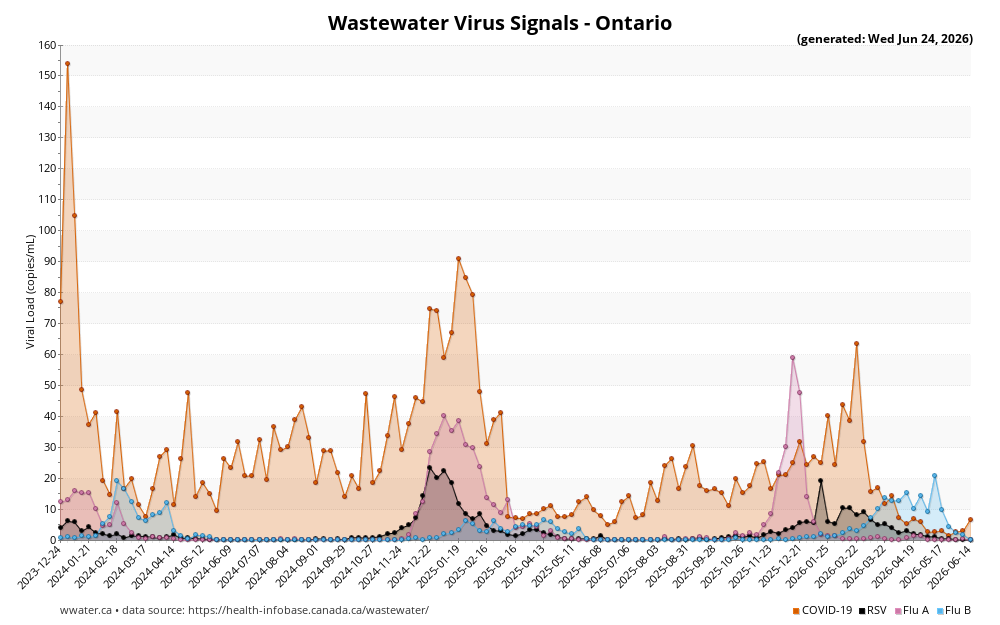
Now, plenty of Canadians had Covid earlier in the year. In Ontario, the peak was around late February / early March. (The source of this graph is https://wwater.ca/Ontario; orange on the graph is COVID-19; pink, flu A; blue, flu B; and black, RSV.)

Wastewater Virus Signals - Ontario (generated Wed June 24, 2026): A chart of Covid-19, RSV, Flu A, and Flu B infections in Ontario, as measured in wastewater, with peaks and valleys, Covid usually most prevalent.

Still, what appears to be happening in Ontario, and Canada-wide, and in other countries, is that the infection peaks are lower year on year, which you can also see in the above graph.

This is not exactly expected, given that basically nothing is being done to stop the spread of this disease: vaccine uptake is low, mask usage isn’t prevalent in Western countries, efforts to improve ventilation and filtration are minimal, paid sick days haven’t become mandatory everywhere, and so on.

So why this is happening, exactly, is a bit of a mystery. I personally wonder if it’s related to another bit of good news about this disease: that the Covid virus is disappearing in wild animals. Because they used to say that the fact that Covid did have such a large pool of animal reservoirs meant that it would endure and continue to mutate. But now it seems to have specialized in humans. (Important to note that you can still infect your pet cats with Covid, though! But they are unlikely to infect you.)

Should I change my masking behavior as a result?

That is the question. Most people dropped masking when the government said they could, or shortly thereafter. I have stubbornly persisted with it, in most public indoor spaces. Excluded are restaurants (though friends / family all know my patio preference) and wine tastings (outdoor or private preferred there, too).

Sidenote: By “mask” I mean a respirator, which is an either N95 (headstrap) or a KN95/94 mask—not a surgical or cloth mask. If I’m going to go through the social and physical discomfort of masking in the first place, I’m going to wear a mask that gives me maximum protection. Surgicals are cheap and easily available, but they gap at the sides, which can let virus and other pollutants in.

Bonus: respirator masks don’t fog up my glasses or cling to my face getting all gross and wet. Very breathable versions are available now as well (see: BreatheTeq by Canada Strong Masks). And they come in fun colours.

These are the reasons I’ve persisted:

  • To avoid catching Covid
  • To protect myself against other airborne contaminants.
  • To protect other people.
  • To show solidarity.
  • To keep up the habit.

The question is, how relevant do these factors remain?

Continue reading “Good health news and what to do about it”