At one point, Stéphanie, our guide, affectionately dubbed us “the toilet group.”
Because this particular walking group was heavily weighted toward women of a certain age, which meant that we all spent an inordinate amount of time waiting around until everyone had a chance to go pee.
On the Amalfi walking tour we’d done previously, pretty much every walk included a stop in the middle of it at a cafe or convenience store where, for the price of a coffee or chocolate bar, anyone who needed to could also use the facilities.
But on these France walks, it seems you often had an opportunity only at the start, then at the end of the walk. Of course, at the start, the urgency tends to not be so great, but then there’s that concern: If I skip this chance, how bad will be the wait for the next one? Hence, the waiting around for the pre-emptive bladder emptying.
For me, though, other aspects factored into the decision of whether to go now, or wait it out. Because with French public toilets, you never really know what you’re going to get. And I don’t just mean missing toilet paper.
Flashback: It’s 1992, we’re in Dieppe, France, and I really have to go. So we stop in for a meal at a restaurant. After giving our orders, I head toward the facilities, have a look, and immediately head back to the table.
“I can’t use that,” I tell Jean.
He, mystified, heads to the facilities to see for himself what horrors await. He shortly returns, laughing.
It was my first encounter with a Turkish-style toilet.
We’ve been to France a number of times since, and I had never encountered another such facility—until this trip. In fact, calling it a “toilet” problem isn’t accurate, as all it is, literally, is a hole in the ground, with two spots for your feet.
And I still can’t use that, so when it was on offer, I was definitely skipping that “opportunity”.
The French also have a certain concern with cleaning the facilities between use, which of course is nice—unless you’re not aware of the method of cleaning. Like, that when you pull the cord to flush, it will also spray water around to clean the whole general area! Regardless of whether you’re still in there…
And no, I did not get caught in that, but others in my group did, having to spend some time in wet pants afterward.
Thereafter, I would skip that style of bathroom as well.
Then there were the pay toilets that require exact change, though that isn’t as bad when you’re in a group, because someone can usually help you out. Some of those also have a cleaning cycle between use, which—again—is nice, only it’s not a super-fast process, so you’re extending the group wait by lining up for those. One them actually conked out after two uses.
Another more modern example had a voice guiding me through the bathroom process (all in français, of course): thanking me for choosing the lower-water flush option and explaining the actual flush would occur after I exiting; warning that I had 20 minutes (20 minutes!) before the door would fly open; etc. It was sort of hilarious.
Then on one walk we actually did stop midway at cafe with a perfectly normal toilet, and what did I do? I became inexplicably unable to unlock the door until those outside told me I was just turning the lock the wrong way.
Nevertheless, I did not give up on cafe bathrooms.
The two things I fretted about most before our “Walking the French Riviera” tour were fitness and weather. Though the tour was classified as leisurely / moderate, we’d found with the Amalfi walking tour that the Exodus definition of “moderate” could result in pretty seriously sore muscles. So this time I thought I’d prepare a bit, by doing more workouts that emphasized lower body strength.
But for weather, obviously, all you could do was try to bring clothing suitable to different conditions. (Even if it doesn’t all match.)
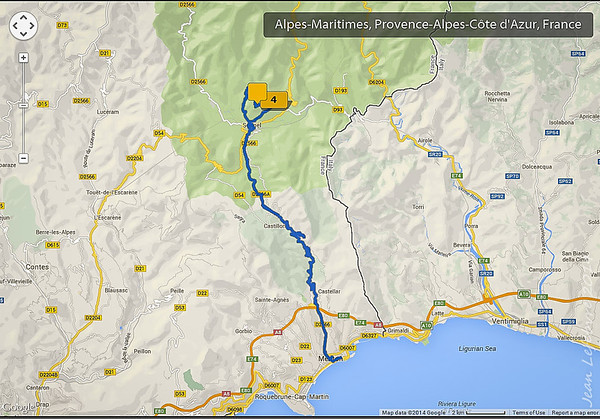
We went on five walks in total, all focused on a different aspect of the Riviera landscape. Our excellent guide Stéphanie would stop at various points to give information about what we were seeing around us. Though interesting, I wasn’t great at remembering that many of those details.
I have no trouble, however, remembering the weather each day.
Walk 1: Cap Martin
This one started right from our hotel in Menton. We did a seaside walk around a cape, then went up into the medieval town of Roquebrune. And though I say “up”, this walk was more on the leisurely side of leisurely / moderate, with an elevation gain of 350 m. Length was 12 km.
We were pleased to find that we were in the fitter half of the walking group of 12, and even more pleased to find that although rain was predicted for the day, it was more like just cloudy. There were a few sprinkles, but nothing too bothersome, and not really interfering with the views.
View of Monaco from the trail
We saw interesting vegetation in the Cap part—olive trees, lemon trees, cactus (which Jean got a little too close to), pepper trees (like, the spice. Which I didn’t know grew on trees.). And Roquebrune was a fairly dramatic, somewhat Italian-looking city. This part of the France is very close to Italy, in fact, and a lot of areas have traded back and forth between the two countries over the years.
Castle in Roquebrune
Walk 2: Sospel
This was our first mountain walk, a bit more of challenge because of the ascent (460 m) and because the path was rougher. To get to the trail start, we took a bus along the narrow, twisty mountain road. The day was predicted to be nice, so I decided to omit the rain pants and waterproof backpack cover, to make things a little lighter.
We pretty much started with an hour’s climbing, but found it quite doable. Our guide was very good at keeping a reasonable, steady pace, so no one got worn out by early over-ambition. Of course, we would stop periodically for the slower ones to catch up. We learned about some of the wild animals in this part of France— though the only ones we saw were squirrels, we did see evidence of boars, who dig up big piles of dirt. We learned that wolves had been wiped out in France, but they are now migrating back from Italy—which isn’t pleasing the French farmers.
At the top was a bunker, built around 1934 in anticipation of war.
We climbed up above this, where there is now a popular site for para-gliding, so a bunch of astro-turf has been laid down. Not the usual thing to see on a mountain top.
We had lunch here, and it was all very pleasant, until some nasty clouds started gathering.
So we gathered up our stuff and started heading down. But there’s only so fast you can climb down a mountain trail. And it did start to rain. And then it rained harder. And then there was thunder and lightning. And then there was hail.
(That would be one thing I hadn’t fretted about in advance: What if I’m caught in a hail storm.)
It soon turned back to rain, and it was just miserable. My jacket was waterproof, but I hadn’t put the hood up in time, so water eventually gathered in there and started running down into the jacket. I had gloves, but they weren’t truly waterproof. No rain pants, and “quick dry” pants aren’t so useful when being constantly rained upon. At least my waterproof boots appeared to hold (though I later found they were little wet inside; I think the wicking socks did their job).
When we got to Sospel, the rain had finally stopped. We had a bit of a wait for the bus, so we toured around the town a bit. But in the time it took us to get a coffee, it started pouring again for our walk to the bus stop. Yay.
At least the bus was warm and dry.
Walk 3: Monaco to Eze
We did manage to dry everything out overnight, partly thanks to our heated towel rack, and the Tuesday forecast was really good. Nevertheless, I packed rain pants, as I would for all remaining walks.
This would be the most challenging walk, I think, because of a significant descent required—775 m. But we cut out some of the ascent by taking the train to Monaco [I’ll do a separate post on some of the city visiting we did], then a bus to La Turbie.
From here, we climbed, getting amazing views all the way. It was just a perfect day weather-wise, as though a reward for the previous day.
Then, after lunch, began a long series of downs, first to town of Eze, a town built on the edge of a cliff.
The group walking down to the Eze, the clump of buildings on the right
Being in Eze itself was a little weird, as it consists of weaving, tunnel-like streets, so you feel a bit like a rat in a maze going through it. But we did stop for a drink at a cafe before doing the final descent, down to the seaside.
There were a lot of stairs at this stage, and many people found that pretty challenging. Again, Jean and I did fairly well with it. I thought I might have sore muscles the next day, but I was pretty good. I guess the working out worked out. (Jean claimed to be fine also, but I did catch him sneaking Naproxin.)
Walk 4: Saint Jean Cap Ferrat
This was the walk after our “free” day, and it was the flattest of them all, just around two capes, through beach front.
It was a beautiful day, and a beautiful easy 11 km walk on nice paths. We started with a train ride (France has a fantastic train network, by the way) to Beaulieu-sur-Mer, then just walked the easy route. Whereas other walks had been more isolated, here there were many beaches, and so many people out sunning themselves.
We finished this walk around 2:00, leaving us enough time to visit the Villa Ephryssi de Rothschild, which I’ll cover separately.
Walk 5: Castellar Menton
This was another mountain walk, and the forecast wasn’t great, so I wasn’t as much looking forward to this one. Still, the morning was very nice. The plan was to take a small bus to the town of Castellar, then walk up to the Italian border, and back down to Menton.
The road to Castellar was even more twisty than the Sospel road. We walked through the small mountain town before heading up on the trail. It was a fairly easy one as uphill climbs go, as the path was pretty wide and the ascent gradual. The path to the Italian border was more challenging, as it was narrower and more rocky. But everyone made it up.
Nice views up here, must say
We did have a good morning, but once again, on the way down, it started to rain. Lighter rain, though. And yes, this time, I had the rain pants, and put up my hood, so it wasn’t too bad. We actually had a choice here, of taking the bus or walking back to Menton. In the light rain, everyone agreed to do the walk down.
Except then it started to pour. And as we got wetter, more and more people started to change their minds about walking. Until finally, Stéphanie (the guide) declared that we were all taking the bus! She felt it would be too slippy to attempt the walk down (had there been any volunteers remaining for it).
We did get off the bus at an earlier stop, though, to have some time to tour the old cemetery of Menton.
We’re just back from a trip to the French Riviera, and I expect I’ll be writing a few blog posts about that.
I feel a need to start, though, by explaining my attire.
I have travelled the world (well, Europe and the Americas, anyway) with this green hat that has served me well, and that I still have, but for this new vacation, which was a walking tour, I felt it was time for a new one.
Jean’s had a series of hats over this same time frame, most of them Tilley Endurables brand. This is a Canadian company that was built around these well-made, lifetime guarantee, water resistant, floatable, breathable, hats. So I thought I’d get me one of those.
And I just couldn’t resist the bright red one. It was fun, it seemed to suit me, it was Tilley.
What I didn’t think about what that red just doesn’t match with everything. And it particularly didn’t match either of my Gortex jackets, one turquoise and purple, another pale mauve, that were basically the required outwear for a walking tour. And though I didn’t have to wear the jackets all the time (mostly, we had nice weather), it also didn’t go with my light blue top, or my deep blue top, or my purple top, which again were of the breathable fabric one kind of has to wear when exerting oneself outdoors.
Me, clashing, in the small medieval town of Roquebrune
Then at one point, we got enough rain that I felt compelled to pull out the rain pants, which I hadn’t worn since the 1980s, and were therefore a lovely 1980s turquoise green. So picture this in your mind: Turquoise green pants, pale mauve jacket (if only I had the other coat that day, but no!), and red hat.
In fact, you’ll have to picture that just in your mind, because I refused to let Jean take any photographic evidence of it.
Here, up in the French alps, wearing the only “outdoor” shirt that somewhat matched the hat…
For the first time in decades, I bought a new album. And by “album”, I mean vinyl record album, LP, “big black CD”, as Jean’s nephew used to call them. And by “new” I don’t mean just mean new to me; I mean that it’s fresh off the presses, a just-released record, preordered from Amazon.
It does, however, feature a couple really old guys: Roger Daltrey, best known as singer of The Who, and Wilko Johnson, not as well-known to North American (except to those who watch Game of Thrones, I guess), but a British guitarist and songwriter, formerly of a band called Doctor Feelgood. The two have been wanting to collaborate for some time, but when Johnson was diagnosed with terminal pancreatic cancer, they decided not to put it off any longer.
I, of course, mainly wanted it because of Daltrey, but I went the LP route instead of CD or iTunes because it just seemed to have such a nice cover:
When it did arrive, in a ludicrously large box, I found the whole package to indeed be quite lovely. It has a sturdy record sleeve, with equally good vintage photos on the back. It has an insert with more photos, and full lyrics—that you don’t need a magnifying glass to read. It has a very solid record cardboard sleeve as well, and the vinyl record itself is thicker, and presumably stronger, than those that were popular back when LPs were all we had. I guess today’s LPs are more luxe products.
But what about convenience? Well, it also came with a download code, so I now also have the album in MP3 format on my iPod.
But first I played the actual LP. And my first impressions are good. It’s just straight-up, fun, rock’n’roll, and Daltrey’s voice seems to me to be very well-suited to Johnson’s songs.
That’s not right, is it? The foods of Easter are homey ham and scalloped potatoes and cheap chocolate. Good Friday is fish. Restaurants are not full to bursting for Easter; in fact, some close for the holiday.
So I’m not sure how we came to mark the start of Easter weekend by going out to not one but two of the area’s finest restaurants. It was as spur of the moment as can be for places that require reservations.
First up, Thursday night before the long weekend, was Verses. We just… Hadn’t been there in a while. We’d hoped to have one final crack at their fine fall / winter menu, but we were just too late for that. Upside was: First crack at their fine spring / summer menu.
The place was fairly quiet this Thursday night, and being there just felt nice. As restorative as a visit to the spa.
A lovely place to be after a busy work week
We were hungry, and it was a bit difficult deciding what to choose on the new menu, most of which sounded delicious. Jean made it easy on himself appetizer-wise by going for his standby foie gras, this time served with “saffron, vanilla waffle, slow poached orange supremes, and Vin Cotto”.
Le foie gras
And I suppose I also went for the somewhat habitual: They usually have some kind of seafood trio as an appetizer, which I usually can’t resist. This time it was scallops:
Sake Kombu cured on arame salad in toasted sesame rice wine vinaigrette
Ceviche, layered with pico de gallo and avocado croutons
Fennel wrapped pan seared on champagne vinegar dressed fennel fronds
Why have scallops one way when you can have them three ways?
Jean favored the tart ceviche style; I thought it was hard to beat the traditional pan seared, but we both agreed the avocado croutons were just the coolest!
We had a heck of a time selecting our wine, partly because I somehow wanted white despite have selected duck as my main course. But we finally settled on a very lovely French Gewurtz. It arrived just after our appetizers, which may be a first (for this restaurant)! (And by after I mean, like, 30 seconds after.)
Andrew suggested this wine
It certainly suited Jean’s main course of three kinds of seafood: tempura shrimp with aioli, grilled octopus salad, and crab and lobster cannelloni with mushrooms and broccoli.
Why have one kind of seafood when you can have four?
The octopus salad had a pleasant smoky taste and very nice texture. The cannelloni were rich and delicious. But perhaps the best were the crispy shrimp, which did not suffer the fate that large shrimp often seem to, of ending up kind of tasteless.
My main was seared duck breast served with a mole sauce. The duck was perfectly prepared, and I loved the chocolate spiciness of the mole, served in its own mound. The dish was called Duck Duck Goose, and the goose was in the form of a quesadilla, which was crispy and rich. The sides were “dirty” rice—wild rice with black beans—and a Brussels sprout slaw.
We resolved to share a dessert, a plan that was complicated a bit when we didn’t agree on which one. Finally Jean just agreed to go with my choice, the maple mousse.
Maple mousse
Of course, this wasn’t just maple mousse in a little dish. It was served in delicious dark chocolate, and accented with a fleur de sel tuile and caramel “dust” that tasted rather like the inside of those Crunchie bars. Everything was quite exquisite.
The Friday outing came about because Langdon Hall somehow put me back on their email list, though I haven’t been there in years. And the email mentioned they were doing an oyster and wine tasting on Good Friday, in Wilk’s Bar. Wilk’s Bar is the somewhat less formal, and somewhat less expensive, dining area at this luxury hotel. We didn’t have any particular plans for the holiday Friday, and most things were closed, so trying that out seemed like a nice afternoon outing.
We didn’t want to have another full three-course meal, but we figured that three oysters likely wouldn’t be enough to sustain us til dinner, either. So we each went with another appetizer. I ordered the squash soup with morels, duck confit, and foie gras. Jean ordered the terrine. We received the 2 oz servings of the white wines that were to suit the three oysters to come: a very dry Chablis, a good sparkling Reisling from Tawse winery, and a delicious oaky Chardonnay.
Why have just one kind of wine when you can have three?
And then we waited. The warm bread basket served with butter made in-house topped with sea salt helped, but it still seemed a long wait for just soup and paté.
When the food did arrive, it came with apologies for the delay; clearly something had gone awry. And they were forgiven when we tasted everything. Hmm. Some of the best examples of squash soup and terrine ever.
Yay! The food is here!
The rest of the meal proceeded at the expected pace. The three kinds of oysters—raw, crispy, and baked—were each just amazingly delicious, and it was fun to have a matching wine for each.
Oyster trio. (It’s high time I drop the “why have one” “joke”)
And we again indulged in dessert: One each this time! Jean had the so-called “ice cream sandwich” while I went with cranberry fritters and “hot chocolate”, which turned out to be warm chocolate mousse. And yes, I dipped the fritters.
Walnut ice cream and daquoise
The least pleasant part of these types of meals—paying the bill—wasn’t quite as bad this day. They gave us the desserts on the house to compensate for the delay in serving our appetizers.
On Saturday, we gathered with extended family. Interestingly, that was also more of gourmet Easter dinner than one might expect: baked lamb, two kinds of potatoes (neither scalloped, exactly), French green beans, asparagus and mushrooms. And fancy chocolate mousse pastries for dessert, along with fruit salad.
The food was delicious. And the company was even better.
Ralph Fiennes, Tony Revolori, Saoirse Ronan. Story of the friendship that develops between concierge Gustav H. and Zero Moustafa, lobby boy, as they become entangled with a wealthy family battling over an inheritance.
She says: Well, that was an unusual movie.
He says: I’d say so.
She says: Did you like it?
He says: [Long pause] Yes, I did. It held my interest.
She says: The Grand Budapest Hotel is the story of a man telling a story of man telling the story of how he came to own the Grand Budapest Hotel, even though that’s really just the side story to his real story, the love story, which is just too painful to tell in detail. So instead he talks of his relationship with Gustav, the eccentric concierge of the Grand Budapest Hotel.
While it seems a bit complicated, it’s all quite enjoyable to watch, because while very quirky, it’s also very funny, and fast-moving, and interestingly staged and filmed. And there is a fair amount of intrigue around the family, and a priceless painting, and which will is really the final one—all in the backdrop of war. I’m not sure I’ve ever seen anything like this movies, including other Wes Anderson movies.
Part of the fun, too, is that it’s so chock-full of stars. It seems every few minutes a new one appears: Look, there’s Jude Law. And Eward Norton. And Bill Murry. And Tilda Swinton. And Jeff Goldblum, Adrian Brody, Jason Shwartzman, Harvey Keitel, OwenWilson, Willem Dafoe…
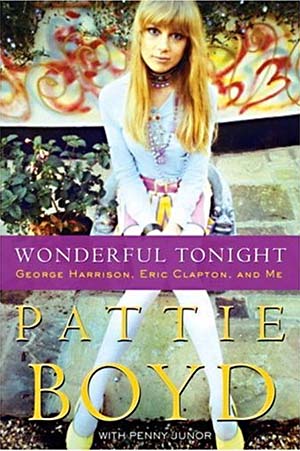
I bought Wonderful Tonight, Pattie Boyd.s autobiography, very much on a whim, from a used bookstore. I was just curious about the woman who married George Harrison (of The Beatles), inspiring him to write “Something”, then left him for Eric Clapton, after he was inspired by her to write “Layla”. That George and Eric remained friends through all this was just one of the things that seemed odd.
When you hear that Pattie Boyd was a model when she met George Harrison, that gives you the impression (based on today) that she was already leading a glamorous life, but modeling wasn’t the same back then. She talks of having to do her own makeup and hair, and running around to various appointments on public transit. She enjoyed it, but it didn’t make her especially rich or famous.
Her childhood was even more austere. She grew up in Kenya, her father a damaged, injured war veteran who eventually abandoned the family. Her mother then remarried to an abusive, unfaithful man. Pattie and her siblings were shuffled off to boarding schools, and eventually were literally abandoned, left in Kenya while her parents moved to England.
Hence, the lack of life model for what a good marriage is.
Because, in case you were wondering, this book gave me the impression that it wasn’t much fun being married to rock stars.
Of course, the relationships started out well. With George, the biggest problem in the early days were the insane Beatles fans. But over time, as The Beatles dissolved, their relationship grew more rocky as well. I found myself rather disappointed to find out that George cheated on Pattie constantly. Yes, I know he’s a rock star, but this is after The Beatles stopped touring, and after George has taken up religion and meditation and is trying to be this very spiritual person.
And one of the people he had an affair with was Maureen Star, Ringo’s wife! I mean, seriously dude, that’s just not right.
But it wasn’t just the infidelity that challenged the relationship, but also George’s mood swings and self-absorption and disregard for what made Pattie happy, such as being able to cook for him.
So yes, she was susceptible when Eric Clapton took an interest, and starting writing her passionate love letters—and one really great song. But it was a long, slow build-up before she was finally ready to leave George. At one of these junctures, Eric threatened to take heroin if she didn’t leave with him then. She didn’t, and he did.
Talk about alarm bells, eh?
Though she’s discreet in terms of details, it’s clear that the Pattie / Eric relationship was a very passionate one once it ignited. If “Layla” was a kind of foreplay for them, “Wonderful Tonight”—which I hadn’t realized was also inspired by her—is indicative of their happy early days together.
But it doesn’t last. Though I think he was off heroin by this point (?), Eric was still an alcoholic. And a slob. And unfaithful. And self-absorbed. Though here I’m making it sound as if Pattie does nothing but complain about her husbands, which isn’t the case. She’s pretty fair. I think I’m the judgmental one.
Pattie also tackles subjects like her infertility (she has no children, despite attempts at in vitro), her failed attempts to help her drug-addicted younger sister, and the challenges of building a life as an ex-wife who didn’t necessarily get a big financial settlements from her rich ex-husbands. Throughout, the writing style is very conversational. I suspect that, in fact, it was actually written by named coauthor Penny Junor, based on interviews with Pattie.
You also, inevitably, get a bit of rock history from an unusual perspective: the Beatles trip to India, drug busts, Live Aid, the murder of John Lennon. She was also friends with members of the Rolling Stones, The Who, Queen, Rod Stewart, and others; her sister has long-term relationship with Mick Fleetwood.
I wouldn’t say this is a book of general interest, but for for those wondering about the lives of rock stars, it certainly provides some insight.
When the federal Conservatives drafted Bill C-23, the so-called “Fair” Elections Act, did they expect it would garner so much attention, becoming a major topic of conversion among politic geeks? Did they anticipate the near universal condemnation the bill has received? Or was this all a nasty surprise?
But shouldn’t you need ID to vote?
Apparently feeling this is their best defense, the Conservatives’ talk about ID issues a lot: That vouching is too open to voter fraud, that 39 different pieces of ID can be used instead.
What they fail to mention is that the ID you present must contain your current address, and most ID does not. The only common piece of ID that does is your driver’s license—but not every Canadian drives.
Most non-drivers currently back up their address-less government ID with the Voter Registration card. However, Bill C-23 would make that card inadmissible. Vouching has been another backup, but again, Bill C-23 would ban that practice.
This bill would make ID requirements more stringent than those in any province, or in most other countries. But voting is a right, not a privilege, and up until 2007, we could vote in federal elections without any ID at all! Provincially, many of us still can:
So, arguably, you should not need ID to vote, actually. But if a government decides to require it, they must do it in a way that account for circumstances such as have recently moved, living in an institution, having a PO box as a mailing address—or being unable to drive. Not doing so is voter suppression, and is likely unconstitutional.
What if they fix the ID thing? Then we good?
No, this Bill has other issues, such as:
Severely limiting what information Elections Canada can share with Canadians, and specifically preventing them from promoting voter turnout. This will kill certain educational programs such as Student Vote. It also may mean that they can’t share the results of their investigations.
Allowing the ruling party to nominate poll supervisors for local voting stations—positions that clearly required neutrality, not partisanship.
Increasing spending limits, and allowing parties to exclude the costs of contacting anyone who has donated to them in the past five years. Can you say loophole?
Requiring that robocall records to be kept, but only for a year—not enough time for a full investigation (as the still-ongoing investigation into the fraudulent robo-calls of 2011 demonstrates: three years and counting).
During hearings, the Conservatives have been unable to come up with a single expert who agrees with this bill. (One they had been quoting testified that they were misrepresenting his report.) In fact, I don’t recall such universal condemnation of something they tried to do since they banned the long-form census.
So they have taken to dismissing all their critique as “self-described experts” or “celebrities”, and personally attacking them: Election Canada’s Marc Mayrand (appointed by Harper) is power hungry. Sheila Fraser (praised by the Conservatives for her work as Auditor General) is a paid shill. It’s been really nasty.
Also, having delivered the bill two years after they said they would, not having consulted ahead with anyone on its contents, they are now trying to rush it through as quickly as possible, limiting debate through time allocation.
Why are the Conservatives doing this?
That is the question.
Other controversial policies, such as GST tax cuts or harsher sentencing laws, are very popular with some people. They are policies that will win them votes, and help raise money. So no mystery why they propose those ones.
But electoral law? Not motivating like money and safety. Sure, diehard Conservatives agree with them, as they do on everything, but this issue just isn’t going to be a big vote-getter or money-maker.
So, why?
a) Is it revenge?
That’s one theory. That Conservatives are angry they were found guilty of electoral fraud in 2005, that several of them have been charged with over-spending during the last election, that they are still under investigation because their voter database was used to commit electoral fraud (the robocalls directing people to the wrong polling stations) in 2011.
They feel picked on, so they want to take power away from Elections Canada as punishment.
b) Is it fear?
About those robocalls: Another theory is that Elections Canada is finally, nearly ready to give its reports on what happened with those in 2011. And the Conservatives, being in government, have an idea what’s in that report, and it’s not good.
So they need this law to pass now so Elections Canada can’t talk about it and they won’t face any repercussions.
c) Is it a nefarious plan to rig the next election?
The Conservatives aren’t so popular right now, remarkably so given that the economy isn’t doing too badly. And there is no doubt that many provisions in this act favor them: They could put biased people in charge of polling stations; they could reduce voter turnout among youth and aboriginal, who don’t tend to vote Conservative; they could spend more money than ever advertising themselves and attacking other parties (and they do have more money than other parties). They could even do more fraudulent calls, with even greater hopes of getting away with it.
Maybe they think this bill is their only chance of winning in 2015.
d) Is it megalomaniac belief that every bill they put forward is pristine and perfect and that anyone who disagrees with them is a silly poo-poo head?
Given this party’s incredible fondness for time allocation to suppress debate on every bill they introduce, combined with an unwillingness to entertain any amendments from any other party, ever: Entirely possible.
Whichever theory you prefer, none of them makes the Conservatives look very good here.
Roger Daltrey, Janet Baker, Carol Hall. BBC adaptation of John Gay’s 18th century opera about greed, lust, and corruption among the working class of London.
She says: Sometimes, when I get a new movie from zip.ca, I can’t even recall why I wanted to see it in the first place, but with this one it was obvious: It stars Roger Daltrey. Furthermore, unlike many movies featuring Mr. Daltrey, it was supposed to be decent.
Still, it is an opera, and it does run 2 hours 15 minutes. I didn’t actually watch it all at once, but in segments, over a weekend.
Though he’s the lead character, MacHeath, Daltrey doesn’t appear for the first 50 minutes of the movie. His character is being discussed (or sung about) that whole time, but in a way that just left me baffled: First, Polly’s parents are upset she’s married MacHeath—they see it as a wasted opportunity. But then she sings about how much she loves him, and they’re OK with it. Briefly. But next thing you know, they want him dead. They suggest Polly kill him, but she’s not down with that idea, so the parents conclude they’ll have to do it themselves.
Then the parents leave, MacHeath arrives, Polly tells him he needs to run away, but instead they just make out.
So here I paused the DVD and went to look up a Wikipedia synopsis. And not just to figure out what the heck had just happened; I decided I might as well look ahead at what was to come as well. Plot, after all, isn’t really the point of opera.
So from that point on, I was able to follow along despite the thick Cockney accents, and found it be a pretty enjoyable piece.
My raison d’être for watching the movie, Mr. Daltrey, looked very fine indeed, all long curly very blonde hair, blue eyes, and tanned—definitely the prettiest thing in the movie. He sounded good, too. Now, I don’t what MacHeath’s songs were supposed to sound like, and Daltrey certainly doesn’t have the “traditional” operatic voice that some of his co-stars do, but he is one those rock stars who actually can sing, on-key and with power and control. His acting also seemed just fine; one of MacHeath’s major problems is balancing the many, many women who find him irresistible (and that he, in turn, also can’t resist), and perhaps, just perhaps, Daltrey was able to draw on his own rock-star life to depict what that’s like.
And as opera’s go, it all moved along pretty quickly, and was quite entertaining, with its plot of lust and deceit, with crimes and lies a-plenty. Though none of the characters were that sympathetic, in the end, except, perhaps, Polly.
The only disappointment was that, having read the synopsis, I was looking forward to seeing the opera’s trick ending played out. Only, this movie had a trick ending to the trick ending.
I don’t mean my own wedding anniversary. I’m pretty good at remembering its date, including year, from which I can then figure out how many years it’s been.
But, like, work ones. I’m always amazed at people who can rattle off exactly how long they’ve been at a company. I had a big anniversary at work recently, so I’m good there for a bit, but I’ll forget the exact number soon enough. Just as I’m not sure how many years at I’ve lived at my current house, what year my car is, or how old the dress I wore yesterday is.
I was wearing a dress because we went out ballroom dancing. We were seated with a couple who have been dancing only a couple years longer than we have, and so we were trying to remember how long ago we had all started.
Of course, I was no help, but nobody was having much luck, until Jean had a flash of inspiration.
“How long ago was My So-Called Life on TV?”, he asked.
“20 years.” . (Why did I know that? Because I looked it up recently, when writing my Jared Leto blog post.) “But what does that have to do with the price of tea in China?”
Then I remembered: “Dancing in the Dark”.
No, not the Bruce Springsteen song. Episode 2, Season 1 ofMy So-Called Life, entitled “Dancing in the Dark.”. The one where Angela’s parents, Patty and Graham, try ballroom dance classes to “reconnect”. Only, they just end up arguing.
Patty and Graham at dance class
Upon seeing that episode, Jean opined that he would most definitely be more open-minded to the whole dancing thing than Graham had been. Cut to a few weeks later, and Fred Astaire Studio called offering free ballroom dance lessons. Jean then felt obliged to agree and try it out. That’s how—and when—we started. ‘94.
I don’t know what’s weirder: That we were inspired by a TV show that made ballroom dance class look like no fun at all, or that Jean is the one who remembered that connection, when I am the one who was particularly devoted to that show.
But now, I am happy to have now recollected that bit of information.
Unlike that 20 year thing… Knowing that is not making me particularly happy at all. Shouldn’t we better dancers than we are, having done it so long? But then again, we did have that break from dancing… Not just a few months or anything; we went years without taking dance classes, at one point.
In fact, how long was that break? And when was it? A seven year break, five years ago? A five-year break, seven years ago?