Award season

Movie award season has come around and I find myself somewhat more interested than some years. If nothing else, at least the talk of movies and actors is a nice distraction from the alarming events going on in the world.

Movie award trophis
Trophies for the Academy Awards, Golden Globes, and SAG awards

However, I haven’t seen that many of the big contenders yet. I am pleased that The Grand Budapest Hotel, which we saw back in April, has been remembered and is getting recognition, as it really was quite delightful. But Wild is only getting recognition for Reese Witherspoon’s acting, when I thought the film as a whole was very good. And the fantastic Pride was up for a Golden Globe, but nowhere in the Oscar list.

So I guess my interest is that I would like to see many of the other contenders as well: The Imitation Game, Selma, The Theory of Everything, Into the Woods, Big Eyes, Still Alice, and Boyhood. Mind you, except for Boyhood—which I was deliberately waiting for the rental version of—those are in theatres now. Rather unlikely I find time to see all of them before award show season ends.

Birdman posterWe did get to Birdman, however, back in December. And I’m still trying to figure out exactly I what I think of it! It tells the story of an actor who had been the star in a superhero movie franchise, and is now trying to adapt, direct, and star in a revival of a Raymond Carver play on Broadway. The effort of putting on the play is not going smoothly, however, and the stress causes him to break down and hallucinate at times. The hallucinations are largely presented as though they’re actually happening.

So it’s an unusual film, and for me that makes it hard to unabashedly love. But I didn’t dislike it, either. It’s certainly creative, and the actors—star Michael Keaton, Edward Norton as another actor in the play, and Emma Stone as Keaton’s daughter—are very good. And you certainly end up rooting for the main character, despite his flaws. Worth seeing if you’re up for a moderate challenge.

Some of the other Oscar contenders, though, I’ve decided I’m not up for the challenge of: Foxcatcher, Nightcrawler, Whiplash, American Sniper. All these movies about dark men being nasty. Oscar clearly loves that shit, but I do not.

Oscar also snubbed the Roger Ebert document, Life, Itself, which we had found quite good. Admittedly, though, I didn’t see any of the documentaries they did nominate, so can’t really say whether they were all better than Life, Itself.

The Lego Movie posterSimilarly with the animated movie category: I haven’t seen any of the nominees, but I did recently see The Lego Movie.(which was nominated for a Globe, but didn’t win), and found it to be one heck of a fun and entertaining movie, no matter your age. Jean was quite skeptical when I suggested we watch it, but he quite enjoyed it, too. (As an aside, he had the same reaction to 2012’s Pitch Perfect, the movie about the all-women a capella group, so that’s another recommended one from us, if you haven’t seen it already.)

At least the “Everything is Awesome” song was nominated, but I really think Lego Batman deserved more recognition for his work. 🙂

The Globes also give awards for TV shows and actors, and I’ve hardly seen of any of those nominees. But weirdly, many of the few I was acquainted with actually won. The Affair got best dramatic series—which appalled the TV critics—and best actress in a drama., and the star of Jane the Virgin won for best actress in a comedy—which delighted the TV critics. I, of course, have caught up with both of those shows recently.

In the mini-series category, Maggie Gyllenhaal took it for the amazing Honourable Woman, which I did watch on CBC. The network’s commercial insertions were jarring, but the series was a fascinating, complex look at Israeli / Palestian relations, and Gyllenhaal was great in it (as she usually is). And Matt Bomber won a supporting actor award for HBO’s The Normal Heart, an interesting movie about the early days of the AIDS crisis, that I watched not long after I subscribed to HBO.

I leave you with some links.

Hollywood Foreign Press (Golden Globe) nominees and winners list

Oscar 2015: Nominations in full (in case you really need to know who’s up for sound editing and for hair and makeup)

Oscar snubs: Shocks and surprises from the 2015 nominations (at least according to The Telegraph)

Wild women! Some reviews

Wild movie posterIt seems apropos to begin with Wild, the movie starring Reese Witherspoon, that we recently saw at the theatre. I was quite looking forward to it, as I’ve really enjoyed every other movie Jean-Marc Vallée has made. I also thought the rugged, outdoors-y story would appeal to Jean.

Wild is the story of Cheryl Strayed, who decides to solo hike the Pacific Coast Trail, which is over 1000 miles long and doesn’t have a lot of “comfort stations.” As her overly full backpack attests, she doesn’t have any experience with this type of trip. As she slogs along, she flashes back to the memories of her past that have led her to this point.

So it’s not inherently the most cinematic movie. The writer, director, and actors deserve credit for making it as compelling as it is.

Cheryl Strayed was kind of wild. Depressed after her mother dies of cancer, she spirals… drops out of schools, engages in casual sex, drinks, experiments with heroin. She does the hike as a kind of act of atonement. Instead she learns that maybe she has nothing to atone for.

The Affair posterThe Affair, an HBO Canada (Showtime in the US) series that we finished watching over Christmas, presents another woman for whom a tragic death leads to “bad” behavior—notably, an affair. The conceit of the series is that each episode is show from two points of view: His (Noah’s) and hers (Alison’s). What’s interesting is how differently each of them recalls the same events. With this series, you can never be sure what the truth is.

Underpinning the story of the affair is a murky murder investigation: For the longest time, we’re not even sure who’s dead. But particularly at the start of the series, it’s the personalities and relationships that are of interest, anyway.

Watching this with Jean was added entertainment, as he’d get so frustrated with the characters and situation at times, he’d have to get up and pace to work off the tension. At one point he commented, “I don’t know why she’s so much more sympathetic than he is.” But she is. It’s sad but understandable that the strain of tragedy has damaged the relationship with her husband. Noah, on the other hand, seems to be undergoing a petulant midlife crisis, with his wife and four children as the victims.

It seems like the kind of series in which everything would get wrapped up at the end of the season, but not so much. This is TV, they wanted a season 2, so it ends in a kind of cliffhanger. That’s worrisome, as I don’t see this necessarily continuing to work well for another 10 episodes.

Jane the ViringJane the Virgin, on the other hand—which we started watching on Shomi about a month ago and have nearly finished already—has enough plot and characters to run for years, probably. Central character Jane is, indeed, a virgin. In a bid to avoid becoming a teenage mom like her own mother, she has vowed to wait until marriage.

Unfortunately, a medical mistake in the first episode causes her to get pregnant anyway. And that’s just one plot among many.

The series is based on and includes Mexican telenovellas, which I know nothing about. But it seems to mean:

  • Fast-moving storylines
  • A large cast of intersecting characters
  • Painfully good-looking actors
  • High drama

(Or maybe that impression is just the result of watching so many episodes in such a short time.) At any rate, it is highly entertaining. If Jane isn’t wild, the same can’t be said of anyone around her: The number and variety of hookups is astonishing. They all (even her mother) see Jane and her morals as a kind of a mysterious, rare bird. Yet she’s not some preachy, perfect, dull character: She’s just a young woman trying to make the best decisions for herself.

In a really crazy world.

Pamela SmartBut HBO documentary Captivated: The Many Trials of Pamela Smart remind us that the real world can be pretty crazy as well.

The Pamela Smart story is one you probably think you know, at least if you were around in 1993. She was the pretty, blonde school worker who had an affair with a teenage boy, who later murdered her husband. She was convicted of conspiring to commit murder, the story being that she had seduced her young lover into committing the act. The case inspired the movie To Die For, starring Nicole Kidmann.

The documentary covers the media circus surrounding the case at the time. I hadn’t realized just how nuts it was on American TV, down to presenting a full re-creation of the supposed crime on television before the fully televised trial (the first ever) even took place! It points out which often-repeated “facts” presented in the media weren’t true, and some of the lax aspects of the case itself (such as allowing the four young men involved to stay together in prison pre-trial; and maybe get their stories straight?).

The “seductress” story was so compelling, it seemed any reality that contradicted it got dismissed.

I went into watching this assuming she was guilty, and the documentary wasn’t necessarily trying to establish her innocence. Still, I’m left wondering, particularly given the inclusion of recordings by one of the jurors (made at time of trial), who had extreme doubts about the evidence as presented. Perhaps Pamela Smart is guilty, But after watching this, I don’t think that’s been proven beyond a reasonable doubt.

Nevertheless, she’s in jail for life, The actual murderers are due to be released soon.

Movie review: Rosewater

*** Rosewater (November 2014) – Theatre

Rosewater movie posterStarring Gael Garcia Barnal

She says: In 2009, The Daily Show with Jon Stewart sent one of the cast (Jason Jones) to Iran to do a real on-location segment for their fake news show. One of the individuals interviewed for the program was journalist Maziar Bahari. As with many Daily Show items, the resulting segment was both amusing and educational.

Unfortunately, the mock interview was then used as the pretext for the actual arrest of Bahari, who went on to spend 118 days in an Iranian jail, with no trial.

On his release, Bahari wrote a book about his experience. And last summer, Jon Stewart directed a movie based on that book.

So, Rosewater is not a comedy. On the other hand, it’s not all grim and depressing, either. The beginning, focusing on Bahari’s coverage of the election in Iran and its aftermath, when the result was rigged, is quite exciting. I’m sure I followed it on the news at the time (via The Daily Show, if nothing else), but I certainly didn’t remember all the details presented of Iran’s thwarted version of the Arab spring.

The movie certainly becomes more insular upon Bahari’s arrest, when it focuses on the interrogations and the interrogators, and how Bahari managed to cope, mentally—but I found that part interesting as well. And I was relieved there were no brutal torture scenes. Gael Garcia Barnal, as always, is very good.

You wouldn’t necessarily expect that Jon Stewart could make a very decent dramatic film on his first try, but he has.

He says: OK. Iran is off the list of vacation destinations.

Movie review: Pride

Like to take a break from the regularly scheduled report of my trip to Washington state to talk about Pride.

Pride movie poster**** Pride (September 2014) – Theatre. Starring Matthew Flynn, George MacKay, Bill Nighy, Imelda Staunton, and others.

He says: That was a great movie.

She says: Pride is based on the true story of a how a group of gay and lesbian activists in London decided to raise funds for the miners striking against the Margaret Thatcher government in 1984. As depicted in the film, the gay rights group at first had trouble even getting anyone in the Miner’s Union to return their phone calls. But by bypassing the national officials and directly  contacting a small, affected community, they find some local support. The two groups gradually gain trust in each other, but are challenged by the rising spectre of AIDS on the one side, and the drawn-out and seemingly hopeless nature of the strike on the other.

That synopsis likely makes the movie seem somewhat sad and dreary, but it’s actually anything but that. Much in the style of “The Full Monty” and “Billy Elliott”, it starts from a place of sadness to tell an ultimately triumphant story with a lot of humor. The movie to me seemed perfectly paced (which I guess reflects editing skill); it never seemed slow, information was hinted and revealed at just the right times. It made you feel good — about people, about the world — without milking the emotion.

The trailer gets that across pretty well:

It’s a great movie.

(By the way, we also, finally, saw Guardians of the Galaxy a few weeks ago. That was good, too! But we liked Pride more.)

Movie review round-up: Love stories

I keep meaning to catch up with the rest of the world and see Guardians of the Galaxy. In the meantime, I’ve been diverting myself with more obscure movies, all of which, I’ve realized, are variations on the love story.

Life, Itself movie posterLife, Itself (July 2014) – Theatre (97% positive rating at RT)

Life, Itself is a documentary about the life of Roger Ebert. And he had an interesting one: he almost accidentally fell into his movie critic role, and that led him to a Pulitzer prize, a popular television show, friendships with movie stars and directors, and even a brief career as a screenwriter for a most unexpected film, Beyond the Valley of the Dolls. He also suffered from alcoholism and, later in life, a debilitating form of cancer that robbed him of speech and the ability to eat.

The filming begins while he is undergoing for said cancer, and his physical struggles and treatment are sometimes hard to watch. Filming continued up to and beyond the day he died (but his death is not on film!).

How is this a love story? Well, that’s courtesy of Chaz, the woman Roger married late in life, who transformed his life for the better, and whose witness to his final days, as presented in this movie, is touching and beautiful.

I’d read the autobiography this documentary is based on, so I knew the outlines of the life story already, but it was quite interesting seeing and hearing the perspectives from other people. The behind-the-scenes films of Siskel and Ebert bickering are particularly fun.

I wasn’t sure what Jean would think of this, but he declared it “pretty good”, commenting approvingly that Roger was not made to look like a saint here.

Austenland movie posterAustenland (August 2013) – Borrowed from library (30% positive at RT—ouch!)

This one (which was a bit hard to track down; hurray for libraries) is the most conventional romantic comedy of the bunch, the story of a young woman obsessed with Jane Austen, who decides to spend an amount of money she can’t really afford to go on a trip to Austenland, where the female participants get to act out their own Austen-like story with male actors.

The lead characters (liked Keri Russell) play it straight, while the supporting cast (James Callis, Jennifer Coolidge) go for very broad humor. This makes the movie feel a bit off-kilter at times. It was funny, though. And I did like that the main story wasn’t entirely predictable, even down to who the leading man really was.

Jean declared that this one “wasn’t bad.”

Don Jon movie posterDon Jon (September 2013) – TMN (80% positive rating)

OK, so this is about a young man, Jon (played by Joseph Gordon-Levitt), who is obsessed with porn and doesn’t much see the point of long-term, real-life relationships—until he meets the lovely Barbara (played by Scarlett Johansson). If this was a true romantic comedy, they would fall in love, she would reform him, they would then have some of conflict, but they’d get together in the end.

This is not a true romantic comedy. And I won’t spoil what does happen, as it is somewhat unpredictable and fairly interesting. It’s notable that the character of Barbara is herself as obsessed with romantic comedies as Jon is with porn. And that proves to have its own issues when it comes to real-life relationships.

I forgot to ask Jean what he thought of this one, but he stayed in the TV room and watched it all, so I’m assuming he didn’t hate this one, either.

Veronica Mars movie posterVeronica Mars (March 2014) – TMN (78% positive rating)

This one is basically a long episode of Veronica Mars, a TV show that ran for three years, from 2004–2007. The premise, somewhat amusingly, is that Veronica Mars gave up all her sleuthing work for nine years now, thus ensuring the show’s fans that they really haven’t missed anything!

What draws her back? Why love, of course, in the form of ex Logan, who’s been accused of the murder of his current girlfriend.

So this is much more a murder mystery than a romance, and I haven’t the faintest idea if it would appeal to anyone who hadn’t watched. As someone who had, I was mainly amazed at how completely I’d managed to forget certain characters over the past 9 years, considering I was a pretty big fan of this show.

Jean declared this a quite enjoyable movie, despite his not being entirely convinced by the murder plot resolution.

Enough Said movie posterEnough Said (September 2013) – Redbox rental (96% positive rating)

Hey, a movie starring grown-ups! In the form of James Gandolfini, as Albert, and Julia Louis-Dreyfus, as Eva. But these are damaged, cynical adults, all divorced or seemingly on the verge of it. Eva, in particular, can’t seem to trust her own feelings of attraction and fondness toward Albert, allowing her view of him to be poisoned by the opinion of others.

Jean, especially, found her behavior hard to watch at times. “God, this is making me so uncomfortable!” was a frequent refrain. In fact, at one point he was so uncomfortable, he had to leave the room for a while.

I think it’s fair to say this movie won’t leave you indifferent. But maybe not the best “date night” movie.

Behind the Candelabra movie posterBehind the Candelabra (May 2013) – HBO Canada (95% positive)

And speaking of uncomfortable… This is the story of the relationship between Liberace, played by Michael Douglas (of all people) and a young man named Scott Thorston, played by Matt Damon, on whose book this movie is based.

It’s not the fact that it’s gay love story that makes this uncomfortable. (I found the early scenes of their budding relationship very sweet, in fact.) It’s the power differential in the relationship that made it increasingly hard to watch. Liberace was older, richer, more famous, more established in his career than Scott… He holds all the cards. Scott becomes completely dependent on him; “Lee”, as he says, becomes “his whole life.”

So when Lee suggests he lose some weight on the “LA diet”—some sort of amphetamines—he does, becoming hopelessly addicted in the process. And when Lee suggests that Scott get plastic surgery to look more like, well, Liberace himself, Scott does that too! z(I actually had to stop watching, for a while, at that point.) And when it ends, well, there was no “alimony” available for gay men back in the 1980s.

It’s interesting, and the actors are very good, but this is no date night movie, either. (No Jean report here; he didn’t watch this movie.)


Movie reviews: The Grand Seduction and The Birder

Thought it appropriate, on Canada Day, to comment on two recently seen Canadian movies. While Canada sometimes has a reputation for making po-faced, off-beat dramas, these were both comedies.

Poster for The Grand Seduction*** The Grand Seduction (May 2014) – Theatre

Brendan Gleeson, Gordon Pinsent, Taylor Kitsch. A small Newfoundland town’s bid for a new factory depends on their enticing a doctor to move to the community.

She says: I loved the Québecois version of this movie and was curious to see how the English one would turn out. The setting was switched from Gaspé to Newfoundland here, which seemed a propos, and allowed them to hire almost the entire cast of 22 Minutes: Mark Critch, Cathy Jones, Mary Walsh. They’re all good, though, as is the lead, Irishman Brendan Gleeson and, of course, Mr. Gordon Pinsent, as he always. Liane Balaban’s part is almost too small to comment on, which is too bad.

As for the doctor, it took me a few minutes to recognize him as having played the hunky Tim Riggins in Friday Night Lights. So that’s what happened to him, in case you were wondering! He’s probably not the strongest actor in this comic piece, but he’s just as hunky as ever.

I enjoyed the new movie. Perhaps not as much as I enjoyed the original, but then, I knew certain jokes were coming this time. While I would have missed those jokes if they weren’t in this movie also, it’s hard to be quite as delighted the second time out. Fortunately, as is common with me, I did forget some details of the original plot, so wasn’t entirely certain how this one would play out. (Or if it played out differently than in the original, for that matter.) Always better to be caught up in the story.

He says: I enjoyed that, too. It was funny, they did a good job adapting it.

**½ The Birder (May 2014) – Theatre

Tom Cavanagh, Mark Rendall, Jamie Spilchuk. In the midst of his marriage ending, teacher and bird enthusiast Ron Spencer loses out on a much-desired job as head of ornithology to Floyd Hawkins. He embarks on a revenge campaign with Ben, the young school janitor, who has his own reasons for disliking Hawkins.

She says: Largely set at Point Pelee Park, featuring a main character who swears by saying “F” (literally, F), and a “villain” who is anything but, this movie flirts with the hokey. It is, undeniably, very funny at times, though, as Ron and Ben’s revenge schemes go terribly awry. And the acting, particularly by lead Tom Cavanagh, elevates the characters to more than cartoons. It’s light, it’s not terribly original, but you won’t hate yourself for watching it and laughing along.

He says: It was pretty predictable, but it did keep my interest.

And, just for the record, some other Canadian movies that I think are terrific. (Even though a number are po-faced, off-beat dramas.)

  • Les Invasions Barbares (Barbarian Invasions) – One of the best movies ever, period
  • Last Night – It’s the last night on earth… by Don McKellar (who directed The Grand Seduction)
  • The New Waterford Girl – To really see what Liane Balaban can do
  • A History of Violence – Cronenberg!
  • Bon Cop, Bad Cop – This is a funny one!
  • Café de Flore – A love story (C.R.A.Z.Y, by the same directory, is also very good)
  • Take This Waltz – directed by Sarah Polley; Away from Her is also recommended
  • Monsieur Lazhar – Yep, another Quéecois one…
  • Atanarjuat (The Fast Runner) – Very long, though
  • Saint Ralph – Quite enjoyable

Movie review-lets, with bonus thoughts on Muppet gender

Movie poster for The MuppetsWe recently watched the 2011 movie, The Muppets, which “rebooted” the characters from The Muppet Show, which ran from 1976 to 1981, and then launched a series of movies. It was fun, especially if you do remember the show. (If you don’t, as with most kids, a lot of the references would go over your head). It’s a musical, with catchy original songs and some hilarious covers, such as a barbershop quartet versions of “Smells like Teen Spirit” and chicken-clucking version of C Lo Green’s “F(orget) You”.

But I became super-distracted by something I’d never really noticed before: Almost all the freakin’ muppets are boys. You have Miss Piggy, of course, and then… Janice, in the band, who rarely says anything, and then… The chickens? Who also don’t talk. So one speaking female Muppet character.

This, my friends, would be your Smurfette principle in action: the tendency of movies for children to have only one female character amongst an ensemble of male characters.

It Happened One Night movie posterAnd speaking of sexism, we also saw It Happened One Night recently. This romantic comedy, starring Clarke Gable and Claudette Colbert, maybe didn’t always have the most enlightened view of the role of women? It does have the excuse, though, that it was made in 1934.

I don’t watch a whole lot of 1934 movies, but some movies are classics for a reason. The two stars have chemistry, the script is lively, and it’s enjoyable watching them play out the romantic comedy pattern of meet, repel, attract, obstacle, reunion.

Not really sure about the title, though, since it doesn’t all happen in one night; it takes places over a few weeks. Unless that’s a reference to the night the walls of Jericho came down? In which case, naughty, naughty!

The Libertine movie posterSpeaking of naughty, naughty, I also saw The Libertine, 2006, starring Johnny Depp as John Wilmot, notorious for writing bawdy poems and plays. The movie wasn’t a hit with audiences or critics, but it’s not that it was badly made. It just took a rather dark view of this character, and that made the movie rather less fun that it might have been. It particularly didn’t shy away from the effects of alcoholism and venereal disease in the last third of the film.

Jean’s review? “Remind me not to get syphilis.”


Movie review: Fed Up

*** Fed Up (May 2014) – Theatre

Fed Up posterDocumentary about the obesity epidemic, linking it to changes in the food industry, particularly increased use of sugar.

He says: That was depressing.

She says: Fed Up gives the stats on the increasing obesity rates, particularly among children, and includes interviews with several such young people and teenagers. You can’t help but feel for how miserable their weight makes them, and how tough is it to lose.

Various experts than give their views that just saying “kids need to exercise more” is misguided, because the amount of calories burnt during exercise is so limited. (This is further bolstered by showing that one of the obese teens profiled is very active, every day, yet can’t seem to get the weight off.) Instead, they point to the changes in the food industry in the past 40 years, and how these track with increasing rates of obesity in America—and increasingly, around the world. This has had terrible and unprecedented effects on health, such as teenagers developing Type 2 diabetes.

The problematic changes include greatly increased amounts of sugar, greater use of cheese, and making conveniences food available everywhere—like at the checkout counters of stores that sell other things. Several examples are shown of governments trying to make changes to the food supply to make it healthier, and the food industry resisting them. This started with the McGovern Report in 1977 and continues to this day with Michelle Obama’s “Let’s Move” campaign which started as a call to action to change the actual food supply, but now seems to be more about getting kids to exercise. (Ms. Obama refused to be interviewed for the documentary.)

It’s an interesting movie, and a compelling argument. It ends with some tips for what you can do while waiting for a better world :-), but I got to say, until that happens, it really is difficult.

For instance. In talking about the problem with sugar, the movie emphasizes that it’s not naturally occurring sugar in fruit, for example, that’s a problem. It’s added sugar. The movie also points out that in ingredient lists, sugar can be listed under many different names (corn syrup, malodrexin, sucrose, fructose, etc. — it was a huge list).

But what the movie doesn’t cover is that nutrition labels don’t distinguish naturally occurring and and added sugar. They just say Sugar. (This is the same in the US and Canada.) So if you look at a nutrition label on frozen peas, for example—just peas, now, no added anything—it says Sugar: 4g.

Well OK, you know it’s only peas, so you won’t worry about that “sugar”. But what if you buy a frozen dinner or something else with multiple ingredients? How much of that is naturally occurring and how much added on? Unless you understand absolutely every item in the ingredients list and can confidently recognize it all as real food, you have no way to know.

Michelle Obama proposed changing nutrition labels to spell out the two types of sugar – video link: http://fw.to/KXR6e3W

The food industry is “considering” it. They say it would be expensive, and change would not be possible for several years.

Movie review: The Grand Budapest Hotel

***½ The Grand Budapest Hotel (March 2014) – Theatre

Grand Budapest Hotel posterRalph Fiennes, Tony Revolori, Saoirse Ronan. Story of the friendship that develops between concierge Gustav H. and Zero Moustafa, lobby boy, as they become entangled with a wealthy family battling over an inheritance.

She says: Well, that was an unusual movie.

He says: I’d say so.

She says: Did you like it?

He says: [Long pause] Yes, I did. It held my interest.

She says: The Grand Budapest Hotel is the story of a man telling a story of man telling the story of how he came to own the Grand Budapest Hotel, even though that’s really just the side story to his real story, the love story, which is just too painful to tell in detail. So instead he talks of his relationship with Gustav, the eccentric concierge of the Grand Budapest Hotel.

While it seems a bit complicated, it’s all quite enjoyable to watch, because while very quirky, it’s also very funny, and fast-moving, and interestingly staged and filmed. And there is a fair amount of intrigue around the family, and a priceless painting, and which will is really the final one—all in the backdrop of war. I’m not sure I’ve ever seen anything like this movies, including other Wes Anderson movies.

Part of the fun, too, is that it’s so chock-full of stars. It seems every few minutes a new one appears: Look, there’s Jude Law. And Eward Norton. And Bill Murry. And Tilda Swinton. And Jeff Goldblum, Adrian Brody, Jason Shwartzman, Harvey Keitel, OwenWilson, Willem Dafoe…

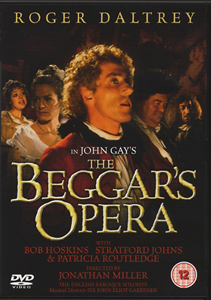
Movie review: The Beggar’s Opera (1983)

*** The Beggar’s Opera (1983) – Rental

Roger Daltrey, Janet Baker, Carol Hall. BBC adaptation of John Gay’s 18th century opera about greed, lust, and corruption among the working class of London.

Roger Daltrey in John Gay's The Beggar's OperaShe says: Sometimes, when I get a new movie from zip.ca, I can’t even recall why I wanted to see it in the first place, but with this one it was obvious: It stars Roger Daltrey. Furthermore, unlike many movies featuring Mr. Daltrey, it was supposed to be decent.

Still, it is an opera, and it does run 2 hours 15 minutes. I didn’t actually watch it all at once, but in segments, over a weekend.

Though he’s the lead character, MacHeath, Daltrey doesn’t appear for the first 50 minutes of the movie. His character is being discussed (or sung about) that whole time, but in a way that just left me baffled: First, Polly’s parents are upset she’s married MacHeath—they see it as a wasted opportunity. But then she sings about how much she loves him, and they’re OK with it. Briefly. But next thing you know, they want him dead. They suggest Polly kill him, but she’s not down with that idea, so the parents conclude they’ll have to do it themselves.

Then the parents leave, MacHeath arrives, Polly tells him he needs to run away, but instead they just make out.

So here I paused the DVD and went to look up a Wikipedia synopsis. And not just to figure out what the heck had just happened; I decided I might as well look ahead at what was to come as well. Plot, after all, isn’t really the point of opera.

So from that point on, I was able to follow along despite the thick Cockney accents, and found it be a pretty enjoyable piece.

My raison d’être for watching the movie, Mr. Daltrey, looked very fine indeed, all long curly very blonde hair, blue eyes, and tanned—definitely the prettiest thing in the movie. He sounded good, too. Now, I don’t what MacHeath’s songs were supposed to sound like, and Daltrey certainly doesn’t have the “traditional” operatic voice that some of his co-stars do, but he is one those rock stars who actually can sing, on-key and with power and control. His acting also seemed just fine; one of MacHeath’s major problems is balancing the many, many women who find him irresistible (and that he, in turn, also can’t resist), and perhaps, just perhaps, Daltrey was able to draw on his own rock-star life to depict what that’s like.

And as opera’s go, it all moved along pretty quickly, and was quite entertaining, with its plot of lust and deceit, with crimes and lies a-plenty. Though none of the characters were that sympathetic, in the end, except, perhaps, Polly.

The only disappointment was that, having read the synopsis, I was looking forward to seeing the opera’s trick ending played out. Only, this movie had a trick ending to the trick ending.

He says: Thanks for not making me watch that one.