A bewildered Canadian on a world gone mad

It’s Canada Day. And right now the world is giving me many reminders of how lucky I am to live here.

1. That Quebec’s referendum on separation was defeated.

I wasn’t paying much attention to Brexit until a couple weeks before it happened, and even then I was thinking that surely they wouldn’t vote Leave? Watching the results come in reminded me so much of the horrible Quebec separation referendum of 1995. A full night of tension (following weeks of worry on a vote I, an Ontarian, couldn’t even participate in) watching the movement of a Yes (separate) / No (stay) line on television.

151030_is0se_rci-m-vot_sn635
That nail biting time before the needle moved to the side of good

But then, while the Yes started out strong, it gradually swung toward the No, who ended up taking it with a 0.6% margin. Whereas Great Britain’s vote was the opposite: A strong initial showing for Stay giving way to Leave, who took it with 2% margin. (No matter how many times I refreshed my browser.)

What would have happened to Canada had it gone the other way? Great Britain’s experience is giving us an idea:

  • A precipitous drop in currency.
  • Tumbling stock markets, with the UK dropping from the 5th to the 6th world economy overnight.
  • Expected rises in unemployment, debt and lowering of GDP and growth.
  • A Leave team with no plan for how to exit.
  • Political disarray all around, leaving no party or leader currently able to effectively govern through the chaos.
  • Regions (Scotland, Ireland, London) unhappy with the result talking separation of their own.

For Canada, it would have been all that, only worse. (For an idea just how ill-prepared the country was for the possibility of a Yes vote in the Quebec Referendum, read Chantal Hébert’s The Morning After: The 1995 Quebec Referendum and the Day That Almost Was.)

And just for the record, Leave voters in Great Britain: What you did was crazy. Your country had a great deal in the EU: you were allowed to retain your own currency and greater control over your own borders than other countries, while still enjoying full trading access and movement of workers. And you gave that up for what?

177763_600

2. That recent attempts to win Canadians’ votes through xenophobic appeals have failed.

While a number of factors inspired Leave voters, the wish to reduce immigration—particular a certain kind of immigrant—was among them, as evidenced by the unfortunate increase in hate crime and racist abuse since the vote (as though racists now feel “allowed” to air their views). Meanwhile, the presumptive Republican nominee for US President wants to ban all Muslims from entering the country (“til we figure out what’s going on”) and build a wall to keep out Mexicans. And France has their National Front party. And so on…

But similar appeals haven’t met with success in Canada. In Quebec’s (them again) 2014 election, the Parti Québecois ran, in part, on a “Charter of Values” that would have banned public sector employees from wearing “conspicuous” religious symbols:

MG0911003A_.indd

This bill was so popular in polls, the PQ used it try to turn their minority government into a majority. It didn’t work. After a fairly disastrous campaign by the PQ, it was the Liberals, who opposed the Charter, who were elected with a majority of the seats. With the added bonus that the spectre of another Quebec referendum on separation retreated further.

Then in the 2015 election, the ruling Conservatives appeared to gain ground in polls after they pledged to ban the wearing of niqabs at Canadian citizenship ceremonies, and to set up a barbaric practices tip line. [This is when I had to check out of Canadian election coverage for a while, as I was so distraught.] But the end result was, again, a coalescing around the Liberal party, who were foursquare against both proposals (and, it must be said, who generally ran a brilliant election campaign).

justin_trudeau_liberal_leader_federal_election_surrey_bc_-_mychaylo_prystupa
A plurality of Canadians chose hope over fear

Upon election, Liberals walked the talk, dropping the court case on the niqab ban, and most notably, welcoming 25,000 (and counting) Syrian refugees, moves that have only made them more popular since the election. Americans look on it in wonder, from The Daily Show to the New York Times:

Why? Well, Vox Magazine says it’s the outcome of decades of Canadian government fostering tolerance and acceptance as core national values. As a result, most Canadians see immigration as an opportunity, not a problem; as something that improves rather than threatens the nation. Apparently, Canada is the least xenophobic country in the Western world.

3. That our current government is (mostly) pro-trade

One of the most confusing results of the Brexit vote, to me, was the cavalcade of federal Conservatives MPs who tweeted their approval—the only Canadian I’m aware of who did so. But isn’t Conservatives supposed be all pro-trade, because it’s good for business, while it’s the lefties who are opposed, fearing it’s bad for labour?

And yet there’s Trump, spitting about pulling out NAFTA. What? When did this turn around? (Harper’s government, it must be said, was most definitely pro-trade, making the MPs comments all the more confusing.)

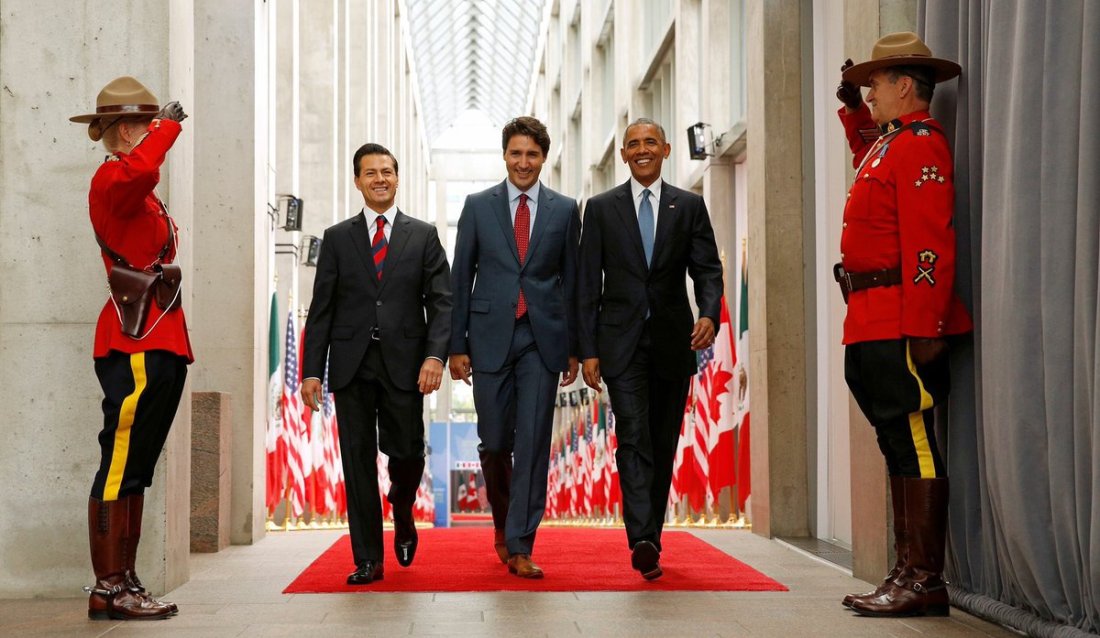
So it was another interesting bit of timing that this week was the NAFTA summit between the current US President, Canadian Prime Minister, and Mexican President.

cmjo22zwmaavs9w
Too bad they’re all men (but this US will be changing that soon, right? right?), but a fine-looking trio they are

Their big message: Trade is good. Countries are stronger when they work together. Globalism brings prosperity. And it was all capped off by one amazing speech President Obama gave in the House of Commons:

And what makes our relationship so unique is not just proximity. It’s our enduring commitment to a set of values, a spirit alluded to by Justin that says no matter who we are, where we come from, what our last names are, what faith we practice, here, we can make of our lives what we will.

Watch or read the rest here.

It was heart-warming, and for a while, one might forget that it remains so much easier to cross borders in Europe than it is to move between the US and Canada, that we have to pay duties on even tiny online purchases from the US, and absolute absurdities such as Canadian inter-provincial (!) trade barriers that cost our economy billions.

So there’s a lot of work to do on this one. But at least it seems the intent it to make things better, not worse, on this front.

Cause that’s the Canadian way.

Happy 149, Canada.


Tear down the wall

Modern Berlin is vibrant. Its streets are always busy, though never uncomfortably crowded. Its people are a multicultural mix who speak a variety of languages, with German predominating, of course. The population is pretty stylish. That it’s a pretty open, liberal society is apparent in various ways, from the casual beer drinking by people on subways cars on the street (not drunks; just people enjoying a beer); the many sex shops and clubs; even the sweet, candy-cotton waft of e-cigarette smoke.

And it certainly seems economically healthy, with all the construction projects foiling Jean’s photography attempts, the many high-end designer shops available, the architecturally beautiful new malls like Bikini Berlin,  and the relative scarcity of homeless people—far fewer than you see in large Canadian cities.

Berlin Dome
The Berlin Dome—one of the rare older buildings in modern Berlin

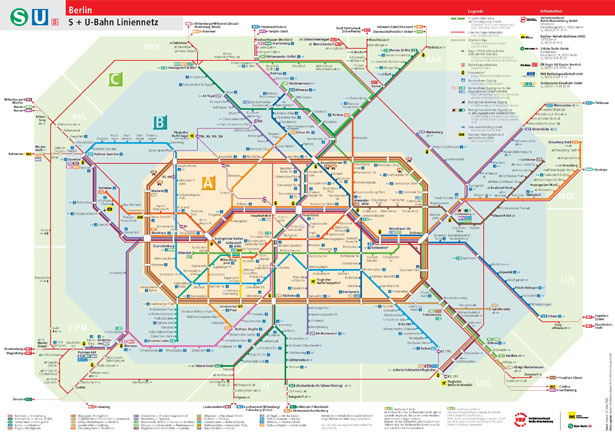
Berliners are well-supported in their desire to move around. Admittedly, the new airport is stuck is some sort of construction limbo, and the current one seems a bit dated. (It’s convenient that you go through security right at your gate, and disembark from the plane right where your luggage is, but there’s a notable lack of airport services.) But the transit system… amazing! It took us a few days to figure out it—the light rail (M trains), the surface trains (S-Bahn), the subway (U-Bahn), the regional train, the buses. But then—sometimes with help of Google Maps—it got us everywhere we wanted to go.

Berlin transit map
Berlin transit map

We did notice some police presence—always around the Jewish synagogue, often at the main train station: one day we emerge to a whole lineup of police officers at the ready with riot gear. But it seemed clear this was about protecting, not repressing the population.

I think that’s why all the memorials to The Berlin Wall struck me so profoundly. The contrast with the present was so stark.

Continue reading “Tear down the wall”

My Internship in Canada (Guibord s’en va-t-en guerre)

My Internship in Canada is that rarest of things: a comedy about Canadian politics. The only other I can think of CBC’s adaptation of Terry Fallis’ fine novel The Best Laid Plans, which CBC rather made a hash of.

My Internship in Canada is more successful. It tells the story of independent MP (another rare thing!) from northern Quebec, Steve Guibord, who—in a parliament where the Conservatives have a very slim majority—finds himself with the deciding vote on whether Canada should join a war effort in the middle east.

My Internship in Canada (official trailer) – YouTube

Following all the drama with great excitement and interest is Guibord new Haitian assistant / intern, Souverain. Souverain proves of great help to Guibord, as he’s intelligent and very well-read on the subject of Canadian democracy. (His explanations to his fellow Haitians back home are also useful to any audience who might themselves not be so familiar with the intricacies of Canadian democracy.) He’s also not above sneaking around behind Guibord’s back, if it’s for the greater good.

Several women play important roles as well: his wife, who’s for the war; his daughter, who’s against it; a local reporter playing out the sometimes-tense relationship between media and politics; and the mayor of one of the main towns in his riding, who becomes increasingly (and hilariously) exasperated with Guibord’s last-minute cancellations.

Geography is also incredibly prominent. The riding is very large (“30 fois la grandeur de l’Haiti!”), and Guibord’s fear of flying make him entirely dependent on the highway system, targeted for protests by natives and truckers.

The laughs at the expense of a stuttering union spokesperson (get it?) are unfortunate, and I’m not entirely sure about the portrayal of the Haitians. Overall, though, this is a good-spirited, funny, and intelligent comedy.

In French with English subtitles.

Sunny ways—Canada is back

I was nervous Monday.

Despite my reduction in news consumption, and even though off on a wine-soaked vacation last week, I was well aware of what the polling was showing: That Harper’s horrible Islamophobic campaigning had seemingly backfired, and that the Liberals’ numbers were rising steadily—showing a comfy 9-point lead in one of the last polls to be released.

But also knew that polls were often wrong, and at any rate, were entirely meaningless. Only the vote counts for real.

My less emotionally invested yet still interested husband set up his tablet in anticipation of result, using CBC website tools to track certain ridings. He was at the ready as soon as Eastern results were posted. As I distracted myself with housework and such, he was giving reports:

“It’s looking good.”

And a little later: “It’s looking really good.”

And we all know what happened. Canada’s Atlantic provinces turned into one big Liberal red lobster.

Nova Scotia riding results
Yes, I know this is just Nova Scotia, not all the Atlantic provinces…

Of course that made me feel better, but we still had a big time gap til the more decisive Quebec / Ontario results.

So we watched a little iZombie to pass the time.

Around 9:30, I turned on the TV and said I’d just “have a look.” Of course, then I couldn’t stop watching (though I did bounce around channels a lot), mesmerized as the “Leading  or Won” seat counts just kept ticking up. By 10:00, they’d called that the Liberals would have a plurality of seats. The numbers kept going up, til it was clear that majority wasn’t an impossibility after all. And that was officially called around 10:35.

Canada votes Liberal majority
Holy doodle.

This would be the first time in about 20 years that a Federal candidate I voted for was elected as part of the governing party. Not to mention the first time in 10 years that I’m not appalled by a Federal election result.

It is unfortunate that the NDP and Greens were collateral damage in this; I didn’t wish ill to either of those parties, who lost some good MPs. But they were just as out-campaigned by the Liberals as the Conservatives were. The Liberals were able to do something else that hasn’t happened in decades: inspire disaffected voters to come back to the polls. The Liberals received more votes than in any party in Canadian history.

Even when the overall results were evident, I couldn’t stop watching. I looked up particular ridings. I cheered the principled Michael Chong’s victory, the only Conservative for whom that was the case.

I was pleased that my local candidate, Bardish Chagger (#MovesLikeChagger) garnered nearly 50% of the vote. I was glad to see her joined by three other Liberal MPs, replacing our previous set of middle-aged, white Conservative MPs with a more diverse group.

New Liberal MPs of Waterloo Region
(And the remaining middle-class white guy’s name is Bryan May, so he can’t be all bad!)

I liked that the Liberals won seats in all provinces, even Alberta and Saskatchewan! (What’s up with Saskatchewan, anyway? Why so Conservative?)

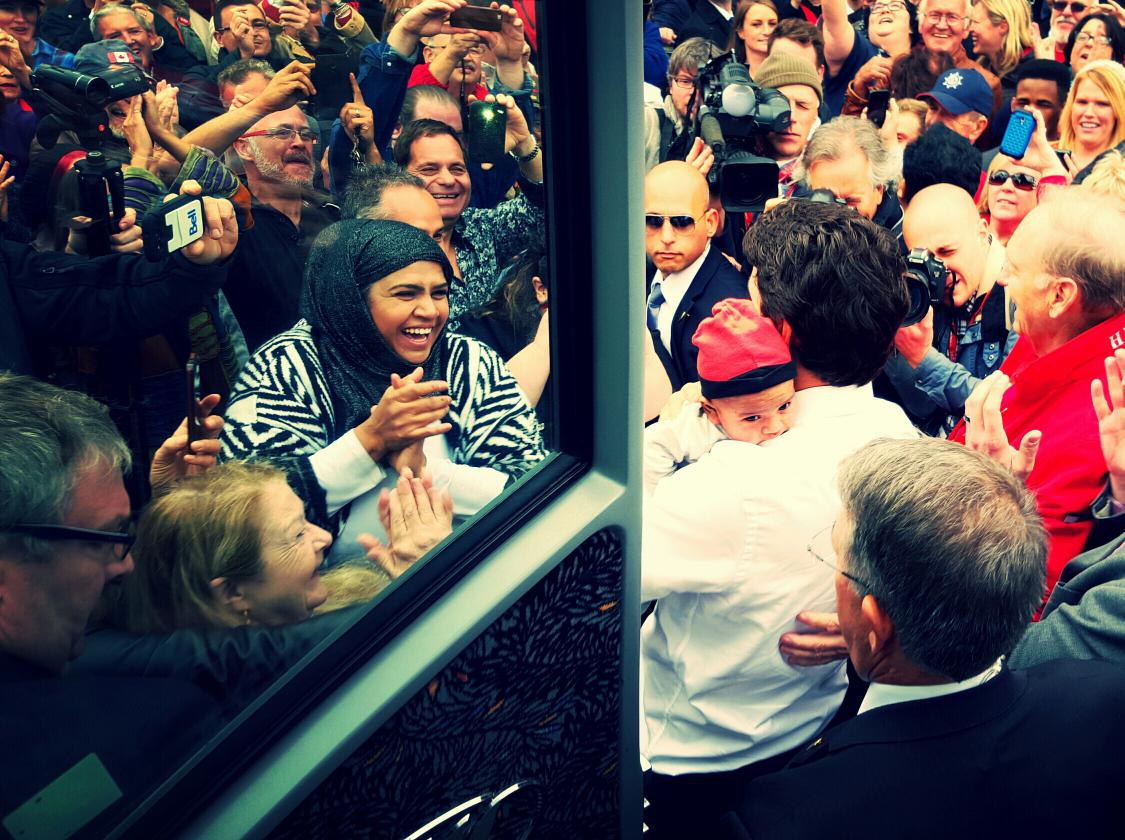
And I stayed up to watch all the speeches. I admit to being moved by Trudeau’s story about the Muslim woman and her baby. (But then again, it was nearly 1:00 AM, so that might just have been an exhaustion response.)

Trudeau and baby with her mother
This is the picture: It really happened!

And while I was going to say to say that results really don’t affect my daily life much, this one has. Because now that I know this story has a happy ending, I’ve ended my news diet, and have happily returned devouring interesting news stories wherever I can find them.

Though I must say I didn’t expect quite so many of them to be about how “boinkable” Justin Trudeau is. World: some respect for our hot new PM-designate, please!

About my last post

I’ve admittedly had some relapses in my “ignore the election” resolve, but the previous post was actually written before said resolution. I sent it as a letter to the editor, but it appears it’s been rejected. As I actually spent a lot of time writing that sucker (takes so much longer to write less!), I just wanted it published somewhere!

(And by the way, Braid used the exact same line to avoid an all-candidates debate on Science held at University of Waterloo.)

Still, sorry for adding to the discussion of topic that I know Canadians are tired of, and non-Canadian don’t give a fig about. (But just for the record, progressive Canadians: Please do get out and vote!)

And frankly, though voiced in a bit of jokey way in my “shit’s making me crazy” post, it’s pathetically absolutely true that my mental health degrades when I pay too much attention to politics. It literally sucks the joy out of my life. And I can’t write about something without thinking about it.

So it’s time this blog got back to the admittedly trivial topics that actually make me happy to ponder.

Starting with a poll in which none of the results could be depressing.

Questions for my Conservative candidate

On Monday, September 21, I attended a Waterloo candidates debate hosted by Fair Vote Canada. I knew that Conservative Peter Braid would not be there. I honestly wasn’t angry about that.

Until they read the email he sent in:

“We do not participate in partisan debates on a single issue.”

Wha…?

This is my response:

  1. Why did you characterize this debate as “partisan” (“fervent, even prejudiced devotion to one party or cause”) when:
    1. Fair Vote Canada is a multi-partisan organization promoting electoral reform, but without advocating for a particular voting system.
    2. All parties were invited to attend the debate, and were given equal opportunity to respond to questions?
  2. If you truly believe (as many Canadians do) that first past the post is the best voting system, why not defend it?
  3. This “single issue” debate actually covered many issues related to Canadian democracy, including the “whipping” of MPs to vote along party lines. Would you like the freedom to put your constituent’s interests ahead of your party’s when voting? If not, why not?
  4. The room was full to capacity with citizens–presumably your constituents–whose questions and comments made it clear how passionate they were about trying to improve Canadian democracy. Why not listen to them instead of dismissing their concerns in a single sentence?

#Elxn42: This shit’s making me crazy

This shit’s making me crazy
The way you nullify what’s in my head
You say one thing, do another
And argue that’s not what you did
Your way’s making me mental
How you filter as skewed interpret
I swear you won’t be happy til
I am bound in a straight jacket

— Alanis Morissette, “Straightjacket”

So, it’s that part of the Canadian federal election where everything seems stupid and awful, we semi-hate everyone now, and when will it be over?!!

At least, I’m pretty sure it’s not just me.

Fortunately, I was able to decide who to vote for in the early and considerably less awful part of this extra-long campaign. And I’m not even primarily voting against something.

On balance, I just found that I like the Liberal platform the best. Things like, banning taxpayer-paid government ads (much as we’ll all miss those “Canada Action Plan” ads). And making the Senate non-partisan (one they’ve already walked the talk on). And, amending the Access to Information Act so it actually provides access to information. Ending omnibus bills. Trying to make Question Period better (it can hardly be worse). And yes, legalizing marijuana.

I also found Trudeau the most appealing leader overall. He’s shown more passion and boldness than the others. And I’m not concerned about his competence to govern.

As well, I am really impressed with the Waterloo Liberal candidate, Bardish Chagger. She’s smart, well-spoken, experienced in working in federal government. And she’s bound and determined to vote for Waterloo interests first, her party second. “I’d like to meet the person who succeeds in telling me what to do”, she said, credibly, at the debate I attended.

So good luck Ms. Chagger!

But I hope you’ll excuse while I now do my best to ignore the rest of the campaign. Because it’s not that I’m not interested. It’s just that me being interested has the unfortunate side-effect of me starting really care what happens. And I have no control over what happens—what politicians do and say, how the media reports it, and ultimately, how everyone else votes.

And that shit makes me crazy (then angry, scared, and finally kind of depressed and hopeless). I need off this emotional roller-coaster.

So bye-bye news radio, hello iTunes. See ya Macleans; the new Entertainment Weekly is in. Watch a leader’s debate? Are you kidding me? It’s the fall TV season! (Plus, I just discovered iZombie and Mozart in the Jungle on Shomi. Seriously, so fun.) Political bios? Not when I have a fresh copy of Aziz Ansari’s Modern Romance.

Now, Twitter remains a minefield. And I’m not ready to give that up, but I guess I can mute / unfollow a few politicos until November or so, eh?

By then, hopefully this will no longer be my anthem:

Straightjacket on YouTube

Submitted without comment

Elizabeth May statement on Canada’s climate commitments

From 31 March 2015

Mr. Speaker, today, March 31, is the deadline for those nations that are ready to do so to table climate commitments with the UN Framework Convention on Climate Change in advance of COP 21. Yesterday in question period the minister confirmed that Canada was not ready and would miss this deadline. The excuse that was offered was that we were a federation and we were checking with the provinces and territories.

Of the 33 nations that, as of today, have met this and have filed their intended nationally determined contributions with the UN, one of those, the European Union, had 28 separate nation states with which to consult, confer and develop a plan, and it met the deadline.

The minister said yesterday that we had until December. That is not correct. By October, the UN system will have calculated the cumulative total of all commitments to see if it is sufficient to avoid 2°C.

At this point, we are missing our obligations to the world, to Canadians, and to our children.

Experiencing pop culture in a time of grief

When someone you love dies, blogging about pop culture, news, travel, and food drops off the priority list.

Doesn’t mean that these trivialities drop our of your life, though. Just that your relationship to them changes, at least for a time.

Music

You know, if you break my heart I’ll go
But I’ll be back again
‘Cause I told you once before good-bye
And I came back again

Music is an emotional mindfield, isn’t it? I don’t think The Beatles “I’ll Be Back” would make anyone’s list of saddest songs ever, but on a day of bad news, I couldn’t handle it. I frantically searched through my playlists for safer havens. I finally settled on “High Energy”, a gathering of uptempo rock and dance numbers, generally with pleasingly dumb lyrics. I stayed locked on that for about a week and a half, ‘til it finally seemed just too incongruous. (Then I switched to Classical.)

Adam Lambert’s excellent album Trespassing was just the sort of uptempo music I needed for a time

Food

I was interested to discover that I still got hungry, still wanted to cook, was still able to eat. Because certain forms of stress and worry make that difficult for me. But not this one, this situation with a known but sad outcome. While  I didn’t eat more, or drink more—I didn’t find comfort in that—I still enjoyed the routine of preparing and eating meals.

I certainly became a distracted cook, though. Leaving the milk out on the counter, putting the vinegar in the wrong pantry, forgetting to start the timer. Like the energy of pushing the sadness away enough to follow a recipe was not leaving enough mental space to remember anything that wasn’t written down.

Things are now improving on that front.

Movies and TV

While actually going out to a movie seemed like too much effort, watching stuff on TV was an appealing distraction. Since I don’t watch much medical stuff anyway, there wasn’t much I felt I had to avoid. Howard’s mother died on Big Bang Theory (as the actress had in real life), but it was handled with a light touch and didn’t set me off. In picking HBO movies, I decided to skip Tom Cruise’s Edge of Tomorrow for now, given its premise of the lead character dying over and over. I instead watched and quite appreciated the comedic In a World, one of the more overtly feminist movies I’ve seen in a long time. Recommended.

In a World trailer

News

The human interest stories—little boys lost in the snow, Oliver Sack’s terminal cancer diagnosis—were best avoided for a while, but I still found the theatre of politics a surprisingly useful distraction. Especially in Twitter form (about the length of my attention span, at times). I couldn’t truly dig up my own personal outrage at some of what was going on, but I could still appreciate and retweet other people’s. #StopC51 and all that.

Books

Cover of Being MortalSo just a few days before all this my book club had selected Atul Gawande’s Being Mortal as our next book. It’s about getting older and end of life care, and how the medical profession has been dealing with it, and how it should.

Of course, there were days I wasn’t up to reading much of anything at all, but when I did feel up to it, I did read this, I seriously doubt I would have selected this particular book if left to my own druthers, but I feel it was in some ways helpful. It’s an excellent book, anyway, and much of it was more abstract and factual, which appealed to my logical side. Stories did become more personal and touching later in the book, but that was later in this whole saga for me too and—I don’t think it made anything worse. It certainly presented a number of scenarios I’m so glad my loved one never went through.

Waterloo municipal election: A reblog of sorts

WordPress has a “reblog” feature that lets you repost other people’s blogs in your own space, but it only works with WordPress-hosted sites. I therefore cannot do that with Darcy Casselman’s 2014 Municipal Elections post, at http://flyingsquirrel.ca/index.php/2014/10/26/endorsements/

His views largely reflect my own, though, and saves me a lot of time to just point you there.

Or even copy / paste some of his words, below.

—————————

With minimal ado, this blog [flyingsquirrel.ca] endorses the following candidates in the municipal races I [Darcy Casselman] get a say in:

Regional Chair: Ken Seiling

Ken’s had this job for a long time. That’s largely because he’s good at it. If he has any faults, it’s that he’s kind of bland and innocuous. You could be easily forgiven for never having heard of the guy despite holding what’s more or less the region’s top job for almost 30 years. He doesn’t grandstand and he doesn’t show boat. And I like that. Chairs shouldn’t do that sort of thing generally. He lets the region’s mayors and councillors do the show boating.

I dread the thought of a Chair who’d use the position to make it all about them.

If I was going to ever vote for someone to unseat him, it would have to be someone who’s had some experience in local government. Preferably a mayor or long-time regional councillor. It’s not going to be some yahoo who wanders in off the street raving about taxes and claiming their “business experience” somehow qualifies them to wrangle a consensus out of this wildly diverse and sometimes fractious region. If you want a job like this, you need to put in the time.

It should come as a shock to absolutely no-one reading this blog that I strongly support the region’s plan to build a light rail transit system. Despite over a decade of public consultation, despite it being approved twice by two successive regional councils, despite shovels being in the ground, some candidates in this election think now is the time to stop the project, no matter how many hundreds of millions of dollars it would cost to cancel it or how disruptive such a drastic change in long-term planning would be for the whole region. It’s ludicrous. Not only is it horrible policy, these people stoop to outright lies and fabrication to try to justify it. It’s appalling. So you should vote for Ken.

That and Jay Aissa is a horrible person.

Regional Councillors: Jane Mitchell, Karen Scian

One is easy: Jane is awesome. Seriously. Read her blog. She’s pretty much everything I want in a regional councillor. She’s engaged, open, thoughtful and accessible. If you have a problem with the region tweet her and if she doesn’t have an answer off the top of her head, she’ll dig it up and get it for you. She’s great.

Next is trickier. We get to pick two regional councillor candidates. The other incumbent is Sean Strickland. I have no problem with Sean. I’ve voted for him before. But this time Karen Scian stepped down from city councillor to represent Waterloo to the region. And I like Karen. Both Karen and Sean are really good and my reason for going with Karen probably have more to do with style than substance. I’ve followed Karen on Twitter for ages and I think I have a very good idea of where she stands on things. My feel for Sean is a bit more vague.

Also, there may be a bit of strategic voting in my choice, as I really, really don’t want to lose Jane Mitchell, and Strickland has always come out ahead of her.

I very much look forward to electing regional council by ranked ballot next election. Block voting is terrible.

Special non-shoutout goes to former MP Andrew Telegdi, who has been mostly invisible in this campaign. He appears to have been recruited by Jay Aissa to run on the anti-LRT ticket, with the cynical assumption he’ll coast in on name recognition without people knowing what he actually stands for. Which is despicable and makes me really sad having held him in such high regard in the past.

Mayor of Waterloo: David Jaworsky

I’ve seen Dave everywhere this year. He’s a great guy, affable, well-connected and engaged.

Unlike the Chair, none of the candidates running have served in public office. Dave, at least, has served on a bunch of non-profit boards, committees and was executive in residence at Capacity Waterloo, an organization I came to know and value through my work with Kwartzlab. I honestly think he’s the best choice for mayor.

As an aside, I was surprised at how much I like Rami Said, who is running on his business experience and an “I will speak for everyone!” platform. These are generally huge red flags for me. Pretending you can always represent everyone is naïve. And government is not, under any circumstances, a business. But he’s good. The deal-breaker, though, is he has no public service experience whatsoever. Not so much as a committee. If he was running for city councillor, I like him well enough I might let that slide, but not mayor. You gotta put in the time.

————————–

So again, above are the words of Darcy Casselman, not mine.

As for my ward (which differs from Darcy’s), I had the happy problem of all the candidates seeming quite decent, making it a tough to pick one. But after watching the debate and reviewing their websites this weekend, I have settled on the one I will vote for.

With school boards, it is very difficult to get information, but thanks to The Waterloo Region Record running brief candidate profiles this weekend, I have managed to select one there, too.

“That we have the vote means nothing. That we use it in the right way means everything.” ― Lou Henry Hoover