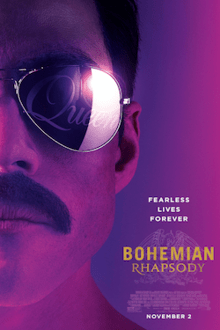
What I wanted to do, really, was see Bohemian Rhapsody, the new Freddie Mercury biopic, on its first day out, so that I could make up my own mind about it without the critiques or praises of others clogging my brain. However, a combination of it being released in Europe a week before North America (theoretically, I could have flown to London for the premiere, but that seemed a bit much) and a lack of willpower on my part meant that I did read some early reviews.
But I at least managed to keep my UK reading to a minimum and get to the North American preview performance.
My friends, I loved the movie.
Now, my husband’s said that it was Queen, so of course I’d like it. So I would just like to point out that I do not, in fact, like every Queen-adjacent product. I have this Queen Symphonic Tribute CD that I can’t stand, because the musical arrangements are crap. I’ve slogged through horribly written Queen bios. I did not enjoy the combination of Brian May, Roger Taylor, and Paul Rodgers performing Queen songs.
But this movie? It felt that it was made for me. I enjoyed seeing how they compressed events and use allusions to cover a decade and a half of Freddie’s life in 2 hours 15 minutes. I reveled in all the little in-jokes and references that only real Queen fans would catch: Jim Beach mucking with the sound board at Live Aid. Adam Lambert playing a trucker who catches Freddie’s eye. And I was totally captivated by Rami Malek’s performance as Freddie, which at times nearly brought me to tears.
All the music performance scenes are outstanding. And that whole final scene at Live Aid. Man. That’s every bit as good as you hope it will be. (And I love Live Aid almost as much as I love Queen.)
Being somewhat masochistic, and having seen it now, I can’t help reading the North American reviews. Now, some of them were positive (like the Toronto Star‘s), even if grudgingly (my favourite of these being the Washington Post’s: Bohemian Rhapsody is bad. Go see it anyway). But more were negative, some scathing (Globe and Mail: 1 star! New York Times: Mud on your face! Big disgrace! [that’s at least a clever diss.]). All adding up to a mere 55% (now 60%) positive critical rating on Rotten Tomatoes.
But a 92% (now 95%) positive audience score.
The most common complaint from the critics is that the movie is not that creative or edgy. And I’m going to grant that this is true. It’s pretty conventionally told, with a script that can’t seem to help but have its characters spell out its themes, however awkward the resulting dialog (The band is family. Freddie invents himself. Queen are a band of misfits.), rather than develop them through more natural interactions.
It’s just that I didn’t care. Cliches are cliches for a reason; they can be quite satisfying! The movie entertained me. But I guess when your job is to see all the movies, you need more from them to give them a good review. Fair enough.
But some other critiques? Deserve their own critique.
1. That the depiction of Freddie Mercury was disrespectful and inaccurate
The Globe and Mail review has that complaint, as does this Uproxx one. Interesting to me that these critics are so confident they know the essence of who Freddie Mercury was better than the people who actually knew and loved him, and who contributed to the film.
Yes, the movie depicts Freddie as, at one point, living a drug- and sex-fueled lifestyle while the rest of the band are settled with their wives and children. And this is a simplification—Roger’s marriages were rather turbulent, Brian fell in love with an actress he ultimately left his wife for, John used to drink vodka on stage, which doesn’t seem a good sign. But it’s a fact that the band was worried about Freddie’s behavior at this time, and that it did cause tension between them.
Overall, Malek plays Freddie as an essentially decent human being, one who struggled with loneliness, and who had a confidence in his talent that led to moments of arrogance. I’m OK with that depiction, and it squares with some of the stories I’ve read about him. I don’t get why it’s making some people so angry.
2. The movie skipped / condensed / reordered / simplified / added event x, y, or z
That it surely did, since otherwise the movie would have to be literally 15 years long. And admittedly, I had the advantage of knowing what was left out or added in, and just filling that in or correcting it mentally. And especially interesting are the bits they just assumed everyone knew and therefore didn’t bother depicting, like how enormously successful “Bohemian Rhapsody” (the song) was.
But OK, you can argue they didn’t make the best choices in how they selected or simplified events.
One common complaint was that it made Queen’s rise to fame look quick and easy, when in fact it was more of a struggle. That could have been interesting to show. But it probably wouldn’t have been as fun. Did you really want to see Freddie just hanging around with Smile for months, making suggestions, until Tim Staffell finally left? Or that one cute scene of him auditioning for Brian and Roger in the parking lot? Would it really be that interesting to watch the entire process of building a song like “We Will Rock You”? Versus just seeing it just go “whoosh” from studio stomping to stadium singalong?
Then there are the things missing entirely: “How about his childhood in Zanzibar?” “What about all the drama with their first manager?” I could add my own: “What about Brian May contracting hepatitis and kiboshing their first US tour?” “What about Barbara Valentine, the other woman Freddie had a love affair with, in Munich? Wouldn’t that have added an interesting complication in this story?”
The first cut of this movie was about 3 hours—maybe some of that is in there. If they ever release an extended version on DVD, that would be great. But I don’t think a theatre rock bio should be that long. And I’m not sure what I would drop from this version to add some of those other bits—though I would have scripted Freddie’s party scene differently. The band-mate fight they invented for the movie made them all look like asses; I think the other three getting alarmed at Freddie’s behavior and discussing that amongst themselves would have worked better. But some songs being out of order, the invented breakup… I can accept for the sake of drama.
Certainly the most controversial change was Freddie telling the band about his AIDS diagnosis shortly before the Live Aid concert. But in reality, that happened two years later. Some said that was unnecessarily manipulative.
But I don’t think it would have felt right if they had omitted AIDS from the movie entirely, to keep it in their selected time span. And, it’s an amazing scene in the film.
3. The movie isn’t gay enough
Likely fueled by Sasha Baron Cohen’s comments when he was dropped as the lead, has been the concern that Freddie would be “straight-washed”. Literally, before they even started filming, I read a whole ranty blog post rant by someone who was positive that would be the case. And then when the first trailer came out, and it showed Freddie with Mary Austin but not so much with dudes, same complaints.
But the movie very clearly (though not explicitly) covers the fact that Freddie had sex with men. Lots of men. And if it risks showing his being gay as a tragedy in his life (though that wasn’t, in fact, the easiest time to be gay), it certainly mitigates that by including the start of his loving relationship with Jim Hutton.
I’m too heterosexual to comment on whether the esthetic of this film is gay enough, but nobody’s going to come out of it thinking that Freddie was straight.
Conclusion
Freddie Mercury was a fascinating man. You could approach his life story from a lot of angles. I hope there are other movies, in the future, that have a different take, that focus on different parts of his life.
But for a first go, I’m satisfied. You might be, too.
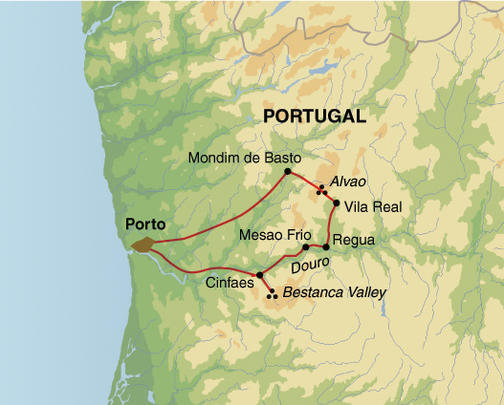
The original choice for our Fall vacation was the Exodus trip Walking the Prosecco Hills, but when we went to book it, they had only one spot left. So we switched to Portugal: Walking and Wine. This was classed as a Premium trip, meaning 4- and 5-star hotels, and was rated a walking level 1, suggesting easier walking than our previous level 2 Exodus trips. We were a bit concerned that October in the Douro region could be somewhat rainy, but we figured we’d just prepare for that possibility and hope for the best.
The area we’d be visiting
Day 1: The Canadian invasion
A definite plus for this trip was the direct flights from Toronto to Porto, even though the choices were two budget airlines: Air Transat or Air Canada Rouge. We went with Rouge, as it had a better itinerary.
Though it was (Canadian) Thanksgiving weekend, things went really smoothly at Pearson: Baggage drop, check-in, boarding… We even had time (before boarding) for an unusually good airport meal at Lee’s (as in Chef Susur Lee). The flight itself took off on time and actually arrived early. Rouge does have older planes without back-of-seat screens (there’s an app you can use to watch movies on your tablet), but at least we were in a row of just two seats, on the side, which was nice.
We had a bit of wait until our Exodus transport would show up (timed for the British flight scheduled for a couple hours later), so we had some lunch and picked up a local SIM card: $30 for 5 GB of data, baby! Great service at the Vodaphone booth, as well.
The British flight ended up delayed by an extra hour, but by then the Exodus people were there anyway and agreed to drive us and one other person who’d already arrived to the hotel at the original time. We faced a long, slow lineup to check in at the hotel, but once we got to our room, we found that it was fine.
The group meeting was at 5:00. We met our two guides, Ricardo and Luis, and the rest of the group. We’d been expecting mostly Brits, as on previous tours, but of the other 14, only three were British (one of them currently residing in California, which left her with wicked jet lag). There was an Australian couple. And everybody else was Canadian! 11 strong. Other than the Brits and us, everyone else had been doing other touring around Portugal before joining the walking trip. (We did have an extra two days tacked onto the end.)
No organized dinner this evening, so we walked Porto’s twisty streets and found a small (literally, the width of an aisle) tapas restaurant to eat in. We tried a few different dishes that were all good, especially the goat cheese melt, and each had a glass of white vino verde. Jean also had a bit of port with dessert.
Church in Porto (photos by Jean, unless otherwise noted)
Day 2: Walking in the valley
In the morning after breakfast (breakfast was included with the hotel each day, all of them offering a very nice buffet), we left our hotel for the Meso Frio region, a couple of hours’ drive away. Our first stop was a coffee shop, and then we embarked upon one of the more strenuous hikes of the trip, in terms of elevation change. (In length it was 7 km.) It was still easier than many on the other Exodus trips we’d been on, but a vigorous start to this trip. The day was gorgeous.
The scenery wasn’t super spectacular on this one, but we saw a lot of agriculture products growing (walnuts, kale, lemons, grapes…), and some sheep.
We had a bag lunch on the trail, then after the hike (which was a definite challenge for some in the group), we were driven to our new hotel. It was in a vineyard, and was very fine.
Not exactly roughing it in Portugal
Dinner was at the hotel. The food was palatable but not outstanding. It was becoming clear this would be a fun group, though.
Day 3: Going to market to learn about port
This day’s walk was only about 4 km, and all on winery grounds. It was another beautiful day, and we got some great views of the just astonishing terraces of the Douro region. They are just everywhere, and so elaborate!
Terraces in the backgroundAnd terraces in the foreground (photo by Helen)
Mid-point through the hike, Ricardo said that those who wanted could go off on an extra little jog to see something special. Many on the trip thought he was saying that it was a market we were going to—though that was a bit confusing, as it was in kind of an isolated, rural place that required some climbing: How were people going to get their wares up there?
Then we arrived a rectangular rock. What Ricardo had been actually saying, in his Portuguese accent, was that we were going to see a marker. Basically, a stone signpost demarcating the official Douro wine region. The placement of these–there are some 300 in total–were an important phase in the development of this wine industry. But a lot of the group was in giggles at their thought that we were going to market.
Ricardo and the marker of the Douru region (photo by Helen)
Our lunch at the end of the hike was at a winery called Quinta do Tedo. It was a buffet with cheese, quiche, cod cakes, chutney, and of course, wine.
We then got a tour and a bit of a primer on the port-making process. At this particular, relatively small, winery, they still used foot crushing for the port-destined grapes. (At least, I don’t think he was kidding about that—our guide here definitely was a kidder.) Though it should be noted that they use the same grapes for port as they do for red wine—just process them differently. Tawny port is aged in much smaller barrels than ruby, imparting more of the wood taste into the drink. Vintage ports are made only in exceptional years. They keep aging in the bottle, but must be drunk pretty quickly once opened. The non-vintage do not age after bottling, but once opened, can be kept for up to year without deterioration.
We then tasted the port: A rose (a type I’d never had before), a tawny, and a ruby. All of them were good and smooth, but the rose was the sweetest, and the tawny was my favorite overall.
Our next stop was the Douro museum, dedicated to the history of wine-making in the region. We got an interesting guided tour of it. Wine-making in the past was extremely labour-intensive!
Back at our hotel, we found a bunch of MG’s in the parking lot. Sadly, they weren’t for us. An MG hobby group were holding a meeting here.
Just a few of the MGs in the parking lot
For dinner that night, we drove into the nearby (15 minutes) town. Big group dinners are always a challenge, but this restaurant managed it pretty well. Ricardo warned us that the entrees were quite large and best shared. Jean was insistent on having veal stew, while I tend not to eat veal, so I shared a salmon dinner with one of the singles on the trip. It was prepared very nicely, and served with good potatoes and cabbage/carrot mix. Jean did a masterful job on his generous serving of veal stew.
Day 4: Vertigo on a rail line, and death at a funeral
We were moving on again, but a full day of activities before arriving at the new hotel. Today’s hike was the longest of the trip, at 10 km, but was mostly flat: a former rail line. The day was once again gorgeous.
Turns out we needn’t have worried about October weather in Portugal
There wasn’t too much drama on this trail, except that to save time, we were encouraged to cross a bridge with openings looking down on a fairly big drop. There was a railing and all, so I thought it would be OK, but once I got on it, the vertigo set in and the heart started racing. I couldn’t get across it fast enough, so every time the group stopped (probably just twice) was kind of torturous. But we all survived it without any obvious panic attacks. (One group member, Carolyn, did so by taking an alternate route down and around the bridge instead, with the second guide.)
The scary bridge (photo by Helen)
After the walk, we were driven to Casa de Mateus, a beautiful property belonging to a member of Portugal’s royal family. Its association with the Mateus bubbly rose wine from Portugal is tenuous: that winery just got permission to use the image of the estate in its branding.
We got a tour of the chapel and the lovely rooms full of art, including the very impressive library, then had some time to wander on our own through the beautiful gardens.
One of the more stunning pieces in the Mateus collectionThe goal here was to make a mini Versaille
Our next stop was at the waterfalls in Alvao Natural Park, but they really aren’t that impressive this time of year. Not much water falling.
A more interesting view than the waterfall
Dinner that night was at our new hotel, which was also lovely, and, it turned out, served some of the best food we had on the trip (goat cheese on croute, sea bass or lamb main, creme brulee… All very well prepared). Making it easier to forgive the sometimes choppy service. One thing we learned on this trip was that vinho verde comes in red and rose as well as white. We shared a bottle of the red with the Australian couple. It’s definitely unusual—tastes kind of like a fresh white, but with extra tannin—but when else are you going to be able to drink it? [Red green wine: very Canadian!]
The group was in great spirits, and one point everyone within proximity was in hysterical laughter over Cheryl’s descriptions of scenes from the movie Death at a Funeral—even though most of us had never seen it. It was just contagious laughter. That only accelerated when her acting out of one scene had her backing into another table. Fortunately, the couple sitting there were good sports about it. (I guess I need to watch Death at Funeral now. It is on Netflix. I was warned to watch the British version, not the American.)
Day 5: Winery, oui oui oui! Octopus, non non non!
Today’s walk was through another winery, Quinta das Escomoeiras, which offered longer and more challenging terrain than our previous winery walk. And it was lovely weather again.
We then got a tour by the winery owner, who purchased the vineyard 24 years ago, after a career as an economist. It required a lot of rehabilitation before becoming a going concern. He explained where the name vinho verdo (green wine) came from. In the early years, they planted the grape vines too close together, and therefore didn’t produce a very good quality product. It was low alcohol and actually had a bit of a green tinge. They improved the process and the product later on, but the name stuck.
As vinho verde is a food wine, instead of a tasting it on its own, we had the opportunity to try the white, rose, and red with a delicious buffet lunch. It was a leisurely meal on the patio, with a distinct feeling amongst the group that we could just stay here all day.
Roughing it in the bush
Our favourite wine was the rose, which I considered purchasing, given that I don’t know that we can get anything but white vinho verde back home? (A Google search says that yes, I can.) But ultimately I decided against carting a bottle of wine around for the rest of the trip, and instead bought a small bottle of dried stevia. (Fernando also grew a number of herbs on his property.)
We were eventually convinced to get back into the vans for a ride back to the hotel, with a little stop at a grocery store on the way. We agreed to go into town for dinner this evening. It was a small, family-run restaurant (not a big town, so not sure what else they’d have there), with a somewhat limited menu, but fine for us (and not so much for those who aren’t into fish, seafood, or pork). Jean, I, and Cheryl, sitting next to us all decided to try one of the specialties: octopus in olive oil. It arrived in the form of a large tentacle on the plate (with veggies on the side).
Helen, sitting opposite us, could hardly stand it. She was totally turned off by the look of this food, and was facing three plates of it! (It was actually quite tasty and tender.) Unfortunate, but kind of funny, from our perspective.
I believe that it’s about this point in the trip that we started doing singalongs in the van. (Wine might have played a role in all this.) One song that kept making everyone laugh was “Donkey Riding” (which I think of as a Great Big Sea tune, but it’s actually an old sea shanty). Apparently some people in Alberta used to sing that song in school. “It’s so stupid!” said Cheryl. “Was you ever in Quebec, riding on a donkey? What…? Why did they teach us that?”
Some questions have no answers.
Another one, courtesy Jean, was “Chevalier de la table ronde”, with everyone joining in on the “Oui, oui, oui!” / “Non, non, non!” parts. Kind of an appropos song for this wine-soaked journey.
Day 6: A little rain and a near-death experience in California
The first rain of the trip occurred overnight, but mostly petered out by the time we started the day’s 8 km walk, along a waterway. There are a few tricky bits through some water-covered parts, but nothing we couldn’t manage (though a couple of group members did opt to skip this one, and Helen got a minor injury from slipping on a rock).
The waterway walk
Afterward, we drove up to a chapel on a (small) mountain that we’d been able to see from our hotel. Driving up there, on twisty roads near the edge, Caroline rather casually told us about how she’d been on similar roads in California when the bus driver had a massive heart attack and died, causing the bus to lurch over the edge. Thanks to fast action from one passenger, greater disaster was averted, and everyone ultimately managed to evacuate with only minor injuries.
But I can see why Carolyn isn’t so fond of heights and was rather tense during this drive.
In less death-defying news, the clouds had cleared enough by this time so we were able to take in the views from there. (Those who skipped the hike also joined us here.)
The chapelThe views
Given a choice between the hotel and the octopus restaurant, the group almost unanimously selected the hotel. Jean and I both had a duck with rice dish called arroz de pato that I’d like to find a recipe for. (And also of the caldo verde we had a few times—a kale-based soup that is really nice.)
Day 7: “An air of melancholy has settled over the group”
The morning before leaving, Jean took some lovely photos at our hotel. People were a bit more subdued this day, as the trip was drawing to a close. “An air of melancholy has settled over the group,” Carolyn observed.
We headed back to Porto, and the original hotel. On arrival, we put our luggage in storage, and Ricardo gave us a bit of a city tour: the train station, Cafe Majestic, Se de Porto, Dom Luis bridge… We crossed the bridge and ended up in Vila Nova de Gaia, the sister city.
This is where all the famous port is made: Taylor’s, Graham’s, Offley, Fonseca, Sandeman… Here we got another tour of one of them (not the biggest name), which provided a somewhat clearer explanation of the whole process than we’d received in Quinta do Tedo. (One more tidbit: late vintage ports are those they had thought might become vintage, but then decide aren’t quite good enough, so they stop the aging process by adding alcohol. So they become another that last a good while after opening. And are generally pretty nice ports.) Here they made white port as well as the other types. We warned that extra dry white port—still isn’t what most people would consider a dry wine.
We tasted a white and a tawny here. In this case we preferred the white.
We then had free time til dinner, so Jean and I wandered off in search of lunch. It was very busy in that area, but we did eventually find a recommended place to eat—a bit tricky to locate using Google because it was upstairs. Almost as soon as we sat down, we were offered white port. Sure, why not. The food was also good, a few tapas followed by a dish called Bacalhau à Brás (I think) that is quite popular in these parts—a mix of cod, potato, and egg.
We did some random ambling before checking in to the hotel and meeting the group for dinner, which was at a restaurant across the street. And was kind of a shambles! Orders mixed up. Bills incorrect. Timing way off. We ended up with two mini-bottles of wine after ordering one, and I believe we were over-charged for appetizers. But at least the food tasted OK.
We said our good-byes to everyone at the end, and then we had two days on our own.
Day 8: History, architecture, and a zombie hurricane
To start, we changed hotels, to one that was a little cheaper than the one included in our tour. It turned out very well. The room was a little smaller, but the location somewhat more convenient, and it had bathrobes! (I’m a sucker for getting a free bathrobe.)
We took a little stop at the local McDonald’s, which seems wrong, but this was very attractive one. (Also, the coffee there is pretty good, and I needed the restroom.)
Not your average McDonald’s
But the Ribeira / Vila Nova de Gaia is a very crowded area of town, so this day we decided to head to the Malagaia area.
Jean took a few photos on the way. This tiling is very characteristic of Porto
We visited the free Museum of Photography which, apart from exhibiting some photographs, also showed photographic equipment from years past, which was quite interesting!
Photos in one minute! It’s easy! (That was a bit of an exaggeration, if you read the fine print…)
For lunch, we happened upon a Michelin-recommended restaurant that gave us one of the best meals of the trip. Highlights were Jean’s sea bass and my strawberry soup with basil ice cream for dessert.
This pineapple dessert with port ice cream was also nice
Jean then agreed to go on a tour of the Casa de Musica, or music hall, that is a fairly recent addition to Porto. No photos, but it’s an architecturally interesting building with all sorts of nooks and crannies to tour—VIP rooms, babysitting area, floating bars in the window, acoustically perfect concert halls… Definitely worth the 8 euros and 1 hour to learn about it.
Rain was predicted for the evening, as Portugal was expecting its first-ever “zombie hurricane” (Hurricane Michael, rising from the dead). The epicentre of high winds wasn’t Porto, but certainly it got heavy rainfall. So we didn’t go too far for dinner. We found a slightly pricey but quite decent restaurant nearby to suit our needs.
Day 9: Potted Potter
In Porto, people line up to get into a bookstore called Lello. One reason they do this is that it’s a gorgeous building. The other is that JK Rowling was inspired by Porto to write HarryPotter. And I expect it’s the latter that really explains the crowds, as Porto has a lot of nice buildings.
We decided to do it. We got there at soon as it opened, at 9:30. There was already a line. You have to buy tickets to get in (credited against any book purchase), so we did that. After about 20 minutes in line, maybe, we were let in.
But it’s crazy in there. It is gorgeous, but so packed with people, it’s hard to appreciate. And forget about calmly perusing for something to read. They tell people not to be too loud in there, to not disrupt people trying to think (or whatever). As if anyone could get lost in thought in here! But at least, now we know.
After that, we decamped to the Museum of Art. It’s not a very big one, but did have some nice works, particularly sculptures. And it wasn’t crowded at all.
One of the gorgeous statues on display
After lunch at our new favourite restaurant in Porto, we did a little shopping. I got a purse made of cork (yes!) and a cute top. Jean bought a bag. Then it was a bit more walking, and a final dinner at a restaurant with a Madeira focus, that was quite pleasant.
Last day photo, and one of the best
The flight home, in contrast to our smooth departure one, was rather chaotic, with people lining up all over the place and impossible to hear announcements. And once on, we ended up having to wait an hour while they located and removed the bags of six people who didn’t make it onto the flight, for some reason. But then the flight generally went as well as can be expected, until my luggage didn’t show up.
The Air Canada attendant explained that my suitcase had ended up with the “connecting flight” ones—likely moved during that search for the bags to remove, one supposes. After 2 hours of waiting, it hadn’t make it onto the carousel, so they agreed to have it delivered to me. It did arrive on my doorstep by 6:00 AM the next day. (And that way we did beat the worst of rush hour traffic driving home from the airport, as Jean pointed out.)
A final song to finish, in salute to Carolyn, who seems to have played a rather prominent role in this blog post!
Before the film Juliet, Naked, the following trailers were shown:
Colette, starring Keira Knightly, about writer Colette’s struggles to express herself as a writer in her own name, after her husband achieves success with the novels she ghost writes for him.
Mary Shelley, starring Elle Fanning, about what inspired Shelley to write Frankenstein, including a battle against the men who tried to take credit for it.
The Wife, starting Glenn Close, about a woman who gave up on her own ambitions to support her husband’s literary efforts, and what that cost her.
Wow. Can’t imagine why there are so many movies about women’s anger and their fight for self-expression right now.
#BelieveWomen #MeToo #StopKavanaugh
Juliet, Naked is a lighter film—but still the story of a woman. Annie (played by Rose Byrne) is dissatisfied with her life: the job she settled into in the town she grew up in, and especially, her long-term relationship with live-in boyfriend Duncan (played by Chris O’Dowd). Duncan has an obsession with an 1990s singer who released a single album: Tucker Crowe. Even before he has an actual affair, Annie feels she’s lost him to someone else.
Juliet, Naked refers to a demo CD that Duncan gets his hands on, featuring early versions of the songs on Tucker Crowe’s album. Annie writes a dissenting review of the album that attracts Crowe’s attention, and they begin an online correspondence. They finally meet when Crowe has business in London…
This was a perfectly delightful movie, largely because of the cast. Tucker Crowe’s kind of a wreck of man, but Ethan Hawke plays him with just the right amount of messy charm. He has very good chemistry with Rose Byrne. And Chris O’Dowd can’t help but be funny and somewhat likable as Duncan, which is important—you can understand why Annie might have fallen for him in the first place.
And the synopsis might make it sound as though Annie is “saved” by Tucker, but that’s not really how this goes. The impediments to their living happily ever after, often so contrived in romantic comedies, are pretty straightforward in this one: the continent between them, the very different places they are at in their lives. Really, Annie saves herself.
This is hardly a vital film you must see to understand the current state of our culture. It’s an enjoyable escape that you don’t need to feel guilty about. And it has a pretty good soundtrack.
Our master bedroom / main bathroom renovation, originally estimated as a 4- to 5-week job, actually took about 11 weeks. But now, it’s (basically) done!
And we are happy with the results. This was the starting point for the bathroom:
And this is how it ended up:
And, OK, we aren’t completely sure about that blue shade for the wall colour, but that’s easy enough to change later. But to take in what happened here:
Complete tear-down and replacement of walls and flooring
Room made smaller, to accommodate a closet in the bedroom
Entrance from the bedroom closed off
Separate shower and bathtub combined into one new unit
(Toilet is not shown, but it is beside the bathtub)
One sink replaced with two
New sink cabinet with seven drawers
Mirrors above the sink with shelving behind them
New countertop, flooring, lighting, tile, and ceiling fan
So generally, despite less square footage, we have more storage space, and all new stuff. The new flooring feels nice under the feet.
As for the bedroom, this where it started (except it normally had furniture in it):
And this is how it ended up:
Here we are pleased with the paint colours! And with getting the yucky carpet replaced with cork flooring; having a bigger closet; the extra space in general; the cool barn door; and the overhead new light (not pictured but it is installed).
Work by Schweitzer’s Plumbing. Though it did take longer than estimated, they did seem to do a good job on each phase of the project.
Saturday we went to a fundraiser for the Cambridge Fashion History Museum. They were holding a Tango Tea, and type of event popular in the 1910s. This was a high tea at which people would do the popular dances of the day—including, but hardly limited to, the tango. They encouraged us to dress in outfits reminiscent of that time. I didn’t have exactly that, but wore a tango dress with a fashion hat—I looked at pictures, and everyone wore hats then.
Me with a Givenchy that was part of the exhibits
Jean wore a fetching pinstripe suit and his Dad’s fedora; unfortunately, the person we got to take Jean’s picture didn’t press the camera button all the way down, so his outfit is lost to the mist.
Another friend took a picture!
They brought in a Stanford professor who specializes in dance history. He did a few classes in the morning that we didn’t attend, but during the tea also did some demos and shorter lessons on the basics of the one-step, the grizzly dance, and other popular dances of the time. Our ballroom dance instructor wouldn’t have approved of the techniques (or lack thereof), but it was fun learning and seeing these dances that did evolve into today’s waltz, tango, quickstep, foxtrot, and samba.
The Sufragettes were active in the 1910s, and through some educational (but fun!) games, we learned more about them. We were also invited to join the movement.
The two ladies in the centre made these dresses themselves
In Canada, most women earned the right to vote in federal and Ontario elections in 1917. Asian women were excluded until after the Second World War, and Native women earned the right only in 1960.
In 2018, Canada has a feminist Prime Minister who insists on a gender-balanced cabinet (though parliament remains far from balanced). In Ontario, we have a ridiculous, unqualified Premier who beat several far more qualified women on the way to power.
So, the fight’s not really over.
Premier Ford is currently pretty busy throwing Toronto’s municipal election into chaos for no reason while trying take away their right to free speech as quickly as possible, so when Greenpeace added to his pile of lawsuits for not doing the legally mandated consulting before cancelling cap and trade, he capitulated (to some degree) and opened a one-month opportunity to comment online. You can find it here: https://ero.ontario.ca/notice/013-3738. Just click Submit a comment.
Not sure what to say? Well, in case it helps, this is what I submitted. (And no, I don’t think it will make a difference, but at least I’ll be able to say I tried.)
This new Spike Lee film is based on a true story. In the early 1970s, Colorado Springs’ first African-American police detective, Ron Stallworth, inadvertently begins an undercover operation into the KKK when his request for documents leads to regular phone calls with the organization. When it comes time to actually meet with members of the group, a white detective is conscripted to pretend to be him.
I went in knowing generally that Spike Lee had “dramatized” the real-life story somewhat, but no details. I looked that up afterward. I couldn’t quibble with his additions, as they did make for a more engaging story—and allowed for more interesting roles for women. But what’s particularly interesting is that some of the more outlandish scenes actually did happen.
The movie is as humorous as the trailer suggests, but it’s not flippant. There are moments when the horror of white supremacy is made very real. And while the movie has a very 70s look and feel, the references to today are overt. The final scenes, jumping ahead to Charlottesville, left the whole theatre dead silent.
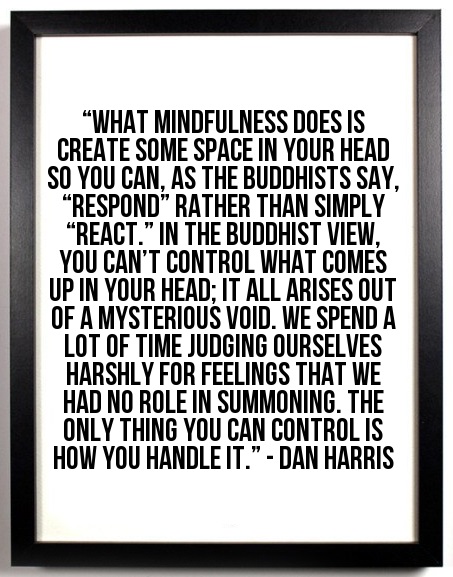
Many years ago I read (at least some of) Wherever You Go, There You Are by John Kabat-Zinn. The point that stayed with me all this time is that if you’re not really fully present and engaged with the now, you’re not really living.
Which doesn’t mean that I am always, or even particularly frequently, fully engaged with the present. I am a hopelessly plan-y person, which makes for a lot of thinking ahead! But I at least had that idea, in the back of my mind, that if you’re going to do a thing, you do that thing, you focus on it, and you really appreciate it. And at least occasionally, I would actually do that.
Kabat-Zinn’s technique for getting better at being present and mindful was (and still is) meditation. That practice, I never adopted. I think I tried a few times, but it never stuck.
This is not me. (Photo by Prasanth Inturi on Pexels.com.)
Jump ahead to January 2018. TV journalist Dan Harris is the guest on The Daily Show, talking about his new book Meditation for Fidgety Skeptics: A 10% Happier How-to Book. A lot of people are interested in trying meditation, he says, but think they don’t have the time. His pitch to them? Five to ten minutes, he says—that’s enough. Don’t even have five minutes? One minute will do.
Then he adds that it’s nothing complicated, that it doesn’t require wearing of yoga pants and becoming a mystic, and that you’re not failing if you don’t manage to clear your head. The attempt to clear your head is what matters.
I finally bought the book this spring, and after a few bouts of anxiety left me wishing I had some better coping techniques, this summer I actually read it.
After an introduction to what meditation is and what its benefits are, the book is divided up into chapters based on people’s excuses for not doing it. I thought I’d only have to read the first two: “I can’t do this” and “I don’t have time for this.” Then when I actually started trying it, it was a bit uncomfortable, so I figured I should also read the third chapter: “People might think I’m weird.” (What’s actually weird? That so many people find being alone with their thoughts so off-putting they are actually willing to give themselves electric shocks as a distraction.)
In the end, I found something of value in each chapter, even the ones that appeared to have nothing to do with me: “Meditation is self-indulgent”—as if I have any trouble with self-indulgence. Or, “If I get too happy, I’ll lose my edge”. Yep, that’s me all right, miserable and edgy, and wanting to stay that way!
But the “self-indulgent” chapter included tips for if you thought you maybe had the opposite problem (of perhaps being a little selfish), and the “edge” chapter included some great techniques from managing worries (the “Is this useful?” mantra).
Furthermore, the book was just more interesting and fun to read than I expected from a “self-help” type. There was a running story-line of going on a meditation tour and trying to gain recruits. Meditation techniques are not “one size fits all”, it turns out.
But did the book work? Yes, absolutely, in that for the first time in my life, I am meditating regularly. (Turns out that my office has a meditation room! Who knew?)
And am I now 10% happier? Is the meditation itself working? Well, that’s hard to say. The whole thing is subtle (the promise is about a 10% happiness increase, not a complete transformation of your entire outlook) and the effects take time. At first it just seemed weird and a bit pointless. Now, sometimes I actually look forward to it. I can’t say for sure, yet, whether I’m developing better long-term coping strategies. But maybe?
We seem to have made it a habit to visit the Lake Erie wine region about once a year. We’ve been liking it partly because it’s less crowded than the Niagara and Prince Edward County areas. But, seems that it, too, has been increasing in popularity recently. Though we didn’t wait til the last minute, we basically couldn’t find anywhere to stay in Kingsville. We ended up at a fine but uninspiring motel in the uninspiring nearby town of Leamington. We slept there but spent our days elsewhere.
Activities
The initially rainy forecast fortunately changed, and we had mostly sun on Friday and Saturday (though an incredible thunderstorm overnight Saturday) and just intermittent rain Sunday. Kingsville was having a Folk Festival, with Alan Doyle as the headliner. (That might have explained the difficulty finding a place to stay.) We decided not to get tickets for that, but did walk the grounds around there Friday night.
On Saturday, we did some hiking at Point Pelee park again. There were signs up that the stable flies were out (see: Be aware of the Stable Flies on Trip Advisor), so we stayed away from the tip, and we didn’t particularly notice them in other parts of the park.
We did see some less annoying wild life.
On Sunday we spent some time in Amherstburg, particularly at Fort Malden. We hadn’t been before, and it was an interesting visit. The fort was placed there by the British to defend against the Americans—not always successfully, as it was also the site of the “longest American occupation on British soil.”
We were there in time to a see (and, especially, hear and feel) a canon firing by the staff. And as you see, there were also certain interesting canon-related statues.
Wineries
We did “official” tastings at three—Aleksander Estate, Muscedere, and North 42—and had lunch at Oxley Estate. The winning grapes across several wineries seemed to be the Pinot Gris, Rose (from either Cabernet Sauvignon or Franc grapes), and Cabernet Sauvignon. Aleksander had a Chambourcin, which is unusual—and a nice light red. North 42 were sadly out of their delicious Sauvignon Blanc sparkling, but did have a really interesting dry Gerwurtz. Muscedere had some very cute goats helping to tend the grounds; the Vidal named in their honour was nice and apple-y.
We previously weren’t that impressed with Oxley’s wines (unlike their food), so weren’t going to bother doing a wine tasting there, but they did offer “wine flights” with lunch. That meant you got 2 oz. of any three wines of your choices. I did that, and along with Jean’s one glass, we found that their wines had quite improved. We especially liked their Pinot Gris and Auxerrois, both more complex fruity whites.
Restaurants
The guy doing the wine tasting at Aleksander suggested Merlis to us for dinner. We decided to try it. The owner was super chatty and loved to explain how he sourced all his ingredients as locally as possible and changed the menu up regularly. To help us decide what to eat he first for a hunger assessment on a scale of 1 to 10. As I was more of a 3 or 4 I was guided to the eggplant Parmesan—it was actually pretty light and quite tasty. Jean was hungrier had the meatloaf special (along with helping me with my side gnocchi).
We also discovered an incredible chocolate shop in Kingsville, by the simple name of Old Dutch Guys Chocolate. Some of the best truffles I’ve had in ages.
North 42 had opened a bistro restaurant that we looked forward to trying on Saturday. Unfortunately, the service was kind of choppy, and while the food wasn’t bad, it didn’t really blow us away. Nice room, though.
Overall best this time (as we didn’t make it Mettawas Station) was probably Oxley Estates. We arrived right a big rain storm had sent them scrambling (much of the seating is outdoors), but they were able to accommodate us promptly nonetheless. And our meal of a cheese platter for me and pickerel for Jean was quite nice.
I do think that, in these times, it’s important to support the newspaper industry financially, if you can afford to. This might seem crazy, when so much news is available for free online—and there’s certainly an argument that news companies haven’t been that smart in making so much of it available free online. But, we need to support real journalists. Those who hold politicians to account. Who spend months on investigative stories. Who fact check. Who provide the background details on that “click-bait” headline. Someone needs to help pay for all that—or we’ll lose it.
However, there is really no need to subscribe to as many newspapers as I do. Most of these subscriptions, I acquired at some great deal, but these deals gradually expire, I have to start rethinking some of these relationships.
But you don’t have to think of your subscription as a charity donation; it is actually a source of useful information—who’s running for office in your town; local perspectives and comments on national and international stories (example: Greg Mercer’s great investigative work on Doug Ford’s shoddy treatment of former Kitchener MPP Michael Harris, later picked up by The Toronto Star); upcoming and ongoing constructions projects; festivals and other events; stores and restaurants opening, closing, moving, and expanding; and updates on when the heck those Ion trains are going to get here. The New YorkTimes is great, but it ain’t going to cover any of that stuff.
Wondering where this lovely neighbourhood trail is? Your local paper might tell you.
Plus, an e-subscription to my local paper, the Waterloo Region Record, is pretty cheap. For just under $8 a month, you get unlimited access to the website and a full replica of the print edition in a handy Android or IOs app. It’s also a nice, I think, that The Record is not a Postmedia publication, meaning it doesn’t run obligatory corporate editorials (that just happen to have a right-wing slant). The Record is owned by the TorStar, who allow the local staff to set their own editorial direction.
Cheap date: The Washington Post
So, this is how they lured me in: They said subscribe to our newsletter, and we’ll give you full website and Washington Post app access for six month. And I said, OK. And it turned out their newsletter was kind of interesting, and I was reading a bunch of their articles (Trump era! You can’t look away!), and when the six months was up they said, how about you give us $20 (US) and then you can keep getting the newsletter and having full website / app access for a year. And I said, OK.
Then the year was up, and I was like, oh my God, what is my price going to jump to now? But it didn’t jump at all (except to the extent that the Canadian dollar fell); it was still just $20 US for another year. Or about $2 Cnd. a month. Which, I can totally afford, so I’m keeping it, because—you can’t look away!
Weekly gentleman caller: The Toronto Star
Though this is soon to change, the Toronto Star doesn’t currently have a online paywall, so my subscription is an old-timey one, to the paper version, but on Sundays only. And at this point, I’m still getting it at half price.
It is kind of nice to get a paper copy (in limited quantities), and I do usually get it read (though not necessarily all on Sunday). I’m also wondering if this small subscription will provide some access once the paywall does go up. So I’ll hang on to this for now to see what happens.
Yes, this is the prestige paper, but the thing that stands out to me about The New York Times is that its online experience is just head and shoulders above everybody else’s. Their long-form stories are interactive and gorgeous. For example, though it broke my heart: Losing Earth: The Decade We Almost Stopped Climate Change.
“Long-term disaster is now the best-case scenario…”
You can seamlessly link to the responsive and attractive New York Times app from browsers and social media. As a subscriber, you can “set aside” any story for safe-keeping or later reading, something I’m now constantly expecting from all other papers! But alas, no one else has it. (Thanks goodness for Pocket.)
And if you like cooking? A vast collection of recipes is available, auto-organized, to which you can add external sources. And even get it all printed up (for a small extra fee). If you want the “full paper replica” experiences, that’s available, too. And though it’s not my thing, the crossword experience is apparently incredible as well.
The lovely (and far less depressing) cooking section of the New York Times
I had this subscription for a year at 60% off, and the full monthly price ($22; they let you pay in Canadian) is now a bit of a shock. Cheaper subscription are available—and even freeloaders aren’t completely cut off. So I’ll have to do some research on how much glamour I really need in my life.
Dysfunctional relationship: The Globe and Mail
If you think The New York Times is a bit pricey… Meet the Globe and Mail. I have the cheapest possible subscription, but now that this 60% off discount has expired, we’re talking $27 a month. That’s just to read stuff on the website—no amazing app, no replica of the full paper, no home delivery, nothing much extra other than… Report on Business magazine.
So I keep breaking up with The Globe andMail. Which is always painful—because it requires a phone call, of course, no handy Cancel button. And the cancellation request is never immediately accepted. No, they first try to lure or guilt you into staying, but if you succumb, you know you’re just putting off the pain to a later date.
But even when I succeed in ending the relationship, I often find myself lured back. Because for all the frustrations with this publication:
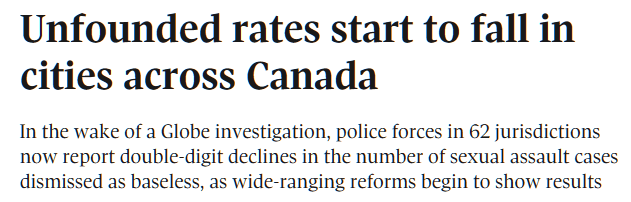
They do have some very good columnists, and they do invest in long-form investigative pieces more so than any other Canadian newspaper. A prime examples is the Unfounded series that Robin Doolittle worked on for 20 months, revealing that an incredible percentage of reported sexual assaults were being dismissed as “unfounded”, or without merit. It’s a rare case of a newspaper story leading to nation-wide changes in policing.
There’s also the simple fact that a lot of Globe andMail stories are “subscriber-only”, period. While there are ways around this (you can get the Globe digital replica free from the library, for example), they are not as convenient as just clicking and reading the story. But what price convenience? That’s what I have to decide.
The focus here is on wine and charcuterie. We were told that they change the wine list monthly. All the menu items are intended to be shared between two people (so not a great place for solo dinners, I guess) and the advice was that ordering one starter, and one charcuterie board, generally provided enough food.
The place is small, and was not overly busy on this Saturday. We liked the musical soundtrack, but even more the fact that it wasn’t too loud; no need to yell at our dining companions to be understood.
And (hurray!) we really enjoyed the food.
To start, we shared the Peking duck crepes. These did feature some vegetables Jean isn’t overly fond of, but the duck itself was delicious, and he was able to eat around the onions and cucumber. I had a glass of Spanish Syrah / Grenache with that, while Jean had a lovely French rose.
An appetizer built for two
Our friends ordered six oysters to start, but were only able to get five—the kitchen ran out. That also meant that we weren’t able to get the oysters normally included on the “Octopus’s Garden” seafood-focused charcuterie board that we ordered. We were able to substitute any other option, and went with chicken liver paté. Our friends selected the classic OG board.
Two boards, one land, one sea
The seafood one included ceviche, lemongrass curried PEI mussels, sous vide octopus, trout pâté, gravalax, and fish cakes, which were served with breads, chips, and vegetables. Every item, truly, was very good (though the ceviche again included the cucumber / onion less favored by my dining companion), and as you can see, you get a generous amount of food. And our friends were just as happy with their choice.
With that, I drank a glass of Ontario Reisling, while Jean went with an Austrian Grüner Veltliner.
The restaurant wisely offers small-size desserts—small enough that you wouldn’t necessarily have to share them. But each couple did, all of us going with the lightest-sounding option on the menu, the lemon soufflé. It was a lovely custard, served in two hollowed-out lemons.
Jean might not be happy that I cropped his photo here, but I was kind of tired of pictures of me
This was the best seafood dinner we’ve had in this town for a long time. We will be back!

 What I wanted to do, really, was see Bohemian Rhapsody, the new Freddie Mercury biopic, on its first day out, so that I could make up my own mind about it without the critiques or praises of others clogging my brain. However, a combination of it being released in Europe a week before North America (theoretically, I could have flown to London for the premiere, but that seemed a bit much) and a lack of willpower on my part meant that I did read some early reviews.








 Then the year was up, and I was like, oh my God, what is my price going to jump to now? But it didn’t jump at all (except to the extent that the Canadian dollar fell); it was still just $20 US for another year. Or about $2 Cnd. a month. Which, I can totally afford, so I’m keeping it, because—you can’t look away!



 Cultureguru's Weblog