Last weekend we to a reprise of the KW Symphony “Dancing through the decades” concert. At this show, they open up a dance floor in front of the stage for the use of those in the audience who are inspired to move. Once again, it was great fun—even though they move quickly from the slow fox / jive / disco era to the modern “what is this beat?” time.
The Symphony posted a (somewhat fuzzy) video of the event on their Instagram. Jean and I are in it. Can you spot us?
Some people have been wondering how McSteamy has been doing since we lost Mocha a few weeks ago. Surely he must miss her?
He must in some way, but not any that is particularly visible to us. This is just as well, as the only visible signs I can imagine would be those of depression: not grooming (or over-grooming), not eating, withdrawal. None of which he is doing, which means we don’t have to jump right into worrying about him.
The only thing I have noticed is that McSteamy and Zoë seem to be hanging out together more. They have play sessions together, and if they’re not quite cuddling together to sleep, they are at least in closer proximity these days.
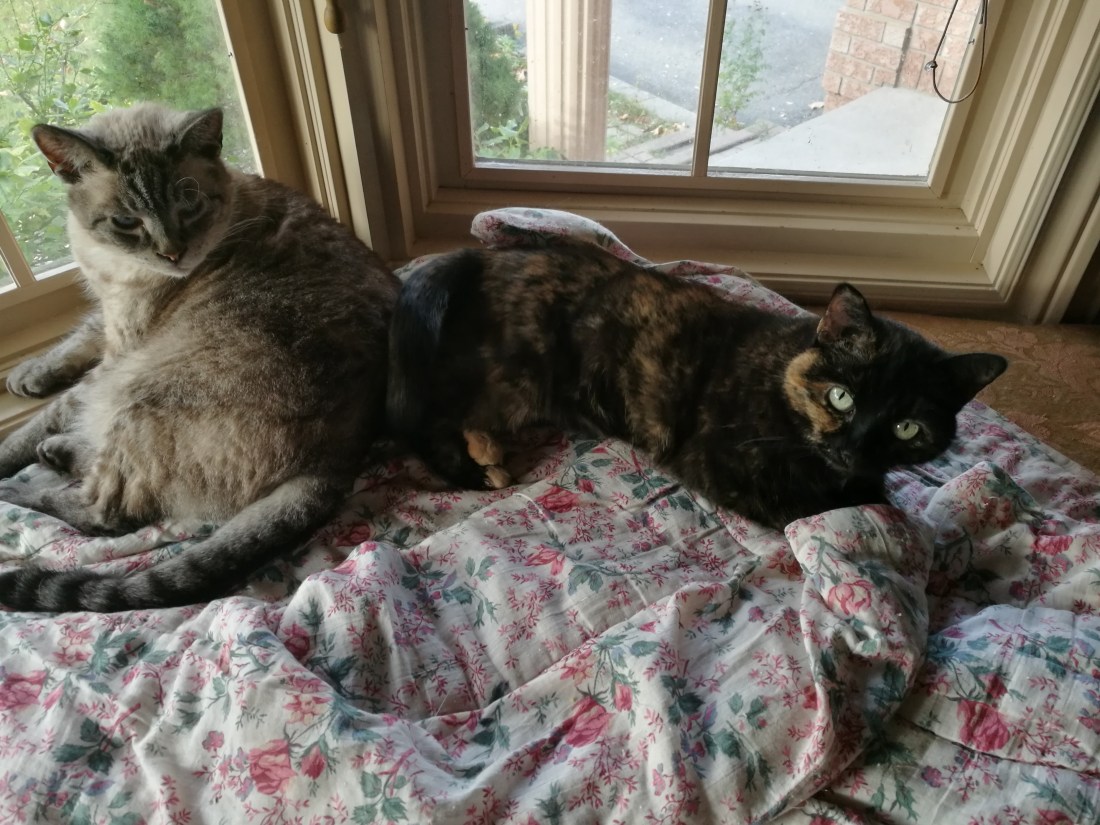
McSteamy on the reboundWhadaya mean, make the bed?They’ll be lazing on a Sunday afternoon
That post title could lead to a number of topics, I suppose, but in this case I’m referring to the movie of that title, built around the 1973 tennis match between Billie Jean King and Bobby Riggs.
The movie starts earlier than that, with a group of top women tennis players—led by Billie Jean King—protest the growing difference in the amount of prize money awarded to the top men tennis players versus the top women: the men were now earning 4, 8, or even 12 times as much as the women. Reason? The men’s game is just “superior.”
The women—initially a group of nine—decided to boycott the tournaments with such practices and launch their own tour, which came to be known as the Virginia Slims Circuit after their cigarette-making sponsor. In retaliation, the women are dropped from the US tennis association, which means they can’t compete in Grand Slams tournaments (Wimbledon, US Open). But also meant that those tournaments were lacking the top women tennis players.
Against that backdrop came the 56-year-old Bobby Riggs, offering a million dollars to a top woman tennis player willing to play him. Riggs needs the money debts, but also loves the attention, and plays it up by making the most sexist comments possible. First willing to take him on is Margaret Court, who gets rattled and loses fairly decisively. That’s when Billie Jean King decides she must take him on, and the publicity machine goes into overdrive.
When I told Jean we were going to see a “tennis movie,” he wasn’t exactly thrilled, but this movie doesn’t have much tennis. Most of it gives us a “behind the scenes” look at these historical events and the key people involved in them. Interspersed as well is the story (somewhat altered from reality) of Billie Jean King meeting and ultimately starting an affair with Marilyn Barnett, despite being married to a good man, Larry King. “There’s only ever been Larry,” she tells Marilyn.
When we finally do get some tennis, it’s to show the highlights of the Bobby Riggs / Billy Jean King match, one I found riveting, though I already knew who would win.
But the whole movie was well-cast (Emma Stone, Steve Carell, Sarah Silverman) and quite interesting. (Jean liked the movie, also, by the way.) Bobby Riggs wasn’t portrayed as a pure villain (that would be Jack Kramer, the tournament chair), but a more nuanced characters with a troubled but loving relationship with his wife, and who was playing a part for the cameras rather than expressing true beliefs. The afterwards of the film notes that Billie Jean King and Bobby Riggs became long-term friends after their historic match.
The saddest thing is how relevant this still seems, even though these events took place some 44 years ago. Yes—with much thanks to Billie Jean King and her contemporaries—things have improved for women in tennis and maybe in a few other sports? (Golf?) But in so many others (soccer, hockey, basketball), they are still such poor cousins to the men, even when they are playing at a higher calibre (as with US soccer). Not too mention the continuing gender wage gap in almost every industry there is.
I mentioned that our hotel had some interesting architectural features, including a glass partition dividing the bathroom from the bedroom, which I had nearly walked into the first day. Overnight Tuesday, I was awoken by the crashing sound of Jean hitting it from the bathroom side. I had assumed that he just hadn’t quite seen it, same as me, but there was a bit more to the story.
He woke up in the night to use the facilities and, seeing a familiar bowl shape in the bathroom, proceeded to sit on that. Only it wasn’t a toilet; it was a bidet. And he sat on it in such a way that he activated the faucet, spraying water both on him and the floor, which he then slipped on, causing him to crash into the glass door.
He wasn’t really hurt, and I’m still giggling about it.
Wednesday
Wednesday was our “free day”. After the included breakfast at our hotel—which was very good—we decided to head back into San Sebastian and spend more time in that city. We didn’t catch the “express” bus we were expecting, but it still got us there, just with some extra stops on the way.
Since we didn’t want to lose our hiking momentum, the first thing we did was climb up Mount Urgull behind the Old City to get some views. We also visited the free museum in the castle there, which covered San Sebastian’s rather lively history. (As an aside, I was still battling a cold this day, and concluding that Spanish nasal decongestant wasn’t quite as effective as North American. But overall the congestion didn’t stop me from doing anything.)
Mount Urgull in the background of San Sebastian streets
When we descended it was around lunch time, and we had resolved to have a pintxo experience. Pintxo are what the Basque call tapas, but apart from the different word, they also serve them differently that in other parts of Spain. Instead of just ordering them from a menu, they prepare them and lay them out on trays all over the bar. You pick up a plate and go through collecting the items you want to try. You then order a glass of wine, enjoy, then traditionally pay at the end (though sometimes have you pay before).
Some recommend having just one item per bar so you can try lots of them, but given that I think you’re expected to order a drink at each place—well, we didn’t want to be that hung over. So we aimed to try two places.
The first was just a random pick among the many bars available. It was a pretty good assortment of appetizers, and a nice Rioja, and we even found a place to sit (though again, it’s more traditional to stand and eat).
For the second we decided to aim for one recommended the Rick Steeve’s book, called Bar Zeruko, which had an “award-winning chef”. And it is true that everything we had here was a step above the first bar. For example, after putting our items on the plate, they took them from us to get all items to the proper temperature and re-plated nicely with the appropriate sauces and seasonings. It was quite busy here (as most places were), but we shared a table with a nice Indian family.
Another San Sebastian scene
We then walked over the San Telmo Museum, which featured art and exhibits on Basque culture. Jean was overtaken with an “afternoon sleepy time” feeling (maybe it was the wine, maybe it was the crashing into glass walls), so he mostly rested while I visited the exhibits.
We then bused back to Getaria.
No group dinner was booked this night, of course, but our attempts to find a place to eat were frustrating. Almost every place listed in Trip Advisor was closed this day. Still not entirely sure if that’s a typical for Wednesdays in October, or if it was because they were resting ahead of the national holiday the next day, when every restaurant was open again.
At any rate, we ended up eating at yet another Pintxo bar, even though I didn’t feel like having that kind of food again, which at any rate wasn’t anywhere near as good as either of the bars we’d been to at lunch. Jean was saved from dealing with my full grumpiness about this by the fact that someone else from the group joined us for dinner, so I had to act at least semi-civil.
We redeemed the evening slightly by then going to a small deli restaurant for dessert—at least those were quite good. I had molten chocolate cake and Jean had this very interesting lemon-lime sorbet with cava (sparkling wine) thing.
Thursday
Today’s walk was apparently the shortest of the trip, and ended with a walk on the beach. Our start was delayed a bit, though, as it was Spain’s national day, which meant reduced frequency of public buses. So our bus ride to the town of Zumaia departed a half hour after we were expecting it to.
Zumaia is not too hard on the eyes
That also meant that there were lots of other people out hiking on this beautiful day. We did part of the el Camino again (again the less popular part). Then we did some walking on rock formations called flysch.
Life on the edge
We ended up walking back in town, early enough in the day to take a little coffee break. With the holiday, though, we had to split into two groups at different establishments.
We then went to hang out at the beach. (It was really a tough day.) A lot of people took their shoes off. A few were surprised by a rogue wave, though no damage done—just slightly wet pants.
Most of the beach looked like your regular sandy beach, but it did have this neat part, with more flysch
There were also some caves to explore.
We then headed back into town to find an ice cream shop, and wait for the bus back to Getaria.
Reward after a tough, tough day 🙂
The group dinner that night was at a restaurant where the waitress didn’t speak much English, which provided some challenges. Now I’ll mention that the vegetarian couple on our tour had limited eating options all week in these small French and Spanish towns; none had a concept of vegetarian entrees. But at this place they weren’t even able to get minimal accommodations, such as putting an egg instead of ham on a salad.
For the rest of us, the food was pretty satisfying, I think, but there was the strangeness that at every course, everyone received their food except one person, who had to wait another 10 minutes or so for theirs. Even though it was inevitably another one of what someone else had ordered. Not sure what was up with that.
Jean and I ordered clams, done two different ways, as main courses—not realizing they were more of an appetizer size serving. And of course, served with no veg or starch. Very good, however. And did leave us with ample room for dessert.
For that menu, we took out the Google Translate app, which caused considerable giggling as one of the desserts was being translated as “panties”. (Very avant-garde of them, serving edible underwear.) I stayed away from that item and ordered a truffle tart, which was very good, not overly sweet. Jean ordered the same lemon-lime sorbet and cava dessert he’d had the night before, but didn’t find it quite as good here.
For wine with dinner, we had the local white, txakoli, which was nice and fresh.
Friday
Now might be a time to mention that I had missed packing a few clothing items I intended—forgot to get them out of the laundry and into my suitcase. Thus answering the question I usually ask myself when packing: Do I really need to bring so many clothes? The answer to that is YES.
It was just a daily annoyance trying to pick among the clothes I did have to find something clean enough, suitable for the current weather, which turned out to be warmer than the original predictions. So those people who say you only need two pairs and three shirts: You’re nuts! Clothes are not heavy. And you don’t want to spend your vacation time hand-washing them. Bring enough to cover your days away, already.
Anyway. On Friday I hiked in my oldest, rattiest hiking pants and re-wore my lightest T-shirt, as this was predicated to be the warmest day yet: 26 degrees + humidity. Two people on the tour decided to skip this one. Both of them had sustained injuries after booking this trip (one to a knee, another to both feet) and though they’d managed to complete all hikes to date, they had decided that was accomplishment enough.
For me, the runny nose had stopped, so that was a relief. (It really was a cold of short duration.)
We started by taking the bus to the nearby town of Zarautz, from which we walked back to Getaria. Zarautz was distinguished by having one of the longest beaches in the region.
View of Zarautz from above
The hiking route took us by many vineyards, all producing the txakoli wine we’d had the night before. Stéphane said that none were open for visiting, though people did seem to be waiting at one of them? I dunno. Would have been interesting to visit if we could have.
On this walk we did get into a little bit of political discussion, on Brexit (they opined it was a bad idea, and the fault of older people who won’t have to deal with it), Justin Trudeau and Canada’s native problem (Jean brought that up—ssh, don’t air our dirty laundry), and hunting policies of various countries. It all stayed pretty civil except for the Londoner insisting that London economically supported the rest of the UK, which the Manchester folks didn’t appreciate. But it didn’t seem to create any permanent tensions.
I guess because the two slowest members were not participating, the walk (billed as 12 km, but measured at more like 10) was done before we knew it, and Getaria came into view before 2 PM. (We also felt, even though it was just a week, that we had definitely improved our fitness compared to the start.)
Walking the vineyards above Getaria
We got back, showered and changed, than had a drink with the group and Stéphane at the nice hotel lounge. No group dinner was booked for the evening, and the rest seemed to be leaning toward pizza at the deli. Jean and I decided to just do our own thing.
We ended up at a place called Txoko. After we’d been seated, given our orders, and had started drinking our txakoli, we noticed the rest of the group arrive! They’d changed their minds and decided to eat here as well. But we anti-socially stayed at our own table.
We got quite good service here, and splurged a bit on salad, followed by clams, then a shared grilled sole, one of the more expensive fish options. It was all very good and fresh, though. We were kind of excited that the menu said the fish came with potato and tomato side, but it was such a tiny portion, it was sort of hilarious. (Tasty, mind you.) For dessert I went with rice pudding and ice cream, while Jean had creme brulee.
Saturday
Today was the last day of the tour, so the only items on the agenda were hotel breakfast followed by shuttle to the Bilbao airport at 8:30. Jean and I were not flying out this day, however. We’d had trouble finding any reasonable flights back to Canada with a Bilbao departure time of 11:00 AM or later. So we booked a flight back on Sunday, and added in a night at a Bilbao hotel.
From the airport, we expected to take a taxi to that hotel, but the bus driver agreed to drive us and the other three people on the tour who had also extended it by a day, which was very nice of him. Our hotels were only 200 m apart.
Despite our morning arrival, we were able to check into our room. It was a more typical European size, but nice. It was the first of the trip with an actual double bed, rather than two singles pushed together, and with a coffee machine. (No face cloths or Kleenex still, though.)
Bilbao is known mainly for its Guggenheim Museum. But it was predicted to be the hottest day yet—high of 30—so we decided to start with a visit to the Old Town. We toured two churches here, but neither was that impressive—Basque churches are quite plain compared with the amazing ones in other parts of Spain. We also walked through the market.
Stained glass in one of the Bilbao churches
Then we headed in the direction of the Guggenheim. It’s architecturally very interesting, so we walked up and around both viewing bridges before going over to it ourselves.
Guggenheim Bilbao
Outside they have a spider sculpture that is pretty much exactly like the one at the National Gallery in Ottawa (it is the same artist). There’s also a puppy monument that, Jean informed me, was originally just a temporary exhibit, but the people of Bilbao liked it so much, the Museum bought it for its permanent collection.
Puppy at the Guggenheim
Some people on our tour who’d visited Bilbao on their free day had recommended the bistro restaurant at the Guggenheim, as did my Rick Steeves’ travel book. So we had decided to eat there. In looking for it, we followed the signs marked “Restaurant”. When we got to the entrance, there were a bunch of people crowded around the posted menu. I thought, we don’t really need to look at that, let’s just go eat.
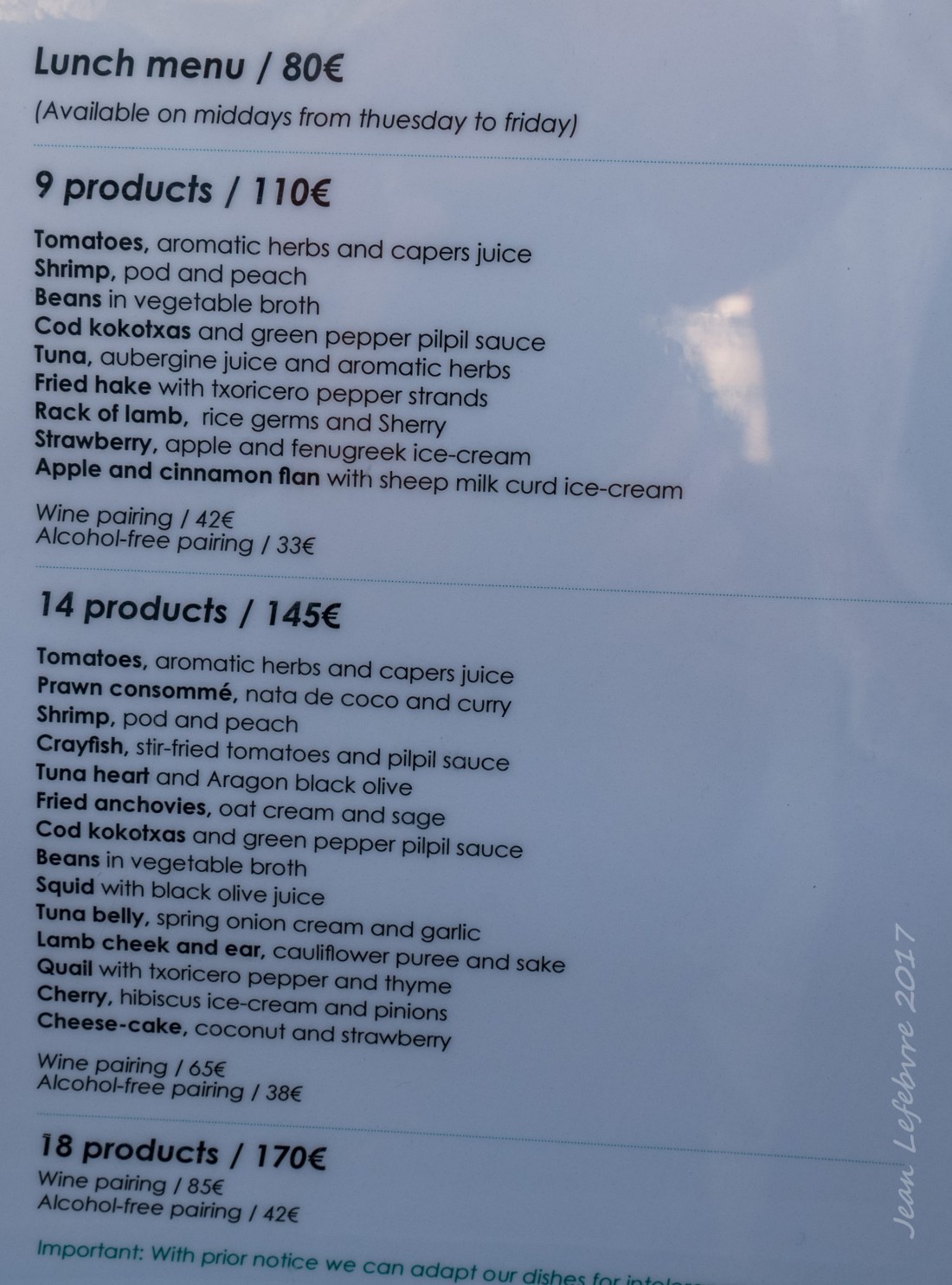
Inside, though, was this very fancy, white linen sort of place. We were almost the only patrons at this point, and were outnumbered by wait staff. Then they handed us the menu.
So, 110 Euros is about 165 Canadian dollars, otherwise known as notably more than we’d typically been spending for the both of us to have dinner on this trip. Should we just walk out and go to the actual bistro?
But it’s kind of awkward to just walk out, isn’t it? So we justified it. After all, we hadn’t managed to get into the fine dining El Cano restaurant we hoped to dine at in Getaria. We’d been eating cheap bag lunches all week. Let’s splurge!
My friends, all nine course were really exquisite, probably some of the best food we’ve ever had. And it was actually more than nine courses, as they started us off with an amuse of tuna, quail’s egg, and basil gazpacho. The house-made bread was herb, sundried tomato, and olive oil. Each item was sourced in a particular way that they told us about, shrimp from this particular cove where they were especially flavorful, baked beans elevated to gourmet levels but still reminiscent of baked beans.
We did not have the wine pairings, both because of cost and because we didn’t want to end up really drunk, but we each had two glasses that were really nice. I start with an orange wine, which is white wine given some skin contact so it gets colour, while Jean had a jura. He followed with a nice Rioja while I had a great blend of Pinot Noir and Txakoli wine, which I will never be able to find in Canada.
This would have been a great place to take food photos, as you can imagine the plating was also lovely, but Jean was a bit intimidated about doing that. Nearer the end of our meal, more people had arrived for lunch (most dressed somewhat casually, as we were), so I did take a couple with my phone.
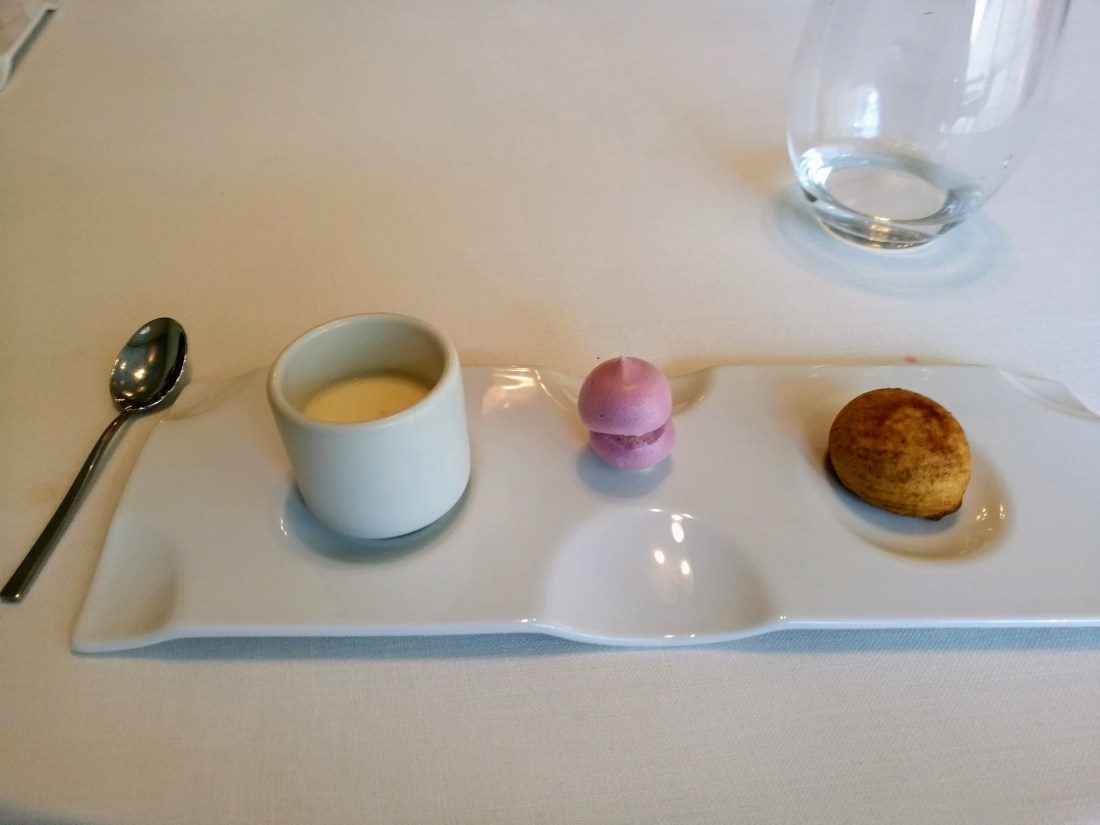
This was an extra dessert, not on the menu, of custard, macaroon, and chocolate beignetThe coffee cups were interesting
We then went in to visit the exhibits. It’s all modern art, and not necessarily the greatest art collection we’ve ever seen, but I did enjoy this tall lighted work of cascading, thoughtful phrases; the huge Andy Warhol painting of Marilyn Monroe collage; the Basquiat works; and this super slow-mo film by the featured artist, that was strangely compelling.
It’s the 20th anniversary of the Guggenheim this year, and to celebrate they were doing a week of special video, music, and light projections onto the building’s surface at night. When we left our hotel for dinner later, tons of people were heading in that direction to watch it. While waiting for our selected Italian restaurant to open, we saw some of the show.
And Italian food was a nice change, though the restaurant was quite warm. Afterwards, we tried to walk back to see more of the presentation (which repeated in 20-minute loops), but it proved rather complicated getting there, and once we did, it was too full of people to get to a good view. Oh well.
Sunday
Sunday was just a travel day. We decided to avoid the stress of a fairly short layover in Paris by booking an earlier Bilbao flight, which meant getting up quite early, then having a long wait at the Paris airport. We were grateful for its decent wifi, and the comfy seats at the Starbucks, which was tolerant of us buying only the periodic latte.
The flight to Toronto was a couple hours longer than the one from Montreal had been, then on getting there, we had to wait a bit before landing. An early thunderstorm had prevented other planes from landing at their designated times, so our turn got pushed back a bit.
That then meant that more planes than usual were landing at the same time, which made customs a bit of a nightmare. They have this whole electronic scanning, take-your-photo thing happening now? (In Europe, they still just have a person look at your passport, you know?) Then even after that, slight wait for the luggage to be unloaded.
But it got there, we got there, drive home was fine, there you be.
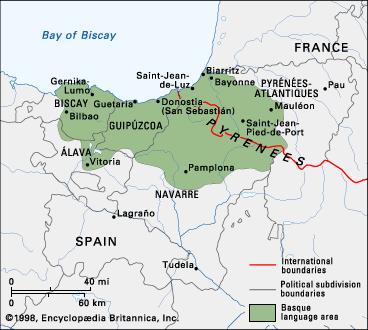
Jean had this trip in mind for a while. I was less certain about it, as I knew nothing about these places—San Sebastian, Bilbao, Biarritz—which meant I had no particular desire to go there. But when I read the description of the trip on the Exodus website, it sounded pretty good. So we went ahead with booking it.
We were headed to this part of France and Spain:
These are the main cities (or towns) there:
Friday / Saturday
It’s tricky booking travel to these smaller European destinations from Canada. We decided to try to fly into Bilbao around the same time as the rest of the tour group (flying in from London—Exodus is a British tour company). That meant flying to Montreal initially (on Westjet) to catch an earlier evening Air France flight to Paris, from where we got another flight to Bilbao.
So it was a bit of milk run, but everything went well, basically. The “long” flight was only about six hours. Then we had to go through security again (why?) and very slow passport control (unusual for Europe), but basically everything was on time and our luggage made it through. We arrived a bit ahead of the rest of the group, but eventually met up with our tour guide, Stéphane, then the rest of the group. We totalled 11.
We were then bused to our hotel in Ascain, France, which is too small to be on the map above, but isn’t far from Biarritz. Hotel room was small but fine, and the place had a nice patio out front and the staff were all quite friendly. They also offered a quite delicious and sustaining daily breakfast (as we knew the “typical” French breakfast of coffee and croissant would not suffice for hiking).
Dinners were not included in the tour package, but for most nights, the tour guide did a group booking for us at a local restaurant, which generally worked out well. The only ongoing issue was that the concept of “splitting the cheque” seemed foreign in these parts (in both France and Spain), so each evening ended with us all having to do math to figure out who owed what.
The highlights of our first French dinner were the really great fish soup (mussels, scampi, white fish) to start, the fries that came with our duck à l’orange, my iced nougat dessert, and that Jean’s cheese dessert was offered in the form of: Here are several slabs of delicious French cheese. Slice off as much as you want.
Sunday
Now’s the time to mention that we were really lucky with weather: Though the Basque region can be pretty rainy, we had nothing but sun all week. Particularly in the beginning, it would start out cool then warm up nicely, followed by a cool evening. Later in the week the temperature trended up, almost (but not quite) to too warm.
The first hike was described as a “gentle walk perfect for stretching out our legs”. This was a ruse, as it actually had more elevation than most of the hikes (470m), and involved climbing and descending two mountains (small mountains, but still) and a hill. Plus, it was listed as 9 km but everyone’s mileage counter (including mine, on my phone) reported it as more like 12 km.
But it was nice.
Overlooking St Jean de Luz and the Bay of Biscay
We saw some animals here, in the form of wild horses named pottocks. They are small and tough and were previously used in mines. More recently, there were problems with them mating with larger horses, such that they couldn’t get enough food in the mountains to survive the winter. Now, to preserve them—and though they are still considered wild—they have “owners” who ensure they get vaccinated (and presumably try to keep the larger horses away from them).
A pottock in its natural habitat
They also do some free-range farming in these mountains, notably of the Basque pigs, who do seem to be living the good life.
It’s a pig’s life
With the first walk, we found we were able to keep up with the group and didn’t have too many sore muscles the next day.
Back in Escain, they were having an annual festival. (Nice of them to time it with our visit.) Part of the involved shepherds guiding some of the pottocks down to a pasture in town, so the tourists could see them without hiking in the mountains. A bit odd, but the horses didn’t look too unhappy being on view, eating their hay. There were also farm animals display, a competition of sheep herding by those amazing border collies, and market booths set up selling food and crafts. We got some lunch items here.
Group dinner was at a place that specialized in fish and seafood. Jean and I shared a very nice cold foie gras starter, with a glass of local sweet wine reminiscent of sauternes. I then had grilled hake, a local fish on many menus, while Jean tried the Basque specialty of squid cooked in squid ink. Very nice texture on that. We shared a crème brulée for dessert. This place was also the only one to help us split the bill: the waitress emerged with a calculator.
Monday
The Monday hike started with a ride to the most popular tourist destination of the area, the train station that brings you up the Rhune mountains. We also took the train up to what was probably the most spectacular hike of the trip. It was a cooler morning, and the clouds were low-lying at that point—it was very neat to be walking above them.
On top of the worldMore pottocks, less impressed than we were by the view
The idea was then to walk down La Rhune, and back up to the train station, take the train down, and walk back to Ascain.
On the border between Spain and France, as marked by the stone
But after lunch (for lunch, by the way, we each had to buy our own provisions from the local store before heading out), before starting our ascent back to the train station, someone asked about just walking all the way back from where we were. The guide agreed that it was a reasonable option, and that it saved us from having to wait around for the train. The group agreed on that, and we did see some interesting things on that stretch of trail.
Grazing sheepA former hunting lodge (vulture hunting) now used by some hikersA pottock who wasn’t too worried about us
At one point the group got split up, on a rocky path that were more of challenge for some (Jean and I were kind of in the middle) and ended up taking different paths down. But the guide managed to gather us all eventually.
You take the high road, and I’ll take…
Our final French dinner was also nice, at Etorri. I had salad followed by squid with tomatoes and garlic, when Jean had duck and duck: foie gras then roast duck with cherries. And creme brulee for dessert (again).
Tuesday
Today was the day we moved from France to Spain, so we started with a private bus ride to Col de Sainte Ignace. The bus then carried our luggage on to our hotel in Getaria while we took a short boat ride, then walked into San Sebastian, where we caught a public bus to Getaria.
Where we took a boat to start the walk
The trail head start included the exciting site of a public toilet (rare on this trip), so four of the women decided to take advantage. It had a system of lights we didn’t quite understand, but the door wasn’t locked, so the first one went in.
We outside then noticed that the light changed to yellow, then red, which seemed a bit ominous in itself, and then we heard this sound of whooshing water. Followed by some screaming, then B. emerging, pants unbuttoned.
“I haven’t had time to go yet!” she said. It had started squirting water out all over, pointing to her speckled pant legs.
So, this was a self-cleaning system that activated after each person. Light green, you go in and do your thing, you emerge, light turns yellow, then red, and it sprays water onto the floor and seat to clean it, then green and ready for the next person. Kind of a nice system, really, for the rest of us in line. 🙂
This was one of the easier walks, which is good because the intermittent sore throat I’d noticed the past two days had evolved into nasal congestion, which meant hiking with a copious supply of TP (European hotels don’t supply Kleenex, period) for nose blowing. It did start with a quite a few stairs going up, but then was largely flat until we later descended into San Sebastian. Here we were walking on part of the famous El Camino trail, albeit its less popular (because harder—more elevation) northern end.
Approaching San Sebastian
San Sebastian was a bigger place than most of us were expecting. We had about an hour here before needing to take the bus, so we prioritized finding a place with coffee and washroom. We followed that up with ice cream before getting the inter-city bus to Getaria.
Our hotel there, Hotel Saiaz, was one of the nicest we’ve ever stayed at in Europe: Quite spacious and interesting architecture and room design. (Including a glass door to the bathroom which looked cool, but will lead to a funny story later.) It also had a fridge, which was handy.
We walked around Getaria a bit, getting cold supplies at a pharmacy where the pharmacist spoke excellent English (not always a given in these parts) and locating the Michelin-starred restaurant Jean had read about (El Kano). Unfortunately, with the combination of a food expo in San Sebastian and the national holiday Thursday, they were all booked up for the week.
Our dinner this night, as it would be the case each night, was booked for 8:30, as the Spanish don’t think anyone should eat their final meal of the day any earlier than that. I started with white asparagus, since Spanish main courses don’t include any sides—just whatever protein you order. (Jean nevertheless had foie gras again.) The asparagus was very good—fresh and flavored with olive oil. We then both had the sea bass, which was nice. I ordered a peach dessert which turned out to be… canned peaches. (Seriously?) Jean did better with the rice pudding.
Spanish menus also don’t routinely include wines by the glass so we got a bottle of Rioja. (At least the wine is fairly cheap.) It was good, but we weren’t able to finish it.
Mocha’s actual date of birth is a mystery. All we know of her origins is that she and her kittens were found in the backyard of our MP at the time. The Pet Patrol organization rescued her, had her spayed, and she was taken in by a foster family. One day she was the featured cat for adoption at Pet Value, which is where Jean and I first met her.
No matter her actual age (and one vet we saw early on suspected she was a few years older than our other cats, based on the state of her teeth compared to theirs), she was always taken to be younger, because she was so tiny. Mocha never really stopped looking like a kitten. It was great, really. All the adorable-ness of kitten-hood without all the work of dealing with an actual baby cat.
Mocha in 2006; apologies for the freaky eye which I don’t know how to fix in editing
Mocha at the pet store was the sweetest thing. You could pick her up and she’d just nestle into your arms and purr. I was smitten. Jean, meantime, was smitten with another, apparently shyer male cat that we met at a foster home. We resolved our differences by adopting both. Mocha and McSteamy took to each other immediately, finding comfort in proximity to each other. Their bond was to endure for a lifetime.
McSteamy and Mocha had an enduring (though platonic) love affair
We soon learned, however, that Mocha’s pet store response was just her reaction to being in a strange, stressful environment: she seemed to feel her best option was to become as placid and sweet as possible. Once in a calm house, though, she reverted to nervous suspicion, and joined the shy McSteamy in hiding under furniture.
In fact, McSteamy was the quicker to warm to us, and within about two weeks had basically concluded we were the best people ever. Whereas Mocha spent months hiding behind cabinets and under furniture, taking advantage of her tiny size to limit contact as much as possible. I even called the Pet Patrol people seeking advice. Just give it time, they said. She will become a loving, affectionate pet.
They were right.
Mocha “climbing mount Jean”, as I like to call it
She eventually stopped hiding, and especially took to Jean. I was the main feeder, which went a long way in putting me in the good graces of the other cats in the house, but Mocha was a nervous eater who seemed to view food as more of a necessary evil than a source of pleasure. So that wasn’t gaining me points with her.
In fact, at one point she seemed to view mainly as Jean competition, tending to take off in a bit of a huff when I deigned to join the two of them in their cuddle-fest. But, I did gain some advantage in not tending to take off for one- or two-week canoe trips. Facing the choice of no pets versus pets from me, she was all in for pets from me. And thereafter seemed to stop seeing me as competition, but more as an acceptable secondary source of affection.
You see, most cats will lie calmly and purr while you pet them, maybe flip around to get a belly rub, relax into sleep. But for Mocha, petting was a serious, intense business. She would rise up to meet your hand. She would rub her face on your face. It wasn’t enough to be pet; she needed, somehow, to pet back.
For Mocha, petting is serious business
And the purr. My gosh, such a big sound from such a tiny cat. We even recorded it once:
And conversely, her mews were quiet to the point of inaudible: You’d only know she was trying to tell you something if you happened to be looking to see her open her mouth.
She had her own rituals, as cats do. In the morning, she liked to sharpen her nails on the corner of the bed (replaced with a scratching post when we got a new bed), then run around and jump on the bed for the first pets of the day.
She was fascinated by flushing toilets.
“One day I will figure out this phenomenon”
After work (our work—cats don’t work), she loved to join Jean in his office to get the evening’s round of petting underway. This was not always conducive to Jean being able to accomplish whatever he was in his office to do: “Girl!” he’d exclaim. “Too intense!”
During TV time, her spot was the back of the couch, just behind our heads.
And at any time, she enjoyed windows, and sunlight (though had no interest in going outdoors), and even better if she could enjoy both with her best friend.
And the cat who once spent months in hiding became so comfortable in her home that even the presence of loud, strange repairmen wouldn’t daunt her. She’d just watch them with interest.
I was a little worried about her before going on vacation this fall. I’d like to suggest this was prescient of me, except that it’s a regular habit for me to worry about the cats before going on vacation. My particular worry focus this time was Mocha’s nasal congestion, even though this was a chronic problem of hers and the vet had already declared it didn’t seem to be serious. I resolved to get a second opinion on return from vacation, and watched her like a hawk before leaving. My conclusion was that she seemed to be happily going through all her usual activities and rituals, and that finally—after all these years—she seemed to really be enjoying her food.
The catsitter said that all went well while we were away (just for a week), but on our return, I noticed pretty quickly that something wasn’t right with Mocha. She moving her head strangely and batting at her mouth. She seemed to be having trouble swallowing water, of all things. On petting her, she seemed thinner than when we had left.
I brought her to the vet the first thing the next day, but the news was not good. She had a growth in her mouth that was, indeed, making it hard for her to eat and drink. There was no guarantee it could be treated, and even attempting to do so would likely require her to be fitted with a feeding tube. Instead, we went with the “trying to keep her comfortable” approach: She was rehydrated and sent home with liquid painkiller and a special, soft, high-calorie food that was easier to swallow (and apparently delicious, given that McSteamy and Zoe kept trying to steal it).
So Mocha’s last days were not terrible. She enjoyed the sun.
She continued to marvel at modern plumbing.
She got herself up in her window.
She gave and got pets.
She cuddled in front of the fire with her bestie.
She died peacefully on October 17, surrounded by the people who loved her.
Me: Why do you say that? Because my Dad buys them?
Jean: And my Grandmother. She always had a bowl of those out.
Me: Come to think of it, my Grandmother always had mints like these around, too.
Shit.
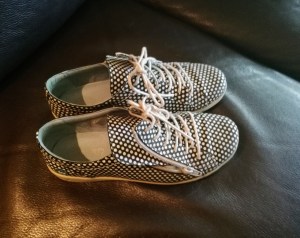
But would your Grandmother buy shoes like these?
(Or allow shoes on the couch?)
So the mission here was to get another pair of comfy shoes that weren’t sandals (as it seemed, at the time, that Fall weather was coming). And I did succeed at that:
But then I saw these other shoes, and they were so cute.
The truth is, outside of ballroom dancing—which requires special dance shoes—I have few opportunities to wear heeled shoes. At work I do the stand-up desk thing, and you can’t do that in heels.
But still…. Pretty cute. And on sale!
I have managed to wear them to one party that was mostly a sit-down affair, and have worn them at work as well, for the sit-down parts of the day. For heeled shoes, they’re pretty comfortable: despite the point, they don’t squish the toes, and the back strap doesn’t dig in. And with so few occasions to actually wear them, they should last for years, right?
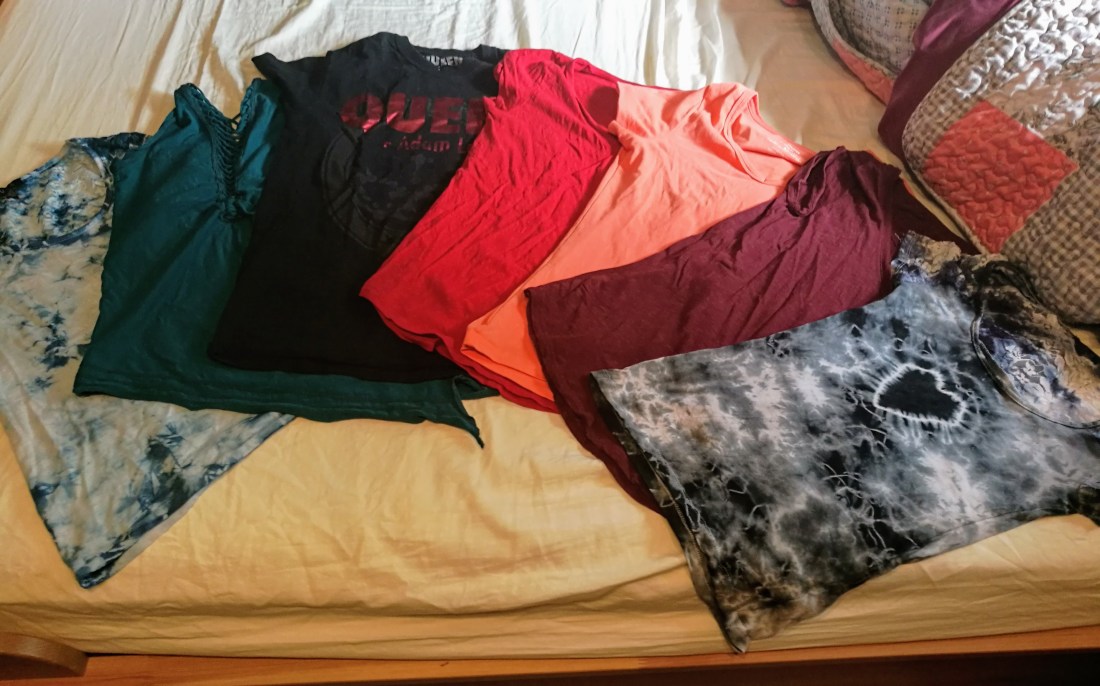
Anyone want to borrow a T-shirt?
It’s possible I have a T-shirt problem.
The above were all acquired this summer, in Ottawa, Kingston, Toronto, and right here in Waterloo. And it’s not as though I didn’t have any T-shirts to start with.
A double shot
We came home from one vacation to find that the drip coffeemaker was no longer working. A fuse or something, I guess—you’d press the button and nothing would happen. That was a Delonghi dual espresso / regular coffee maker that I’d received as a work gift. Only, the espresso part broke down within weeks. It looked impressive, but for years had supplied only regular coffee, and now couldn’t even do that.
Still, when we put it out with the trash, someone took it away within minutes. Good luck to them in trying to make it useful again.
Meanwhile, we were doing Bodum coffee, which is very good, but presented a timing issue. Jean is more of a morning person that I am. He’d get up and make enough coffee for both of us, but by the time I was up and ready to drink it, it was often more lukewarm than hot.
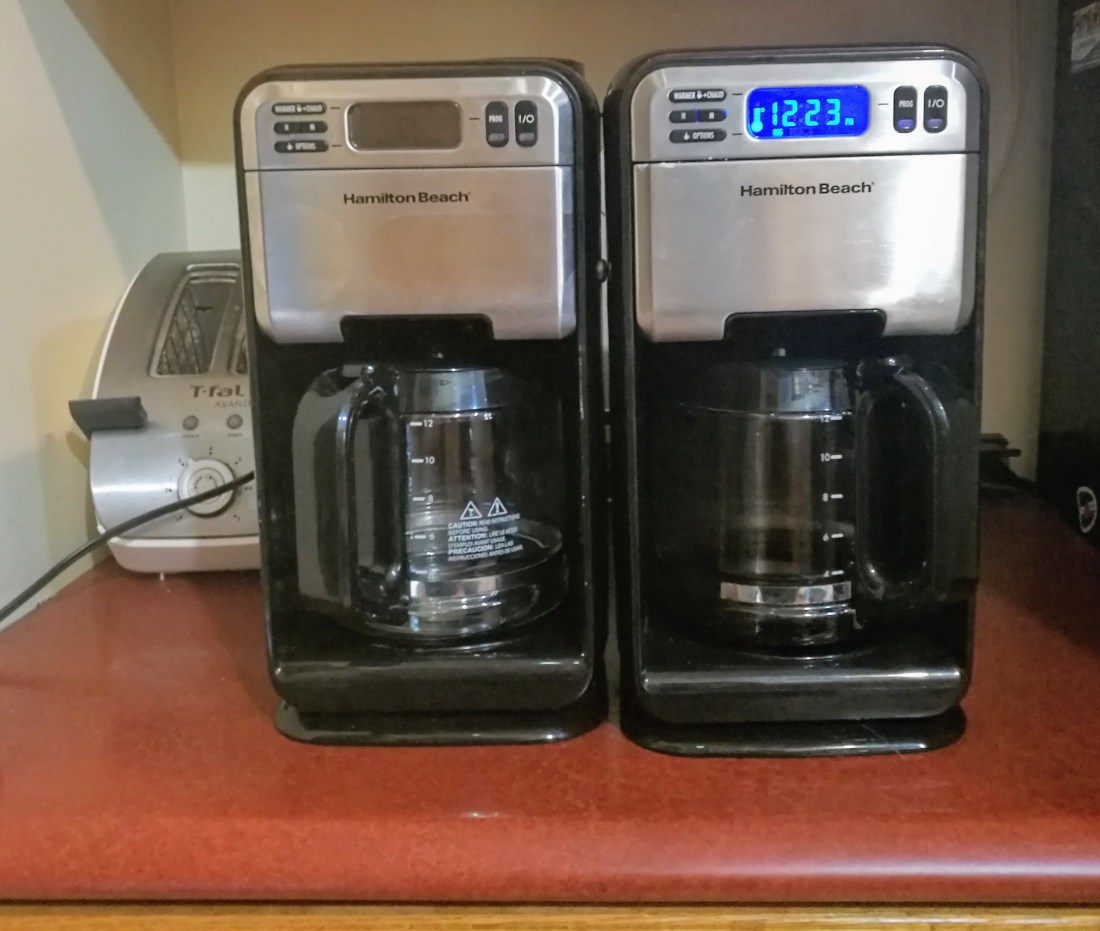
We started by tasting a single-origin coffee to determine which cheap machine was most acceptable to discerning coffee drinkers, then ran the panel a second time with preground Dunkin’ Donuts house blend from the corner store. The Hamilton Beach 12-Cup Coffee Maker (46201) swept both rounds of testing. It placed second to the Oxo [9-cup coffee maker, a $200 US coffee maker] in Round 1 and actually beat the Oxo during the Dunkin’ round.
That Hamilton Beach unit was more widely available in the US than in Canada, but Amazon could ship it to us from an outfit called Moto Liquidation that warned would be “like new” but “show signs of handling/unpacking and usages, boxes have damage.”
That proved pretty accurate—box was somewhat battered but unit looked new. Only the first day we tried it, we found that we only got about half the amount of coffee requested—the rest of the water spilled out all over the counter.
We contacted Moto Liqidation who said that we could either get a refund, or they would send us another coffeemaker. Either way, they said, we could keep the one we had. And hence:
Unit 2 has a slight wobble, but not one that interferes with coffee making. And if any of the parts ever break or fail, well, we can pillage them from unit 1.
It does make really good coffee.
TV in the kitchen
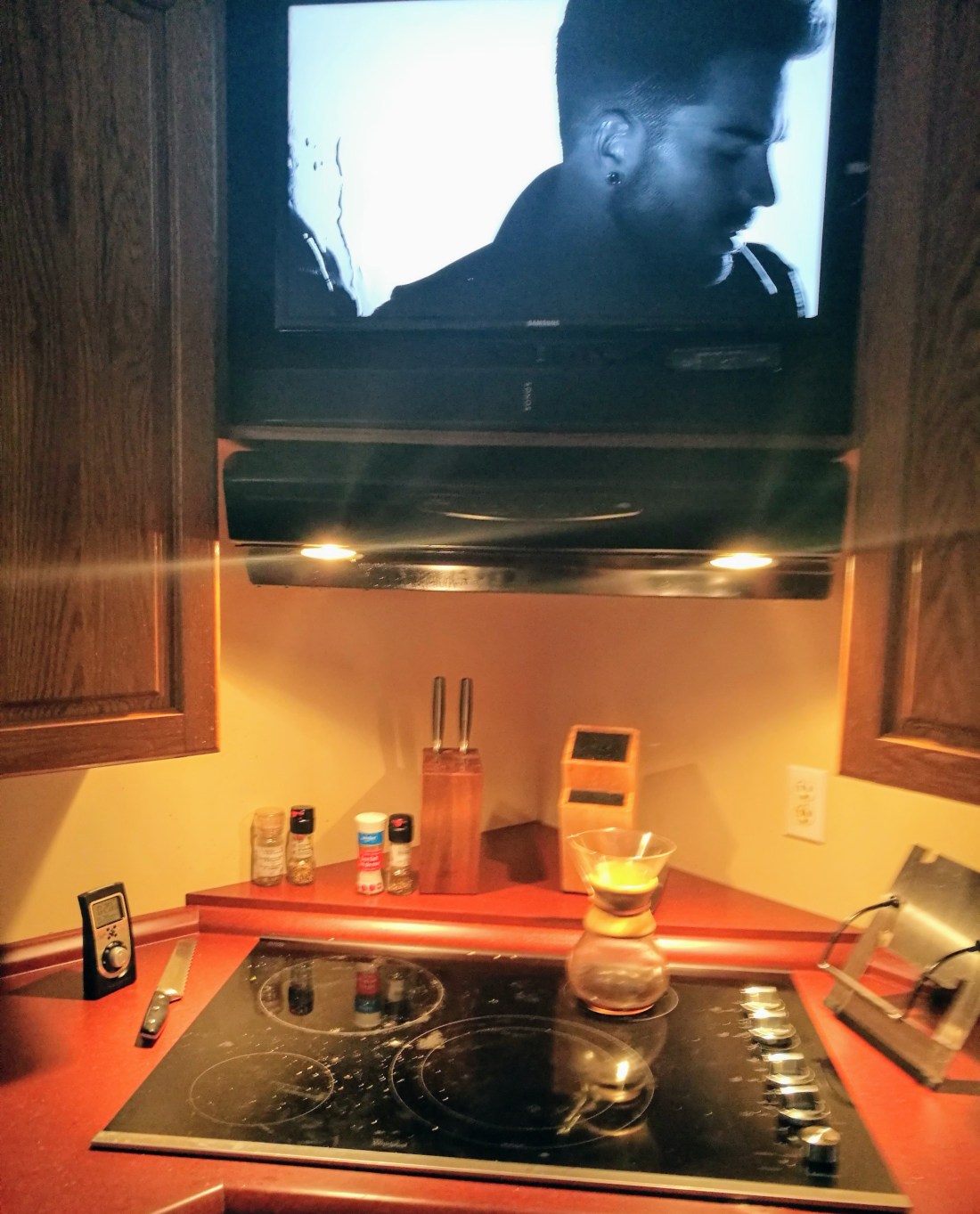
I believe it’s not so unusual now, but when we got our kitchen renovated 15 or so years ago, our designer considered it very odd that we wanted space for a TV in there. Still, she penciled one in, above the stove top, plenty big enough for TVs of the time.
Fast forward, and the space is just barely big enough for the smallest of today’s TVs. And there’s absolutely nowhere else in the kitchen a TV could go (short of doing another renovation).
Furthermore, at some point I decided I also wanted the option of listening to music in the kitchen, and I don’t mean over headphones. So we got a Sonos Play 5, with the idea that when we bought a small digital TV to replace the old tube one, we could hook it up as the TV speaker.
But the Sonos 5 is large, and trying to find a spot for it near the TV was a challenge. Not just in having enough room, but also in the fact that anything near the stove top gets totally coated in disgusting grease, and I didn’t want that to happen to my nice speaker.
Then Sonos came out with a new speaker that was exactly what we needed. The Playbase is a wide, flat TV (and music) speaker that the TV is meant to sit on. It’s sized to exactly fit in the limited space we have available. The sound quality, by all accounts, incredible. The only problem? It’s a pricey sucker.
[All Sonos Playbase reviews, summarized: Woah, that sounds awesome. … Wait, you want how much for it?]
So I kept dawdling on it til the the September long weekend, when I just decided to go for it.
The only available TV spot in the kitchen is… not wide, and at risk of greaseA better view of the Sonos playbase. The other little box is the Rogers digital adapter.
The new TV took two tries, as the first one had a cracked screen. Figuring out just how to get the cable through was trickier than expected (tip: even it’s a digital TV, you still need a digital adapter to decipher the channels).
But the Sonos was problem-free in hooking into our network of other Sonos units. And it does sound great. And having the Chromecast on the TV opens up new viewing and listening possibilities: Netflix, YouTube, Spotify (even if not paying for Premium), SoundCloud app.
(The neighbourhood scavengers, by the way, had no interest in the tube TV beyond the power cord. But no worries, we properly e-cycled it.)
As for the grease, we’re trying to minimize its effects by using the back burners more. It’s making that back corner kind of gross, but so far so good on keeping the speaker clean.
So I was happy. Until the following Tuesday (i.e. the next business day) when Sonos decided it was time to offer me 15% off a new Playbase. As long as I hadn’t already bought one, of course…
Bah. Good thing I saved money with the on-sale shoes and the cheap coffee maker, eh?
Writing the lines as they come to me
Scratching them out almost immediately
Don’t know what it’s done to me
When I Write My Master’s Thesis—John K. Samson
It’s all gonna change
When I write my master’s thesis
Paperback Writer—The Beatles
Dear Sir or Madam, will you read my book?
It took me years to write, will you take a look?
Every Day I Write the Book—Elvis Costello
Chapter One: We didn’t really get along.
Chapter Two: I think I fell in love with you.
You said you’d stand by me in the middle of Chapter Three
But you were up to your old tricks in Chapters Four
Five and Six.
And I’m giving you a longing look
Every day, every day, every day I write the book
Suzanne Vega—Book and a Cover
What’s that they told you
About a book and a cover?
Jools and Jim—Pete Townshend
Typewriter tappers
You’re all just crappers
You listen to love with your intellect
Wrote My Way Out—Nas, Lin-Manuel Miranda, Dave East, Aloe Blacc
Sister tapped my brains, said, pssh, you’ll get ’em right back
Oversensitive, defenseless, I made sense of it, I pencil in
The lengths to which I’d go to learn my strengths and knock ’em senseless
These sentences are endless, so what if they leave me friendless?
We Used to Wait—Arcade Fire
I used to write
I used to write letters
I used to sign my name
I used to sleep at night
Before the flashing lights settled deep in my brain
Please Read the Letter—Robert Plant and Allison Krause
Please read the letter, I
Wrote it in my sleep
With help and consultation from
The angels of the deep
The Letter—The Box Tops
Well, she wrote me a letter
Said she couldn’t live without me no more
Letter from Bilbao—Lowest of the Low
I am writing you this letter
In desperation, I’m afraid
All She Wrote—Ray Davies
All she wrote was a goodbye letter
“It’s over for us, to tell you the truth
I’ve met this person in a disco
He’s really special, reminds me of you”
Word Crimes—Weird Al Yankovic
Like I could care less
That means you do care
At least a little
Underwhelmed—Sloan
She wrote out a story about her life
I think it included something about me
I’m not sure of that but I’m sure of one thing
I had every intention of seeing Wonder Woman at the theatre this summer—I fully expect I’ll enjoy it—but it didn’t stick around the major theatres as long as I expected, nor did it get the second round at the art cinemas I was expecting. (Especially as the Apollo Cinema did have it listed as “coming soon”, only it never did.)
So when Google offered a movie rental for 0.99, I thought Wonder Woman would be a great way to spend that, and was quite excited to see it listed in the Play store. But when we sat down to watch it, I realized it was only available for $20 purchase at this point, and I did not want to do that.
So I turned to my Netflix list to see what movies I had short-listed there, and hence we instead watched…
The Lobster
Holy doodle, that’s a weird and disturbing movie. The premise is an alternate world in which people who find themselves single have a couple unappealing choices. One is the officially sanctified approach of checking themselves into a hotel where they have 45 days to find a partner. If they fail, they are surgically converted into an animal (a lobster, a dog, a pony).
The other option is to illegally escape and join The Loners in the woods. While always at risk of capture, here you have more freedom, and no threat of having to become another species. But you are strictly forbidden any kind of romantic entanglement.
So, both those options are terrible, and as the movie shows, even those who manage to couple aren’t really in a great situation, necessarily, given the incredible incentives do so.
On Rotten Tomatoes, critics rated this movie as 89% positive, but only 64% of the general public agreed. I can see the critics admiring this—it’s definitely original and in many ways well-crafted. But it’s a tough one to enjoy. And I’m not completely sure what the point was? Perhaps some comment on our society’s antipathy toward singledom…?
I did survive that rather bleak movie, however, this weekend we buckled down and watched…
Still Alice
Which I’d been putting off because I thought it would be sad. And, I was right, it was sad. Very sad to see the highly intelligent and articulate Alice become increasingly incapable of hanging on to her memories, at the young age of 50. (Also scary—I couldn’t help trying to do all of Alice’s memory tests with her.)
But it is a good film, with a great performance by Julianne Moore and Kristen Stewart. And it doesn’t deliberately, manipulatively try to heighten the sentiment. It doesn’t have to.
And what were the art cinemas showing instead of Wonder Woman? Well, for one night anyway, it was
Deconstructing the Beatles’ Revolver
Which is a love it or hate it kind of a thing. In Deconstructing the Beatles, a music professor takes a deep dive into one Beatles album, in this case Revolver. He uses rare footage and audio archives to go track-by-track giving insight into the creation of each song, from inspiration to final mix.
Does that sound like something you might interesting? Then you’re probably right. Or does that sound like the most boring thing ever? You’re probably also right.
The only reason Jean joined me at this one was that we were also accompanied by a friend of his that was solidly in the “interesting” camp, and Jean didn’t want to miss out on the social aspect. But this sure wasn’t his cup of tea. I found it cute that he fell asleep during discussion of “I’m Only Sleeping” (“Please don’t wake me, no don’t shake me…”).
As for me, I learned quite a bit about Revolver, one of my favourite Beatles albums, which I think will only enhance future listening of it.
When the Stratford Festival decided to include Molière’s Tartuffe in their line-up of 2017 plays, they had no way of knowing how the US presidential election would turn out. But they were not about to miss the dramatic opportunities this afforded them.
Tartuffe was a comedic satire written in 1664, and was immediately controversial for speaking truth to power. It was banned after its first performances, but Molière fought for it, and five years, it was revived to great acclaim.
Stratford’s English-language production is set squarely in the present, with the characters listening to modern pop (much of it French), making lattes, and being distracted by their cell phones. The main nod to the age of the script is that all the dialog rhymes—which strikes me as an amazing feat of translation (by Ranjit Bolt).
In Tartuffe, the (white) father of the household—and his mother—are in the thrall of a recent house guest, the apparently pious Tartuffe. Everyone else—his wife, children, brother-in-law, and housekeeper—are appalled. Can’t the father see that Tartuffe is nothing but hypocrite and con man who cares for no one but himself? Doesn’t he care that Tartuffe’s rules are making their lives miserable? (That everyone other than the stepmother are played by people of colour is a clever bit of casting: so we have women, people of colour, and younger people in complete disbelief that the older white characters cannot see Tartuffe for what he is.)
For most of the play, none of the current political subtext is made particularly explicit. It’s only in the climatic final scene that a certain orange President is specifically alluded to.
The production was hilarious, and it was great to see this situation played out in purely comedic fashion. And that it all worked out in the end. If only real life were so simple.











 Jean: Why are you buying those?