On Monday, September 21, I attended a Waterloo candidates debate hosted by Fair Vote Canada. I knew that Conservative Peter Braid would not be there. I honestly wasn’t angry about that.
Until they read the email he sent in:
“We do not participate in partisan debates on a single issue.”
Wha…?
This is my response:
Why did you characterize this debate as “partisan” (“fervent, even prejudiced devotion to one party or cause”) when:
Fair Vote Canada is a multi-partisan organization promoting electoral reform, but without advocating for a particular voting system.
All parties were invited to attend the debate, and were given equal opportunity to respond to questions?
If you truly believe (as many Canadians do) that first past the post is the best voting system, why not defend it?
This “single issue” debate actually covered many issues related to Canadian democracy, including the “whipping” of MPs to vote along party lines. Would you like the freedom to put your constituent’s interests ahead of your party’s when voting? If not, why not?
The room was full to capacity with citizens–presumably your constituents–whose questions and comments made it clear how passionate they were about trying to improve Canadian democracy. Why not listen to them instead of dismissing their concerns in a single sentence?
This shit’s making me crazy
The way you nullify what’s in my head
You say one thing, do another
And argue that’s not what you did
Your way’s making me mental
How you filter as skewed interpret
I swear you won’t be happy til
I am bound in a straight jacket
— Alanis Morissette, “Straightjacket”
So, it’s that part of the Canadian federal election where everything seems stupid and awful, we semi-hate everyone now, and when will it be over?!!
At least, I’m pretty sure it’s not just me.
BREAKING: New poll shows 87% of Canadians believe this election is called #elxn42 because it is 42 weeks long.
Fortunately, I was able to decide who to vote for in the early and considerably less awful part of this extra-long campaign. And I’m not even primarily voting against something.
On balance, I just found that I like the Liberal platform the best. Things like, banning taxpayer-paid government ads (much as we’ll all miss those “Canada Action Plan” ads). And making the Senate non-partisan (one they’ve already walked the talk on). And, amending the Access to Information Act so it actually provides access to information. Ending omnibus bills. Trying to make Question Period better (it can hardly be worse). And yes, legalizing marijuana.
I also found Trudeau the most appealing leader overall. He’s shown more passion and boldness than the others. And I’m not concerned about his competence to govern.
As well, I am really impressed with the Waterloo Liberal candidate, Bardish Chagger. She’s smart, well-spoken, experienced in working in federal government. And she’s bound and determined to vote for Waterloo interests first, her party second. “I’d like to meet the person who succeeds in telling me what to do”, she said, credibly, at the debate I attended.
So good luck Ms. Chagger!
But I hope you’ll excuse while I now do my best to ignore the rest of the campaign. Because it’s not that I’m not interested. It’s just that me being interested has the unfortunate side-effect of me starting really care what happens. And I have no control over what happens—what politicians do and say, how the media reports it, and ultimately, how everyone else votes.
And that shit makes me crazy (then angry, scared, and finally kind of depressed and hopeless). I need off this emotional roller-coaster.
So bye-bye news radio, hello iTunes. See ya Macleans; the new Entertainment Weekly is in. Watch a leader’s debate? Are you kidding me? It’s the fall TV season! (Plus, I just discovered iZombie and Mozart in the Jungle on Shomi. Seriously, so fun.) Political bios? Not when I have a fresh copy of Aziz Ansari’s Modern Romance.
Now, Twitter remains a minefield. And I’m not ready to give that up, but I guess I can mute / unfollow a few politicos until November or so, eh?
By then, hopefully this will no longer be my anthem:
I don’t mind the smaller ones, where you can arrive at a particular time to see an act you’re interested in, then leave. But those big ones where you’re supposed to stay there all day, at the mercy of the elements… Not really my thing.
Would I have wanted to be at Woodstock? Of course not! Rain, insufficient food, inadequate toilets, overcrowded, bad drugs everywhere… Plus, the inadequate sound system coupled with the overcrowding meant that most attendees couldn’t even see or hear the amazing performances.
Woodstock festival crowd
Live Aid? Well it was certainly better organized, and they got great weather. All acts I loved, too. Still, that seems like a hell of long day to be standing there in the heat, watching one 20-minute performance on stage, one 20-minute performance “by satellite, from Philadelphia.”
Just the photo of this massive Live Aid crowd kind of gives me hives…
But the beauty of a really big festival is you don’t have to suffer through that to see it. Woodstock became a movie. Live Aid was shown on TV.
And man, can that reach boost careers. Woodstock, the movie, made The Who superstars in the States. Everyone who performed at Live Aid subsequently sold more records. And for Queen, the incredible response to their stunning performance possibly saved the band from breakup; it most certainly re-energized their career.
But that’s all ancient history. I had no idea, really, whether current artists benefit in the same way from playing big festivals. Logically, some must have had an earth-shattering performance at Coachella or Glastonbury or South by Southwest that changed everything for them. I just can’t name a single one of them. I generally don’t watch festivals broadcasts anymore.
So why Rock in Rio? Because—you guessed it—the headiners were Queen + Adam Lambert. That the performance start time was just after 11:30 pm and that they played for over two hours was no deterrent. Pyjamas on, Internet feed sent to the big-ass TV connected to the surround-sound system, husband conveniently out of town and therefore not bothered by the noise—I was good to go.
Background on Rock in Rio: Queen more or less established this festival 30 years ago, with (yet another) iconic performance. The band had never played South America before, and were stunned that the ginormous crowd (something like 85,000 people) knew all the words. Even to less popular songs like “Love of my Life”.
And… The modern Rock in Rio crowd. Imagine trying to get to the bathroom!
This was Adam Lambert’s first time in South America, and only his second festival performance ever. At pre-performance press conference, he was typically humble and respectful of Queen’s legacy, but also confident he was up to the challenge. Brian May agreed that not only did Freddie and Adam both have extraordinary vocal abilities, they both have an inherent ability to really connect with an audience.
The confidence and praise were borne out. The show was so worth staying up for. While the fan-made YouTube videos of various Q + AL concerts are plentiful and often of surprisingly good quality, they just can’t match what professional camera operators with full stage access, plugged into the actual sound system, can provide. The audio and video quality were terrific. I had no streaming issues whatsoever (other than having to get off my butt every 15 minutes or so to move the mouse so the computer didn’t go to sleep. Hadn’t thought to change those settings ahead of time.)
Some highlights were, of course, the usual ones you get any of these Q + AL shows: the getting on your bikes and riding during “Fat Bottomed Girls”; the camping it up during “Killer Queen”; the welling up after Freddie’s appearance in “Love of My Life”; reveling in the father / son drum battle; floating on the beauty of “Who Wants to Live Forever”; fist pumping to “I Want It All”; clapping along with “Radio Gaga¨ (yes, even in my TV room); drooling over the five costume changes (super-tight pants a key feature of each outfit).
That a song Adam co-wrote was included in the set and didn’t seem a poor cousin to the Queen classics, but truly was one of the highlights, is amazing. A good song is a good song. And I love this rock version of it.
And an interesting lesson in how modern artists do get a boost from festival appearances that are broadcast worldwide, even if the likes of me aren’t aware of it. The playing of “Ghost Town” seemed to be the major news items to come out of Q + AL’s appearance there. Adam’s followers on every social media have notably increased. And the original song–which has been out since April–has reached new highs on the charts not only in Brazil, but also in the US, Canada, and worldwide.
Bring on that Adam Lambert North American tour, baby.
(Umm, but with an emphasis on indoor performances, please! 🙂
In no particular order… But brought to you by the letter C.
Chef (movie)
This Jon Favreau movie (he stars and directs) is about a talented chef whose restlessness with the owner-imposed constraints of his restaurant come to a head in spectacular fashion when a prominent food critic gives him a bad review. In the aftermath, he starts a new chapter of his life—in the unlikely confines of a food truck.
This movie features three things I love: well-prepared food, travel, and Twitter! And they’re all wrapped up in a funny and endearing story, chock full of great actors in parts big and small. I didn’t buy that—even with his great cooking—Jon Favreau’s character could attract not only Sofia Vergara but Scarlett Johansson, but I’ll forgive him that, as I found everything else so wonderful.
Available on US Netflix (among other places, I’m sure)
After a hookup that leads to a week of wild sex, irish teacher Sharon is horrified to find that American Rob has impregnated her. So the two make an attempt at having a real relationship despite the challenges of immigration visas, unsupportive family members, dubious friends, and the health problems that can occur when a 42-year-old gets pregnant. Fortunately, they really like each other…
This is one of the funniest series I’ve seen in a long time. Often crude, but we’re all adults here, aren’t we? And it was nice that the backbone of the series was a couple who are growing in fondness for each other in the midst of considerable craziness and stress.
Also great, in the world of “peak television”, was that this series has only six episodes, and each is only about 25 minutes long! Mind, it did end on a bit of a cliffhanger. But apparently season 2 is on the way soon.
Available on Shomi (Canada), Amazon (US), and BBC4 (UK)
Cabernet Franc (wine)
Sometimes, when at a winery tasting, you get caught up in the fun and excitement—and the effects of alcohol—and you buy and bunch of bottles. But when back at home, with the daily grind, you open them… And you can’t remember what the big deal was. They’re fine, but kind of meh.
Well, that just hasn’t happened with wines we were most impressed with on our Lake Erie winery trip this summer: the Cabernet Franc. We’ve by now had one bottle of the Aleksander (2012) and one of the Cooper’s Hawk (2013) and remain rather wowed by both. Fruity, delicious, vanilla accents, maybe? But not overwhelming. “Can be eaten with food.” Thing is, I don’t remember Cabernet Franc being such a wow grape. Has it improved, have my tastes changed, were those just especially good years?
At any rate, if you’ve been dismissive of Cabernet Franc, you might want to give it another whirl.
Guanaquita is a Salvadorean restaurant. The second and fourth Tuesday of every month they have a salsa night. Friends of ours suggested we go check it out.
It was our first time for Salvadorean food—we couldn’t tell our papusas from our pastelitos. Fortunately, the waitress was helpful in guiding us through and pointing out the most popular options.
Salvadorean food is something like Mexican; indeed, part of the menu was “Mexican with a Salvadorean touch”. Jean and I shared the Guanaquita platter of pork papusa (a stuffed, Naan-like bread); zucchini pastelito (similar, only deep fried); a chicken enchilada, and corn tamale (corn in a soft tortilla-like bread). That was actually a one-person sampler ($10.95), so we also shared Mexican pork enchilada entree, served with rice and beans ($8.95).
Picture of Salvadorean food taken by someone–not us
It isn’t gourmet cooking, but everything was quite good, really. They said they made it all fresh and we believed it, as it took a good hour to get our food! In the meantime, we enjoyed the decent bottle of off-dry Pinot Grigio ($28) that we shared.
Then it was time to shake our booties. It started with a lesson in a Latin dance called, I think, the Kizomba. To me, it seemed similar to the Merengue. He started by showing the basic steps to everyone in a line. (We missed some of that, as we were finishing dinner.) Then we paired up to learn a couple’s routine.
(Or whatever the heck dance it actually was!)
At first I wasn’t exactly thrilled with the instructor’s plan for us to move around the room, switching partners til we danced with most everyone. Did I mention that one of the moves involved the guy raising your arms above your head, then sliding his hands down your arms (which you have raised, at this point), your sides, and onto your hips?
But I decided to get with the program—it didn’t hurt that there were a number of young and frankly quite good-looking men participating. (There were also a good number of people our age and older, so didn’t we feel like we had crashed a university kegger or anything.) And it was interesting to partner with people of such varying skills: those counting the steps out loud, the many staring down at their feet —contrasted to those who actually knew how to lead!
The instructor was quite good, though, and whatever the level each person started with, it seemed that everyone could keep up, basically.
Then it was lights down, music up, and time for free-range Latin dancing. We learn some styles as part of ballroom lessons, but this place offered a wider ranges of beats, so we had to improvise on that. Some people were really good! One guy asked me to dance while Jean was settling the dinner bill, and he was an effective enough leader that I could pretty easily follow even though it wasn’t in the dance style to which I was accustomed. (Though it did seem as though that song went on forever… Maybe it was a medley of songs.)
The place was very hot (temperature-wise I mean, this time) on this steamy September night, and it was a school night, so we didn’t stay out that late. But we had good time. Good enough that we’d like to try it again sometime…
Though yesterday’s supper featured pork chops (certified humane raised) in a buttery, wine shallot sauce, Jean declared that the vegetables were really the highlight of the meal. Quite easy to prepare, and Ontario broccoli and cauliflower are in season now.
Roasted Broccoli and Cauliflower
Toss 750 g broccoli and cauliflower florets in 2 Tbs. extra-virgin olive oil. Roast on a baking tray at 400° F for 20 minutes.
Whisk together the zest of ½ lemon, 1 Tbs. lemon juice, 2 Tbs. each extra-virgin olive oil, Parmesan, hot water, and chopped toasted pine nuts. Season with freshly ground black pepper.
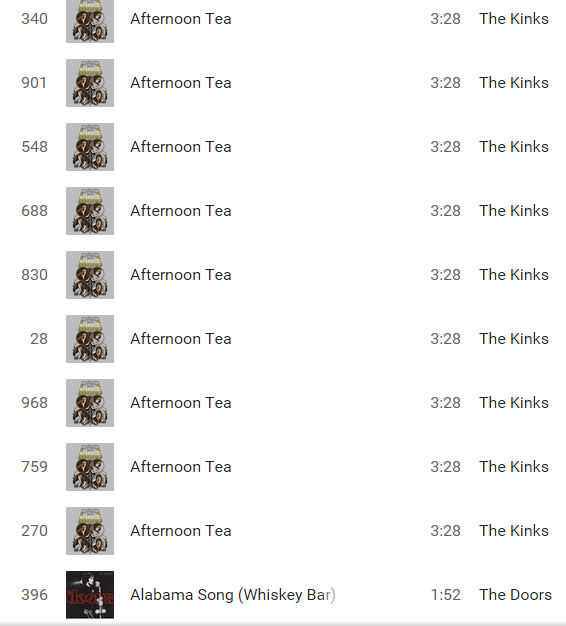
The iTunes playlists that Google automatically backs up to their cloud get hopeless cluttered with multiple versions of each song, til you reach the maximum size of 1000 songs. You can manually remove duplicates — one by one, folks! — but others crop up in their place.
It’s irritating. You can’t add any more songs to those playlist. When you play them, they repeat songs despite the “No repeat” setting. And downloading a playlist takes way more space and time than it should.
How a 75-song playlist looks when bloated to 1000 via repeats. Google must think I really want my Afternoon Tea.
So I’m just going to live with the duplicate problem. Those aren’t my “real” playlists anyway–they’re just a backup. A free backup, at that. So it’s a little buggy. So be it.
Google music services: Take two.
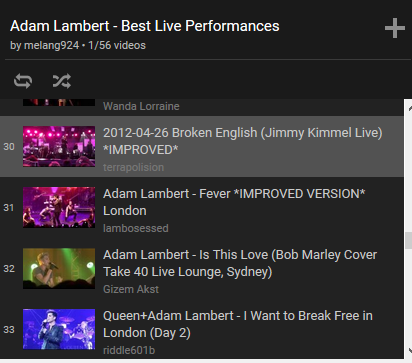
I don’t know if you’ve tried to play a YouTube playlist in Chrome recently, but this week, I did. I found a nice 56-song playlist of live performances, started it off at song 1, and figured I’d have a good set of tunes going for a few hours while I worked away.
Only it kept repeating songs, sometimes just one, sometimes a loop of two or three. It took me a while to figure out that this happened whenever an ad played–every three songs or so. It seemed to then go back in the playlist instead of forward.
I could “reset” the playlist to the right song manually, but after the sixth or seventh time of doing that when all I wanted was a steady flow of tunes, I was getting really cranky.
This “no repeat” YouTube playlist wasn’t so much playing that way
I actually got to wondering if YouTube had a paid, ad-free version I could get instead. I was about ready to plunk my money down.
However, Google was not ready to take it. While they plan to launch subscription YouTube someday, it ain’t available yet.
But Google did help me out. Through their search engine I came across this solution:
Use Firefox, not Chrome
Add in the most wondrous (and free, no restart required) Firefox extension, Adblock Plus
After that, not only did the song repeating stop, so did all the ads! Woo hoo!
I’m sure many of you are like, “Duh!”, because you’ve been blocking browser ads for years, but if I’ve helped even one person not hear a song more times than they’d like (“these are my problems, my first-world problems”), my work here is done.
Timmins, Ontario is not exactly known as a fine dining destination. So when jean posted photos of us eating items such as lobster bisque, caprese salad, rack of lamb, and crème brulée, some of the locals couldn’t believe the meal was had in Timmins.
Rack of lambAmaretto crème brulée
The restaurant is relatively new. It is called 1800 Restaurant, and it is located in the somewhat tired-looking Ramada Inn on Riverside. (When we went for dinner, the hotel seemed eerily quiet, as though almost no one was staying there.) But they’ve done a reasonable job of sprucing up the dining room, even if the cushioned seats were a bit low for the vertically challenged.
And the food was… pretty decent, actually. Jean’s lobster bisque had a good base, but was too salty for our taste buds; it might have been fine for some people. Caprese salad is admittedly an easy dish (as long as you have good tomatoes), but some restaurants still manage to get it wrong. This one didn’t. Our dining companions seemed to enjoy their appetizers of seared scallops and fried rice balls, respectively.
As my main, I had pickerel almandine—pickerel being a local fish. My brother reported that on an earlier visit, that dish had been too salty. They have rectified that problem. My only issue was the lemon seasoning not being applied consistently to the fish, so in some spots being too intense. Overall it was still a good dish, though, with crisp vegetables and mashed potatoes. (Will note that one diner judged the mashed potatoes too dry, but I was fine with them—matter of taste, I guess.)
Two people had the seafood cappelini with goat cheese, which was quite nicely executed.
The house-made desserts of creme caramel and creme brulee, each infused with a different type of alcohol, were successful, the brulée slightly more than the caramel.
The service was acceptable, but by no means fine dining levels. For example, the bottle of German Riesling we ordered (just $35) was opened for us, but not poured. Just plunked on the table. That seemed really odd. And getting our bill at the end took ages—a good 45 minutes after we were done—as staff kept disappearing into back rooms. Our waitress was perfectly pleasant all evening. But the service was just… not refined.
Still, I do hope this place survives, particularly if they keep improving, as they seem to be.
On our drive back from Timmins, we stayed in the sleepy town of Singhampton and dined at Haisai. We’ve been to Haisai several times before, but hadn’t been for dinner in several years. All the dim sum items available at lunch are also on offer for dinner (though the wood-burning oven pizzas are not), but since we’d already tried a number of those, we decided to go the more traditional appetizer / entree / dessert route.
Jean declared his zucchini soup the best ever and—I can’t remember what my appetizer was. But I’m pretty sure I liked it as well. They had only three entree items on the menu. I went with the white fish, while Jean had the suckling pig. Both were well-prepared, seasoned, and arranged. Delish, For dessert we shared the peach and almond tart with chantilly cream.
Our mains at Haisai, as always built around local ingredients
Talking with Hermann Stadtlander, restaurant host, we found out that the future of Haisai is somewhat in doubt. Several of the kitchen apprentices are moving on, and Hermann himself is off to apprentice in Europe for about a year. So it’s far from certain that the restaurant will even be open this fall and winter.
Le sigh.
My hairdresser had mentioned a new restaurant called Fork and Cork that she thought was downtown Kitchener. When I looked it up, though, I found that it was actually on Weber East, near Fairview Mall.
But it sounded kind of promising: Chef trained at Stratford cooking school, with past experience at Toronto’s Buca, offering a menu with a focus on local foods. So we rather spontaneously decided to go eat there on Friday.
The place was larger and busier than we were expecting. It also had those wonderful open ceilings that make rooms noisier than they need to be! Yay! Jean described the overall atmosphere as somewhat industrial. (Nice detail, though: They seem to have their own water spritzer, so you can get carbonated water without paying San Pelligrino prices.)
But they do know how to cook here. Jean continued his soup run, and declared the corn chowder with pork hocks the best he’s ever had. (That’s two “best ever” soups within two weeks, if you’re counting.) I had the lamb skewers, which were nicely seasoned and cooked. It is a bother to have a pull meat off sticks, though.
Fork and Cork appetizers
We are all about the pasta for our mains. Both the spaghettoni with braised duck leg and the ravioli stuffed with peas and goat cheese were pretty amazing, really. And the Italian ripasso we picked out went well. (They have quite a few local wines also, and pretty reasonable prices—many bottles around $40. The ripasso, at $62, was one of the most expensive.)
Not sure what I’m pointing at here…
The only slightly disappointing item was one of the desserts. The peaches with ginger ice cream and sesame brittle sounded great in theory, but the ingredients didn’t work together in practice (though they all tasted fine on their own). The flourless brownie was just delicious, though.
The service was good, our waitress attentive and knowledgeable. The pace of the meal was a bit fast, though. Each course came out a bit more quickly than we were expecting—albeit never before we were done with the last. So this is no place for a long, leisurely romantic dinner or catch-up with friends.
My title says one price, which is a bit of an exaggeration. Of course the totals of each meal weren’t identical, but they were all in the same ballpark for two people, three courses, one bottle of wine (likely the biggest variable). The totals for each including tax and tip: 1800 was $162, Haisai was $176, and Fork and Cork was $185.
This summer’s vacation read was Station Eleven by Emily St. John Mandel. It also happens to be the 2015 One Book, One Community selection for Waterloo region this year.
I was taken in by this novel pretty much from the get-go (the get-go being pre-vacation). It takes place in the not-so-distant future where a killer flu has wiped out 99% of humanity, with quite a few more dying in the resulting chaos as the world’s infrastructure crumbles in the absence of its caretakers—networks, fuel stations, the electrical grid…
Cheery, huh?
But it isn’t entirely depressing, as the novel moves back and forth through time, to the days of the epidemic, yes, but also before that, and up to 20 years afterward. It’s like a jigsaw puzzle, figuring out how these characters were connected, finding out the origin of mysterious events in the future timeline.
Shakespeare plays a prominent role. The center point of the novel is a Toronto production of King Lear, an unorthodox production featuring children. We learn how the starring actor became famous and get to know his wives. We find that one of the children in the play, a survivor, years later joins a traveling Symphony who bring music and iambic pentameter to the various settlements. Travels that are not without peril.
The book, as one critic said, makes you wistful for our current world. To the post-epidemic young, electricity, running hot water, the Internet, and flying machines all seem unimaginable wonders. One of my favorite lines:
None of the older Symphony members knew much about science, which was frankly maddening given how much time these people had had to look things up on the Internet before the world ended.
I finished the novel on the drive home, and so as not to be rude, I brought Jean up to date via synopsis, then read the last third aloud to him. He got as caught up in it as I had. (Nevertheless, I would recommend reading the entire thing.)
On paper, Mad Max: Fury Road is not my kind of movie. Little sounds less promising to me, movie-wise, than “it’s basically just one big car chase”.
Mad Max: Fury Road is, basically, just one big car chase.
But somehow, the visuals and the pacing of this thing make it work. Visually, everything looks so amazing. Like this dude:
This character has no lines, and bringing him along on this chase makes no sense. (“What, they couldn’t just play a CD?”) But man, did he look cool. (And boy, could he play guitar.)
The story, such as it is, has Max getting kidnapped by these white-skinned people who live in a compound where bad guy Immortan Joe rules the population by controlling the water supply. The action begins when Furiosa (Charlize Theron), secretly stashes away Immortan Joe’s “wives” in her armed vehicle on a purported fuel supply run. Furiosa is reported as having gone off-route, and then the women are found missing. Immortan Joe gathers his troops (including the guitar player) to get them back. Max is taken along as unwilling blood donor.
Mad Max, living blood bag
A crash allows Max to join Furiosa’s side, despite mutual suspicion. Interestingly, despite his titular status, Max remains pretty much her sidekick through the movie.
Is this a feminist movie? You can make a case for it. The women are not just supporting the men’s story; they aren’t just victims or girlfriends. And yes, that was kind of refreshing.
Furiosa, hero
And the violence level? Well, nothing that especially upset my delicate sensibilities. Maybe it all went by too fast.
Now, Jean did complain that much of the movie didn’t really make sense, plot-wise. “It was kind of a bad movie, wasn’t it?”
Yet the next day we had a big old discussion about it, aided in part by this article in The Toast: Welcome to Your Steampunk Future. Sorry There’s No Water, but We Did Put Skulls on Everything. (And read the Comments on this article, too. Yes, really — it’s OK. Comments are moderated at The Toast.) And we had did come to agree that while much of what happened was a bit mystifying, that didn’t really matter. They didn’t go on and on talking about this strange world and its ways, and you didn’t have to understand all the details to follow what was happening.
So yes, it’s an illogical movie that is basically one long car chase. Nevertheless, it provides plenty of food for thought.


 After a hookup that leads to a week of wild sex, irish teacher Sharon is horrified to find that American Rob has impregnated her. So the two make an attempt at having a real relationship despite the challenges of immigration visas, unsupportive family members, dubious friends, and the health problems that can occur when a 42-year-old gets pregnant. Fortunately, they really like each other…




 Cultureguru's Weblog


