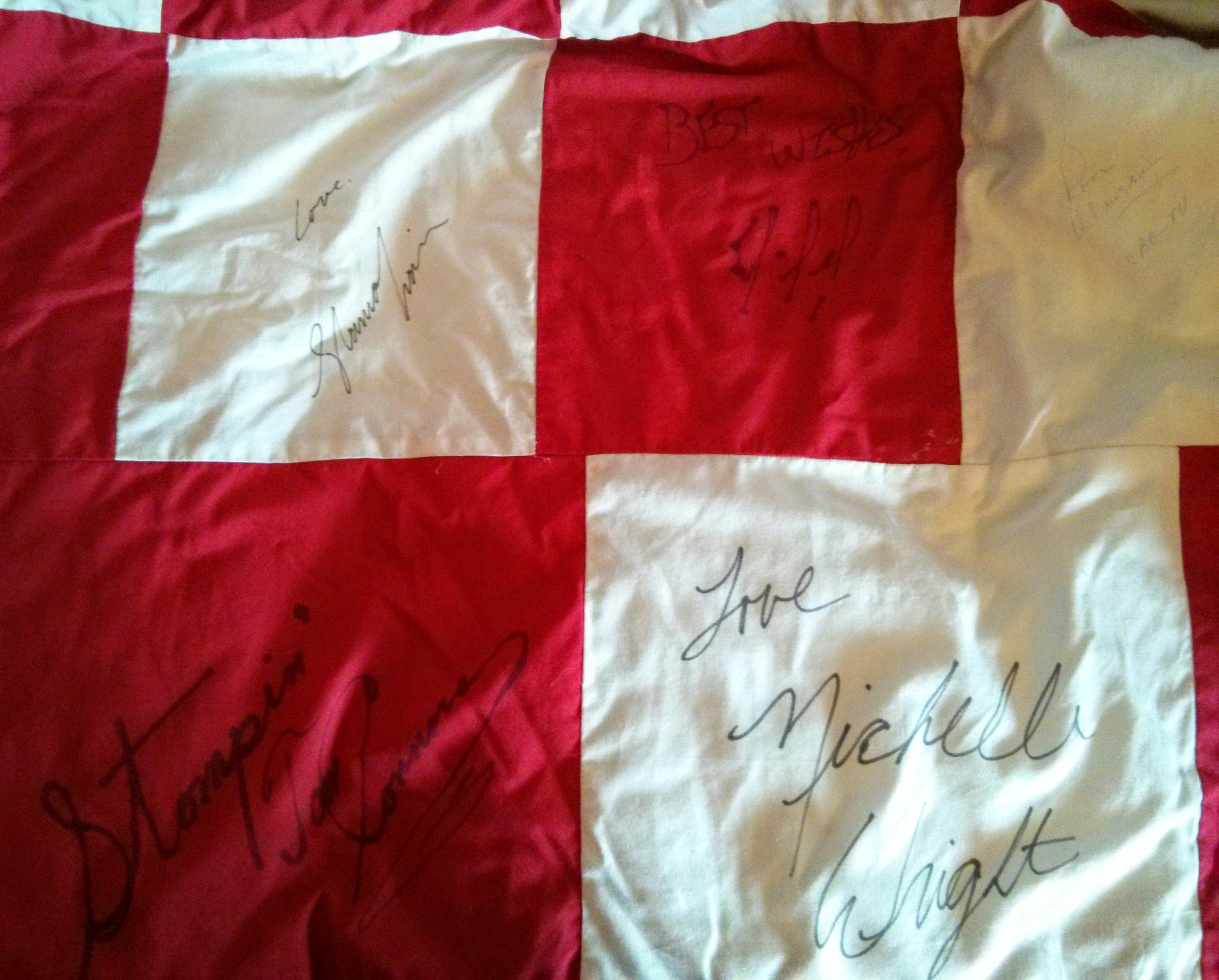
I also spent some time (badly) photographing possibly the most Canadian item I own: A red and white quilt signed by various Canadian celebrities. My mother won it in a museum fundraiser back in 1997, and I recently inherited it.
Since 1997, some of the signatures have faded, and some of the “celebrities” have become obscure. But a number remain fun to look over.
Aw, Mr. Dressup!
So Pamela Anderson was still married to Tommy Lee in ’97. And an interesting juxtaposition beside Jann Arden’s drawing (yes, that angel is naked. As angels are.).
Speaking of Pamelas and juxtapositions, Pamela Wallin was then just a TV journalist, not a disgraced Conservative Senator. The modest signature below hers is that of the Prime Minister of the day, Liberal Jean Chrétien.
Stompin’ Tom was still was us in 1997, and Shania Twain is still with us today. Not sure what’s up with Michelle Wright these days…
We recently visited a new-to-us restaurant in Cambridge, Homage. It’s a relatively small place in a heritage building, with a wood decor, and a fairly casual, slightly hipster atmosphere. It mission statement is food that is “rooted in classic techniques, sourced from the community of farms around the area, served with respect and care”.
Homage interior. Not our photo; this is from their website.
We—or at least I—had been hoping to try their five-course tasting menu, but it turns out they now offer that only “upon advance request”. What they had instead was a small printed menu, supplemented with some chalkboard specials.
The menu was so small, in fact, that we all ended up getting the same entree: the vegetarian gnocchi. The other options were beef or sausage focused, which none of us were big on, or roast chicken, which we like, but which didn’t seem special enough.
We almost all had the same appetizer, too—a sweet pea soup. But then I decided to veer off into the sausage and asparagus flatbread.
Every item was very well prepared, quite flavorful, and the waiter was able to give us the farm origin of all key ingredients. Serving sizes were modest, so we had room for dessert. Two of us had the lovely chocolate parfait, another the strawberry marquis. And the bill was also modest: about $135 for the three of us, including a bottle of wine and some coffee.
And the restaurant–while admittedly not packed full–was blessedly quiet. No need to shout out our conversation.
And they don’t disqualify any for being too noisy, so both Nick and Nat’s Uptown 21 and The Bauer Kitchen are also there.
They also have a number of places that I’ve also enjoyed, but didn’t include because I haven’t been there recently enough: Ellison’s Bistro, Janet Lynn’s Bistro, Borealis Grille & Bar, Masala Bay, and Red House. (I should really get back to some of these…)
The charming Elvis Ellison, owner and chef at Ellison’s bistro. Also not our photo; this one is from Huffpost Canada.
And, they have a few more that I’m now curious about:
Bread Heads: “My vote for best pizza in the region”, it says.
The Belmont Bistro. I liked their previous incarnation as the Village Creperie, and the new menu sounds good.
Rainbow Caribbean Kitchen. “The top place in town for Jamaican fare”. That would be different, for a casual meal.
Timeless Cafe and Bar: With a “unique atmosphere” and “regularly changing menu” of delicious food.
The Guanaquita Restaurant, with El Salvadoran food, and dancing, apparently? Hmm.
Then a number that I’m not interested in, because they’re just not my kind of place:
The Bent Elbow, “A place of beer worship” where “food is secondary”. (Basically the definition of “not my kind of place”.)
Lancaster Smokehouse: Cause it’s all about the ribs, which I don’t eat.
Del’s Enoteca (formerly Del Dente). Pizza. But why go here if Bread Heads has the best pizza?
Rana Doner Kebabs
Holy Guacamole. Isn’t this a chain? (Though it is useful to know that it offers decent Mexican.)
Kinkaku Izakaya. I don’t care if it’s better than most all you can eat sushi. It’s still all you can eat sushi.
Then these are the ones that I gave love to, but Huffpost didn’t: Gilt, Bloom restaurant, Sole, Aqua (at the Crowne Plaza—apparently only now “officially” launched), Niko Niko Sushi Roll, along the coffee shops, Death Valley’s Little Brother, Princess Cafe, and Cafe Pyrus.
And their list is strictly KW, so anything far afield, like Langdon Hall or the Easy Pour Wine Bar, is also not there.
In Canada, weather dictates that outdoor festival is pretty short. That’s why I found that timing and programming of Kitchener’s Summer Lights Festival pretty smart. This night of “exploration and discovery” in downtown Kitchener, ran from 8 pm to 1 am, which meant that it started right after the Multicultural Festival in nearby Victoria Park ended. And, it was held in coordination with the Open Ears Festival of Music and Sound and the Our World Festival of Music.
Not only a clever way of allowing people to attend many festivals at once, but it also made the one event much more big and interesting than any of them would have been alone.
They blocked off part of King Street in Kitchener, so you ended up exploring it in that way. (I got suddenly curious about Fritsch Fragrances, Inc., which looks like it’s about 100 years old. Does it really only sell fragrances? Is that a viable business model?) A number of the restaurants and stores were open. Food carts and trucks were on the streets, as were installations such as:
The community couch (sit and talk to strangers—which I didn’t)
The black light post (get painted and glow)
Painters of the night (artists painting on the street, that is)
Board game zone
Henna tatoo station
Etc. The public buildings were also transformed—the KW Symphony building became a 90s house dance club (pretty dead one at first, but it did liven up later); the inside of City Hall an old-time arcade and Rock Band performance site; and The Museum a live concert venue (featuring a Very! Loud! rock band when we walked in), with an “alternative” market.
Lighting up the City Hall fountain at the Summer Lights Festival
The range of music and sound on the streets was quite astonishing. Open Ears brought in the weird but cool experimental stuff: the art installation featuring percussion instruments the public could bash away on; the arrangement of different musicians and styles all around the city hall fountain; the classical musicians providing a live soundtrack to a silent French surrealistic movie.
Then there was the AcaBellas, doing their best Pitch Perfect mash-up of Daft Punk’s “Get Lucky” with, well, two other songs that I’m sure are really famous and popular… And the jazz group performing ‘”What a Wonderful World” in front of a dance floor. (Jean refused to shake his groove thing, though, citing improper footwear and a dislike of rhumba.) Along with the more expected folk guitarists and bands doing classic rock covers.
The lovely Alysha Brilla
The definite highlight for us, though, was the performance by the woman who convinced us to get out there past by our bedtime in the first place: Alysha Brilla. Her style of music is mix of jazz, pop, and Latin. We know of her mainly because CBC—even the news channel—plays her music a lot (for which she thanked them during her performance). We started watching her from afar, then got closer, until I, at least, couldn’t resist joining the crowd dancing right in front of the stage. She was terrific at egging us all on.
Dance party in Kitchener!
I did not, however, volunteer to go up and dance on stage. Those who did, had some serious skills!
All in all, one of the funnest concerts we’ve been to in a while. We really got lifted.
Thanks to their 0.99 cents for three months offer, I’ve been trying out Spotify Premium for a few weeks. Here are my inconclusive conclusions about it so far.
What is Spotify?
It’s a streaming music service, whereby you can listen to any song in their vast collection from your PC, phone, or tablet. They have apps for each and your login keeps your account synchronized between devices. Artists are paid according to their streaming popularity (though whether they are paid enough is under debate).
What’s the difference between free Spotify and Spotify Premium (paid)?
With Premium, you get:
No ads, which otherwise are played every few songs.
Higher music quality. And yes, it’s a noticeable difference, at least when playing through a good stereo system.
Play any song on demand. on any device. The free service prevents you from doing this on the mobile apps.
Ability to download songs on phones and tablets for offline playing, thereby reducing data usage. (You don’t keep the songs; they’re only available within the Spotify player.)
Skip as many songs as you like. With free, you can do this only five times per hour.
I’m not a big song skipper—if I’m hitting so many songs I don’t like I’d rather just change playlists or artists—but otherwise I would say the premium features make Spotify a much more pleasant listening experience.
What else is good about Spotify?
The size of the catalog, for sure. It’s terrific for checking out new (or old) artists or songs you’re curious about or revisiting old favorites.
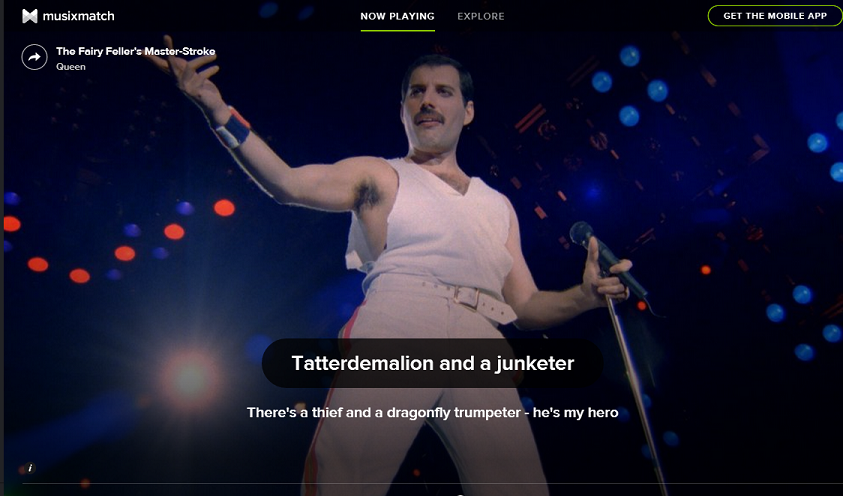
The integrated lyrics. In the desktop version, with one click you transform the app into a sort of karaoke machine, with the lyrics scrolling by as the singer sings them. If the timing or words are wrong or missing, you can supply them yourself, if so inclined. In the Android app version, you can achieve the same with the floating MusicMix app.
The rather esoteric lyrics to Queen’s “The Fairy Feller’s Master Stroke”
The ability to follow other people’s playlists. Although, to be honest, I’m only following Adam Lambert’s. Still, it gives me a little happy that I get notified every time Adam adds a song to his playlist. (Even though we don’t have 100% the same taste in music, as it turns out.)
Now Playing with Adam Lambert (I wish… 🙂
What’s not so good about Spotify
They have a desktop browser version that makes me feel stupid, because every time I go there, I have a heck of a time figuring out how to get to my music. The link to that part of their site is teeny and buried and it’s so annoying.
Scroll down, way down, the Spotify website to get to the actual music player
(I guess it’s their way of pushing you to their desktop app instead, the usability of which is fine.)
No way to mark songs as favorites, which is a weird omission. I’m listening to find songs I like and might want to get back to, but there’s no easy way to do that. You can add songs to “My music” or playlist, but that isn’t quite the same…
How does Spotify compare with Google Play Music?
To truly answer this question, I’m going to have to give Google’s paid version another trial run.
But what I can say so far is, that Google beats Spotify on the following counts:
Google has a thumb’s up button to mark the songs you like.
Google does a better job of integrating my actual songs—that is, the thousands of songs I’ve purchased and lovingly categorized in iTunes lo these many years. With my permission, Google just takes all that music and puts it in the cloud for me, using their version when they have it and uploading my copy when they don’t. And unlike Apple, they do that for free, up to a size limit I’m never going to reach it. Spotify can only handle local “owned” music.
That’s all lovely; however… Having looked at my Google playlists more closely due to writing this post, I have discovered that they are kind of a mess, with each song in every one of them being repeated up to four times, for some reason.
My Summertime playlist in iTunes is a mere 195 songs, no repeatsGoogle bloats this exact same playlist up to 999 (!) songs by repeating each song multiple times….
And, Google playlists are arbitrarily limited to 1000 songs. Which is not enough for me. But, I am at this point grateful for that limit, since I suspect I would otherwise have each song repeated hundred of times in those playlists, instead of mere four or so…
When I’m truly trialing Google, I’ll have to investigate how to clean that up. And see if it’s really true that Google’s auto-generated playlists, based on an artist or song you like, are much better that Spotify’s (as I’ve heard).
In the meantime, I can say what’s about the same between the two:
The monthly price.
The option to download for access without data usage on mobile.
The size of the catalog of streaming songs (so I’ve heard).
The integrated lyrics in the app version.
And what it lacks compared with Spotify:
The web version doesn’t have integrated lyrics, at least not with such a good interface.
It does not allow me to follow celebrity playlists.
Also, Google doesn’t have an, ad-paid free option for listening to the streaming music. (I think this is true.)
Aren’t there other music streaming services?
Sure, lots, like Rdio, but Spotify is the market leader, and Google Play Music is a logical alternative for those using Android devices (as the upcoming Apple Music will be for iOs people).
And anyway, this blog post is long enough already.
Is it worth paying $10 a month for music vs. buying music as you want it and listening to that?
That is the question that I haven’t entirely figured out the answer to yet.
Because my purchased music, it has to be said, does has its own benefits:
It is already paid for.
It is already organized exactly the way I like it.
I don’t always to discover; sometimes I want what I know.
But also, I have enough of music (over 8000 songs) that I can actually do a fair amount of experimental listening just within my own catalog.
I can play it in my car via CD or iPod. But my car (despite being fairly new) has no bluetooth or wired support for Android devices, so no streaming services work in it.
I actually do have some songs you can’t get on the streaming services. They have a lot, but not everything.
But how long can I stick with buying rather than paid streaming?
That is the question. Apple no longer makes iPod Classics and has been basically ruined iTunes. (I’m still using version 10.) So what am I going to play “my” music (about 60 GB worth) on in the future?
And as for acquiring new stuff, who knows how much longer Amazon, Google, and Apple will be just as willing to sell you a CD or a digital music file as they are to have you pay a monthly rental fee for it?
I’ve been doing “web stuff” a long time, and some of my old pages come up shockingly high in Google search results. For example, when searching on the best places to eat in Kitchener Waterloo, my page was sometimes on that first page of results. Despite the contents being increasingly out of date.
Yes, I know, y’all read this three years ago, when it was new and hot. But I just finished it. So cast your mind back…
(But if you not have read it (or seen the movie] yet: Spoilers ahead.)
What it’s about, basically
Nick Dunne’s beautiful wife Amy disappears on their anniversary date. The house shows signs of a struggle, but almost in a staged way. The police have to consider Nick a suspect.
What I liked
This was an awesome vacation read. It was very gripping, the plot’s twists and turns continually holding my interest. A perfect way to while away the hours on the sun deck.
But I also found the narrative structure very intriguing. Despite the fact that the story was being told in the first person by Nick—we still weren’t getting the whole story. He was keeping secrets not only from the police, but from us, the readers.
This (along with some of the movie publicity, I must admit) becomes a clue that we should possibly also doubt Amy’s diary entries that intersperse Nick’s telling of her disappearance in the first part of the novel. Who can you trust?
What I had some issues with
The story’s structure is such that we’re supposed to find some equivalencies between Amy and Nick, I think, but, but… Amy is a murderous, vengeful psychopath. Nick is a bit flawed and weak.
Of course, Amy’s extremes made for this very enthralling plot—but it was very extreme.
About that ending
I talked to a number of people about this book and the movie. A lot of people hated the ending. A few people thought it was just right. But love it or hate it, one thing they had in common was: They couldn’t quite remember what the ending was. Only their feelings about it. Curious.
Well, at this point, I can still remember the ending, and I wasn’t crazy about it. It seemed a rather odd choice. And yet I wasn’t sure how I would have preferred that it end. I was briefly determined to see the movie, as I had somehow got in my head that it ended differently than the book, and I was curious to see an alternative. But further research dashed my hopes: It has the exact same ending, apparently.
Guess I’ll wait to see the movie when I forget the ending, as that seems an inevitable occurrence…
What the book says about marriage
I’ve heard this “it’s an indictment of marriage” theory, but frankly, I don’t think this book says anything about marriage in general. Heck, given the narrative structure, we don’t even learn about Nick and Amy’s specific marriage. Not really. We only find out about it through a lying diary and the fog of memory (his and hers). It’s all past tense, and at a very tense time for both!
Really, I think, the only lesson you can take is: Try not to marry a murderous psychopath.
Can we blame Amy’s parents?
This was another theory i’d heard before reading the book, and then I kept waiting for Amy’s parents to do so or say something that would give a hint as to how they had turned her into what she was, but… Bupkus. Sure, they weren’t perfect. She was an only child, they literally elevated her to “Amazing Amy” status through a series of books they wrote, but not every spoiled kid turns into this.
It’s probably best not to try to find deep meaning in a fun vacation read. Even one written with such skill.
Our recent trip took us to Dubrovnik, Croatia (after a 9+ hour flight, transfer, and additional 45-minute flight). We then took a one-week, small-ship cruise of the Dalmatian Islands, ending up back in Dubrovnik. From Dubrovnik, we took a short trip to nearby Lokrum Island.
Not our boat’s itinerary, exactly, but does point out the places we visited.
He’d found a small-ship cruise that fit into one of the few periods this spring where we could fit in a 10-day vacation.
And that’s about it, really. Jean did all the booking of this trip: the cruise, the flights (not that easy to arrange), the hotel in Dubrovnik, where we stayed before and after getting on the ship. I bought a couple Croatia travel guides and flipped through them, but overall, this was one of the trips I’d prepped for the least.
Reading the cruise itinerary, we both had similar thoughts: Wow, that sounds really relaxing.
Some recent-ish news about subjects previously featured in this blog…
KW Glee, who blew us away with their performance with the KW Symphony earlier this year, proved that performance was no fluke as they were named Show Choir Canada’s Grand Champions. They also won best vocal, choreography, show design, and new choir. Unsurprisingly, their spring concert is sold out! We’re going to have to be more on the ball for tickets if want to see them in concert again.
As for the TV show that inspired KW Glee, the last two season 5 Glee episodes featuring Adam Lambert — “Trio” and “New New York” turned out to be… Pretty good, actually. Not so good that I feel the need to watch more episodes of Glee or anything, but worth watching for more than the Lambert pretty.
Adam Lambert himself has been in full promotional mode this week, as his new single has been released. “Ghost Town” is incredibly catchy and rather, as long you’re OK with the house style (which I am). Now that I’m no longer in a grief fog, I’ve also been re-listening to his Trespassing album. It’s quite good (and more than just distracting pop, really); very surprising it wasn’t a bigger success. Let’s hope he gets the success he deserves with the new album, out in June.
And he’s still handsome. Guess that’s not news.
.But the other “Americans” I’ve been watching, Elizabeth and Phillip, have been recognized with a Peabody Award for Quality in Television. Well-deserved, I think; we’re nearly done watching Season 1 of The Americans and the show only get more complicated and fascinating as it goes. Apparently it’s just as good (or even better) through seasons 2 and 3. Great viewing ahead!
Although we had no complaints about the food at our first visit to the Easy Pour Wine Bar, the service left something to be desired.
It’s not a high-end, white-linen place; we weren’t expecting anyone to hold our chairs as we sat or to be given a complimentary amuse to start.
But we did expect familiarity with the menu, as it is a bit of an unusual one. It has a list of items “to share”, then some salads, then flatbreads, then a small number of “heartier plates”. So it wasn’t as clear as at appetizer / entree / dessert restaurants how much to order from each category. We needed guidance, and we didn’t really get it.
And it didn’t help the situation any when Jean asked which cheeses were included on the cheese plate, and the waiter didn’t know, and then seem quite startled that Jean expected him to go to the kitchen to find out.
Hence the rather large gap since our last visit. But when some friends wanted to go out for dinner, we thought we’d give them another chance.
And fortunately, we had a much more “on the ball” waitress this time out, who opined correctly on the amount of food we’d ordered, steered in a different direction when we ordered two rather similar items, and gave some good wine suggestions. We decided to share everything, picking among the “to share”, salad, and flatbread categories. We started with the Mixed board, a nice selection of cheese, olives, deli meats, bread, and crackers.
The remaining items were brought out together, per our waitress’s suggestion:
Pea seared sea scallops
Warm pecan crusted goat cheese
Roasted beet salad
Truffle mushroom flatbread
Everything was really tasty, good texture, temperature, and presentation.
Our additional request for a special that day, oysters roquefeller, was apparently not heard, but just as well, as the above was enough food, and then most of us had room for dessert. I had the pumpkin creme brulee, which was light and delightful, and Jean went for the more hardy sticky toffee pudding.
The restaurant itself has character, It’s a stone building, not that large, with wood interior and open ceiling to the second floor. It was packed this Saturday night, and that made it a bit noisy, but we still managed conversation. (Although once the musicians started, that became harder, but that was only at the end of our meal.)
Nice night out. Good to know the service issues aren’t chronic.













 What it’s about, basically


