About my last post

I’ve admittedly had some relapses in my “ignore the election” resolve, but the previous post was actually written before said resolution. I sent it as a letter to the editor, but it appears it’s been rejected. As I actually spent a lot of time writing that sucker (takes so much longer to write less!), I just wanted it published somewhere!

(And by the way, Braid used the exact same line to avoid an all-candidates debate on Science held at University of Waterloo.)

Still, sorry for adding to the discussion of topic that I know Canadians are tired of, and non-Canadian don’t give a fig about. (But just for the record, progressive Canadians: Please do get out and vote!)

And frankly, though voiced in a bit of jokey way in my “shit’s making me crazy” post, it’s pathetically absolutely true that my mental health degrades when I pay too much attention to politics. It literally sucks the joy out of my life. And I can’t write about something without thinking about it.

So it’s time this blog got back to the admittedly trivial topics that actually make me happy to ponder.

Starting with a poll in which none of the results could be depressing.

#Elxn42: This shit’s making me crazy

This shit’s making me crazy
The way you nullify what’s in my head
You say one thing, do another
And argue that’s not what you did
Your way’s making me mental
How you filter as skewed interpret
I swear you won’t be happy til
I am bound in a straight jacket

— Alanis Morissette, “Straightjacket”

So, it’s that part of the Canadian federal election where everything seems stupid and awful, we semi-hate everyone now, and when will it be over?!!

At least, I’m pretty sure it’s not just me.

Fortunately, I was able to decide who to vote for in the early and considerably less awful part of this extra-long campaign. And I’m not even primarily voting against something.

On balance, I just found that I like the Liberal platform the best. Things like, banning taxpayer-paid government ads (much as we’ll all miss those “Canada Action Plan” ads). And making the Senate non-partisan (one they’ve already walked the talk on). And, amending the Access to Information Act so it actually provides access to information. Ending omnibus bills. Trying to make Question Period better (it can hardly be worse). And yes, legalizing marijuana.

I also found Trudeau the most appealing leader overall. He’s shown more passion and boldness than the others. And I’m not concerned about his competence to govern.

As well, I am really impressed with the Waterloo Liberal candidate, Bardish Chagger. She’s smart, well-spoken, experienced in working in federal government. And she’s bound and determined to vote for Waterloo interests first, her party second. “I’d like to meet the person who succeeds in telling me what to do”, she said, credibly, at the debate I attended.

So good luck Ms. Chagger!

But I hope you’ll excuse while I now do my best to ignore the rest of the campaign. Because it’s not that I’m not interested. It’s just that me being interested has the unfortunate side-effect of me starting really care what happens. And I have no control over what happens—what politicians do and say, how the media reports it, and ultimately, how everyone else votes.

And that shit makes me crazy (then angry, scared, and finally kind of depressed and hopeless). I need off this emotional roller-coaster.

So bye-bye news radio, hello iTunes. See ya Macleans; the new Entertainment Weekly is in. Watch a leader’s debate? Are you kidding me? It’s the fall TV season! (Plus, I just discovered iZombie and Mozart in the Jungle on Shomi. Seriously, so fun.) Political bios? Not when I have a fresh copy of Aziz Ansari’s Modern Romance.

Now, Twitter remains a minefield. And I’m not ready to give that up, but I guess I can mute / unfollow a few politicos until November or so, eh?

By then, hopefully this will no longer be my anthem:

Straightjacket on YouTube

Station Eleven

Station Eleven cover

This summer’s vacation read was Station Eleven by Emily St. John Mandel. It also happens to be the 2015 One Book, One Community selection for Waterloo region this year.

I was taken in by this novel pretty much from the get-go (the get-go being pre-vacation). It takes place in the not-so-distant future where a killer flu has wiped out 99% of humanity, with quite a few more dying in the resulting chaos as the world’s infrastructure crumbles in the absence of its caretakers—networks, fuel stations, the electrical grid…

Cheery, huh?

But it isn’t entirely depressing, as the novel moves back and forth through time, to the days of the epidemic, yes, but also before that, and up to 20 years afterward. It’s like a jigsaw puzzle, figuring out how these characters were connected, finding out the origin of mysterious events in the future timeline.

Shakespeare plays a prominent role. The center point of the novel is a Toronto production of King Lear, an unorthodox production featuring children. We learn how the starring actor became famous and get to know his wives. We find that one of the children in the play, a survivor, years later joins a traveling Symphony who bring music and iambic pentameter to the various settlements. Travels that are not without peril.

The book, as one critic said, makes you wistful for our current world. To the post-epidemic young, electricity, running hot water, the Internet, and flying machines all seem unimaginable wonders. One of my favorite lines:

None of the older Symphony members knew much about science, which was frankly maddening given how much time these people had had to look things up on the Internet before the world ended.

I finished the novel on the drive home, and so as not to be rude, I brought Jean up to date via synopsis, then read the last third aloud to him. He got as caught up in it as I had. (Nevertheless, I would recommend reading the entire thing.)

Bonus: This is how Emily St. John Mandel edited Station Eleven.

Gone Girl (the book)

Yes, I know, y’all read this three years ago, when it was new and hot. But I just finished it. So cast your mind back…

(But if you not have read it (or seen the movie] yet: Spoilers ahead.)

Gone Girl coverWhat it’s about, basically

Nick Dunne’s beautiful wife Amy disappears on their anniversary date. The house shows signs of a struggle, but almost in a staged way. The police have to consider Nick a suspect.

What I liked

This was an awesome vacation read. It was very gripping, the plot’s twists and turns continually holding my interest. A perfect way to while away the hours on the sun deck.

But I also found the narrative structure very intriguing. Despite the fact that the story was being told in the first person by Nick—we still weren’t getting the whole story. He was keeping secrets not only from the police, but from us, the readers.

This (along with some of the movie publicity, I must admit) becomes a clue that we should possibly also doubt Amy’s diary entries that intersperse Nick’s telling of her disappearance in the first part of the novel. Who can you trust?

What I had some issues with

The story’s structure is such that we’re supposed to find some equivalencies between Amy and Nick, I think, but, but… Amy is a murderous, vengeful psychopath. Nick is a bit flawed and weak.

Of course, Amy’s extremes made for this very enthralling plot—but it was very extreme.

About that ending

I talked to a number of people about this book and the movie. A lot of people hated the ending. A few people thought it was just right. But love it or hate it, one thing they had in common was: They couldn’t quite remember what the ending was. Only their feelings about it. Curious.

Well, at this point, I can still remember the ending, and I wasn’t crazy about it. It seemed a rather odd choice. And yet I wasn’t sure how I would have preferred that it end. I was briefly determined to see the movie, as I had somehow got in my head that it ended differently than the book, and I was curious to see an alternative. But further research dashed my hopes: It has the  exact same ending, apparently.

Guess I’ll wait to see the movie when I forget the ending, as that seems an inevitable occurrence…

What the book says about marriage

I’ve heard this “it’s an indictment of marriage” theory, but frankly, I don’t think this book says anything about marriage in general. Heck, given the narrative structure, we don’t even learn about Nick and Amy’s specific marriage. Not really. We only find out about it through a lying diary and the fog of memory (his and hers). It’s all past tense, and at a very tense time for both!

Really, I think, the only lesson you can take is: Try not to marry a murderous psychopath.

Can we blame Amy’s parents?

This was another theory i’d heard before reading the book, and then I kept waiting for Amy’s parents to do so or say something that would give a hint as to how they had turned her into what she was, but… Bupkus. Sure, they weren’t perfect. She was an only child, they literally elevated her to “Amazing Amy” status through a series of books they wrote, but not every spoiled kid turns into this.

It’s probably best not to try to find deep meaning in a fun vacation read. Even one written with such skill.

To breed or not to breed (redux)

Selfish, Shallow, and Self-AbsorbedA new book is out called Selfish, Shallow, and Self-Absorbed: Sixteen Writers on the Decision Not to Have Kids. It seems to be getting a lot of buzz (and selling pretty well).

I have not read it, so can’t comment on its contents. As one of this selfish, shallow, and self-absorbed tribe, however, it did surprise me a bit that my choice remains of such interest. Or still be so hard to understand.

Mind, I had my own phase of reading a number of books on this subject—looking for kindred spirits, I guess. Some years ago I wrote a review of three of them. I got quite a bit of feedback on it, which was very unusual for content on a personal website. Thought I might repost the reviews now. It’s only very lightly edited from how it appeared then.


Despite the declining birth rate, it’s still considered odd for a heterosexual couple to not have children. The default is to have children (preferably two, one of each sex), and if you don’t, you’re expected to explain why. But if you’re going to go just on logic, there isn’t much reason to have children. We no longer need them to help on the farm, and there’s no guarantee they’ll take care of us when we’re old. Better to build up good RRSP savings.

No, the decision to have children is all about emotions, no logic. People want them. And when they have them, they love them, and can’t imagine life without them.

I guess. I wouldn’t know, would I? But I can say that my reasons for not going there are also mostly emotional. I just don’t want children. I can’t really say why I don’t; I just don’t. Never have. Have never heard the biological clock ticking; have never looked at children with an aching wish they were my own. Apparently this is unusual, especially for women.

This is why I tend to be drawn to artistic artifacts that reflect how I feel (or don’t feel, I suppose). Such as the following three books, all of which I’ve read (or listened to) in the past year. Warning that some of my comments may spoil the two fiction books.

We Need to Talk about Kevin coverLionel Shriver (a woman) wrote the fictional We Need to Talk about Kevin as her way of working through the question of whether she should have children. The book is told in the voice of a woman, Eva K., who never wanted children, but acquiesed because she knew her beloved husband would never be happy without them.

To say that the child, Kevin, does not turn out well is an understatement: After a difficult childhood, he becomes a high school mass murderer. The question is, how much of that violence and anger was genetic (nature), and how much is due to Eva’s admitted reluctance to becoming a mother (nurture)? With the whole story told for her point of view, looking back with the knowledge of how her son has turned out, Eva is not a completely reliable narrator. For example, she sees willfulness even in the newborn Kevin, who seems to be inconsolable with her but quiet and happy as soon as her husband comes home.

Shriver is a skillful writer and, despite the darkness of the novel, I found it a compelling read. I couldn’t help but feel enormous sympathy for the narrator as she dealt with her husband’s fervent desire for a child, his over-protectiveness during her pregnancy, her reluctance to push during childbirth, her disappointment at how their lives changed to accommodate the child. Apparently much of this material has also struck a chord with women who weren’t reluctant mothers but still struggle with these issues. (Motherhood is hard. Or so I’ve heard.)

Of course, the novel takes it to an extreme. Taking an abnormally long time to be toilet trained or wantonly destroying prized possessions may not be that unusual, but school murder and somehow contributing to your sister losing an eye to corrosive chemicals—well, those are pretty rare events.

The sister. Yes, an interesting turn Shriver’s novel takes is that Eva decides that another child is needed. Her husband, noting the difficult relationship she has with Kevin, is completely against this. Eva tricks him into impregnation. The second child couldn’t be a greater contrast to Kevin, and Eva finds she has no difficulty loving her.

Her relationship with her husband, however, gets strained beyond repair. He, of course, accepts his daughter, but can’t get beyond Eva coldness toward her son. They agree to separate after the school year, but the murder intervenes.

Eva addresses all of the writing is to her husband; the whole novel is in the form of letters he never responds to. (We find out why near the end of the book.) While she claims to love him always and unconditionally, and greatly mourns his loss, I felt strangely unsympathetic toward him. Eva really felt that she saw Kevin as he really was, while Kevin just put on a happy act for his father. Seeing the whole story through her eyes, it was hard for me not to feel some contempt for this apparently wilful blindness, and to not quite get why Eva loved her husband so much. Whether that aspect is a failure of writing or just my personal issues, I’m not sure.

(Postscript: After writing the novel, Ms. Shriver shows to remain childless.)

Baby Proof coverMuch lighter and different in approach is Baby Proof by Emily Griffin, a mother of two. Griffin wanted to explore the conflict between a couple who didn’t agree on whether to have children, and she wanted the woman to be the reluctant one. It’s another first-person novel, though not in the form of letters this time.

The main character, Claudia, has always felt that she didn’t want children. She had resigned herself to the fact that this might mean she would never have a husband, either, until she met Ben, who shares her views. They wed, and all is well for the first couple of years, until Ben changes his mind and tries to change hers. Their arguments grow increasingly heated until they decide that divorce is the only answer. But neither ends up being that happy in divorce, either.

In this novel, the deck really seemed to be stacked against Claudia, who didn’t seem to have anyone in her life who understood her point of view. Ben changed his mind about kids then kept demanding reasons why she wouldn’t have any, just so he could shoot them down. Claudia runs to her friend Jess, who would have a family herself if only she could find Mr. Right, only to be once again pressed to come up with reasons for not having children. Then there is her one sister who is desperately undergoing fertility treatments, and her other sister with the two great kids.

Honestly. For a novel about being childfree, it felt oppressively child-full.

The resolution was also somewhat unsatisfying. Where Kevin ended on a small yet plausible ray of hope (believe it or not), Baby Proof has Claudia deciding that Ben is her soul mate, and that if she must have a baby to keep him, so be it. Meantime, unbeknowst to her, Ben is also resolving that she is more important to him than a child. In the end, they are back together, and she’s still on birth control, but she’s wavering about it.

Child Free and Loving It! coverPerhaps Claudia needed to read some of the testimonials in Nicki Defago’s Childfree and Loving It! In this non-fiction collection, the married but childfree by choice Defago examines the issues around the question of whether to have children: over-population, the environment, work, life as a couple, obnoxious parents. I didn’t find much of this information all that startling or new (though some might). But what I did find particularly interesting were the personal testimonials.

Under cover of anonymity, she got comments from people content with their decision to have or not to have children, but also those who had them but regretted it. In some cases, they’d had their doubts before, but went ahead to please their partners. In other cases, they hadn’t given the matter that much thought, then been overwhelmed by the reality. These people tended to emphasize that while they loved their children, they still felt their lives would have been better without them. And this wasn’t just from new (stressed) parents, but also from those with older children and teenagers and some looking back from a very welcome empty nest.

These sorts of sentiments are very rarely expressed, but important to hear, I think. While it may be sad to regret not having children, how much sadder to regret having them!

Experiencing pop culture in a time of grief

When someone you love dies, blogging about pop culture, news, travel, and food drops off the priority list.

Doesn’t mean that these trivialities drop our of your life, though. Just that your relationship to them changes, at least for a time.

Music

You know, if you break my heart I’ll go
But I’ll be back again
‘Cause I told you once before good-bye
And I came back again

Music is an emotional mindfield, isn’t it? I don’t think The Beatles “I’ll Be Back” would make anyone’s list of saddest songs ever, but on a day of bad news, I couldn’t handle it. I frantically searched through my playlists for safer havens. I finally settled on “High Energy”, a gathering of uptempo rock and dance numbers, generally with pleasingly dumb lyrics. I stayed locked on that for about a week and a half, ‘til it finally seemed just too incongruous. (Then I switched to Classical.)

Adam Lambert’s excellent album Trespassing was just the sort of uptempo music I needed for a time

Food

I was interested to discover that I still got hungry, still wanted to cook, was still able to eat. Because certain forms of stress and worry make that difficult for me. But not this one, this situation with a known but sad outcome. While  I didn’t eat more, or drink more—I didn’t find comfort in that—I still enjoyed the routine of preparing and eating meals.

I certainly became a distracted cook, though. Leaving the milk out on the counter, putting the vinegar in the wrong pantry, forgetting to start the timer. Like the energy of pushing the sadness away enough to follow a recipe was not leaving enough mental space to remember anything that wasn’t written down.

Things are now improving on that front.

Movies and TV

While actually going out to a movie seemed like too much effort, watching stuff on TV was an appealing distraction. Since I don’t watch much medical stuff anyway, there wasn’t much I felt I had to avoid. Howard’s mother died on Big Bang Theory (as the actress had in real life), but it was handled with a light touch and didn’t set me off. In picking HBO movies, I decided to skip Tom Cruise’s Edge of Tomorrow for now, given its premise of the lead character dying over and over. I instead watched and quite appreciated the comedic In a World, one of the more overtly feminist movies I’ve seen in a long time. Recommended.

https://www.youtube.com/watch?v=bZHBjLFu5is

In a World trailer

News

The human interest stories—little boys lost in the snow, Oliver Sack’s terminal cancer diagnosis—were best avoided for a while, but I still found the theatre of politics a surprisingly useful distraction. Especially in Twitter form (about the length of my attention span, at times). I couldn’t truly dig up my own personal outrage at some of what was going on, but I could still appreciate and retweet other people’s. #StopC51 and all that.

Books

Cover of Being MortalSo just a few days before all this my book club had selected Atul Gawande’s Being Mortal as our next book. It’s about getting older and end of life care, and how the medical profession has been dealing with it, and how it should.

Of course, there were days I wasn’t up to reading much of anything at all, but when I did feel up to it, I did read this, I seriously doubt I would have selected this particular book if left to my own druthers, but I feel it was in some ways helpful. It’s an excellent book, anyway, and much of it was more abstract and factual, which appealed to my logical side. Stories did become more personal and touching later in the book, but that was later in this whole saga for me too and—I don’t think it made anything worse. It certainly presented a number of scenarios I’m so glad my loved one never went through.

Chocolately, literary, comforting joyful Christmas (with an Eighties tinge)

This might be a record number of Christmas posts in a row, but it is more than a one-day event for me (albeit not 12 days), starting with our Noël à deux in advanced of December 25. I’ve already mentioned the meal we had, but we also do a small gift exchange. Jean’s main gift from me was a new watch of a brand he admired, but he got some other little things, like a Chromecast and “life-changing” Saxx underwear (as the ads I now encounter everywhere I go on the web remind me).

My main gift was a record player, which many people thought was an interestingly retro choice of gifts. What I didn’t mention too loudly was that this is actually my second record player (we won’t even talk about how many DVD players I have). The main feature the new one has that the other didn’t is a USB connection to make it easy to digitize LPs. (Because some songs are rather difficult to find digital versions of.) But it also has a nice Start function, and is hooked into the better stereo system. I’ve already listened to more LPs in the last 2 days than I have in the last 2 years.

I received other little items, including a great deal of chocolate: Not one, not two, but three boxes of Purdy’s chocolates; a raspberry chocolate bar; and mini snowballs! I also happened to win a Godiva chocolate basket at a Christmas dance. So the chocolate stores are shored up for a while.

Then we headed to Timmins, where it was weirdly mild this year, but not so mild as to melt the snow:

Gillies Lake in Timmins

We took advantage of the nice winter weather to go walking and snowshoeing, once on our own, once with toute la gang (almost).

Snow shoers
Five of the fourteen of us who went snowshoeing one day

A day after a fresh snow fall, the kids couldn’t resist doing this:

GIF of tree snow clearing

Christmas Eve my side of the family had dinner and stockings at my brother’s house, then the two of us went out to the Réveillon with Jean’s side of the family. As usual, everyone was fasting:

Réveillon food
A tiny sampler of the available food

There was a very good turnout, with only a few nieces and nephews away this year. The gift exchange from Jean’s side is an anonymous one on a theme, which this year was royal purple. I am now the proud recipient of two purple travel mugs. My lucky giftee now owns Prince’s Purple Rain on CD and BluRay.

With my family it was the first time in quite a few Christmas’s that all the siblings were up. We had a terrible time. 🙂

Two siblings and an in-law
Two siblings and an in-law, as I don’t seem to have a photo of all siblings. Perhaps I’ll get one from Dad later.

We also attempted a theme this year, though it was only loosely adhered to: comfort and joy. Cozy scarves were a popular item.

jean with cashmere
Cashmere!
S-S and faux fur
S-S rockin’ the faux fur

As were books! I have, like, six new books now. Most everyone else got a least one, I think. I made my sister’s fit into the theme with the Pleasure in the title—pretty close to joy, right? (Plus, John Taylor—yummy! Joy!)

In the Pleasure Groove

To add to my haul and increase the utility of my earlier gift, I dug through the LPs from our teenage years that had been languishing at my parent’s house, and brought home a bag-ful. Duran Duran, Aha, Prefab Sprout, Adam Ant, Depeche Mode, Talking Heads, The Housemartins, Paul Young, Squeeze, Echo and the Bunnymen, … I have quite the makings for an Eighties party.

80’s Music Medley from YouTube

November was a heavy month

At least in terms of activities. (And the news. But I won’t be getting into that here.)

I’ve already blogged about dining at Gilt and taking in Nightshift; seeing Swing in concert; and listening to Who’s Next live in the tiny seats at Massey Hall. Now a summary of the rest.

Footloose the Musical: Not just a frolic

What I remember of Footloose the movie is that a preacher in a small town has banned dancing. Kevin Bacon moves to that town, takes up with the minister’s daughter, and dances his way into convincing the town to lift the ban.

Footloose the Musical, which we saw at the St. Jacob’s Playhouse, was very well-done, but the sadness running through the whole piece was a surprise to me. If also in the movie, I had forgotten about the abandoning father, the dead son and brother, the silenced women. Those people really needed to dance!

Jean was mostly sad that a piece that we first saw as contemporary is now an item of nostalgia.

A 100-mile feast with 7000 km theme

It’s somewhat confusing that 100-mile dinner of local food has a theme of A Tour of Italy, a country 7169 km away (says Google). But that’s what the Waterloo Inn had an offer, as sponsored by the Chamber of Commerce and in benefit of local physician recruitment.

It was the place to be if you wanted to network. We were there for the food, but gathered up various business cards nonetheless. We were encouraged to Tweet during dinner, and so I did, and as a real rarity, also acted as food “photographer.” (I did all five courses, but will stick to three here.)

The Importance of Being Earnest: Reliably entertaining

I’ve seen the play before, I’ve seen the movie, yet I didn’t hesitate when invited to the University of Waterloo production of this Oscar Wilde play—and not only because the tickets were free (for me, because I’m special :-). I never remember the story that well; just that I really enjoyed watching it play out! This production, in the newly renovated Humanities Theatre, was no exception.

More people need to go to Marisol

We dined there before the Swing concert, and it was lovely as always, but alarmingly quiet for a Friday night. More people need to find this place! We can’t keep losing the area’s best restaurants.

Christmas parties

Some companies still have these. If yours doesn’t, I recommend marrying into one that does. It’s worked out for me.

Photo & Video Sharing by SmugMug

Writers on music: Like dancing about architecture?

That’s the saying, eh, that writing is about music is like dancing about architecture. Well, the KW Symphony begs to differ, and recently had a concert featuring novelists Miriam Toews and Wayne Grady, whose recent books (All My Puny Sorrows and Emancipation Day) have musicians as main characters.

Each novelist got half of the program, in which they read from their work, had the symphony play a piece related to what they read, discussed music and writing with the conductor, then listened to a modern work by the symphony and read a response to that.

it was a fascinating evening. The symphony were “forced” into genres they don’t typically tackle—jazz and piano concertos (featuring a lovely soloist from Wilfrid Laurier), and I’m sure the novelists hadn’t been previously familiar with the work they commented on.

And I have two new novels on my reading list.

The unfinished books of vacation

It’s not uncommon to have multiple books on the go. Different books for different occasions.

  • Essay collection for short bursts of reading
  • Novel for extended reading time
  • eBook or tablet for low-light conditions

On vacation, the effect only gets multiplied.

  • Audiobook for car trips
  • Innocuous book to avoid awkward whatchya reading? conversations when visiting
  • Travel books, because what better time to plan the next vacation than when on vacation?

But all this switching has the downside of no particular tome actually getting finished. Now I have at least three that I feel equally eager to complete, yet am no longer in the circumstances where I can plough through as much material.

Audiobook Prime of Miss Jean BrodieIn fact, other than Globe and Mails, sundry magazines, and a Kindle novella, the only book completed last week was the audio version of Muriel Spark’s 1961 novel, The Prime of Miss Jean Brodie. I’d picked this up based on a Guardian article that said those “100 books you must read” lists were ridiculous, but here were five you really must read. This was one of the five.

It’s a fairly short book, but a very interestingly constructed story, moving back and forth in time, revealing more details in each pass. It tells of a teacher, in the prime of her life (as we are reminded repeatedly), whose unconventional teaching methods at a British schools for girls often has her at odds with the school administration. Miss Brodie doesn’t to just “teach to the test” (though she does emphasize the importance of passing the tests, so she can keep her job); she wants to inspire her girls to be creative and bold.

In one of her many controversial moves, Miss Brodie selects certain girls as her favorites based on their particular strengths, and primes them in particular to become the crème de la crème. She continues to meet and try to to influence them even when they are no longer in her class.

And one of them betrays her.

Jean complained that Miss Brodie was an irritating character, and she is. She’s charismatic, but not entirely and always sympathetic. There’s much to ponder on in the interplay of the characters. It would be a great book club book.

As for the unfinished…

Will Ferguson 419 book coverI was intrigued by the premise of Will Ferguson’s novel, 419. It’s a suspense story built around the well-known Internet scam of the Nigerian prince who needs your help in getting his considerable fortune out of the country. And it takes off pretty quickly, with the investigation into the tragic end of one victim of the scam, interspersed with the point of view of the scammer in Nigeria.

But then it goes a bit weird, introducing more Nigerian characters who don’t seem to have anything to do with the rest: A young pregnant woman walking across the country, for some reason; a young man whose village is devastated by the oil companies. At first I was impatiently flip-reading through those parts, eager for the original story to return. Then I realized I’d be missing half the novel if I did that.

So I went back and read at a more normal pace, and eventually got caught up in those tales as well. I have about a quarter of the book left now, though, and I still have no idea how the two narratives relate to each.

But I am curious to find out.

American Savage coverOn the essay / nonfiction front, we have American Savage, by Dan Savage, a gay man who writes a sex advice column (that I don’t think I’ve ever read). He’s also behind the It Gets Better campaign to support gay youth, and the redefinition of Rick Santorum’s last name. (Ahem.) This is a collection of essays on a variety of topics including relationships, politics, religion, and education.

I have found most of the pieces quite interesting, presenting facts I didn’t always know, and certainly making me look at some issues in a new way. Why we all probably know far more bisexuals than we think we do. (Psst: Because they’re passing as straight!) Halloween as a gay pride parade for straight people (and why that’s a good thing). The anti-man bias of most advice columns—because said columns are mostly read by women. And why that bias is bad for relationships.

His own life experiences often illuminate the arguments: How his mother reconciled being a devout Catholic with fully accepting her gay son, and why he himself can’t do the same. (Be a devout Catholic, that is. He does accept his sexuality. 🙂 The striking evidence, in his own lifetime, of how much things have gotten better for gay people—and how that happened.

Still up: “Still evil. Less evil. But still evil”, “It’s Happened Again”, and “Bigot Christmas”.

Sounds interesting.

Fangirl audiobook coverAnd Fangirl, a novel by Rowell Rainbow, is what we started to listen to after Brodie was done. I was struck by how much this book grabbed and held my attention, in contrast to the classic novel, which sometimes caused my mind to wander.

Surprise, because I suppose this would be classified a Young Adult fiction? It’s the story of 18-year-old Cath, who goes off to college with twin sister Wren insisting that they not be roommates and try to be more independent of each other. Wren is very outgoing and friendly, while Cath is the opposite—almost pathologically introverted and anti-social. Needless to say, Cath has a bit of trouble adapting.

The Fangirl part comes from Cath’s hobby—really more an obsession—with writing slash fan fiction about two characters from a fictional but Harry Potter-like series of books: Simon and Baz.

That it was so engaging (for Jean as well) despite not exactly reflecting our current stage of life (and no, I don’t write fan fiction, either) is, I think, a testament to Rowel Rainbow’s ability to create really full-fledged, complex, believable characters: Cath’s fearless and intimidating roommate; her charming writing partner Nick; her creative but unstable father, and so on.

And while I’m actually not too worried about polishing off the two paper books fairly soon, we have 2.5 hours of listening left to Fangirl—and no imminent road trips! How are we going to get this one done?

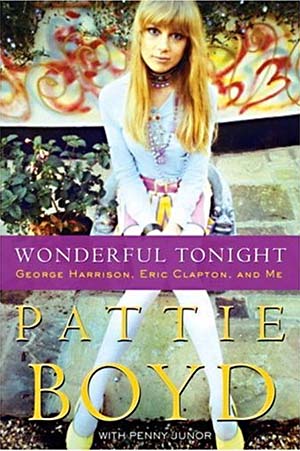
Wonderful tonight

I bought Wonderful Tonight, Pattie Boyd.s autobiography, very much on a whim, from a used bookstore. I was just curious about the woman who married George Harrison (of The Beatles), inspiring him to write “Something”, then left him for Eric Clapton, after he was inspired by her to write “Layla”. That George and Eric remained friends through all this was just one of the things that seemed odd.

Cover of Wonderful Tonight

When you hear that Pattie Boyd was a model when she met George Harrison, that gives you the impression (based on today) that she was already leading a glamorous life, but modeling wasn’t the same back then. She talks of having to do her own makeup and hair, and running around to various appointments on public transit. She enjoyed it, but it didn’t make her especially rich or famous.

Her childhood was even more austere. She grew up in Kenya, her father a damaged, injured war veteran who eventually abandoned the family. Her mother then remarried to an abusive, unfaithful man. Pattie and her siblings were shuffled off to boarding schools, and eventually were literally abandoned, left in Kenya while her parents moved to England.

Hence, the lack of life model for what a good marriage is.

Because, in case you were wondering, this book gave me the impression that it wasn’t much fun being married to rock stars.

Of course, the relationships started out well. With George, the biggest problem in the early days were the insane Beatles fans. But over time, as The Beatles dissolved, their relationship grew more rocky as well. I found myself rather disappointed to find out that George cheated on Pattie constantly. Yes, I know he’s a rock star, but this is after The Beatles stopped touring, and after George has taken up religion and meditation and is trying to be this very spiritual person.

And one of the people he had an affair with was Maureen Star, Ringo’s wife! I mean, seriously dude, that’s just not right.

But it wasn’t just the infidelity that challenged the relationship, but also George’s mood swings and self-absorption and disregard for what made Pattie happy, such as being able to cook for him.

So yes, she was susceptible when Eric Clapton took an interest, and starting writing her passionate love letters—and one really great song. But it was a long, slow build-up before she was finally ready to leave George. At one of these junctures, Eric threatened to take heroin if she didn’t leave with him then. She didn’t, and he did.

Talk about alarm bells, eh?

Though she’s discreet in terms of details, it’s clear that the Pattie / Eric relationship was a very passionate one once it ignited. If “Layla” was a kind of foreplay for them, “Wonderful Tonight”—which I hadn’t realized was also inspired by her—is indicative of their happy early days together.

But it doesn’t last. Though I think he was off heroin by this point (?), Eric was still an alcoholic. And a slob. And unfaithful. And self-absorbed. Though here I’m making it sound as if Pattie does nothing but complain about her husbands, which isn’t the case. She’s pretty fair. I think I’m the judgmental one.

Pattie also tackles subjects like her infertility (she has no children, despite attempts at in vitro), her failed attempts to help her drug-addicted younger sister, and the challenges of building a life as an ex-wife who didn’t necessarily get a big financial settlements from her rich ex-husbands. Throughout, the writing style is very conversational. I suspect that, in fact, it was actually written by named coauthor Penny Junor, based on interviews with Pattie.

You also, inevitably, get a bit of rock history from an unusual perspective: the Beatles trip to India, drug busts, Live Aid, the murder of John Lennon. She was also friends with members of the Rolling Stones, The Who, Queen, Rod Stewart, and others; her sister has long-term relationship with Mick Fleetwood.

I wouldn’t say this is a book of general interest, but for for those wondering about the lives of rock stars, it certainly provides some insight.