Electoral reform: Asking the right questions

Canada’s current, low-key debate about whether to change the federal voting system (and if so, how) is way less dramatic than the political power plays in the UK, Australia’s coping with a near-tie in their new Parliament, and the insane US election. But it’s what we got.

The Liberals ran on a promise that 2016 would be last election under “first past the post” (FPTP), but without committing on how it would change. They have struck an all-party committee to try to figure that out. The main debate is between those who want PR (proportional representation) vs. those who want to keep FPTP. (A side debate is whether the question should be put to a referendum.)

Maryam Monsef

Democratic Institutions Minister Maryam Monsef appears as a witness at an electoral reform committee on Parliament Hill in Ottawa on Wednesday July 6, 2016. (Photo: Sean Kilpatrick/CP)

Essentially, PR proponents think it’s important that each Canadian voter have a reasonable chance of electing an MP of the party they vote for. In practice, this would be achieved by having larger multi-member ridings that allow for a more proportional distribution of total votes, vs. the current system of one member per smaller riding. (Andrew Coyne, PR advocate, explains.)

FPTP proponents don’t agree that this matters. They seem to think that wanting to be able to elect an MP from the party of your choice is just a sign of not really understanding the Canadian system of responsible government. For example: Roundup: Values vs. mechanics.

Now, said lack of understanding is likely true—we don’t have great civics education in this country, and even politicians seem a bit fuzzy on how it’s all supposed to work. But, just dismissing PR proponents as ignorant is neither helpful, nor persuasive.

Admittedly, PR proponents have a tendency to be overly optimistic about the system’s potential benefits, claiming it will lead to increased voter turnout, better representation of women and minorities in Parliament, improved social equity, more political harmony—even a cleaner environment. Absolutely none of which is guaranteed. (Not the most egregious example of these, but see Activists gear up for ‘historic opportunity’ to usher in proportional representation.)

But, PR does give you that better shot at electing an MP from your preferred party. An MP who is then more likely to vote for legislation you agree with, and against legislation you don’t.

I wish FPTP proponents would address that fact. Why exactly do they think we better off having one MP from a party we didn’t vote for (which happens to the majority of voters under FPTP), than having four or five MPs, one of whom (odds are greater) we did vote for? What  current benefits will we lose if we move to a multi-member riding system?

While not exactly addressing this question, I did find this article, from a pro-FPTP perspective, rather interesting: Trump and electoral reform: Connecting the dots. Not sure about the main point that Canadian politics is in such a great state right, so why change it. If true, isn’t that more a factor of who won the last election than the system itself? Great Britain has the same system; does anyone think their politics are in a great state right now?

But, Mr. Heath did cause me to think about the fact that even if you do manage to elect an MP you want under PR, and they mostly vote how you prefer they do, that might not make any difference in the grand scheme of things. MPs that are not part of the coalition government still won’t win too many votes. It’s also absurd to think that under PR, there won’t ever be Conservative governments again (even if the current Conservatives, with their constant bleating about referendums, seem to believe that themselves). PR is no road to leftie utopia. All parties would adapt, include theirs.

It is a bit fear-mongering, though, to suggest that “the first thing you are going to get is a redneck anti-immigration party, which will get around 15% of the vote, and which will hold the balance of power in any parliament where the Conservative party has the most seats.” Not that such a party might rise; that’s likely true. But that such a party would definitely and always partner with a more moderate Conservative partner. I have a higher opinion of Red Tories than that; I expect they might prefer to ally themselves with another centrist party than a bunch of racists.


A bewildered Canadian on a world gone mad

It’s Canada Day. And right now the world is giving me many reminders of how lucky I am to live here.

1. That Quebec’s referendum on separation was defeated.

I wasn’t paying much attention to Brexit until a couple weeks before it happened, and even then I was thinking that surely they wouldn’t vote Leave? Watching the results come in reminded me so much of the horrible Quebec separation referendum of 1995. A full night of tension (following weeks of worry on a vote I, an Ontarian, couldn’t even participate in) watching the movement of a Yes (separate) / No (stay) line on television.

151030_is0se_rci-m-vot_sn635
That nail biting time before the needle moved to the side of good

But then, while the Yes started out strong, it gradually swung toward the No, who ended up taking it with a 0.6% margin. Whereas Great Britain’s vote was the opposite: A strong initial showing for Stay giving way to Leave, who took it with 2% margin. (No matter how many times I refreshed my browser.)

What would have happened to Canada had it gone the other way? Great Britain’s experience is giving us an idea:

  • A precipitous drop in currency.
  • Tumbling stock markets, with the UK dropping from the 5th to the 6th world economy overnight.
  • Expected rises in unemployment, debt and lowering of GDP and growth.
  • A Leave team with no plan for how to exit.
  • Political disarray all around, leaving no party or leader currently able to effectively govern through the chaos.
  • Regions (Scotland, Ireland, London) unhappy with the result talking separation of their own.

For Canada, it would have been all that, only worse. (For an idea just how ill-prepared the country was for the possibility of a Yes vote in the Quebec Referendum, read Chantal Hébert’s The Morning After: The 1995 Quebec Referendum and the Day That Almost Was.)

And just for the record, Leave voters in Great Britain: What you did was crazy. Your country had a great deal in the EU: you were allowed to retain your own currency and greater control over your own borders than other countries, while still enjoying full trading access and movement of workers. And you gave that up for what?

177763_600

2. That recent attempts to win Canadians’ votes through xenophobic appeals have failed.

While a number of factors inspired Leave voters, the wish to reduce immigration—particular a certain kind of immigrant—was among them, as evidenced by the unfortunate increase in hate crime and racist abuse since the vote (as though racists now feel “allowed” to air their views). Meanwhile, the presumptive Republican nominee for US President wants to ban all Muslims from entering the country (“til we figure out what’s going on”) and build a wall to keep out Mexicans. And France has their National Front party. And so on…

But similar appeals haven’t met with success in Canada. In Quebec’s (them again) 2014 election, the Parti Québecois ran, in part, on a “Charter of Values” that would have banned public sector employees from wearing “conspicuous” religious symbols:

MG0911003A_.indd

This bill was so popular in polls, the PQ used it try to turn their minority government into a majority. It didn’t work. After a fairly disastrous campaign by the PQ, it was the Liberals, who opposed the Charter, who were elected with a majority of the seats. With the added bonus that the spectre of another Quebec referendum on separation retreated further.

Then in the 2015 election, the ruling Conservatives appeared to gain ground in polls after they pledged to ban the wearing of niqabs at Canadian citizenship ceremonies, and to set up a barbaric practices tip line. [This is when I had to check out of Canadian election coverage for a while, as I was so distraught.] But the end result was, again, a coalescing around the Liberal party, who were foursquare against both proposals (and, it must be said, who generally ran a brilliant election campaign).

justin_trudeau_liberal_leader_federal_election_surrey_bc_-_mychaylo_prystupa
A plurality of Canadians chose hope over fear

Upon election, Liberals walked the talk, dropping the court case on the niqab ban, and most notably, welcoming 25,000 (and counting) Syrian refugees, moves that have only made them more popular since the election. Americans look on it in wonder, from The Daily Show to the New York Times:

Why? Well, Vox Magazine says it’s the outcome of decades of Canadian government fostering tolerance and acceptance as core national values. As a result, most Canadians see immigration as an opportunity, not a problem; as something that improves rather than threatens the nation. Apparently, Canada is the least xenophobic country in the Western world.

3. That our current government is (mostly) pro-trade

One of the most confusing results of the Brexit vote, to me, was the cavalcade of federal Conservatives MPs who tweeted their approval—the only Canadian I’m aware of who did so. But isn’t Conservatives supposed be all pro-trade, because it’s good for business, while it’s the lefties who are opposed, fearing it’s bad for labour?

And yet there’s Trump, spitting about pulling out NAFTA. What? When did this turn around? (Harper’s government, it must be said, was most definitely pro-trade, making the MPs comments all the more confusing.)

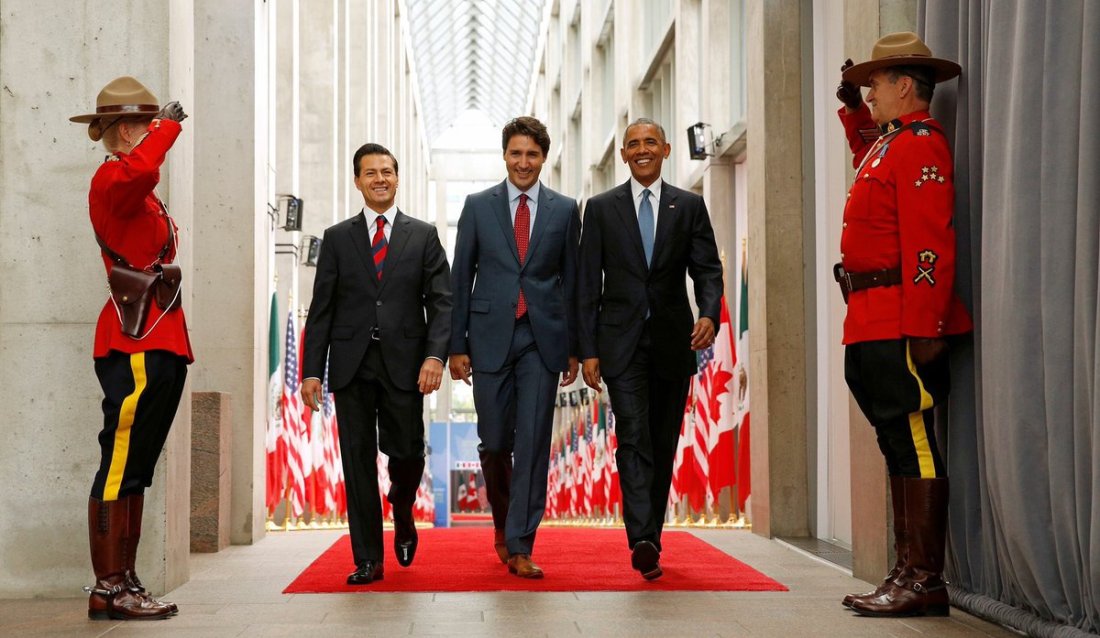
So it was another interesting bit of timing that this week was the NAFTA summit between the current US President, Canadian Prime Minister, and Mexican President.

cmjo22zwmaavs9w
Too bad they’re all men (but this US will be changing that soon, right? right?), but a fine-looking trio they are

Their big message: Trade is good. Countries are stronger when they work together. Globalism brings prosperity. And it was all capped off by one amazing speech President Obama gave in the House of Commons:

And what makes our relationship so unique is not just proximity. It’s our enduring commitment to a set of values, a spirit alluded to by Justin that says no matter who we are, where we come from, what our last names are, what faith we practice, here, we can make of our lives what we will.

Watch or read the rest here.

It was heart-warming, and for a while, one might forget that it remains so much easier to cross borders in Europe than it is to move between the US and Canada, that we have to pay duties on even tiny online purchases from the US, and absolute absurdities such as Canadian inter-provincial (!) trade barriers that cost our economy billions.

So there’s a lot of work to do on this one. But at least it seems the intent it to make things better, not worse, on this front.

Cause that’s the Canadian way.

Happy 149, Canada.


Sunny ways—Canada is back

I was nervous Monday.

Despite my reduction in news consumption, and even though off on a wine-soaked vacation last week, I was well aware of what the polling was showing: That Harper’s horrible Islamophobic campaigning had seemingly backfired, and that the Liberals’ numbers were rising steadily—showing a comfy 9-point lead in one of the last polls to be released.

But also knew that polls were often wrong, and at any rate, were entirely meaningless. Only the vote counts for real.

My less emotionally invested yet still interested husband set up his tablet in anticipation of result, using CBC website tools to track certain ridings. He was at the ready as soon as Eastern results were posted. As I distracted myself with housework and such, he was giving reports:

“It’s looking good.”

And a little later: “It’s looking really good.”

And we all know what happened. Canada’s Atlantic provinces turned into one big Liberal red lobster.

Nova Scotia riding results
Yes, I know this is just Nova Scotia, not all the Atlantic provinces…

Of course that made me feel better, but we still had a big time gap til the more decisive Quebec / Ontario results.

So we watched a little iZombie to pass the time.

Around 9:30, I turned on the TV and said I’d just “have a look.” Of course, then I couldn’t stop watching (though I did bounce around channels a lot), mesmerized as the “Leading  or Won” seat counts just kept ticking up. By 10:00, they’d called that the Liberals would have a plurality of seats. The numbers kept going up, til it was clear that majority wasn’t an impossibility after all. And that was officially called around 10:35.

Canada votes Liberal majority
Holy doodle.

This would be the first time in about 20 years that a Federal candidate I voted for was elected as part of the governing party. Not to mention the first time in 10 years that I’m not appalled by a Federal election result.

It is unfortunate that the NDP and Greens were collateral damage in this; I didn’t wish ill to either of those parties, who lost some good MPs. But they were just as out-campaigned by the Liberals as the Conservatives were. The Liberals were able to do something else that hasn’t happened in decades: inspire disaffected voters to come back to the polls. The Liberals received more votes than in any party in Canadian history.

Even when the overall results were evident, I couldn’t stop watching. I looked up particular ridings. I cheered the principled Michael Chong’s victory, the only Conservative for whom that was the case.

I was pleased that my local candidate, Bardish Chagger (#MovesLikeChagger) garnered nearly 50% of the vote. I was glad to see her joined by three other Liberal MPs, replacing our previous set of middle-aged, white Conservative MPs with a more diverse group.

New Liberal MPs of Waterloo Region
(And the remaining middle-class white guy’s name is Bryan May, so he can’t be all bad!)

I liked that the Liberals won seats in all provinces, even Alberta and Saskatchewan! (What’s up with Saskatchewan, anyway? Why so Conservative?)

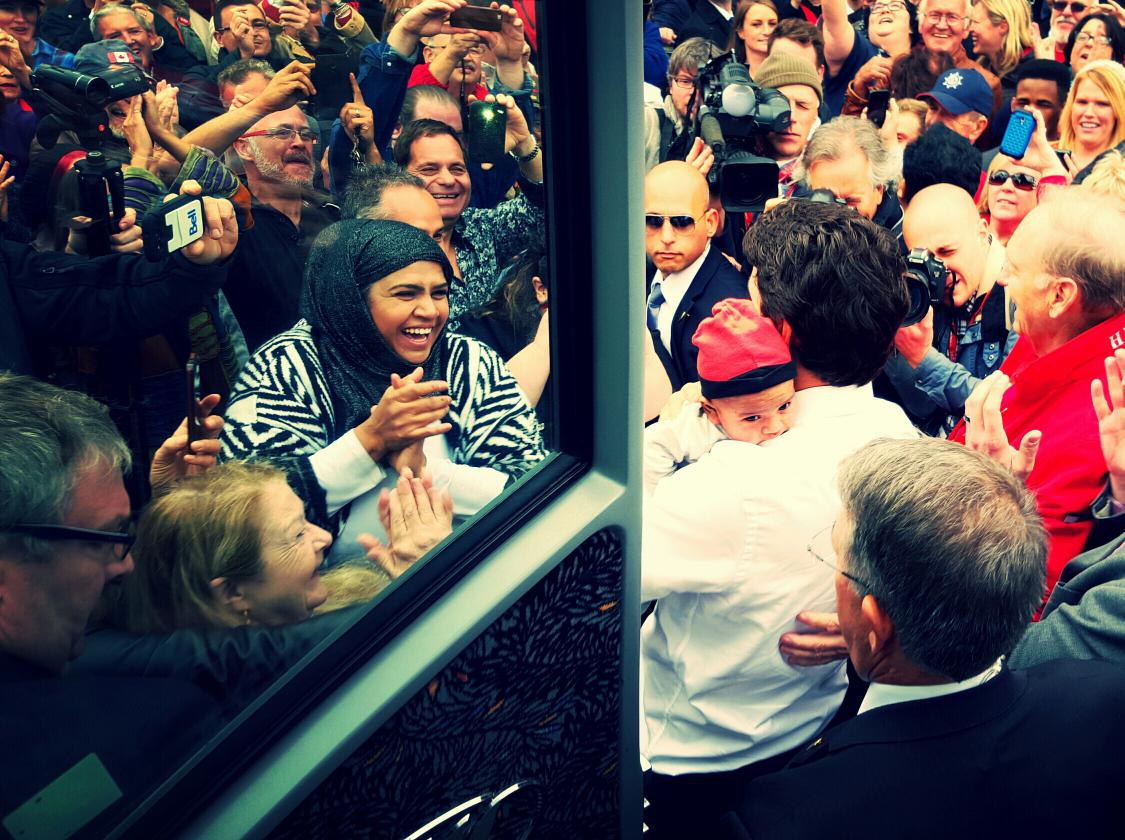
And I stayed up to watch all the speeches. I admit to being moved by Trudeau’s story about the Muslim woman and her baby. (But then again, it was nearly 1:00 AM, so that might just have been an exhaustion response.)

Trudeau and baby with her mother
This is the picture: It really happened!

And while I was going to say to say that results really don’t affect my daily life much, this one has. Because now that I know this story has a happy ending, I’ve ended my news diet, and have happily returned devouring interesting news stories wherever I can find them.

Though I must say I didn’t expect quite so many of them to be about how “boinkable” Justin Trudeau is. World: some respect for our hot new PM-designate, please!

Questions for my Conservative candidate

On Monday, September 21, I attended a Waterloo candidates debate hosted by Fair Vote Canada. I knew that Conservative Peter Braid would not be there. I honestly wasn’t angry about that.

Until they read the email he sent in:

“We do not participate in partisan debates on a single issue.”

Wha…?

This is my response:

  1. Why did you characterize this debate as “partisan” (“fervent, even prejudiced devotion to one party or cause”) when:
    1. Fair Vote Canada is a multi-partisan organization promoting electoral reform, but without advocating for a particular voting system.
    2. All parties were invited to attend the debate, and were given equal opportunity to respond to questions?
  2. If you truly believe (as many Canadians do) that first past the post is the best voting system, why not defend it?
  3. This “single issue” debate actually covered many issues related to Canadian democracy, including the “whipping” of MPs to vote along party lines. Would you like the freedom to put your constituent’s interests ahead of your party’s when voting? If not, why not?
  4. The room was full to capacity with citizens–presumably your constituents–whose questions and comments made it clear how passionate they were about trying to improve Canadian democracy. Why not listen to them instead of dismissing their concerns in a single sentence?

How to make a Canadian quilt

In honour of Canada Day, I just installed the Canadian English Dictionary extension for Firefox, so now WordPress doesn’t mark “honour” with a “u” as a typo. Yay!

I also spent some time (badly) photographing possibly the most Canadian item I own: A red and white quilt signed by various Canadian celebrities. My mother won it in a museum fundraiser back in 1997, and I recently inherited it.

Since 1997, some of the signatures have faded, and some of the “celebrities” have become obscure. But a number remain fun to look over.

Mr. Dressup signature and image
Aw, Mr. Dressup!

Jann Arden, Pamela Lee sigzantures

So Pamela Anderson was still married to Tommy Lee in ’97. And an interesting juxtaposition beside Jann Arden’s drawing (yes, that angel is naked. As angels are.).

Pamela Wallin and Jean Chretien signatures

Speaking of Pamelas and juxtapositions, Pamela Wallin was then just a TV journalist, not a disgraced Conservative Senator. The modest signature below hers is that of the Prime Minister of the day, Liberal Jean Chrétien.

Shania Twain, Stompin Tom, and Michelle Wright signatures

Stompin’ Tom was still was us in 1997, and Shania Twain is still with us today. Not sure what’s up with Michelle Wright these days…

Lynn Johson signature
And this one is just lovely

A few more items in Canada’s tapestry:

Google logo, Canada Day
Google’s logo today

Songza’s curated Canada Day playlists.

Raccoon on deck
A recent deck visitor

Trout, spinach, and roseRaspberries, strawberries, and dessert

Some fine local food.

Happy July 1, everyone! Canada flag

The Orwellianly named Elections Act: Comments and questions

When the federal Conservatives drafted Bill C-23, the so-called “Fair” Elections Act, did they expect it would garner so much attention, becoming a major topic of conversion among politic geeks? Did they anticipate the near universal condemnation the bill has received? Or was this all a nasty surprise?

(If you need a primer on the Bill, see Everything you need to know about the Fair Elections Act, courtesy Globe and Mail.)

But shouldn’t you need ID to vote?
Apparently feeling this is their best defense, the Conservatives’ talk about ID issues a lot: That vouching is too open to voter fraud, that 39 different pieces of ID can be used instead.

What they fail to mention is that the ID you present must contain your current address, and most ID does not. The only common piece of ID that does is your driver’s license—but not every Canadian drives.

Most non-drivers currently back up their address-less government ID with the Voter Registration card. However, Bill C-23 would make that card inadmissible. Vouching has been another backup, but again, Bill C-23 would ban that practice.

This bill would make ID requirements more stringent than those in any province, or in most other countries. But voting is a right, not a privilege, and up until 2007, we could vote in federal elections without any ID at all! Provincially, many of us still can:

Voter ID requirements by province

So, arguably, you should not need ID to vote, actually. But if a government decides to require it, they must do it in a way that account for circumstances such as have recently moved, living in an institution, having a PO box as a mailing address—or being unable to drive. Not doing so is voter suppression, and is likely unconstitutional.

What if they fix the ID thing? Then we good?
No, this Bill has other issues, such as:

  • Severely limiting what information Elections Canada can share with Canadians, and specifically preventing them from promoting voter turnout. This will kill certain educational programs such as Student Vote. It also may mean that they can’t share the results of their investigations.
  • Allowing the ruling party to nominate poll supervisors for local voting stations—positions that clearly required neutrality, not partisanship.
  • Increasing spending limits, and allowing parties to exclude the costs of contacting anyone who has donated to them in the past five years. Can you say loophole?
  • Requiring that robocall records to be kept, but only for a year—not enough time for a full investigation (as the still-ongoing investigation into the fraudulent robo-calls of 2011 demonstrates: three years and counting).

(Handy YouTube video on bill’s issues at: http://www.youtube.com/watch?v=ht_sOeGJJG4)

During hearings, the Conservatives have been unable to come up with a single expert who agrees with this bill. (One they had been quoting testified that they were misrepresenting his report.) In fact, I don’t recall such universal condemnation of something they tried to do since they banned the long-form census.

So they have taken to dismissing all their critique as “self-described experts” or “celebrities”, and personally attacking them: Election Canada’s Marc Mayrand (appointed by Harper) is power hungry. Sheila Fraser (praised by the Conservatives for her work as Auditor General) is a paid shill. It’s been really nasty.

Fair Elections Act: Because Elections Canada has a hidden agenda, and Harper's Conservatives don't

Also, having delivered the bill two years after they said they would, not having consulted ahead with anyone on its contents, they are now trying to rush it through as quickly as possible, limiting debate through time allocation.

Why are the Conservatives doing this?
That is the question.

Other controversial policies, such as GST tax cuts or harsher sentencing laws, are very popular with some people. They are policies that will win them votes, and help raise money. So no mystery why they propose those ones.

But electoral law? Not motivating like money and safety. Sure, diehard Conservatives agree with them, as they do on everything, but this issue just isn’t going to be a big vote-getter or money-maker.

So, why?

a) Is it revenge?
That’s one theory. That Conservatives are angry they were found guilty of electoral fraud in 2005, that several of them have been charged with over-spending during the last election, that they are still under investigation because their voter database was used to commit electoral fraud (the robocalls directing people to the wrong polling stations) in 2011.

They feel picked on, so they want to take power away from Elections Canada as punishment.

b) Is it fear?
About those robocalls: Another theory is that Elections Canada is finally, nearly ready to give its reports on what happened with those in 2011. And the Conservatives, being in government, have an idea what’s in that report, and it’s not good.

So they need this law to pass now so Elections Canada can’t talk about it and they won’t face any repercussions.

c) Is it a nefarious plan to rig the next election?
The Conservatives aren’t so popular right now, remarkably so given that the economy isn’t doing too badly. And there is no doubt that many provisions in this act favor them: They could put biased people in charge of polling stations; they could reduce voter turnout among youth and aboriginal, who don’t tend to vote Conservative; they could spend more money than ever advertising themselves and attacking other parties (and they do have more money than other parties). They could even do more fraudulent calls, with even greater hopes of getting away with it.

Maybe they think this bill is their only chance of winning in 2015.

d) Is it megalomaniac belief that every bill they put forward is pristine and perfect and that anyone who disagrees with them is a silly poo-poo head?

Given this party’s incredible fondness for time allocation to suppress debate on every bill they introduce, combined with an unwillingness to entertain any amendments from any other party, ever: Entirely possible.

Whichever theory you prefer, none of them makes the Conservatives look very good here.

I’ll close with a reminder that if you think this bill maybe has some issues, you can:
Contact your MP about it
Fill in this handy-dandy petition at Democracy Watch
Join the NDP’s opposition
Join the Liberal’s opposition
(And the Greens are also against it.)

And also, you know, vote. Preferably for a party that cares about your right to do so.

Full text of Bill C-23

Stephen Harper: The Musical

As a fundraiser, Fair Vote Canada sponsored a production of James Gordon’s one-man show, Stephen Harper: The Musical. I got curious about it, and Jean agreed to go with me. (This was last weekend; this weekend we went to the lovely Yuletide Spectacular Christmas concert with the KW Symphony, like normal people.)

The location was kind of neat and one I hadn’t previously known about: A former shoe factory now repurposed as a cultural center—the Courtyard at Bonnie Stuart. The room where the show was performed was on the small side, but they did manage to pretty much fill it.

Stephen Harper puppet and James Gordon
James Gordon with the Stephen Harper puppet

I really didn’t know what to expect from this show, except that it would be critical, have music, and feature a Stephen Harper puppet.

For the critiquing, some I certainly agreed with it, but some was more anti-corporate, anti-capitalist than I was totally comfortable with. Bit too hippy-trippy, even for me.

But the songs weren’t half bad, making for a pretty entertaining show, overall. It was also supplemented with some video segments. One of my favorite bits was a discussion of the church Mr. Harper belongs to, an area rarely covered in the media. That featured a video cameo by “hippie Jesus”–that is, the actual peace-loving, money-damning dude of the Bible, as opposed to the distortion version espoused by some churches (whom “hippie Jesus” disavowed).

Given the subject matter, Gordon also strives to keep the material updated. There was a segment on the Occupy Movement, but he acknowledged that now seems kind of long ago (doesn’t it?). But it also included a very funny “Thank God for Rob Ford” song, so new he needed to refer to the lyrics sheet, that opined that Harper had quite appreciated Ford’s antics this fall drawing attention away from what the CPC government is up to.

As Fair Vote Canada is supposed to be non-partisan, I wasn’t sure about the fit with this show, until we got to the “What can you do?” segment. One suggestion was a change in the voting system to be more proportional. The whole last bit is meant to be something of a motivating call to arms, that didn’t entirely work on me.

But it certainly wasn’t a bad night out.

Canadian democracy is broken, but you can help fix it (in 140 characters or less)

Canadian democracy is in trouble. Governments won’t give straight answers to questions in houses of governance, they limit media access, they routinely impose time allocation on debates, they pass bills to limit the rights of independent MPs, they delay and censor access to information requests, they conduct business in secret, they refuse to provide budget information to civil servants.

I think the root problem with Canadian democracy is our federal and provincial voting systems. Most people’s votes elect no one and therefore have no other effect (now that the federal per-vote subsidy is gone). Only votes for the winning candidate matter, and whether it’s by 11 votes or 11,000, the winner still gets the entire riding. Votes for all other candidates are wasted. (More at Fair Vote Canada.)

As a result, a party needs only 35% to 40% or of the popular vote to win the majority of the seats. They can and do narrowcast their appeal, so they don’t really care if most citizens don’t like what they’re doing. It disincentivizes parties from working together, as everyone is chasing the 35% dream of absolute power. And it encourage abuses of the electoral system, in overspending (as with Dean Del Mastro and other MPs), expense schemes (“in and out”), and outright fraud (robocalls), because such illegalities can give that small percentage extra needed to win it all.

Realistically, though, I don’t think the voting system is going to change any time soon. I think it’s worth trying, but it’s natural for parties to love the current system. Having nearly a one in three chance of winning it all is pretty hard to resist.

But that doesn’t mean that nothing can be done.

Great Britain, for example, uses the exact same voting system as Canada, with the exact same distorted results in seat numbers. But nevertheless, many have observed that government works better than ours. British MPs quite often vote against party lines, something Canadian MPs almost never do. British ministers, unlike ours, actually answer the question during Question Period. MPs seriously debate issues using their own words, not party talking points.

British MPs are much more empowered than Canadian ones. And it makes all the difference.

Somehow, gradually over the last 30 or so years, Canadian MPs have lost more and more of their ability to make much of a difference in Parliament. Here are a couple of accountings of their sad lot, by Andrew Coyne’s in The Walrus, “Repairing the House” and in this blog post from On Procedure and Politics: The real problem is MP irrelevancy.

But right now, this week, Tuesday, a private member’s Bill is being presented that could change this. Michael Chong, of the Conservative party (yes!) has been working on a it for a couple of years. Andrew Coyne (him again), endorses it  as A bill that would change Canada’s Parliament forever.

It proposes that MPs get to decide who sits caucus and who gets to be leader, and removes the provision for party leaders to sign off on all electoral candidates. Doesn’t sound like much, and by itself, certainly would not fix everything. But it does lay the groundwork for reform, by once again empowering MPs to actually represent us, the citizens, and not just their parties, in Parliament.

So if you’re in favor democracy and would like to see it working again in Canada, tell your MP to support Michael Chong’s Reform Act.

If you’re on Twitter, you need only 140 characters and this list of Canadian MPs on Twitter. You can also follow the discussion via #ReformAct.

If you’re on Facebook, you can Like this page (or whatever the heck it is you Facebook people do): https://www.facebook.com/TheReformAct

If you’re on email, you can email your MP — here’s the list: http://www.parl.gc.ca/MembersOfParliament/MainMPsCompleteList.aspx

Parliament in Ottawa
Let’s make this place work again

Byelections are hard

My riding is one of two in the midst of a byelection for the Ontario legislature. And I am Undecided.

I have decided against the Progressive Conservatives (I know, you’re all shocked) and the six fringe candidates that are running. That leaves three options: Liberals, NDP, and Greens.

Recently I’ve just been voting for whoever appears to have the best chance of defeating the Conservative candidate, and in this riding, that’s normally Liberal.

But a byelection is not the same. For one thing, I do not have to fear the Conservatives in the same way, because even if they happen to win both seats up for grabs, they will still not form government.

For another, it’s not really so clear the Liberals are the next leading contenders. The NDP have a strong, well-known local candidate, and with voters not having to fear an NDP government resulting from her winning the seat, they might just vote for her. There’s no knowing for sure, but all indications are that this is a three-way race.

So, another strategy I sometimes take when struggling to decide is to just pick the best local candidate. In a byelection, this seems a particular sensible approach. Therefore, I watched the local debate, and came to the conclusion that… All the candidates I’m considering are quite good, really.

The Liberals Eric Davis and the NDP’s Catherine Fife both speak very well and knowledgeably. He’s a lawyer and she’s local schoolboard trustee, and they both already have the politician’s ability to seem like they’re answering a question when they haven’t, really. And it’s in this respect that the Green’s Stacey Danckert was quite refreshing, even though she was soft spoken and less assured. But she was also clearly very smart, informed, and sincere.

Plus, the Greens have some cool policies. Combine the Separate and public school boards? Yes, we can! (Wait, that’s someone else’s slogan.) Reduce income taxes and increase pollution taxes? Sounds good to me. Proportional representation? Bring it on.

But do the Greens have any shot at all in this thing? That is unlikely. Do I consider them anyway, for supporting the candidate and the policies? I’m undecided.

This byelection is also unusual in that actually could change the shape of the Legislature. If the Liberals happen to manage to win both byelection, they’d end up with a very slim majority. Do I want this? Majority governments—including this one—tend to be rather arrogant and undemocratic. But minority governments are all gamesmanship, with everyone threatening elections at every opportunity… All dreaming that majority they might win.

Basically, we have terrible political system, in which both majority and minority governments kind of suck. I can’t change that with my vote. (Ontarians could have changed that in a referendum a few years ago, but they didn’t. I may never forgive you for that, Ontarians. But I’m digressing.)

So… Not much point in voting strategically, no clear favorite amongst a set of good candidate, not really sure who I want to win the seat (except I’d prefer not Conservative or a fringe candidate).

Gosh, I may actually have to read the party platforms, or something.

Hurrying toward dictatorship

Our so-called leaders speak
With words they try to jail ya —
They subjugate the meek
But it’s the rhetoric of failure

–The Police, Spirits in the Material World

This week I heard the KW Symphony and Jeans’n’Classics play the music of Sting and The Police. That was fantastic.

I also read a lot of political columns about the federal Conservative government is up to. That was the opposite of fantastic.

Earlier in their majority mandate, pundits wondered, why the rush? Why push so many bills through, and why impose time allocation on all of them?

Now that their agenda is becoming clearer, I think we know:

The Harper revolution has never been about abortion or gay rights. This prime minister has little interest in social conservatism.

Rather, the revolution is economic. It is aimed at eliminating regulations—particularly environmental regulations—that interfere in profit-making. It is aimed at reducing wages (which is why the Conservatives take swipes at unions whenever possible). It is aimed at scaling back any social programs—from Old Age Security to Employment Insurance — that help keep wages up.

–Thomas Walkom, Stephen Harper’s stealthy war against wages and the environment

Not quite what they campaigned on, eh? And even though true believers may applaud the efforts to plunder the natural world—they seem to feel that, with fervent enough belief in the capitalist system, one can overcome those pesky biological needs for clean water, air, and food—I’m not sure they’d be as happy about efforts to impoverish them.

So, the Conservatives really have to get all this done as quickly as possible, stifling debate wherever they can, before opposition can really mobilize. Before most people even notice.

Let’s see how many different outrages we heard about—just this week!

1 Denying medical coverage to refugees

2 Working to increase crime rates by cutting rehabilation programs and encouraging prison overcrowding

When the emphasis moves away from corrections toward more and harsher punishment of both the physical and psychological variety, recidivism rates will increase and real correction will become more difficult. That will likely mean more crime over the long haul in a country that, apart from the United States (which is in a league by itself), has one of the highest incarceration rates in the world.

— Jeffrey Simpson, Globe and Mail

3 Rejecting all amendments to the new Copyright Act

This is—believe it or not—a largely good piece of legislation, except for a problematic clause on digital locks. Why not consider amending that?  Far as we can tell, only because the opposition parties brought them forward. I mean, God forbid opposition members actually get to do anything for us in return for our tax dollars.

None of [the defeated] amendments were radical or undermined the goals of the legislation. There is much to like in Bill C-11 but the defeat of provisions designed to improve access for the blind, preserve fair dealing, enhance education, and open the door to innovative services hardly seems like something to celebrate.

— Michael Geist

4 Admitted to dismantling an Environmental advisory group because it recommended a carbon tax

The fact is, a carbon tax is the best way to deal with climate change, so any group serious about it has to advocate for one. The Conservatives have, of course, demonized carbon taxes, so they can’t impose them now. So instead they are trying a “regulatory” approach, Communist style, which as we see, doesn’t work. Canada’s carbon emissions just keep going up. Do they care? Apparently, no.

So that’s four pretty big things in one week—but none are the biggest thing. Not by a long shot. No, the biggest thing, quite literally, is the 420-page Omnibus Bill supposedly to “implement the budget”, but in fact, doing a whole lot of other things as well.

(Which, of course, they immediately imposed time allocation on. Why would anyone need any extra time at all to review 420 pages of confusingly worded new laws?)

This bill, among so other things:

  • Repeals the Fair Wage act.  [You didn’t want a fair wage, did ya?]
  • Repeals the Environmental Assessment act.
  • Makes some kind of changes to EI. We’re not sure what, really. We’ll tell you eventually, after this bill is passed. Trust us. It will be great.
    (Rick Mercer: “How can the gov say we will find out what is in the budget after the budget is voted on? Does that work on other planets?”)
  • Re-writes the Fisheries Act, the Species at Risk Act, and the Navigable Waters Protection Act.

There’s a ton of environmental law changes in here. The thrust of most, from what I can tell, is to get rid of informed government bodies who currently regulate these matters, and move them to uninformed Harper Cabinet to decide . I’m serious.

Writer Richard Poplak wonders why Canadians aren’t angrier about this. Why we aren’t mobilizing.

There’s a bill, called C-38. It’s driven to Parliament on forklifts retrofitted for maximum stealth. This bill, similar at 420 pages in weight and heft to a small pony, is delivered to dead-eyed MPs, behind whom stands the chief whip, taser in hand. The drool-drenched backbenchers nod in unison, and put the bill back on the forklifts for rubber-stamping further down the line.

By not making this the issue of our generation, by not linking this with other efforts calling for responsible governance and respect for democratic institutions–and by not understanding that this trend is not just local, but global–Canadians are rolling over and playing dead.

And why is that?

Well, maybe we’re just a little exhausted from the constant barrage of appalling behavior from our federal government.
Maybe we’re overwhelmed. We just don’t know which of the many outrages to go after first.
Maybe we don’t know how to protest. What would actually work?
Maybe we’re just sick of whole thing. We’ve tuned out. It’s nice out. We have gardening to do.

Unfortunately, that is exactly what Stephen Harper wants.

Speak out against Harper’s budget (NDP)
Harper is ending environmental protection (Liberal)
Environmental Devastation Act (Green Party)
Black Out Speak Out (Environmental groups)
Apologize to the rest of the world