I haven’t done anything major of late, but I’m still keeping busy with a number of minor items, such as…
Watching Riverdale
A very buzzy show right now, playing on CW in the US and on Netflix in Canada. Beforehand, I liked the idea of a dark, Twin Peaks-y take on Archie Comics, and I’ve been generally happy with the results. The tone is still somewhat uneven—sometimes exaggerated Gothic, sometimes gritty realism—and Jean does tend to roll his eyes at the drama, drama of some scenes. But we’re both pretty entertained by it, overall.
Doesn’t hurt that he took an instant shine to Betty, while I am seriously crushing on Jughead… On Jughead, yeah. This is not like the comics! Sure, Archie is handsome, but also a jock and a bit bland, and Kevin is cute, but not in that Adam Lambert way. But Jughead is a writer, he’s sensitive, he’s moral, he’s troubled (poor and bullied; alcoholic father)—and also, so pretty!
[SPOILERY] There’s been considerable Internet discussion about whether the Jughead character would be asexual / aromantic as in the comics, so I was curious how that would play out. I can’t say I’m personally disappointed with the decision, but it is certainly a missed opportunity to do something groundbreaking.
Finding a movie Jean likes
Back in December we went to see Office Christmas Party, an over-the-top, light comedy we both found kind of fun. But then we followed withe Loving and Moonlight. These are both quality films that I enjoyed. But they are also slow-paced, character-driven dramas, and Jean was somewhat bored by both. So I took a pass on going to Fences and Manchester by the Sea with him—I’ll catch up on those myself.
The Lego Batman Movie seemed like it should be a good bet, though, right? And while it was not quite as good as the original Lego Movie, I was still very entertained by it. But while Jean wasn’t exactly bored, he was just kind of meh on this one. He just didn’t catch all the digs at the Batman lore that made the movie so clever.
And Lala Land? (“Did you know this is a musical?” he asked, walking in. Umm…)
But hey Mikey, he liked it! (Me too. It’s fun, and beautifully filmed.)
Fretting about details of a party we’re hosting
Usually late at night, when I should be falling asleep.
“Huh,” said Jean, when I reported this. “I don’t think about that at all.”
But he definitely helps me work on whatever aspect I’m most recently fretting about.
I guess that makes us a good partnership. Though I do envy his ability to just assume that things will be fine and work out.
Each week, over the course of 10 weeks, Revisionist History will go back and reinterpret something from the past. An event. A person. An idea. Something overlooked. Something misunderstood. Because sometimes the past deserves a second chance.
I’ve listened to 8 out of 10 so far, and find them all fascinating. Like:
The Lady Vanishes, on how one woman (or African-American, or gay person) achieving breakthrough success doesn’t necessarily pave the way for more.
Thanks to The Big Man Can’t Shoot, I now understand that my very disinterest in looking athletic (a hopeless endeavour, anyway; I am simply not athletic) made me a basketball free-throw champion. (It was literally the only thing I was ever better than anyone else at in gym class.)
Hallelujah explains the creative process and unlikely series of fortunate events that turned Leonard Cohen’s original un-listenable song into the iconic tune it is today. (Though I think KD Lang should also have earned a shout-out in this piece.) And as a bonus, introduced me to a new Elvis Costello tune.
Listening to women
I’ve always been a feminist, of course, but the US election has made it all feel more acute. My Twitter feed has been feeling gender unbalanced, so I’ve been seeking out more women’s voices:
@AKimCampbell, first woman Prime Minister of Canada, and also a really hilarious person. (And very active retweeter, but I’ve learned you can follow a person’s tweets but not their retweets.)
@kashanacauley, humorist and now writer at The Daily Show.
@tagaq, wherein singer Tanya Tagaq provides an interesting, First Nations perspective on the day’s issues.
I’ve also been listening to more music by women. This has led Spotify, who previously recommended me a whole lot of dance club music (thanks to following Adam Lambert, and perhaps enforced by a bout of listening to show tunes) to conclude, well, maybe I would enjoy some Indigo Girls and Melissa Ethridge as well.
I kind of do like their music, though, so it’s all good. And also, the songs by these strong women:
I’m not a gym person. I do the ballroom dance classes; I’ll go out for walks, hikes, or snowshoeing. But apart from that, it’s at-home fitness for me. I got free weights, I’ve got machines, and I have yoga mats and straps. And I have a big-ass TV, because for motivation in using the fitness equipment, I find exercise videos helpful.
But back in the fall I decided I needed something new. I hadn’t stopped exercising, but was certainly gravitating toward the shorter, 20-minute workouts more often. And finding it fairly easy to make an excuses to skip a day, or days.
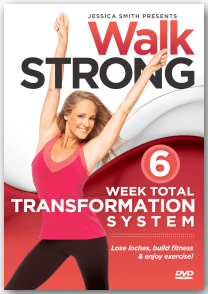
The videos still in fairly high rotation tended be by Jessica Smith. And I was sometimes supplementing those with free offerings from her YouTube channel, a quite extensive collection of routines she films in her living room, organized by time, style, and activity. But I was intrigued by her Walk Strong! series of videos, even though I had to pay for those.
The physical DVDs seem to be available exclusively from Amazon US for $58.88. but for $5 less ($53.88) you can get instant access to online versions of them. They just run in a browser on PC, tablet, or phone, so all you need is your user name and password (and a means to play or cast them to your TV, preferably).
It also comes with a PDF of a welcome guide that emphasizes this is a program about a health, not a promise to make you skinny (despite the video series’ “6 week total transformation” tagline), and a six-week calendar suggesting an order in which to get through all videos a number of times.
I found this approach really worked for me. Getting 10 new videos at once in itself alleviated boredom. And although you had your typical fun cardio, interval cardio, upper body strength, lower body strength, and so on, there were also a couple with a very original focus:
Brain Fitness Fun: Moves requiring coordination and sequencing, that you therefore have to think about. Augmented with on-screen text giving you facts about brain health.
Prehab Routine: One that works every joint in your body, from your neck (I always discover mine is remarkably stiff) to your hips (including some Kegel exercises—“We can’t really demonstrate these”) to your toes (mine are not terribly agile).
But if the rest are less wholly original, I still like the style. Jessica’s persona is very much the warm, encouraging coach, not the stern drill sergeant. And though each workout has a particular focus on cardio, strength, or flexibility, it’s not an exclusive. The strength workouts includes sequences where you’re moving fast enough to raise your heart rate. The aerobics will include some resistance. So the whole program feels very well-rounded.
Each workout is 30 minutes, which is manageable for fitting in to most days. And they all include a countdown clock, which is the greatest thing! Jessica is joined in each workout by two others: Beth (55) who does the advanced moves, and her mom Debbie (59) who does the beginner moves. The women look great, but like real women.
The equipment required is fairly basic:
Yoga mat (unless you have very plushy carpet to work on)
Sturdy high-backed chair
Hand weights (I use 5 lbs and 8 or 10 lbs—might get to 12)
Towel (or yoga strap in one case)
These are the other programs:
Cardio Party! Steady-state aerobics with focus on fun
Total Body Training—Total-body strength training
Barefoot Fusion Sculpt—Cardio and strength to build balance, endurance, and flexibility
360 Abs—Cardio core training
Dynamic Stretch—Stretch out muscles and build flexibility
Upper Body Strength—Upper body strength training
Interval Mix—High-intensity interval training
Lower Body Strength—L0wer body strength training
I have gone through the whole 42-day sequence, in somewhat more than 42 days (some days I do other types of exercise, some days don’t leave time for exercise). I don’t know that I’ve “transformed”, whatever that means, but I am meeting the goal of working out more often and it has boosted my strength, as I think that’s the area I’d been getting more lax on.
My plan now is to start over again, but to sometimes sub in other workouts I have of a similar genre for that day. I therefore hope to keep the boredom at bay a while longer. (Of course, Jessica also has other fitness programs available…)
Because Canada is backward in terms of cell phone service, I experience the wonders of unlimited data only when I travel. (Within Canada, even if I were willing to pay for unlimited data, no one would sell it to me. Not in my province, Canada’s most populous.) So while in New York, back in October, we wandered the streets with my Nexus and a Roam mobility SIM card, confident we could Google Map, museum-narrate, and Open Table to our heart’s plan.
And indeed, the cell service phone service was fine. The phone itself, however, was not. It was a bit of an aged device, and it kept doing Weird Stuff. Mysteriously battery draining. Locking. Randomly rebooting.
Enter Huawei
So when I saw the Huawai Honor 8 on sale ($50 US off) at B&H in New York, I could not resist. And I did not even know, when I made that decision, that when shopping in person at B&H, they thrown in a bunch of other stuff free. So I left the store not only with my new phone, but a case for it, an SD card, premium over-the-ear headphones and a leather case for those, and some mini photography accessories (those, I handed over to Jean).
The Honor 8 is a generally well-reviewed phone, with specs that, apparently, put it nearly up there with iPhones and Google Pixels that cost twice as much (or more). The only real criticism I’ve read is that of Android purists, who object to Huawei’s practice of modifying the interface to make it look more like an iPhone. (They do this to please customers in their main market, China.) That doesn’t overly bother me, since it still basically acts like an Android—including the ability to customize it yourself to make it more Android-like.
As a light cell phone user, it’s more phone than I need, really, and some of its features—such as the apparently great camera (Jean was amazed that it came with an aperture setting)—are somewhat wasted on me. Still, I’m quite happy with it overall.
The good
The size and look. While it has a somewhat bigger screen than the Nexus 4, it’s still very slim, very light, and so fits quite nicely in the hand. It also has this attractive glass backing (so glad my free case was transparent) and a beautiful collection of photos that appear on the lock screen.
Until I got an Honor 8, I thought I didn’t care how my cell phone looked. Turns out I do.
Battery life. It charges quickly, and holds a charge well. As a light user, all I do is plug it in for about 10 to 15 minutes each morning for more than enough juice for the day. While I haven’t tested this, I suspect I could go three, four days on a single charge.
Performance. Responsive, responsive. Every app I’ve tried loads quickly, smoothly—unless there’s some problem with the app itself.
Gorgeous screen. So sharp and clear. Text is easy to read, despite the screen size. Pictures look fantastic.
Fingerprint sensor. Easy to set up, and now I can unlock it with my finger. And get the notification bar down by sliding my finger the sensor. (I can’t quite get the hang of the double-tap to launch my calendar, though.)
Maintenance notifications. It warns me if an app is consuming a lot of resources, which is particularly appreciated when on data. It weekly (you can adjust timing) prompts me to clean up cache, to keep things humming. And although this was annoying at first, you must individually allow app notifications. I now realize the benefits of not being bothered by apps I don’t care so much about.
Storage: It has a lot (32 GB), even without the extra SD card. I’m using only a small fraction now, but nice to know that much more is available.
The bad
Too tempting. It’s new, and it’s fun, and now I’m going slightly over my small data allocation just about every month. (Once because I clicked a YouTube link without realizing what it was, which—even though I shut it down as quickly as I could—was immediately followed by a text from my cell phone provider that I’d already reached 50% usage. That’s the downside of responsiveness!)
Yet another connector. It requires a USB-C, which isn’t all bad: It’s two-sided, and has therefore put an end to my struggles to get the mini-USB inserted right side up. But it does mean that full collection of devices requires not one, not two, not three, but six different types of connectors!
Connectors for, respectively, cell phone, eReader, small tablet, foot pedal, large tablet, iPod classic #maybeIhaveTooManyDevices
Kobo Aura One
Unlike with the cell phone, I wasn’t a smart shopper of this device at all. Instead, I was one of those silly “early adopters” who tried to get my hands on it as quickly as possible, and therefore (of course) at full price.
And it wasn’t easy. This eReader also generated many good reviews, and at launch, simply didn’t produce enough devices to meet the demand. Stores had no stock, so I ordered online, but it was back-ordered, then delayed from that. I ended up getting it just days before the New York trip, at which point a search for a case proved equally fruitless. It’s not a standard size, so only the “official” one would do. I went most of the trip without one, and managed to avoid dropping it. On the last day in Montreal, I found and bought a case at Best Buy.
At full price. Of course.
And how is it? It’s fine. It’s an eReader, so it doesn’t do anything more exciting than let you load and read books. But it is a step up from my previous Kobo (which Jean has inherited).
The good
Screen. It’s slightly bigger than the usual eReader, but not so big that it’s awkward. It’s still a thin, light device you can manage with one hand. And the bigger size means less frequent page turning. And it’s definitely sharper than the old eReader.
Back-lighting. It automatically adjusts to the amount of light in the room, and also to the time of day, screening out more and more blue light as it gets later. You can override anything of this if you want, but I find it works well. And since I do read a lot in bed, I appreciate anything that potentially aids in good sleep.
Waterproof. Though I have yet to immerse in the tub, apparently I can.
Speed. It’s truly amazing how quickly new books are downloaded onto this device.
Library ebook borrowing integration. My local library is part of the Overdrive ebook borrowing program (most North American libraries are), and now that I’ve set up my Kobo with my library card number and separate Overdrive login, I can very easily load library books onto the device. No more having to do that on the PC using Adobe Book Manager.
When “shopping” for ebooks on this device, I get the Kobo store buying option of course, but if my library does have it available, I can borrow it right then, or put it on hold. The book loads like any other, but expires at the end of the loan period, leaving a preview version behind. I used this, for example, to borrow a Montreal travel book for the trip.
Storage: It also has a lot (and I’m also using only a small fraction of it at this time).
The bad
Typing. It’s just no fun typing on this thing. No auto-correct. Not that responsive. Fortunately, being an eReader, typing is definitely a secondary activity. But still, hate when I have to do it.
Battery life. Honestly, it’s still excellent, far exceeding any cell phone or tablet. It will last weeks. Just not quite as many weeks as the old eReader. You have to pay for that extra processing power somehow.
Pocket integration. I do use Pocket, but I log in via Google, and that simply doesn’t work on the Kobo. I apparently need a dedicated Pocket account, but how do I do that without losing all the articles already saved? So I’ve yet to figure out how I might access my Pocket articles on this device.
Wired magazine itself isn’t premium priced. Plus, they post most of their articles on their website for free. They get a little antsy about ad blockers, but that’s fair.
I started following Wired on Twitter during the last Canadian election. I thought that a little more science and tech news would be a nice break from all the politics in my feed. And I was right; it was welcome content. With the far worse US election on now, I can hardly give up on it.
But I hadn’t realized to what extent I was personally susceptible to constant promotion of the latest and greatest tech. I should have suspected, given that a single Wired article led me to spend I don’t know how much on a three-room Sonos system. I do love it, admittedly, but maybe there are other, cheaper wireless speakers that would have satisfied?
Mmm, shiny new tech. (Image: Shutterstock)
Now I’m constantly drooling over new cell phones. Not iPhones, mind—I am simply not of the Apple world, and not even Wired can convince me to join it. (Possibly because I take such perverse amusement in reading about iWorld troubles; to wit the hilarious Don’t update your f-ing iphone!
End of digression.)
But in “my” world of unlocked Android phones, look what they said about the Nexus 6P (the later iteration of my current phone):
There is absolutely no reason not to buy this phone. None. Zero. The Nexus 6P is the closest thing there’s ever been to a perfect Android device.
The perfect Android device! Why wouldn’t I want that? There’s no reason!
Except that, you know, it is a $700 (Can.) phone. Wired’s answer to that point (in US dollars) [bolding mine]:
The Nexus 6P is absolutely the best Nexus phone ever. Hell, it’s the best Android phone ever. And at $499 unlocked, it’s even cheaper than nearly all its competitors. Everything Google could do, it did. It proved how good Android can be—that an Android phone can be better than the iPhone.
So it’s a deal! $700 is a deal, because it’s the best phone ever!
Only while I was pondering that, it basically went out of production, because there are new Nexus’s (Nexi?) coming out soon, and Wired hasn’t reviewed those yet.
Huawei’s new device, the Honor 8 (there have been many other Honors before), is every bit the spec monster smartphone. Glassy, colorful design; 12-megapixel camera, plus a second sensor just for good measure; ultra-fast processor and four gigs of RAM; fingerprint sensor that doubles as a clickable shortcut key; latest version of Android; lots of storage, with room to add more. In most practical ways, it’s not that far off from Samsung’s new Galaxy Note 7, or other Android phones like the new Moto Z. The only thing the Honor 8 is missing is the absurdly high (and VR-friendly) screen resolution, but you know what else it’s missing? $400 on the price tag.
Which translates to $520 Canadian. So look, by dawdling I’ve just saved $180! And, the Nexus is clearly too big (plus, out of production). I was about ready to order my new Huawei.
…Ignoring the fact that’s nothing really that wrong with my current phone, and the the little detail I don’t really use my phone that much, anyway. I’m much more the tablet girl, and Wired is kind of down on tablets these days (particularly of the Android variety).
I was also feeling some e-waste guilt. I started to ponder what could I do with the old phone, should I in fact get a new one. There are articles about that (you can guess where). It seemed it might serve as a sort of tablet extension for cases where the small screen isn’t so much an issue—for Chromecasting, Twitter reading, playlist display, and such. And yes, I can do that with the phone now, only that always risks me leaving the house without it—which doesn’t happen if I just keep the phone safely in my purse.
As I was justifying all that in my head, I won a 10″ tablet in a draw.
The prize
Now, this is not the sort device Wired would rave about. It’s a bit slow and clunky. It has only 8 GB storage and limited ability to use the SD storage. The screen looks acceptable only from direct angles. It’s not sporting the very latest version of Android.
But as an extension to my “good” Samsung Pro tablet, it’s fine! There are even a few things it does better.
It’s proven enough of a distraction that I’m willing to put off the phone purchase again.
Well, that, and the fact that I’m also… Awaiting shipment my new Kobo Aura One ereader!
The new Kobo Aura One is literally big, a 7.8-inch behemoth in a world of standard 6-inch displays. But its features are also outsized, whether it’s robust waterproofing, a clever new nighttime lighting system, or a way to help you read as many top-shelf books as you please without paying a cent. More importantly, they’re all enhancements you won’t find on an Amazon Kindle.
It was a mere $250 Canadian, and Jean thinks he will use my old Kobo. (Which is good, cause it’s still perfectly fine.)
This was to be a post about the technical issues we’ve encountered this week, but my two attempts at it seemed too long, pointless, and frankly boring. (I realize that might describe many of the posts at this indulgent blog, but when you’re boring even yourself, that’s a problem!)
Yes, last week we had intermittent but regular Internet outages. And a cell phone mysteriously locking up. And a NAS drive reporting a boot error that made its data inaccessible. And home phone outages. And flickering cable signals. And being locked out of financial software.
It was all kind of stressful.
But we’re out of crisis mode for the moment. Thanks to a cell phone reboot, a physical NAS drive swap, a visit from a Rogers technician who replaced our very old connector, and a software patch update, all systems are go at the moment, no data lost.
So I don’t want to go on about it all. I’ll just share some lessons learned:
A two-drive NAS is great, but use it as backup of your PC hard drive, and not the sole source of data. (And of course consider cloud backups for more critical items.)
Rogers home phone people seem more savvy than the Internet ones (?), so if having troubles with both services, try to talk to them. The home phone person detected a problem almost immediately, and had me set up with a service appointment the next day.
Now I can once again enjoy the virtual sunsets of Estonia. And share them with you.
My “big plan” for the Friday of the long weekend was to watch the webcast of the opening show of Queen + Adam Lambert’s tour, performed as part of the Rock in “Rio” festival in Lisbon. So it was a bit dismaying when, on Wednesday or so, the webcast company announced that, “at the band’s request”, they would no longer be showing it.
Someone contacted Brian May about it on Twitter. And he actually answered.
So then the Glambert hunt was on to find some way to watch Portuguese broadcast TV from the Internet.
The “best” source finally found was a bit of Trojan horse one that kept trying to lure you in with “free” logins and “mandatory” Flash upgrades that actually installed malware on your computer. But with the installation of a browser ad blocker + being very careful not to click anything other than maximize video button, we were in!
Of course, it wasn’t the full-fidelity video or sound we would have had with the official webcast, but it was still a professional recording of the whole show, not just some fan’s Periscope.
So it’s really too bad the concert itself sucked.
I kid! The show was terrific, as though they’d hadn’t taken nearly a year-long break from performing together. They added a bunch of new songs (truly new to many of the Glamberts): The Hero. Hammer to Fall, Stone Cold Crazy, The Game. They had some new props. And Adam had six costume changes, all of which featured very tight pants.
I do wonder at the promoter’s logic here as well. Surely the number of people who’d decide that, having seen the webcast, they don’t need to an actual show would be outweighed by the number who do see it and decide it’s awesome enough that they want to be there themselves? Certainly that’s been the history of this band (all of which I was there for—watching from my living room):
Their Live Aid performance, broadcast on TVs worldwide at the time, reminded everyone how amazing Queen was live. Increased album sales and sold-out tours followed.
A great webcast might be the closest to live you can get—but it ain’t live. It’s just not the same as being there.
Ah well. At least I got to see it, since I’m not flying off to Europe for this set of shows. And there is hope that a better-quality version will see the light of day eventually (as the promoter has also been diligent about getting any YouTubes of the Portuguese broadcast taken down). Queen Official did release this one high-quality track from the show today. Enjoy.
I was happy enough with it overall to expand the system as my birthday present this year. We got a single Play 1 speaker for the bedroom, and a Sonos Connect for the living room stereo system. So now I could finally try the multi-room feature.
Generally, it’s pretty easy to set up and use. Whenever you want to play the same music in more than one room, you “group” the speakers. This doesn’t work only with the native queues, but with whatever you’re choosing to play through Sonos: a radio station or a line-in application. It took a little while to figure how differing queues behaved with the grouping and ungrouping, but I think I get that now.
So the only big gap in that functionality—for us, anyway—is that you can’t set Sonos alarms as a group. So even though we set both bedroom and kitchen to start CBC Radio at the same time each morning, they’re never completely in sync. So in parts of the house where you can hear both, you get these weird echoes. Can be fixed by manually grouping the speakers, but it’s a bother having to do that daily.
Jean had also discovered, at some point, that with a paid Google Play Music account, you can send music right from that Google Play Music app to Sonos, without having to go through the Sonos app. This is a feature I’ve become quite fond of—it’s just faster to do that (for anything I don’t already have queued), plus the MusixMatch lyrics then works in automated mode!
That definitely gave Google Play another edge Spotify as the music service I’m willing to pay a monthly fee for—that, and its free cloud storage of my own music (even though that doesn’t work perfectly). Now, Spotify does have more and better playlists, nicer social functionality, and sometimes gets new music just a little faster than Google does. But I still wasn’t quite convinced to pay monthly for both, especially as you can do quite a bit with free Spotify (though playing it through Sonos isn’t one of those things).
As for the fact that Sonos doesn’t give access to play counts and dates—that’s bothering me less than I thought it would. The geeky solutions I looked up were a little too geeky for me, so I just do a little manual kludging to get an approximation of my previously automated “smart” playlists. But with the streaming, I also simply have a lot more ways to listen to new music than I used to.
I recently filled in a Sonos survey rating their current features and noting what else I’d like. At the end was the more demographic stuff—age, gender, education, the usual—then a series of questions I wasn’t expecting. How much do the following statements describe me?
I like to travel to learn about new cultures
I enjoy trying different types of foods and cuisines
Healthy and nutritious eating is important
Music is a major part of my life
So, OK,, that describes me a lot.
But would you have guessed that being an adventurous / nutritious eater who likes travel makes you more likely to want an app-controlled wireless speaker for your house? Like, how are those things connected?
I’m not one for analyzing my site stats, as that might interfere with my goal of being self-indulgent as to what I write about.
But my husband, he likes to explore the numbers. And he was noticing that a surprising number of people were trying to access an old essay of mine about the movie Pretty Woman. And that this kept happening, week after week. Odd.
He got curious enough about it this weekend to dig into it more. He discovered that there’s a college in Buffalo whose curriculum (on film studies, I guess?) was linking to my old essay as an example of what students in the course would be expected to produce.
Interesting, and somewhat flattering, I guess.
I had a look at the essay again, and reproduced in on my newer site: Pretty Woman: A Fantasy Theme Analysis. (I also left the older page up. Those people are having trouble enough finding it as it is.) I had completely forgotten that it was actually an oral presentation, not a written paper, so it’s much more conversational than most of my academic writing.
I also marvelled at all the pop culture research I’d managed to do for it, in those pre-Internet days.
And noted that I was awfully judgmental about sex work. (And also that I called it prostitution instead of sex work.)
But, I did no latter-day revising. I just fixed a couple typos, and took advantage of the web’s existence to add some photos and a YouTube video.
I vaguely wanted to do our New Year’s gourmet-ish, cooking together dinner again this year, but I was completely uninspired as to what to make.
But I had the week off before Christmas and New Year’s, and I had three-month trial subscription to Texture (formerly Next Issue) magazine app, with its multiple food magazines. So I decided to go through those virtual pages for ideas.
I hit pay dirt almost right away, in a Food and Wine magazine from December 2015. They had recipes for all these different theme parties. But instead of sticking with one theme, I picked and choosed among different ones. Preferred criteria were that they sound good, of course, but not require me to run all over town looking for obscure ingredients. And not having us slaving in the kitchen all day.
The one course not covered by this one Food and Wine issue was dessert. And I wasn’t finding much inspiration in other magazines, either. But that weekend’s Globe and Mail happened to feature a New Year’s Eve menu for two people—including a cake that made just two servings! We had a winner.
We did this on January 2. We started working around 4:00, and were dining by about 6:30.
Theoretically first up (really, most everything was ready at the same time) were marinated olives with oranges, which, at Jean’s suggestion, were served with almonds and walnuts.
This involved frying up some garlic, orange zest, and hot pepper, to which olives were added. Then everything marinated in orange juice. So pretty simple.
I don’t how much that treatment enhanced the olives? But I was pleased to find that the Finger Lakes Cabernet Franc we’d selected went nicely with them.
The main course was a smoky mussel stew. For this one, potatoes and Brussels sprouts were roasted, while fresh mussels cooked in a mix of white wine, butter, shallots, and herbs. The mussels were then removed from the broth, and cream added. Everything then came together: potatoes, Brussels sprouts, mussels (shelled), with the addition of smoked mussels.
This isn’t the prettiest dish ever, but it was some good! The slight smoky with the creamy and the butter and the roast veg… Even the fact that we had to use frozen Brussels sprouts (fresh unavailable!) couldn’t wreck this. Yum.
The side dish was brown basmati rice with coconut and turmeric; basically, rice cooked in coconut mik with turmeric and salt. And served with mint on top. It was fine, but nothing outstanding. Rice does turns a nice yellow colour, though.
The wine we had with was an Ontario Gewurtz. Great wine; not sure if it was the best possible match, however.
The salad was spinach with orange and goat wine, with a red wine vinaigrette. I wasn’t able to find blood oranges, so Jean suggested adding cranberries to make the pictures prettier. 🙂
The dessert, finally, was a gâteau Basque. You make it a bit like a pie crust, mixing together flour, egg, sugar, and butter, then forming it into a disk and putting it in the fridge. When ready to bake later, you roll it out to cake pan size.
It was served with a simple cream sauce of whipping cream, sherry, and sugar, and topped with raspberries.
It was yummy, yummy this. As was the sparkling Moscato D’Asti we had with. Though supposedly only two servings, we had enough left to enjoy the next day, also.


 The videos still in fairly high rotation tended be by




 End of digression.)






 But my husband, he likes to explore the numbers. And he was noticing that a surprising number of people were trying to access an old essay of mine about the movie Pretty Woman. And that this kept happening, week after week. Odd.


 Cultureguru's Weblog